This was supposed to be an extraordinary year for Tesla—Elon Musk had insisted on it.
2025 was set to be “the biggest year in Tesla history,” Musk pronounced to investors at the end of January on the company’s earnings call. He maintained that Tesla would launch its paid robotaxi service in Austin in June to compete against Waymo, and that the EV maker would be rolling out the service to other cities before this year is up. He set an internal target to build 10,000 Optimus humanoid robots. And executives projected they will have the first builds of Tesla’s semitruck design out before the end of this year.
And yet—just three months later—everything is spiraling.
The Trump administration’s titanic 145% tariffs on Chinese imports are expected to hit a quarter of the vehicles Tesla manufactures in the U.S.—and further tarnish Tesla’s position in one of its most important markets. Chinese EV rival BYD has continued to lap up market share in Asia with its more affordable vehicle, eroding Tesla’s leading position in the region. The national highway safety regulator, NHTSA, recalled nearly all of Tesla’s luxury trucks, the Cybertruck, in March. And Tesla’s vehicle sales dropped again this quarter, below the company’s own projections.
Musk’s status as Trump’s “special government employee” has not only pulled his attention away from Tesla’s gigafactories and into D.C.’s bureaucracy—but it has also intertwined Musk’s brand with Trump’s. That has already led to vandalism of Tesla cars and protests outside U.S. showrooms; a damaged relationship with a big chunk of its customer base in Europe; and serious questions around the company’s prospects in China, a critical market for the manufacturing and sale of its vehicles.
“It’s a different world than the last time we heard from Musk on the conference call,” Dan Ives, one of Tesla’s longest-standing bullish analysts whose research notes on the company have become increasingly dire over the past month, said in an interview. Ives has estimated that Tesla has lost at least 10%—but maybe even 20% or higher—of its future customer base globally, because of “self-created brand issues.”
Tesla, in some ways, is diving into the tariff craze better positioned than its Detroit-based peers. General Motors and Ford have much more exposure to China than Tesla does. At the same time, Tesla’s stock price—which has soared above peers’ since its first profitable year in 2020—is not so tied to fundamentals as it is to the grand vision Musk has presented around Tesla’s artificial intelligence and self-driving capabilities.
Analysts have opined that the stock performance doesn’t directly correlate with the company’s financial performance anymore. “Tesla shares continue to strike us as having become completely divorced from the fundamentals,” J.P. Morgan analyst Ryan Brinkman opined in a note earlier this year.
But with Musk distracted in the White House, and the White House tariff policy putting incredible pressure on his most important business, it will be critical for Tesla to adhere to the timelines it has publicly set. And with Tesla shareholders losing patience, Musk, more than ever, needs to regain trust and inspire confidence—something he will have a chance to do for the first time since the tariffs during the company’s quarterly earnings call on Tuesday. None of it will be easy.
Liberation Day
Uncertainty surrounding Trump’s tariff scheme has roiled the markets, even after a 90-day pause was rolled out. But the tariffs on the auto industry are still alive and well: A duty of 25% was set, effective April 3, on all vehicles imported into the U.S. fully built. Other key tariffs, including a 25% one on global auto parts and a 125% to 245% tariff on Chinese imports of batteries or rare earths, could roil the industry.

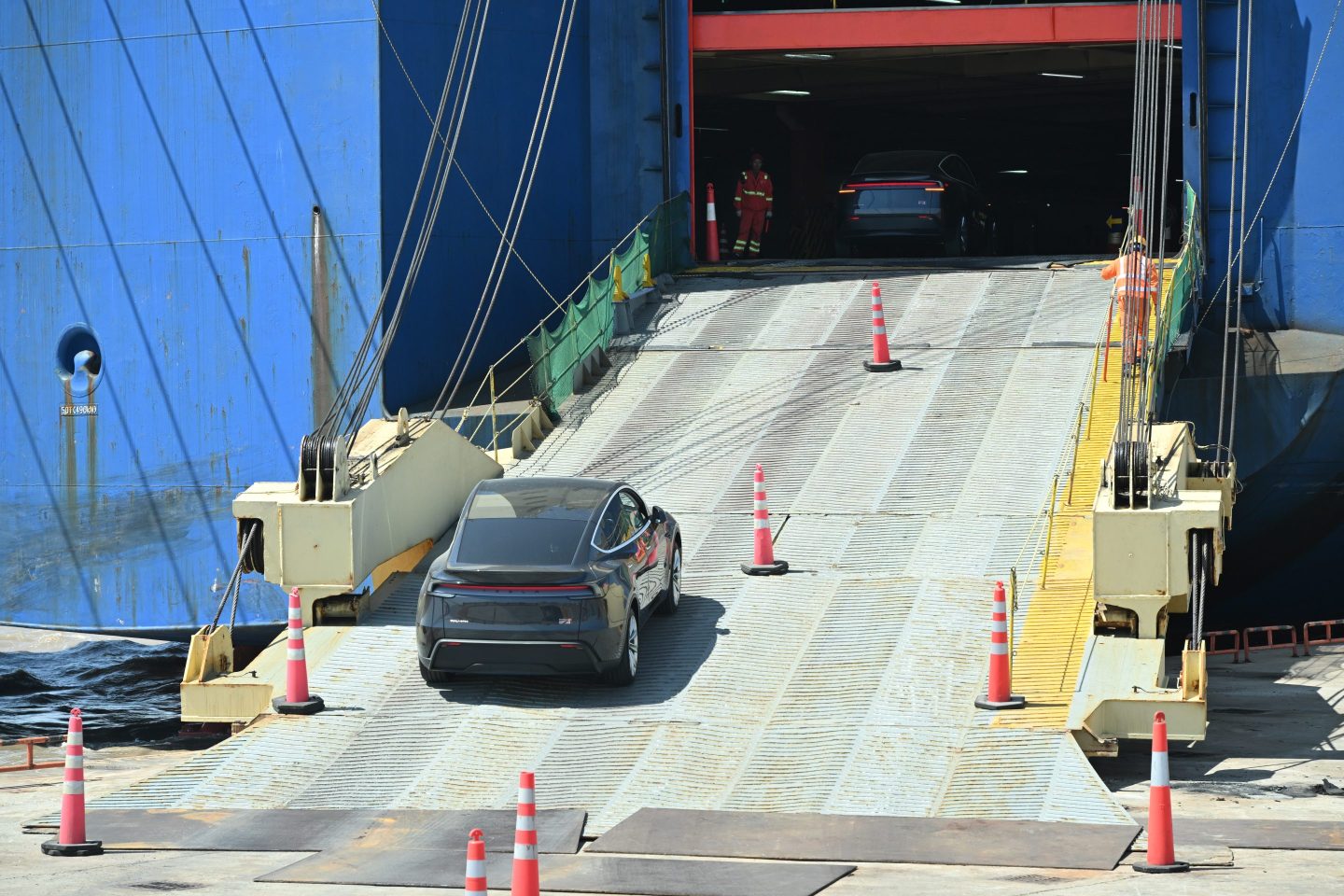
The tariffs have led S&P Global Mobility to reduce its annual U.S. automobile sales estimate by 700,000 cars, one of the largest single-month changes to its forecast ever. And they are already taking a toll on Tesla. After China levied its own retaliatory tariffs, charging 125% import duties on vehicles imported into the country, Tesla stopped taking orders from Chinese customers for its Model S and Model X. Tesla has also reportedly stopped shipping some parts for its Cybertrucks and Semi into the U.S., because the tariffs have gotten too high.
Overall, however, Tesla may be more immune to the tariffs than its competitors, as it manufactures most of its vehicles in the U.S. While the company imports materials like steel and aluminum, the vehicles are made in U.S. gigafactories.
“They’re the best house in a bad neighborhood, but still, 20% to 25% of U.S.-built Teslas have tariff exposure,” Ives says.
Analysts are forecasting that Tesla will post $21.5 billion in revenue and $1.3 billion in net income on its earnings call this Tuesday—compared with $21.3 billion in revenue and $1.1 billion in net income during the year-ago period. Tesla shares closed at $241.38 on Friday afternoon, down more than 36% from January—but still up more than 64% from this time last year.
“We think TSLA sentiment can change rapidly once catalysts emerge, and the next few months are catalyst-rich,” Alexander Potter, a research analyst at Piper Sandler, wrote earlier this month in a research note.
Why the robo launch is so critical
For some Tesla bulls, there’s only one issue that really matters right now: autonomous driving.
The nearer-term innovation in focus is autonomy—and if Tesla can win the race to develop self-driving car technology for the mass market, the thinking goes, none of the company’s other troubles, or Musk’s antics, will matter so much.
Not surprisingly, Musk has talked up a big game. He has said that Tesla will start volume production of its robotaxi—which will have no steering wheels or pedals—in 2026, and that Tesla will eventually be manufacturing 2 million of them a year. And he has promised that a paid robotaxi service of some kind will debut in Austin in June.
“That right now is probably front and center,” Ives says. “It kicks off a big part of the future vision of Tesla. So I think it’s extremely important to also hit that date, too.”
Exactly where Tesla is in the process of rolling things out, however, is not clear. In late October, Musk said that Tesla was conducting test rides, with safety drivers, for employees in the Bay Area. According to emails from a Tesla engineer to the Austin Fire Department obtained by Fortune via a Freedom of Information Act request, however, as of November, Tesla seemingly still hadn’t tested its autonomous function on public roads anywhere in the U.S.
“We have not done any testing on public roadways with any autonomous vehicles,” the Tesla engineer said in the email to the Austin Fire Department in November, when discussing details about the upcoming launch. Though Tesla did have its robotaxi driving around at its Austin gigafactory, “these are prototype vehicles for developmental purposes only, and are not driving on public roadways at this time,” she said.
All of Tesla’s testing on public roadways has involved so-called Level 2 systems, meaning that, while the system is controlling the driving and braking, humans are behind the steering wheel and remaining fully attentive at all times. By contrast, Waymo, which is Tesla’s main competitor, is already doing 200,000 paid rides every week at Level 4—with no human drivers in the vehicles—across various cities around the U.S. And given that Waymo opened its wait list for customers in Austin earlier this year, Tesla is already far behind its rival in the first city where it plans to launch.
If there’s one secret weapon in Tesla’s arsenal that could help it catch up, however, it’s data.
Alex Kendall, the cofounder and CEO of Wayve, a London-based company building AI software for autonomous driving, says that data is a critical component in building effective self-driving software. Wayve is pursuing the idea of working with multiple carmakers and fleet operators and getting them to combine their data into a single platform to help level the data advantage that Tesla might have. Not only does Tesla almost certainly have more driving data gathered from its cars worldwide than any other automaker, says Kendall, but it also has more diverse data than its self-driving competitors. Earlier generations of self-driving companies, such as Waymo and now-defunct Cruise, deployed their cars in only a few tightly controlled driving environments. This matters because it is the amount and diversity of data that will allow a company to build AI self-driving systems that work well in a wide array of traffic and weather conditions.
The amount and diversity of data also matters for discovering “edge cases”—uncommon or rare occurrences, such as a fire engine blocking a road, or a bicyclist who has fallen into the street—that are the toughest challenges for self-driving software to successfully navigate. Having more diverse real-world driving data can help companies build better simulators, which in turn allow that company to generate lots more synthetic—or computer-generated—data to further refine their self-driving software.
But all that said, Kendall says there is much more to creating a successful self-driving system than just the magnitude and diversity of data a company has. “I wish it was as simple as data in and driving out,” he said. “But there are so many other aspects to it.”
And when it comes to those other aspects, Tesla may have much less of an advantage. For instance, Kendall said that while larger and more diverse driving datasets will almost certainly contain more edge cases, identifying those edge cases in that sea of data is technically tricky. Building good simulators and deciding exactly what scenarios to simulate to augment the real-world data is also a key differentiator. Finally, building the best “learning algorithm” for an AI system to help it master driving is also critically important, and this depends on having brilliant AI researchers and engineers as well as access to enough computing power to train top-of-the-line AI models. Tesla, Kendall says, may have some of these components, but has not yet demonstrated that it can put them all together in the most effective way.
How Tesla’s self-driving systems ultimately stack up to competitors—and whether they do on time, especially with the promised Austin June launch approaching—will be critical as the company navigates what’s been a very difficult year.
“If June becomes August, and August becomes October, that would be a very, very bad thing,” Ives says.