• Home
  • Latest
  • Fortune 500
  • Finance
  • Tech
  • Leadership
  • Lifestyle
  • Rankings
  • Multimedia
Economy

Tariffs threaten a pharmaceuticals shortage, as 95% of ibuprofen comes from China

Sasha Rogelberg
By
Sasha Rogelberg
Sasha Rogelberg
Reporter
Down Arrow Button Icon
Sasha Rogelberg
By
Sasha Rogelberg
Sasha Rogelberg
Reporter
Down Arrow Button Icon
April 30, 2025, 1:46 PM ET
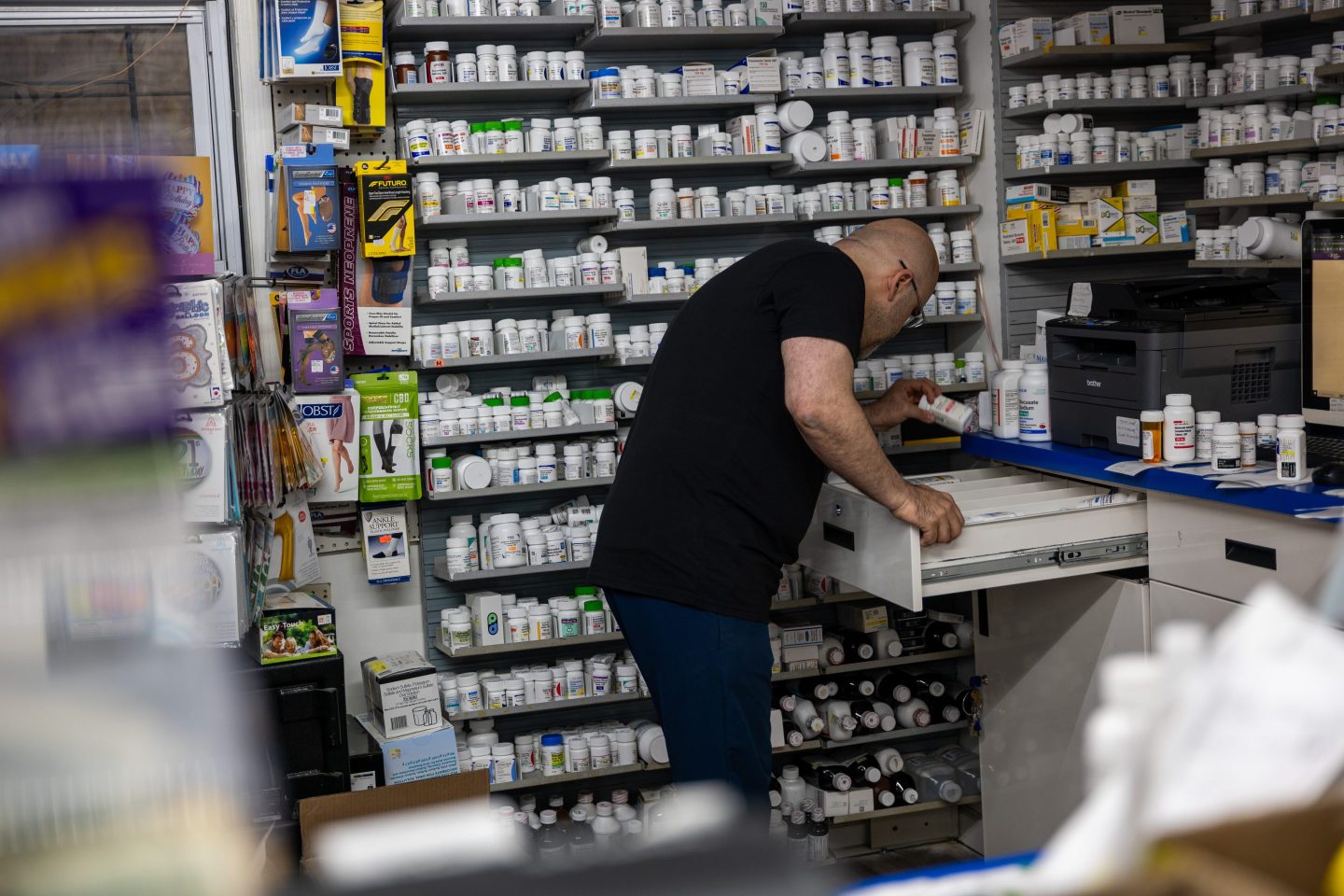
A man leans over and reaches for a bottle while standing in front of a shelf on medications.
Some in the pharmaceutical industry fear tariffs on China could exacerbate U.S. drug shortages.Spencer Platt—Getty Images
  • The U.S. gets the vast majority of common, generic medications from China, meaning President Donald Trump’s steep tariffs on Chinese imports could cause a shortage of key drugs. Generic drugs are affordable because of manufacturers’ razor-thin margins. Increased costs as a result of tariffs could disincentivize them from producing certain pain-relief meds.

Tariffs already have many Americans concerned about the state of the economy, but the incoming taxes on pharmaceutical goods from China could present a more literal headache.

Recommended Video

The U.S. gets nearly all of its supply of common over-the-counter pain medications from China, meaning President Donald Trump’s 145% tariffs on the country could have an outsize impact on the U.S.’s method of sourcing key drugs, Apollo chief economist Torsten Sløk said in a Wednesday blog post. About 95% of the U.S.’s ibuprofen comes from China, Slløk noted, citing data from trade-protectionist advocacy organization Coalition for a Prosperous America and the National Institutes of Health’s National Center for Biotechnology Information. 

More than 90% of the supply of anti-inflammation steroid hydrocortisone also comes from China, as well as 70% of acetaminophen and 45% of the U.S.’s penicillin imports. The U.S. is particularly reliant on China for more affordable, generic drugs, and generic drugs make up 90% of prescriptions filled in the U.S., according to the Food and Drug Administration.

Tariffs have already more broadly threatened the availability of consumer products in the U.S. as American companies stockpiled goods before the tariffs went into effect, only to pull back once those products became more expensive.

“The consequence will be empty shelves in U.S. stores in a few weeks and COVID-like shortages for consumers and for firms using Chinese products as intermediate goods,” Sløk said in an April 25 post.

These shortages are imminent, according to Gene Soroka, executive director of the Port of Los Angeles, the U.S.’s largest port, which receives about 45% of its imports from China. Seroka has begun to see a “precipitous drop” in shipments from China that will result in only five to seven more weeks of full inventories on retail shelves, he predicted.

The White House did not immediately respond to Fortune’s inquiry on plans to exempt medications from tariffs.

Exacerbating a drug shortage

For America’s drug supply, tariffs could make a bad problem worse.

The U.S. has contended with stubborn drug shortages in the past three quarters, with 270 active shortages as of March 2025, but down from the all-time high of 323 shortages in early 2024, according to trade organization American Society of Health-System Pharmacists. These shortages can be caused by natural disasters temporarily halting production or regulatory challenges. 

Key players in the pharmaceutical industry fear tariffs will pile onto the factors driving the scarcity. Profit margins for generic drugs are incredibly thin to keep them affordable, meaning some manufacturers could stop producing drugs that are too expensive to make as a result of the increased cost of raw materials, according to John Murphy, president and CEO of trade group Association of Accessible Medicines (AAM). To make matters worse, Murphy said, any hiccups in the supply chain will also likely mean an increase in drug prices for consumers.

“AAM is concerned…that any duties on pharmaceutical products, particularly inputs, will lead to increased costs of manufacturing generics and biosimilars in the United States and, thus, result in higher prescription drug prices and decreased access for patients in our country,” Murphy said in a March letter to U.S. trade representative Jamieson Greer.

Despite Trump’s intention with tariffs as encouraging domestic production, American pharmaceutical companies may be hesitant to take a chance on increasing their own manufacturing capabilities, Marta Wosińska, health economist and senior fellow at the Brookings Institution, told USA Today. The future of tariffs—with Trump now considering “substantially” cutting the levies—creates too much unpredictability for drug companies to take meaningful steps to address them.

“Making a billion-dollar investment in the United States when I don’t even know whether tariffs are going to be there a month from now makes it a really difficult calculus for companies,” Wosińska said.

The Fortune 500 Innovation Forum will convene Fortune 500 executives, U.S. policy officials, top founders, and thought leaders to help define what’s next for the American economy, Nov. 16-17 in Detroit. Apply here.
About the Author
Sasha Rogelberg
By Sasha RogelbergReporter
LinkedIn iconTwitter icon

Sasha Rogelberg is a reporter and former editorial fellow on the news desk at Fortune, covering retail and the intersection of business and popular culture.

See full bioRight Arrow Button Icon

Latest in Economy

Finance
Lorem ipsum dolor sit amet, consectetur adipiscing elit, sed do eiusmod tempor incididunt ut labore et dolore magna aliqua. Ut enim ad minim veniam
By Fortune Editors
October 20, 2025
Finance
Lorem ipsum dolor sit amet, consectetur adipiscing elit, sed do eiusmod tempor incididunt ut labore et dolore magna aliqua. Ut enim ad minim veniam
By Fortune Editors
October 20, 2025
Finance
Lorem ipsum dolor sit amet, consectetur adipiscing elit, sed do eiusmod tempor incididunt ut labore et dolore magna aliqua. Ut enim ad minim veniam
By Fortune Editors
October 20, 2025
Finance
Lorem ipsum dolor sit amet, consectetur adipiscing elit, sed do eiusmod tempor incididunt ut labore et dolore magna aliqua. Ut enim ad minim veniam
By Fortune Editors
October 20, 2025
Finance
Lorem ipsum dolor sit amet, consectetur adipiscing elit, sed do eiusmod tempor incididunt ut labore et dolore magna aliqua. Ut enim ad minim veniam
By Fortune Editors
October 20, 2025
Finance
Lorem ipsum dolor sit amet, consectetur adipiscing elit, sed do eiusmod tempor incididunt ut labore et dolore magna aliqua. Ut enim ad minim veniam
By Fortune Editors
October 20, 2025

Most Popular

Finance
Lorem ipsum dolor sit amet, consectetur adipiscing elit, sed do eiusmod tempor incididunt ut labore et dolore magna aliqua. Ut enim ad minim veniam
By Fortune Editors
October 20, 2025
Finance
Lorem ipsum dolor sit amet, consectetur adipiscing elit, sed do eiusmod tempor incididunt ut labore et dolore magna aliqua. Ut enim ad minim veniam
By Fortune Editors
October 20, 2025
Finance
Lorem ipsum dolor sit amet, consectetur adipiscing elit, sed do eiusmod tempor incididunt ut labore et dolore magna aliqua. Ut enim ad minim veniam
By Fortune Editors
October 20, 2025
Finance
Lorem ipsum dolor sit amet, consectetur adipiscing elit, sed do eiusmod tempor incididunt ut labore et dolore magna aliqua. Ut enim ad minim veniam
By Fortune Editors
October 20, 2025
Finance
Lorem ipsum dolor sit amet, consectetur adipiscing elit, sed do eiusmod tempor incididunt ut labore et dolore magna aliqua. Ut enim ad minim veniam
By Fortune Editors
October 20, 2025
Finance
Lorem ipsum dolor sit amet, consectetur adipiscing elit, sed do eiusmod tempor incididunt ut labore et dolore magna aliqua. Ut enim ad minim veniam
By Fortune Editors
October 20, 2025
Fortune Secondary Logo
Rankings
  • 100 Best Companies
  • Fortune 500
  • Global 500
  • Fortune 500 Europe
  • Most Powerful Women
  • Future 50
  • World’s Most Admired Companies
  • See All Rankings
Sections
  • Finance
  • Fortune Crypto
  • Features
  • Leadership
  • Health
  • Commentary
  • Success
  • Retail
  • Mpw
  • Tech
  • Lifestyle
  • CEO Initiative
  • Asia
  • Politics
  • Conferences
  • Europe
  • Newsletters
  • Personal Finance
  • Environment
  • Magazine
  • Education
Customer Support
  • Frequently Asked Questions
  • Customer Service Portal
  • Privacy Policy
  • Terms Of Use
  • Single Issues For Purchase
  • International Print
Commercial Services
  • Advertising
  • Fortune Brand Studio
  • Fortune Analytics
  • Fortune Conferences
  • Business Development
  • Group Subscriptions
About Us
  • About Us
  • Editorial Calendar
  • Press Center
  • Work At Fortune
  • Diversity And Inclusion
  • Terms And Conditions
  • Site Map
  • About Us
  • Editorial Calendar
  • Press Center
  • Work At Fortune
  • Diversity And Inclusion
  • Terms And Conditions
  • Site Map
  • Facebook icon
  • Twitter icon
  • LinkedIn icon
  • Instagram icon
  • Pinterest icon

Latest in Economy

A man walks between two luxury cars with the skyline of Dubai in the background.
RetailLuxury
The Middle East is one of the world’s fastest growing luxury markets—and the war in Iran may cut its sales in half, analysts say
By Sasha RogelbergMarch 20, 2026
3 hours ago
Stressed out job seeker on laptop
Successjob hunting
Job seekers aren’t imagining things: the number of candidates ghosted by employers just reached a three-year high thanks to AI
By Emma BurleighMarch 20, 2026
4 hours ago
SuccessCareers
AI boom is fueling demand for skilled trades—and demand for technicians, HVAC workers, and electricians is soaring, with six-figure salaries to match
By Preston ForeMarch 20, 2026
4 hours ago
InvestingDebt
300 years of wars show they are ‘always disaster times’ for holders of government debt because of inflation and financial repression
By Jason MaMarch 20, 2026
4 hours ago
Jerome Powell, wearing a suit, looks ahead with his brow furrowed.
EconomyEconomics
Economists agree: You’re not crazy for feeling like the rich get richer, and the poor are doing worse. Welcome to the ‘K-shaped economy’
By Sasha Rogelberg, Eva Roytburg and Nick LichtenbergMarch 20, 2026
5 hours ago
Trump standing waving hi at a crowd
AIDonald Trump
The White House has a plan for AI regulation, and it starts with keeping states out of it
By The Associated Press and Seung Min KimMarch 20, 2026
6 hours ago

© 2026 Fortune Media IP Limited. All Rights Reserved. Use of this site constitutes acceptance of our Terms of Use and Privacy Policy | CA Notice at Collection and Privacy Notice | Do Not Sell/Share My Personal Information
FORTUNE is a trademark of Fortune Media IP Limited, registered in the U.S. and other countries. FORTUNE may receive compensation for some links to products and services on this website. Offers may be subject to change without notice.