
Editor’s note: This article originally appeared in the Feb. 3, 2003 issue of Fortune.
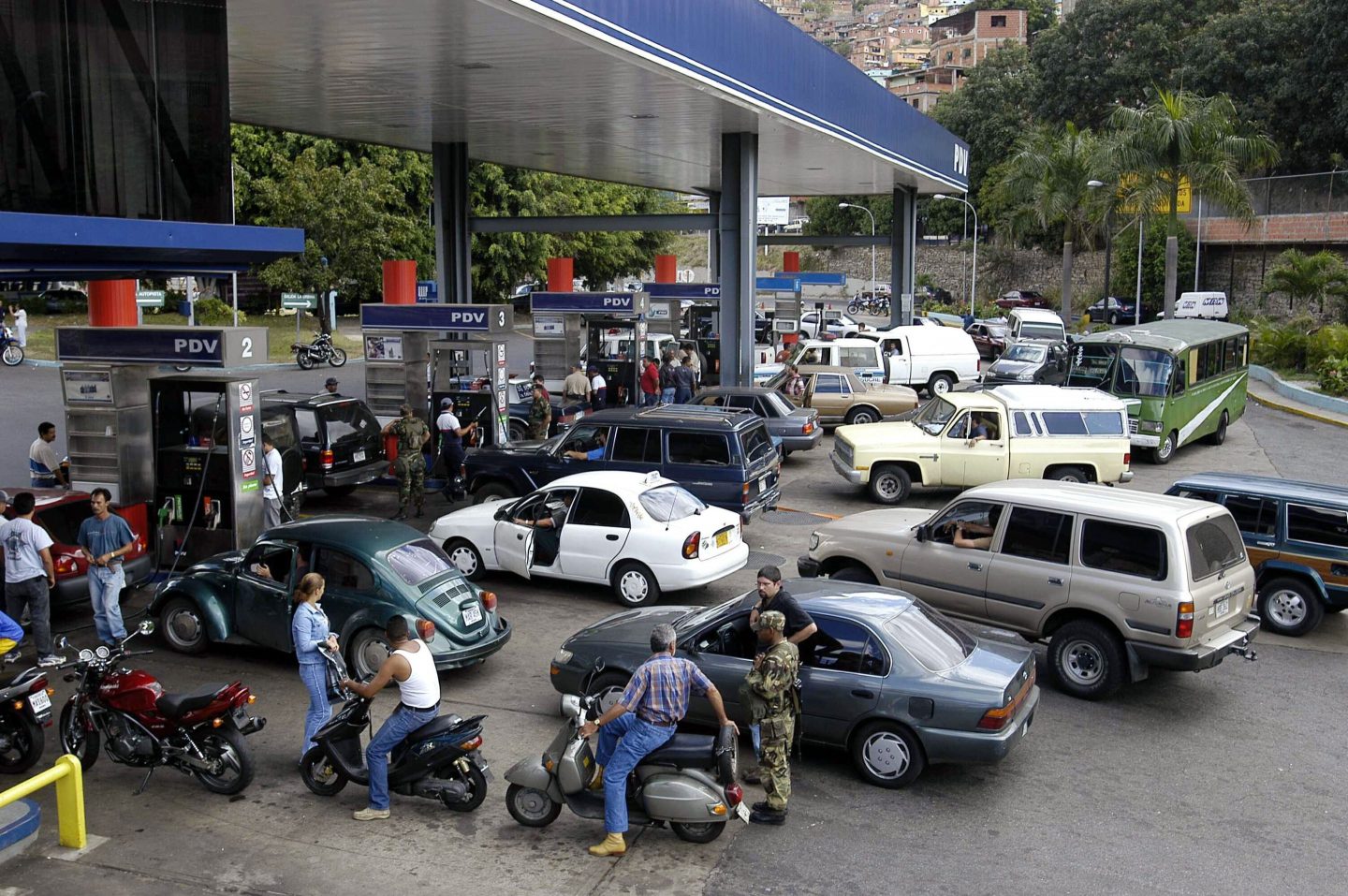
The line outside the Shell station on Avenida Lecuna in central Caracas stretches for nearly a mile. Every few minutes the procession of cars and trucks, their hoods shimmering in the tropical heat, creeps forward—sometimes a few inches, sometimes a few yards. Two bored Venezuelan soldiers, rifles slung lazily over their shoulders, wave the next set of drivers into the station for their turn at the pump. Most of them have traveled across the city and waited more than two hours for the privilege of filling their tanks. Yet they express only muted frustration: They know that elsewhere the gas lines are six hours long. Besides, after almost seven weeks of a general strike—aimed at toppling the country’s President, Hugo Chavez, but so far succeeding mainly in crippling Venezuela’s petroleum industry—waiting has become routine.
Venezuela’s drivers aren’t the only ones waiting for an end to the country’s political crisis. The U.S. usually imports 14% of its oil—1.5 million barrels a day—from Venezuela, which until the strike began ranked as the world’s fifth-largest petroleum producer. With the loss of the country’s oil supply, petroleum reserves in the U.S. have fallen to their lowest level since 1975, threatening to complicate planning for a likely war with Iraq.
“It’s been a stealth crisis,” says Daniel Yergin, president of Cambridge Energy Research Associates, a firm that tracks the international oil market. “It sort of sneaked up on everyone. We can make up for a disruption in supply from either Venezuela or Iraq, but not both.” Already gasoline prices have risen by 5 cents a gallon in the U.S. as a result of the strike, and if production doesn’t resume soon, they’re likely to be a dime higher by summer.
The crisis may also crimp earnings at several international oil companies. ChevronTexaco, ENI, BP, and ExxonMobil all have drilling operations in Venezuela, some of which have been shuttered by the strike. In addition, several U.S. refineries have announced production cuts or been forced to purchase expensive spot-market oil. The most exposed refiner is Citgo, owned by the Venezuelan state oil company, Petróleos de Venezuela (PDVSA). Citgo, based in Tulsa, normally gets half of its raw crude from PDVSA, but since the strike began it has had to purchase about 400,000 barrels a day on the open market.
In an attempt to stabilize world prices, OPEC voted in mid-January to increase daily production quotas by 1.5 million barrels—a move unlikely to ease the pressure on oil markets anytime soon. The new quotas compensate for only about half the Venezuelan shortfall. What’s more, there’s doubt whether OPEC can meet the revised targets. Edward Morse, an executive advisor at Hess Energy Trading in New York, says many OPEC countries were already producing at full capacity to take advantage of recent high prices. Most analysts believe that if spare oil does exist, it can be found in Saudi Arabia and the United Arab Emirates. But it takes 45 to 60 days for tankers to reach the U.S. from the Middle East, compared with four to eight days from Venezuela.
Given the importance of Venezuelan oil to U.S. energy security, American diplomats are mounting a renewed effort to facilitate a settlement of the political crisis. It won’t be easy. The government and a coalition of opposition groups known as the Democratic Coordinator have been negotiating for more than two months under the auspices of the Organization of American States. So far they have made little progress.
The strike, which began Dec. 2, pits a fractious alliance of labor unions, business groups, and civic organizations against Chávez, a former paratrooper elected President in 1998. A populist demagogue and an admirer of Fidel Castro, Chávez presided over the adoption of a new constitution, changed the name of the country to the Bolívar Republic of Venezuela, and promised a more equal distribution of the nation’s oil wealth in a country where 80% of the 24 million inhabitants live in poverty. But polls indicate Chávez maintains the support of just a third of the populace, most of them poor. Opponents accuse him of undermining democracy and trying to turn Venezuela into a dictatorship. Since April, when he survived an aborted coup, the opposition has tried to force Chávez to resign or call early elections. (His term doesn’t expire until 2007.)
At the heart of the opposition’s strategy is PDVSA. With $46.3 billion in revenues and $3.7 billion in profits in 2001, the oil giant is Latin America’s largest company. It accounts for a third of Venezuela’s GDP, 80% of its export income, and half of the government’s revenues. The opposition assumed that if it could shut down PDVSA, it could quickly compel Chávez to step down.
Shutting down PDVSA proved to be the easy part. About 35,000 of the company’s 40,000 employees participated in the strike, according to former PDVSA executives now leading the work stoppage. Total production has been cut from 3.2 million barrels a day to about 500,000, independent oil analysts say. Government officials claim that the strike has cost $4 billion in lost revenue.
The work stoppage has hobbled other parts of the economy as well. Most factories have shut down, and multinational corporations—including McDonald’s, Coca-Cola, and Ford—have closed their operations here. Beer is hard to find, and in some places basic food stuffs like flour are unavailable. Navy ships have been sent to neighboring Colombia to bring back food. The economy, already in recession, is likely to contract 20% this year, and the country may be forced to default on its $18 billion of foreign debt. There is talk of the central bank’s imposing currency controls to prevent capital flight—estimated at between $6 billion and $12 billion so far.
For many PDVSA executives the strike is as much about the future of the company as it is about the future of the country. PDVSA long had a reputation for being one of Venezuela’s most meritocratic institutions. Its executives stayed aloof from politics, and politicians were loath to meddle in the company’s affairs for fear of ruining Venezuela’s money machine. But since his election, Chávez has been trying to wrest control of PDVSA from the foreign-trained technocrats who traditionally managed it.
Chávez aimed to use PDVSA’s cash for his social programs, increasing the amount the company had to turn over to the government by 30%. He appointed a series of political allies to head the company. And he replaced the board of directors with a group of loyalists, many of whom had little or no experience in the oil industry. When top executives complained, they were fired. That prompted the first nationwide strike, which culminated in the April coup attempt. After Chávez was restored to power, he installed Ali Rodriguez, a former Marxist guerrilla who had served as Minister of Energy and Mines, as PDVSA’s president—the company’s fifth in four years.
But Rodriguez’s efforts to neutralize dissident executives backfired. When another general strike was called last fall, the vast majority of PDVSA workers walked off the job. The government sent soldiers to seize oil wells and refineries and fired 1,000 employees. It has succeeded in restarting some production, but at a tremendous environmental price. The blue-green surface of Lake Maracaibo is now painted black by oil slicks. Strikers blame inexperienced workers brought in by the government. The government says the spills are the result of sabotage.
Meanwhile, political tensions mount. Daily demonstrations and counter-demonstrations increasingly end with tear gas and rubber bullets. Yet Chavez remains firmly in control. Small businesses have reopened, employees are gradually returning to work, and the black market is thriving. Many Venezuelans are pessimistic. They say that the situation is likely to get worse before it gets better—that blood will flow before the oil does again.
‘The Devil’s excrement’
“Ten years from now, 20 years from now, you will see,” former Venezuelan Oil Minister and OPEC co-founder Juan Pablo Perez Alfonzo predicted in the 1970s, “oil will bring us ruin.” It was an oddball statement at a time when oil was bringing Venezuela unprecedented wealth—the government’s 1973 revenues were larger than all previous years combined, raising hopes that black gold would catapult Venezuela straight to First World status. But Perez Alfonzo had a different name for oil: “the devil’s excrement.”
Today he seems a prophet. When it hit the jackpot, Venezuela had a functioning democracy and the highest per-capita income on the continent. Now it has a state of near-civil war and a per-capita income lower than its 1960 level.
Far from an anomaly, Venezuela is a classic example of what economists call the “natural resource curse.” A 1995 analysis of developing countries by Jeffrey Sachs and Andrew Warner found that the more an economy relied on mineral wealth, the lower its growth rate. Venezuela isn’t poor despite its oil riches—it’s poor because of them.
How could that be? For the same reason so many entertainers go bankrupt. Showered with sudden windfalls, governments start spending like rock stars, creating programs that are hard to undo when oil prices fall. And because nobody wants to pay taxes to a government that’s swimming in petrodollars—”In Venezuela only the stupid pay taxes,” a former President once said—the state finds itself living beyond its means.
A cycle begins. The economy can’t absorb the sudden influx of money, causing wages and prices to inflate and the nation’s currency to appreciate (by an average of 50%, according to a World Bank economist’s study). That makes it harder for local manufacturers to compete. Incentives, meanwhile, become wildly distorted. When free money is flowing out of the ground, people who might otherwise start a business or do something innovative instead busy themselves angling for a share of the spoils. Why slog it out in a low-margin industry when steering some oil business toward a contact could make you a millionaire? Thus a doubly deadly dynamic: a ballooning public sector, a withering private one.
Eventually you’re 16th-century Spain. It, too, once struck it rich on gold (not the black kind) from the Americas. Its monarchs spent like loons, expanding the army 15-fold, creating an elaborate patronage system and sending conquistadors in search of El Dorado. (Spanish gold also financed Columbus’s discovery of Venezuela.) While inflation and currency appreciation slowly killed industry and agriculture, a parasitic class of noblemen lived off gold money (think of Saudi Arabia’s idle princes), waiting for the next ship to come in. By the time ships stopped coming, Spain wasn’t able to feed itself, forcing it to declare bankruptcy eight times and finishing it as a world power.
But the Midas myth dies hard. “This is a country that can never, ever sustain itself on oil,” Terry Lynn Karl, author of The Paradox of Plenty: Oil Booms and Petro-States, says of Venezuela. “But everyone from the President to the poor believes it can.” And therein lies the trap.
President Hugo Chavez rode popular rage into office by focusing on corruption. But what neither he nor anyone else will face up to is this: Oil is not an economy. Creative economic activities have spillover effects that become self-sustaining. Oil spills only into a barrel—and from there usually into the hands of a favored few. That’s the real reason Venezuela’s productivity growth has been roughly half the Latin American average.
Can the curse be avoided? A few smaller countries—Malaysia, Norway, Mauritius—curbed its worst effects by spending slowly and using the money to diversify their economies. In Venezuela oil still accounted for 80% of exports before a devastating strike made even that scarce. As a 16th-century Spanish economist said of his homeland, “What makes her poor is her wealth”—a suitable lament for Venezuelans who have been waiting so long for their ship to come in. —Jerry Useem