
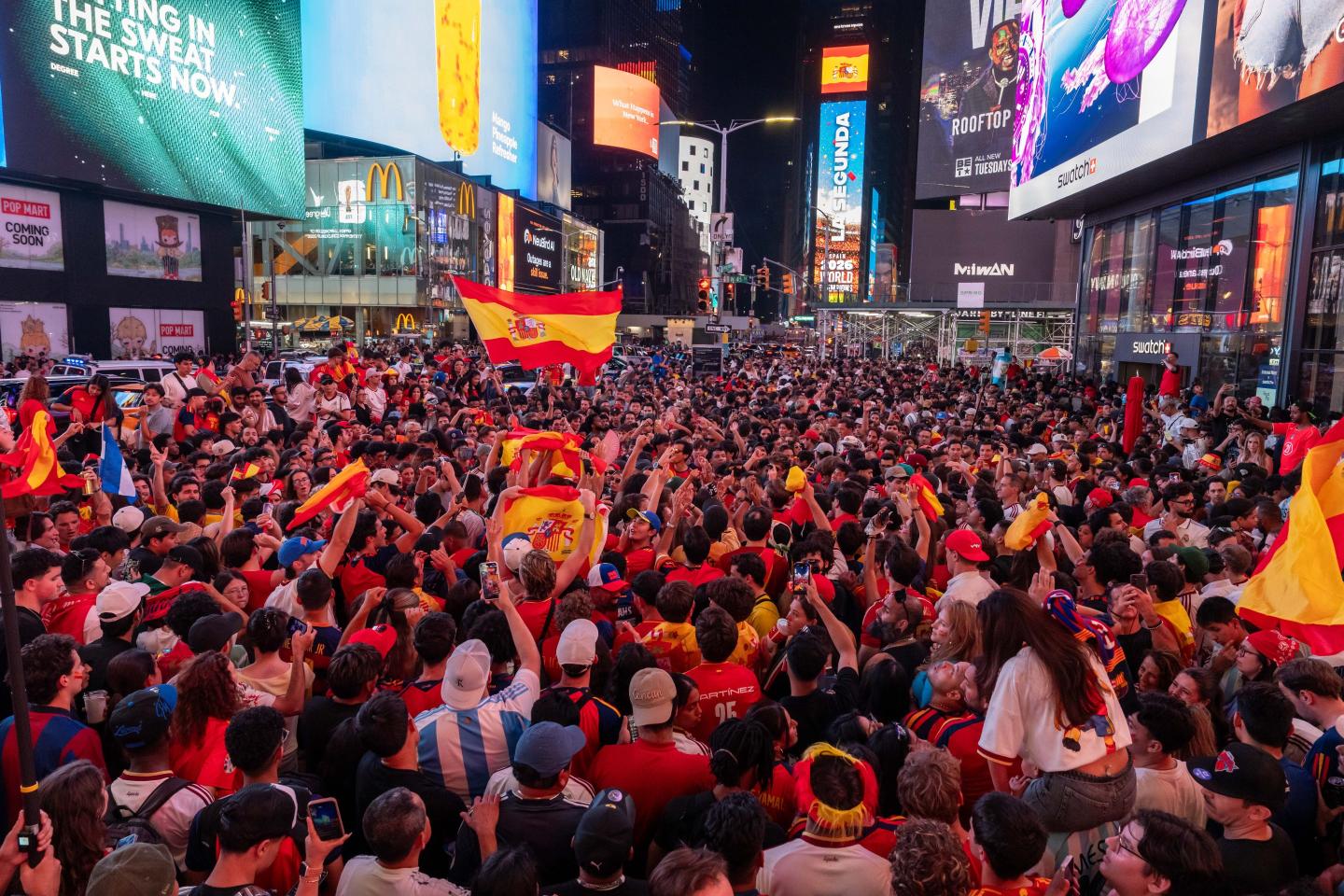
On July 19, 80,663 packed MetLife Stadium to watch Argentina and Spain fight for the World Cup. And they weren’t alone: tens of thousands more filled bars and watch parties across New York and New Jersey, from a 50,000-person free viewing on Central Park’s Great Lawn to Times Square, where Argentina supporters staged a fan takeover the night before kickoff. And that was just the region: Millions more watched from bars, living rooms, and fan zones across the rest of the country and the world.
It turns out all the hubbub the World Cup created appeared to bring in a pretty penny for the region. The 2026 FIFA World Cup generated $3.5 billion in total economic output for the New York and New Jersey region, according to a final analysis shared with Fortune by the FIFA World Cup 2026 New York New Jersey Host Committee—beating the tournament’s own pre-event projection of $3.3 billion.
The report, conducted by Tourism Economics, an Oxford Economics company, found the $1.9 billion in direct spending during the tournament rippled out to $3.5 billion in total economic activity once indirect and induced effects were counted. More than 645,000 fans attended the region’s eight matches, including the July 19 final at MetLife Stadium, while another 626,300 non-local visitors traveled to New York or New Jersey for Official Fan Events and related programming. Together they spent $1.7 billion in the regional economy; the Host Committee, FIFA, and other stakeholders added another $286 million in operational spending.
That’s not the end of it. The tournament also led to the creation of 27,424 total jobs, including nearly 18,000 directly tied to World Cup operations and visitor spending. Food and beverage businesses saw the largest employment gain, at roughly 4,500 total jobs, followed by transportation and lodging at about 4,400 and 4,000 jobs, respectively. Those jobs translated into $1.4 billion in total labor income.
The tax revenue, however, told a smaller story. Of the $3.5 billion in total economic impact, $759.2 million flowed back to government coffers as tax revenue, about 22 cents of every dollar the tournament generated, split between $414.2 million for state and local governments and $344.9 million federal. That’s the return public officials can point to directly, even as the broader $3.5 billion figure captures private-sector activity—hotel bookings, restaurant tabs, retail sales—that doesn’t touch a public budget line at all.
“The final numbers demonstrate that New York and New Jersey didn’t just rise to the occasion—we exceeded expectations and delivered an impact that will be felt long after the final whistle,” CEO of the Host Committee Alex Lasry said in a statement.
The Host Committee attributed the jump over its original forecast to higher-than-expected operational spending, larger-than-anticipated turnout at Official Fan Events, and a bigger share of international match attendees than initially projected, each partly offset by a larger-than-expected local share of both.
What they spent to get there
The final tally comes after months of naysayers deriding the total spend from both New York and New Jersey, which put up an estimated $245 million combined to stage the tournament, according to state and city records, though no single government agency has published one reconciled total—and even the two sides of the region don’t fully agree with themselves on the math.
New Jersey accounts for roughly $155 million of that total, according to Gov. Mikie Sherrill’s office: $35 million directly to the Host Committee for local infrastructure and community initiatives, plus another $120 million budgeted for construction and security costs, including a new pedestrian bridge over Route 120 at MetLife Stadium. (As Fortune reported ahead of the World Cup, the United States’ infrastructure leaves much to the imagination, and arguably, this should have already been built regardless of the impetus of the World Cup). Separately, NJ Transit’s board approved $100 million to build a temporary bus terminal at MetLife near Secaucus Junction, intended to move 20,000 fans an hour, plus a $35 million contract to design a dedicated bus corridor whose construction cost was never publicly estimated. Some state legislators put New Jersey’s total taxpayer cost even higher, telling reporters the figure topped $300 million.
New York City accounts for the remaining roughly $90 million, according to City Council documents: $29 million for the Economic Development Corporation, $20 million to the Host Committee, $12 million for NYPD security, and smaller sums for marketing and emergency management, against a projected $51 million in city tax revenue. But the city’s own comptroller has disputed that: City Comptroller Mark Levine’s office put costs closer to $70 million against just $55 million in expected revenue—a wider shortfall than the city’s own budget documents show, and one the Mamdani administration has pushed back on, arguing the comptroller’s estimate undercounts the tournament’s benefit to the city. Gov. Kathy Hochul’s office separately put in $6 million to subsidize stadium shuttle fares and another $6 million toward the free Central Park watch party for the final, which drew 50,000 people to the Great Lawn.
Sustained cultural impact of the World Cup
Alongside the spending, the city and state also built out free and low-cost programming aimed at making sure residents weren’t priced out of their own tournament. New York City hosted watch parties in all five boroughs, including free viewings across the city and on Central Park’s Great Lawn. FIFA and Street Soccer USA installed a temporary mini-pitch in Central Park with free youth clinics, community tournaments, and open-play sessions. The Host Committee’s credits related programming with reaching more than 5,000 young people through clinics and community events, building 17 community mini pitches across the region, and distributing free or discounted tickets to more than 2,000 New Yorkers and New Jerseyans.
But what’s still missing is a real answer to what New York and New Jersey actually spent. No state comptroller, city agency, or host committee has published a final, audited accounting of total public cost now that the tournament is over—only the pre- and mid-tournament budget estimates and line items reported piecemeal by different offices. So whether that goodwill spending closes the gap between what the states put in and what they got back in tax revenue is a separate question from the one the Host Committee’s report answers.