
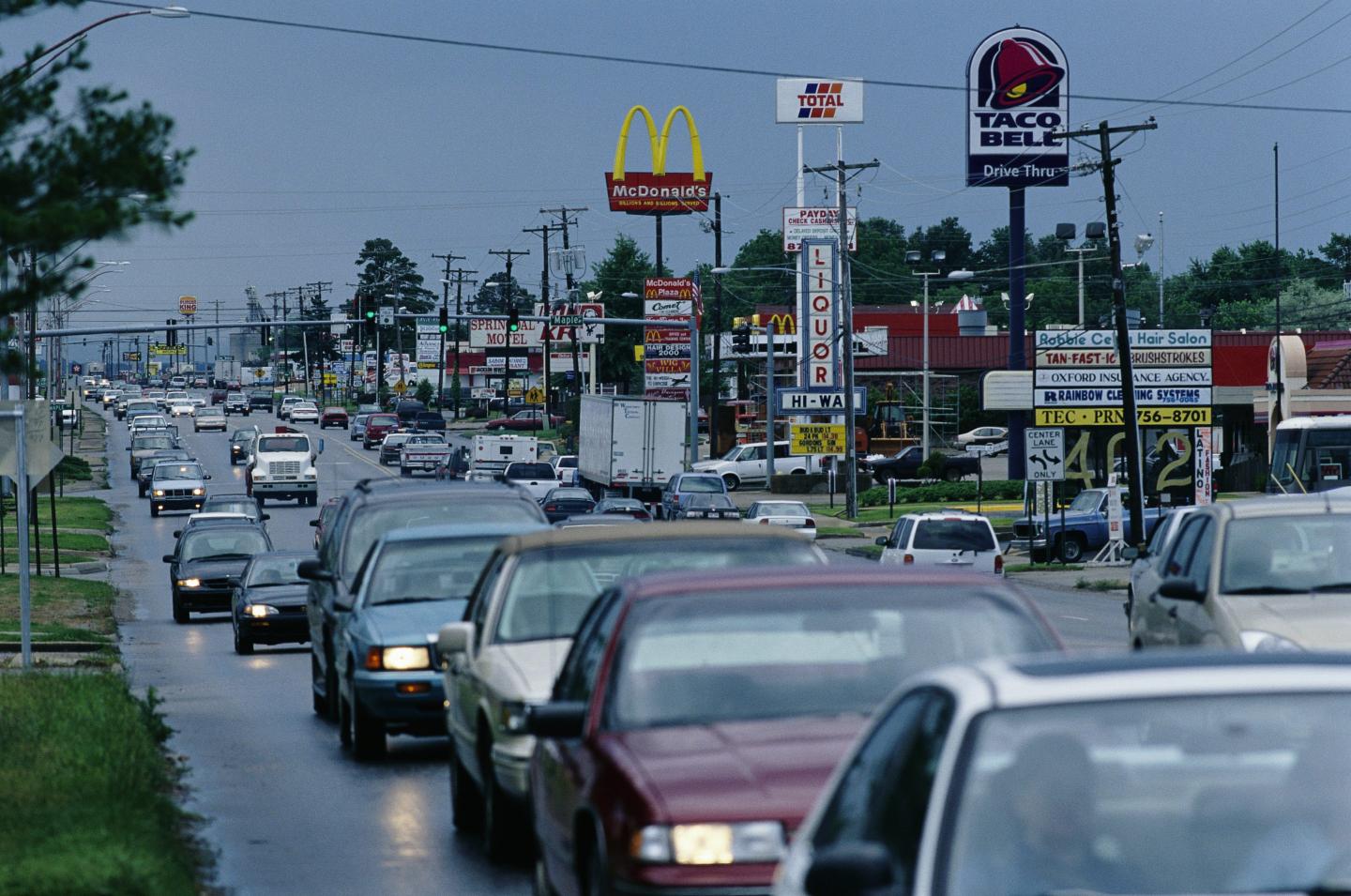
The hit 1999 HBO show The Sopranos is still heralded today for its great storytelling, depicting immigrants and their American-born children and what the American Dream actually looked like once you strip away that mythology. Showrunner David Chase won multiple Emmys for the series, but it might be the small, blink-and-you’ll-miss-it moments that people resonate most with today. Ahead of the 2026 World Cup—originally billed as a celebration of the U.S. in addition to Mexico and Canada—these moments become all the more prophetic. Soccer fans from all over the world will descend upon the U.S., and it’s none other than the show’s commentary on the state of American infrastructure that takes center stage.
The memes are almost everywhere: One shows the straight-from-Italy Furio disgusted while looking out of a cab window at the standard American road, complete with the fast-food chains, struggling shoe stores, and nail salons that make up America’s strip malls. Perhaps you’ve seen another Sopranos meme, of the show’s main character similarly sitting in a car that picked him up at Newark Airport, somberly looking out onto the fuel and wastewater treatment facilities that dot the New Jersey Turnpike, a scene juxtaposed earlier with his family’s idyllic trip in Italy. Tony Soprano’s America, rendered in all its asphalt glory.
The United States’ infrastructure leaves much to be desired, to say the least. The country spent years campaigning for the right to host the world’s most-watched sporting event, promising FIFA that it was ready. And with an expected 5 million visitors leaving their home countries—complete with high-speed rail, free or low-cost reliable transportation, and livable yet unplanned walkable cities—to attend the World Cup next month, American host cities are scrambling to sustain that increased demand on their cities and are finally questioning why the average American city pales in comparison to that of almost every other World Cup host city. With America’s top engineers giving the country’s infrastructure a C rating (which, for the first time ever, was an improvement), engineers and infrastructure experts are hoping this tournament will be a wake-up call to really plan a livable city and improve the way we get around.
“We’re not investing enough in infrastructure. We’re basically playing catchup to just try to get to what’s called the state of good repair,” said Marsha Anderson Bomar, president of the American Society of Civil Engineers (ASCE), the country’s oldest national engineering organization, representing more than 160,000 civil engineers.
“And so if that’s the majority of what you’re doing, then you’re not really getting ahead of the curve with respect to the actual infrastructure needs.”
The world’s been watching
On TikTok, Europeans are posting training montages for walking along the shoulder of the I-95 to get to New Jersey’s MetLife Stadium. The viral Sopranos meme imagines Italian fans leaving behind the Amalfi Coast for six-lane thoroughfares with no sidewalks. This week, commenters on Reddit joked foreign visitors will get “a quintessential American experience” when they board yellow school buses to the World Cup final.
It wasn’t even a joke: The New York/New Jersey World Cup host committee announced it would slash shuttle bus fares to MetLife Stadium from $80 roundtrip to $20 by hiring fleets of yellow school buses, up to 300 on peak match days, shuttling 18,000 fans from Manhattan to the Meadowlands stadium. Soccer fans from Munich, where the U-Bahn costs €1.90; from Madrid, where the Bernabéu stadium sits on top of a subway station; from Tokyo, where the trains apologize for being 30 seconds late—they’re going to board a yellow American school bus to watch the World Cup final.
The irony is the school bus is actually an improvement.
N.J. Transit initially announced roundtrip rail tickets on match days would cost $150, a markup of more than 1,000% over the standard $12.90 fare. After public backlash, the price dropped to $105, then $98. FIFA president Gianni Infantino called this, among other similar practices seen in the other U.S. host cities, typical of the American sports landscape. “You cannot go to watch in the U.S., a college game, not even speaking about a top professional game of a certain level, for less than $300,” Infantino said at the Milken Institute Global Conference. “And this is the World Cup.”
N.J. Transit CEO Kris Kolluri insisted the pricing wasn’t exploitative: “We’re literally trying to recoup our costs.” Should that be true, the transit agency servicing the World Cup final is saying that moving people to a stadium is so expensive for the agency, a $98 train ticket is the breakeven.
In Qatar in 2022, all eight stadiums were within 35 miles of one another and connected by a brand-new metro system. In Russia in 2018, every ticket holder rode trains between host cities for free, and the government capped hotel prices to prevent gouging. In South Africa in 2010, match-day ticket holders rode the Metrorail for free. In the U.S.—a country that paved over its cities to accommodate cars—the idea of walking to a World Cup game seems as absurd as it is impossible. The Guardian tested whether you could simply walk from Manhattan to MetLife, and a four-and-a-half-hour journey later ended when the pedestrian route was completely blocked. This, Anderson Bomar said, is going to pose likely the largest problem: Mostly every foreign visitor will be walking, and they’ll expect to walk places in a country where the majority of streets have no sidewalks at all.
“I think it’s going to be challenging. I really do. I think there’s gonna be a lot of pedestrian activity, but at the end of the day, not everybody’s going to be staying within walking distance of where they want to be during the events,” he said. “There’s going to be a lot of different modes of mobility—scooters and bikes and things like that to help a little bit; the Uber and Lyft type of ride-share is going to be tested in terms of capacity. The buses, the trains. I think in a lot of places they’re going to be tested just because you don’t really have a way to know exactly what’s going to happen.”
Don’t want the train or the school bus? There’s zero on-site parking at MetLife for the World Cup. Fans who drive must reserve a spot at the nearby American Dream Mall at $225 per game, then walk across a pedestrian bridge. In Miami, parking at Hard Rock Stadium has peaked at nearly $250. And for deep pockets? Helicopter rides from Manhattan to Teterboro Airport, which is still four miles from MetLife, start at $5,700 roundtrip. In Boston, Blue Hill Helicopters is charging up to $30,000 for a group of eight to fly to a small airport that’s still nine miles from Gillette Stadium, at which point you get into a black car and sit in the same traffic as everyone else.
“There’s really no single category where we’re investing enough. The only places where it’s a little bit better is, for example, on the railroads, because it’s a private investment, so there’s a profit motive for investing in the rail infrastructure. Because the more capacity they have, the better the tracks they have, the more likely it is that they will make more money doing their business,” said Anderson Bomar.
She said this is very common for infrastructure in the U.S. where the question of private vs. public funding is top of mind for such major projects, and it’s not specific to just the World Cup. It’s not at all a shock that private companies are offering helicopter rides or elite car service, just as it’s not a shock that public transportation agencies are fighting for federal, state, and city funding just to fix an existing issue, instead of building something new.
“On the public side, clearly we don’t have that kind of motivation for investing in infrastructure,” said Anderson Bomar, who in addition to being the ASCE’s president and a transportation engineer also led her own firm through the 1996 Atlanta Olympic Games. “It’s the ASCE Code of Ethics: We’re all about public safety, health, and welfare. And when that’s your motivation, some people don’t necessarily buy into the level of investment that’s needed to really, truly provide adequate infrastructure, both in terms of quantity and quality of the infrastructure.
“If you don’t have enough human capital to run your system, some of the cities are going to be stressed a little bit more with respect to having enough people,” she said, adding the logistics are compounded by the sheer amount of labor involved.
Paying American market rates…for American infrastructure
The good news is not every American host city is price gouging. Los Angeles announced a roundtrip transit fare of $3.50. Philadelphia said there would be no fare increases at all, with costs covered by a federal grant. Houston and Atlanta are keeping standard fares.
That gap extends well beyond transportation. FIFA’s Infantino, speaking at the Milken conference this month, defended the tournament’s sticker shock by saying the U.S. has “the most developed entertainment market in the world, so we have to apply market rates.” Football Supporters Europe calculated that attending every match from the group stage through the final costs a minimum of $6,900, nearly five times the equivalent at the 2022 Qatar World Cup. Even President Trump broke ranks with his ally Infantino in reference to the $30,000 sticker price of the World Cup final: “I wouldn’t pay it either, to be honest,” he told the New York Post. For New York City’s part, Mayor Zohran Mamdani negotiated 1,000 tickets at $50 a pop and a free roundtrip bus to the World Cup games for city residents, in the name of ensuring that “working-class New Yorkers” wouldn’t be priced out of the event happening in their own backyard.
New Jersey Gov. Mikie Sherrill pushed back on FIFA’s refusal to help offset transportation costs, pointing to the organization’s projected $11 billion in tournament revenue. FIFA’s position? The contracts it signed in 2023 with the 16 host cities (Atlanta, Boston, Dallas, Houston, Kansas City, Los Angeles, Miami, New York, Philadelphia, San Francisco, Seattle in the U.S.; and Mexico City, Guadalajara, and Monterrey in Mexico, and Toronto and Vancouver in Canada) clearly stated the governing body wouldn’t be paying.
Maybe those visiting the United States will benefit from that very American market that Infantino pointed to. Anderson Bomar said the one positive she can see from the convergence and lack of transportation alternatives is an increase of micromodal transportation options. “These are the different markets where the events are going to be held. The scooters and bikes should try to capitalize on that market. They’re in it to make money; they see a huge opportunity if they bring in a lot of micromobility assets. The transit systems are going to do their best to be as functional and reliable, and have as much capacity, but the transit agencies, particularly on the bus side, they’re struggling with having enough bus drivers.”
New York City is throwing everything it has at the problem. The city launched the most expansive summer ferry schedule in NYC Ferry history and is building a dedicated bus lane connecting Queens to LaGuardia Airport. City Council Majority Leader Shaun Abreu is pushing for a new ferry route from the underused West Harlem pier—built in 2009 for $20 million of public money and sitting without service ever since—to Edgewater, N.J. “Charging fans $150 for a nine-mile train ride that normally costs $12.90 is indefensible,” Abreu said. “That is not a transit plan. It is a shakedown.”
Meanwhile, fans are improvising their own solutions. In Boston, 1,100 members of Scotland’s Tartan Army chartered 20 yellow school buses from Providence at $47 a seat, half the official shuttle price. “No extortion from the Tartan Army,” organizer Gregor Cowan quipped.
The D student hosting the party
In March 2025, ASCE released its quadrennial infrastructure report card, issuing the nation a C rating, its highest grade since the report began in 1998. Public transit got a D, tied with stormwater for the lowest grade of any category. The ASCE projects a $152 billion funding gap for transit alone between 2024 and 2033, inside a $3.7 trillion overall infrastructure gap.
“Some of the cities that are hosting FIFA events have been doing a lot of, I’ll say, some cosmetic work, a little bit of capacity-related work,” said Anderson Bomar. “I had my own company leading up to and through the 1996 Olympic Games, and in those years we built all kinds of stuff to get ready, because the city was a small town, relatively speaking, pre-Olympics.”
She said the World Cup presents a fundamentally different challenge than events like the Olympics. “With the Olympics, the way that people moved was a little bit more predictable,” she said. “With the World Cup, there’s so much less of a definitive pattern. How many people are coming to be in the city who don’t even have tickets but want to be there for the vibe of it all? People are going to be everywhere.”
For the 1996 Atlanta Olympics, the city drew a circle on the map: inside it, no parking. Buses and drivers were brought in from across the country. She hasn’t seen that magnitude of effort from any World Cup host city. “The cities are not building a lot of new infrastructure,” she said. “The kinds of things being done for the World Cup are more about managing crowds, about entertaining crowds so they stay calm and engaged.”
Visitors shouldn’t expect the gleaming, purpose-built experience of Qatar. “They’re not going to see shiny new things everywhere,” Anderson Bomar said. “I would think they would have a reasonably positive experience, but they’re not going to feel everything brand-new like they did in Qatar.”
The bigger lesson, she argued, is that infrastructure investment shouldn’t be a scramble before a marquee event. “It shouldn’t be a race to the start date of the event every time. Taking care of people by having reasonable infrastructure—that should be a priority. It should be a way of life.”
Anderson Bomar was hopeful, however, that despite the country’s poor infrastructure rating, events like the World Cup and Olympics will be the impetus to building the adequate infrastructure the country needs. She pointed to Los Angeles’ growing rail connection network as one such example, saying the city has upgraded its rail system specifically for the 2028 Olympics, and some World Cup visitors will be able to use.
“The World Cup is benefiting from it, but it wasn’t the reason that they were doing [it]. They were really much more focused on the Olympics that are coming in ’28,” she said. “There’s just not a lot of new infrastructure being created for World Cup.”
Millions of visitors from countries that made different choices are about to experience America’s infrastructure all at once. They’re going to land at LAX or Boston, JFK or Newark, sit in traffic on the New Jersey Turnpike, pay $98 for a rail ticket or board a yellow school bus, and arrive at a stadium in a parking lot that they weren’t allowed to walk to.
The 2026 World Cup is making America’s infrastructure problems impossible to ignore. And as Anderson Bomar says, the school bus isn’t a transportation solution but a metaphor of a country improvising because it never built the thing it actually needed.
“I hope it leaves Americans more supportive of investing in infrastructure. That would be a good outcome.”