
FIFA will collect an estimated $8.9 billion from the 2026 World Cup while the 11 U.S. cities hosting it could face a collective shortfall of upwards of $250 million. And that’s thanks to FIFA’s restructuring of how it runs the World Cup.
For most of the tournament’s history, a World Cup was run by a local organizing committee that absorbed the costs and shared in the upside. For the first time in World Cup history, that’s not the case. In the 2026 edition, FIFA is operating the tournament itself, dealing directly with host cities rather than through national federations. Under that arrangement, it controls essentially all of the revenue, from media rights and sponsorship to ticketing, hospitality and merchandise. The cities and states whose names are on the marquee control the costs. In effect, it becomes a franchise model in which the franchisees pay to operate the business and the franchisor keeps the receipts.
When Gianni Infantino campaigned for the FIFA presidency in 2016, he promised to quadruple the organization’s income, and he’s on pace to realize that goal after 2026. That’s why, in addition to the other historic changes underway this World Cup, Infantino and FIFA are lauding the expanded, 48-team, 104-match tournament across three countries, with the FIFA president calling it the equivalent of “104 Super Bowls.”
Dynamic pricing for the world’s most equalizing sport
A large chunk of the revenue haul comes from a mechanism FIFA is deploying at a World Cup for the first time: dynamic pricing. Ticket prices float with demand, the way airline seats and concert tickets do, which means that face values that start at a federation-only $60 and climb to $7,875 for a Category 1 seat at the final. As a result, several matches are selling for many times what comparable seats cost at Qatar 2022. Industry trackers have already labeled it the most expensive World Cup in history—a designation FIFA has done nothing to dispute, and in fact, is what Infantino attributes to U.S. “market rates.”
The pricing reflects a simple incentive, says Victor Matheson, a sports economist at the College of the Holy Cross who has studied mega-events for nearly three decades. Unlike a local team that needs its fans back next season, FIFA has no repeat business to protect. “FIFA is not coming back to the United States for another 30 or 40 years,” he told Fortune, “which means that you can afford to make that ticket buyer angry today, and squeeze all of the money out of them you can.” A local franchise might leave money on the table to keep season-ticket holders happy, but for FIFA, arriving once a generation, it has no such reason to.
What the host cities get out of this is the privilege of paying for it. FIFA’s contracts assign security, transportation, stadium retrofits, administration, and public fan zones to the localities, while withholding access to the revenue streams like tickets, sponsorship and media, that might offset them. The result, as economist Andrew Zimbalist of Smith College put it, is a structurally losing proposition. “There are very, very significant costs to host cities, which host anywhere from four to eight games,” he said. “I think it’s fair to say that none of them will benefit economically from the World Cup because they don’t get the revenue, but they get the costs, which can run well over $100 million.”
The host of the final loses money on paper
New York City’s own fiscal watchdog has run the numbers, and they don’t work. City Comptroller Mark Levine estimated this spring that even if FIFA’s prediction of 1.2 million regional visitors fully materialized, the additional tax revenue flowing to New York City would be no more than $55 million—while the city is on track to spend roughly $70 million in added costs for the NYPD, emergency management, and small-business support. That is a loss, on paper, in the optimistic scenario, and if the number of visitors falls short, the gap only widens.
A spokesperson for Mayor Zohran Mamdani argued the comptroller’s estimate “falls short of capturing the full scope of what this World Cup will mean for our city,” pointing to $1.7 billion in expected direct spending that would “translate into hundreds of millions in tax revenue.” That $1.7 billion figure—like FIFA’s claim of $432 million in state and local tax revenue—describes the entire New York–New Jersey region, not the city’s slice of it. The host committee, working with the consultancy Tourism Economics, has projected $3.3 billion in regional economic impact and more than 26,000 jobs, a number it unveiled by ringing the opening bell at the New York Stock Exchange.
The optimism isn’t arriving
The trouble with a forecast built on 1.2 million visitors is that the visitors have to show up. As of mid-March, advance hotel reservations for New York’s World Cup weeks were tracking 2% below bookings for those same dates in 2025—a year with no special events at all. By early May, a American Hotel & Lodging Association survey of hoteliers across all 11 U.S. host markets found 80% reporting bookings below initial forecasts, with 65% to 70% citing visa barriers and broader geopolitical concerns as a drag on international demand.
In New York, roughly two-thirds of hotel respondents reported softer-than-expected bookings—though the report noted demand there still tracked a normal summer; in Boston, Philadelphia, San Francisco, and Seattle, hoteliers went further, describing the tournament as a “non-event.”
Matheson said foreign visitors are the entire engine of a host country’s economic gain—a New Yorker who buys a ticket is just moving money around the city—and the Trump administration, he said, is “doing his best to reduce the economic impact of this event by making the United States an unfriendly and an unwelcome place for foreign tourists to come.” A would-be visitor from Oslo or Munich, he added, “might just say, look, I just don’t like the way this country is acting, and I’ll save my money, and I’ll go in four years when the tournament is in Spain.”
The hotel association found that FIFA had reserved enormous room blocks for official use, creating what it called an “artificial early demand signal,” then released roughly half of that inventory back to the market, forcing hotels to recalibrate forecasts downward. In New York, that poses an even larger issue, as the hotel workers’ union contract expires June 30 for the first time in a decade.
A poor track record
None of this would surprise the economists who study these events. The projections fail, Matheson explained, for three compounding reasons. The first is the substitution effect: a local fan hasn’t enlarged his entertainment budget just because the World Cup is in town. “That’s $410 I’m spending for a ticket to go see Scotland-Morocco,” he said of his own plans, “so that’s $410 less that I’m spending on Red Sox tickets or Museum of Fine Arts tickets or Legal Seafoods.” The second is crowding out: the tournament displaces the tourists and conventions a city would have hosted anyway. He pointed to Paris during the 2024 Olympics, where “all the hotels were full, but guess what, all the hotels are always full in Paris during the summer,” even as attendance at the Louvre and the Musée d’Orsay fell by about 25%. “You have gotten rid of one kind of tourist and replaced it with another.”
The third reason is the one that indicts FIFA’s model directly—what economists call leakage. When a fan spends money at a locally owned restaurant, it recirculates through the local economy several times over. A World Cup ticket does the opposite. “When I spend $400 on a World Cup ticket, that money all goes to FIFA,” Matheson said. “So not only is it not going to any local person in the first place, they’re not taking that money and then respending it in the local economy either.”
“That $400 would have been much better for the local economy had I spent basically anything but a FIFA ticket.” The same logic applies to the inflated hotel bill, he noted—the surcharge flows to corporate headquarters, not to the desk clerks and housekeepers. “Most economists suggest that economic impact is lower than typically advertised by people like FIFA and boosters.”
Research from the University of Toronto found that 12 of the last 14 World Cups produced net economic losses for their host regions. When ProPublica pressed FIFA repeatedly for details on event revenue, the organization never responded; it said it “expects cities to benefit.” The benefits are asserted. The costs are contractual.
Underwriting all of this would be easier if cities could raise money the way any business does. They can’t, because FIFA’s commercial exclusivity rules wall them off from their own corporate neighbors. FIFA told North American hosts they could sell local sponsorships to cover their costs. It then made it nearly impossible by locking up the market categories for its own partners: cities couldn’t even sign convenience-store chains, because their food sales were deemed to cut across primary partners like McDonald’s. The 11 U.S. host cities face a collective shortfall of up to $250 million, according to The Independent. Even the $625 million in federal security funding meant to backstop the cities was still being lobbied for late in the process, and, averaged across 11 hosts, wouldn’t come close to covering the bills.
The fan-zone reversal: pushing the benefit downstream
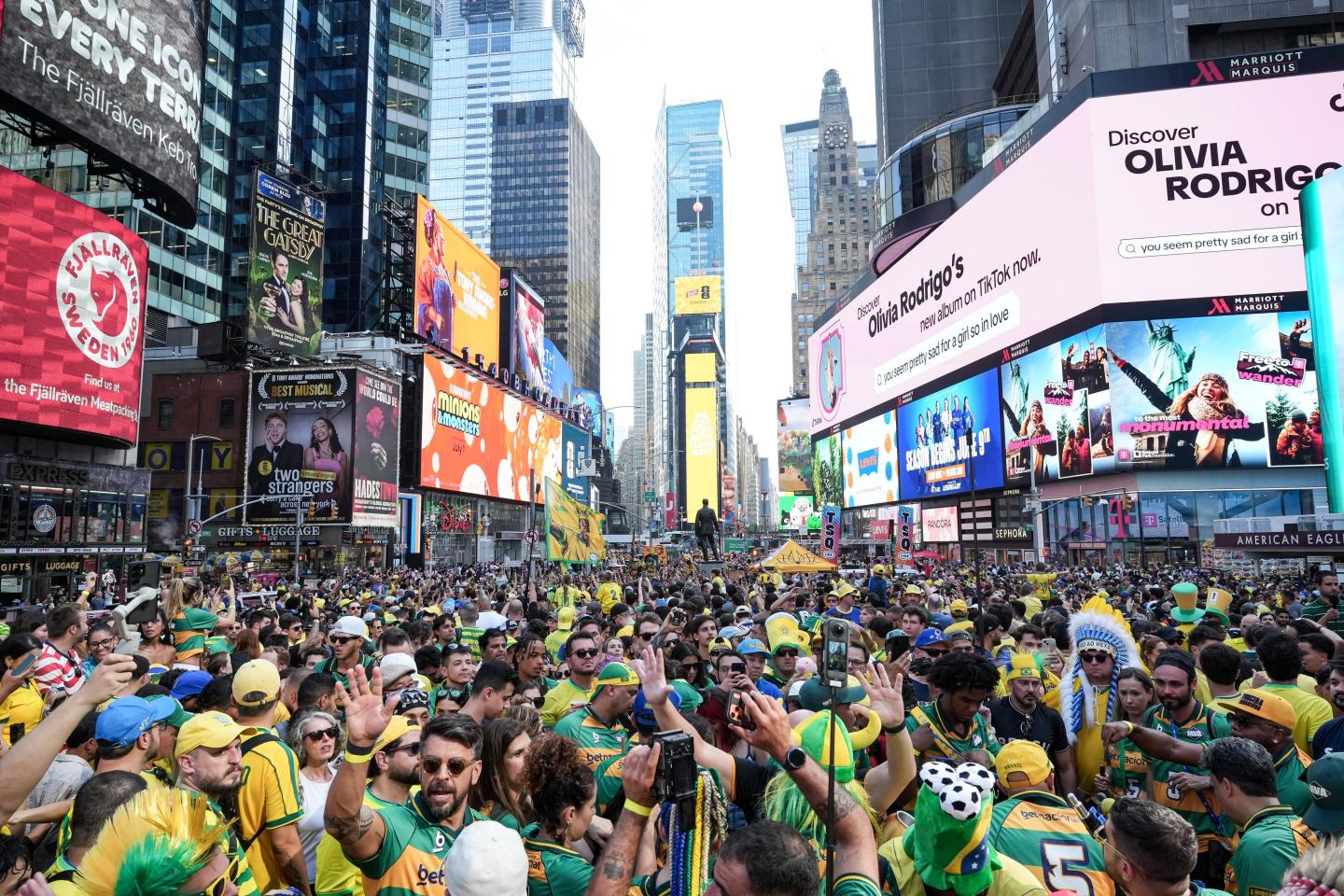
If FIFA’s model pushes costs down and pulls revenue up, New York’s response has been to invert it. Mamdani made the city a national outlier by announcing free fan zones in all five boroughs—”free 99,” in his phrasing—reversing a plan by his predecessor, Eric Adams, to charge for entry, and breaking from Los Angeles and Toronto, which are charging fans to recoup expenses. The administration frames the free model as a deliberate effort to route economic activity and equity toward small businesses, backed by a Five Borough Winners Special promotion nudging fans into neighborhood bars and restaurants rather than FIFA’s perimeter.
Mamdani’s betting that the multiplier shows up in Jackson Heights and the Bronx rather than in city tax receipts. New Jersey has made similar moves: after the marquee New York–New Jersey festival planned for Liberty State Park was canceled, the state replaced it with a thinner network of community events across 21 counties, backstopped by $5 million in economic-development money. The pattern holds nationwide, because staging a fan fest can cost about $1 million a day with little FIFA support, a figure so high that Boston cut its festival to 16 days, less than half the tournament.
No single number has captured the cost-shifting better than the price of the train. New Jersey initially set the round-trip fare from Manhattan to MetLife Stadium—a 20-minute ride that normally costs about $13—at $150, prompting a public backlash and a feud between Governor Mikie Sherrill and FIFA. NJ Transit said moving fans to and from the stadium would cost it $62 million, with outside grants covering only $14 million. “This isn’t price gouging,” NJ Transit chief Kris Kolluri said. “We’re literally trying to recoup our costs.” The fare was cut twice, to $105 and then to $98, with each reduction financed not by FIFA but by a hastily assembled roster of corporate sponsors including DoorDash, FanDuel, and American Water. Governor Kathy Hochul separately slashed the Manhattan shuttle-bus fare from $80 to $20, meaning two of the most powerful governors in the country spent the spring competing to subsidize FIFA, a private organization.
To Matheson, that distributional question is the heart of the matter. The premium-experience model that drives stadium economics—fewer, pricier seats sold to the wealthy rather than cheap ones sold to the many—becomes indefensible, he argues, once public money is involved. Asking taxpayers to subsidize a profit-maximizing event, he said, “when you’re simultaneously asking for handouts from regular taxpayers, is appalling,” and forcing “blue-collar workers to pay higher taxes so the wealthy and the upper middle class can go see games in shiny new stadiums is absolutely one of the worst pieces of public policy out there.”