
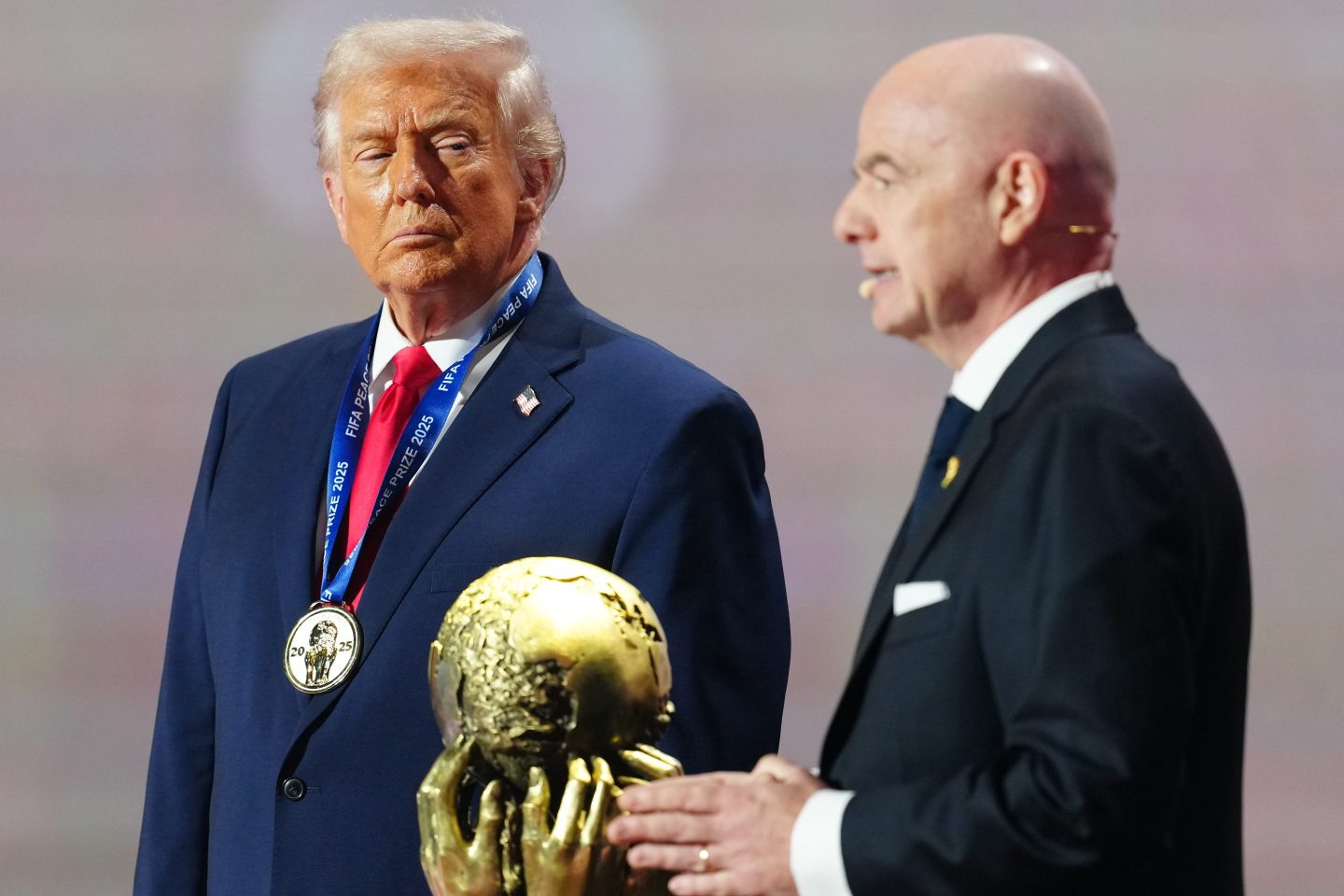
Last year, FIFA president Gianni Infantino hailed the upcoming World Cup as the equivalent of “104 Super Bowls,” quantifying just how big the sport known as football worldwide is—or, at least in comparison to America’s football version. With the average Super Bowl getting 125.6 million views annually, Infantino expects the World Cup to attract the equivalent viewership of three Super Bowls a day for all 39 days of the competition. FIFA predicts games would touch six billion viewers globally, and expects the influx of travelers and tourism will help contribute to a projected $30.5 billion economic windfall for the three host countries of the U.S, Mexico and Canada.
The U.S. hospitality industry, however, is skeptical of the event’s money-making promises.
Of more than 200 hotels surveyed across the 11 U.S. host cities, nearly 80% said hotel bookings are tracking below initial forecasts, a new report from the American Hotel and Lodging Association (AHLA) found. Though FIFA data shows more than five million tickets have already been booked for the event, “indicators suggest the anticipated economic lift may fall short of expectations,” the report said.
Most respondents noted trouble with overseas visitors obtaining visas, in addition to other geopolitical challenges, as the primary factors slowing down travel demand. Other U.S. hotels said FIFA created “an artificial early demand signal” with an overcommitment to hotel blocks. In March, FIFA exercised an opt-out clause in its contract and cancelled thousands of hotel rooms in all 16 of the World Cup host cities, including Philadelphia and Dallas, to accommodate shifting demand.
According to a FIFA spokesperson, the organization’s accommodations team worked closely with hotels to adjust room blocks, including on rates and room types.
“All room releases were conducted in line with contractually agreed timelines with hotel partners—a standard practice for an event of this scale,” the spokesperson said in a statement to Fortune. “In many cases, room releases were made ahead of established deadlines to further accommodate requests from hotels.”
The hotels surveyed—in the cities of Kansas City, New York, Los Angeles, Boston, Seattle, San Francisco, Houston, Dallas, Miami, Philadelphia, and Atlanta—blamed low international demand, with some saying booking pace was trending below even typical summer expectations. The remaining five host cities are spread out between Canada and Mexico, comprised of Mexico City, Guadalajara, and Monterrey in Mexico and Toronto and Vancouver in Canada. This year is the first time since 2002 that a World Cup has been hosted by multiple countries, and may be among the most politically charged one yet following a year of high tensions after the U.S. imposed tariffs globally, including on its co-bidders. All of this combined, the hotels say, makes the World Cup a little more than a blip on the map.
“Many respondents describe the tournament as a ‘non-event’ in these cities,” the report said.
Unique challenges for the 2026 World Cup
Total expenditures for the World Cup—including from host cities, FIFA, investors, and tourists—will likely top $13.9 billion, FIFA estimates. The U.S. alone is expected to spend more than $11 billion to host the event. However, analysts have cast doubt on FIFA’s ability to deliver on its economic promises. An Oxford Economists report published last month predicted “some GDP growth” as a result of the games over the summer, but only temporary job gains in the leisure and hospitality sectors.
Just a few weeks away, the first match will kick off on June 11. The tournament coincides with a period of tumultuous travel some warn could hamper attendance. People already have travel wariness thanks to the Iran war, now entering its second month, which led to a de facto closure of the Strait of Hormuz and has left oil prices elevated above pre-war levels.
Last month, Goldman Sachs warned Europe’s jet fuel supplies could fall below its key 23-day shortage threshold—though carriers including the Swiss International Air Lines say they have enough supply for flights through the end of June. Still, the average price of a transcontinental flight rose from $167 in late February to $414 in mid-March, according to a Deutsche Bank analysis.
The costs of attending the World Cup stateside go beyond just airfare. Tickets for many of the matches top $1,000. And that’s on the lower end: The World Cup final at MetLife Stadium in New Jersey on July 19 costs nearly $33,000. NJ Transit, which originally had a round-trip ticket package from New York City to MetLife Stadium for $150, lowered it to $105 last week following public backlash over the massive price hike. On average, tickets from New York Penn Station to the stadium are typically $13 for the 45 minute train ride.
The FIFA spokesperson said tickets have been released at various price categories, including a minimum of 1,000 tickets at $60 each for each match, including the final.
Though Infantino said the steep ticket costs were a product of “market rates” in the U.S., where the entertainment economy is so developed, even President Donald Trump admitted the tickets were too expensive.
“I wouldn’t pay it either, to be honest,” Trump told The New York Post last week.
That’s in addition to some soccer fans’ decision to snub the U.S. during the World Cup. In January, 170,000 people in the Netherlands signed a petition calling on the Dutch national team to boycott the event following the Trump administration’s threats to take over Greenland. The Dutch cabinet rejected the boycott.
Lisa Delpy Neirotti, director of the Sport Management Program at the George Washington University, said while politics may be a factor to consider, soccer fans will be more swayed by ticket and travel prices than anything else.
“The geopolitical issues are a very small piece of it,” she told Fortune.
Why global sporting events usually fall short
Exorbitant costs and logistical barriers are certainly a drag for soccer fans looking to attend the
World Cup, Delpy Neirotti said, but international sporting events have a history of setting unrealistically high economic aspirations.
“Everybody wants to hear big numbers, right?” she said. “That gets everybody excited. That gets everybody to buy in.”
Part of those unrealistic expectations may come from the events’ propensity to spend beyond initial projections. A 2024 University of Oxford study found the previous three summer Olympic Games (prior to Paris’ in 2024, where researchers did not collect data) exceeded budgets by 185% as a result of immense security requirements and infrastructure demands. The 1976 Olympic Summer Games in Montreal cost $1.5 billion more than its project’s $124 million budget, and it took taxpayers about 30 years to pay off the 10-digit debt.
That’s not the case for all international games. The 2022 World Cup in Qatar contributed nearly 1% of the country’s GDP, though the event was more likely to attract out-of-country tourists given the country’s smaller population. Its small size also meant a stronger concentration of venues, which made it easier for attendees to view multiple matches in one trip.
Delpy Neirotti does not expect an economic disaster from this year’s World Cup, but does warn that expectations should be tempered. There’s a likelihood that as most tickets become available, more soccer fans will book last-minute trips to give the hospitality and tourism sector a boost.
“It does bring economic impact, but it may not bring the impact that the report said,” Delpy Neirotti concluded. “You get all this hype, and then it kind of falls short. So then people are disappointed, but they still should be happy with it.”