• Home
  • Latest
  • Fortune 500
  • Finance
  • Tech
  • Leadership
  • Lifestyle
  • Rankings
  • Multimedia

Trendingnow

1

Social Security unraveling: 7,100 workers sacked, performance metrics retired, disability claims falling

2

Erin Brockovich, the activist who defeated a utility giant and inspired a Julia Roberts film, is pushing data centers to be more transparent

3

'Where we are today is frightening': a Pulitzer-winning historian sees a doomsday scenario involving China and the national debt

1

Social Security unraveling: 7,100 workers sacked, performance metrics retired, disability claims falling

2

Erin Brockovich, the activist who defeated a utility giant and inspired a Julia Roberts film, is pushing data centers to be more transparent

3

'Where we are today is frightening': a Pulitzer-winning historian sees a doomsday scenario involving China and the national debt
EconomyAutos

The U.S. auto industry went from global hegemon to running a $3.3 trillion trade deficit with the world: ‘That’s not acceptable’

By
Tristan Bove
Tristan Bove
Contributing Reporter
Down Arrow Button Icon
By
Tristan Bove
Tristan Bove
Contributing Reporter
Down Arrow Button Icon
May 12, 2026, 1:55 PM ET
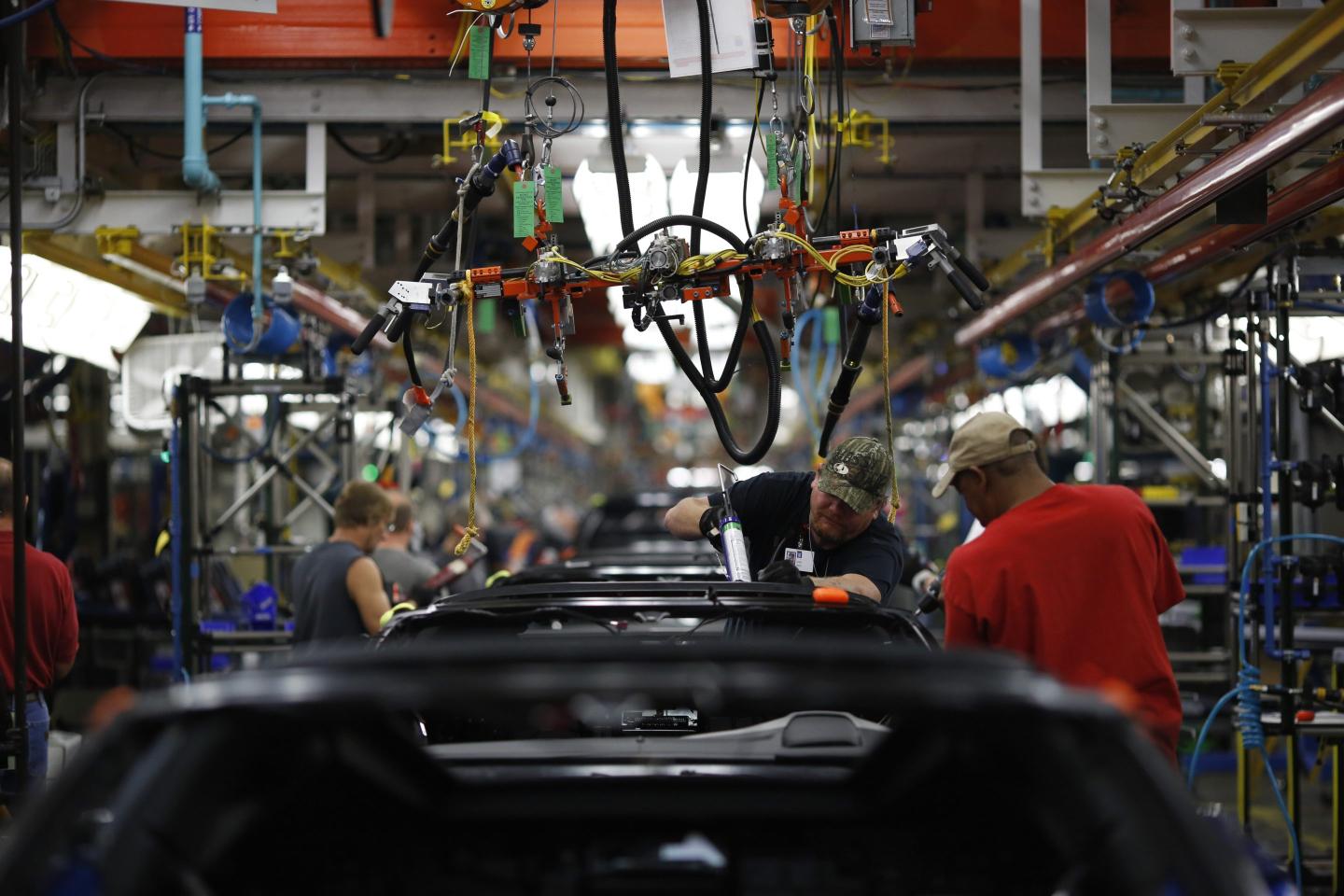
Employees in a General Motors factory.
America's auto industry decline comes with high stakes for the rest of the country.Luke Sharrett/Bloomberg via Getty Images

It would hardly be an understatement to say the U.S. auto industry has historically been one of the country’s primary economic growth engines. The assembly line of the Model T days would go on to permanently reshape manufacturing work, and transportation infrastructure and cities were built around Americans’ unrelenting car-centric culture. 

Recommended Video

But despite its outsized role in the 20th century U.S. economy, the nation’s once-unmatched auto industry is now struggling to keep up with global competitors. And it’s not just carmakers who are smarting. If the U.S. auto industry’s decline proves permanent, the country’s national and strategic security could be at risk, too.

Carmaking represents an “enabling industry,” according to a report documenting the state of the U.S. auto sector released Monday by the Information Technology & Innovation Foundation (ITIF), a think tank focused on science and technology policy. The sector occupies a central role in the country’s manufacturing and innovation ecosystem, to the extent that it underpins industrial capacity and expertise in the production of defense goods and dual-use technologies, according to the report. 

But U.S. carmakers have largely ceded the title of automotive innovators-in-chief to global competitors, particularly China, which leads the world in motor vehicle production, as well as exports. As China barrels ahead to dominate the global auto market and lead in electric vehicle production, the U.S. industry could retreat into an even more diminished role, according to the report, risking falling further behind in a crucial front of its competition with China.

“The United States must act, and act now” Stephen Ezell of ITIF, one of the report’s co-authors, said in a statement. “The United States can still rebuild auto competitiveness if it treats the sector as what it is: a strategic industry tied directly to national power.”

Decline of a kingpin

The numbers behind the U.S. carmaking’s faltering competitiveness and global prestige make for stark reading. The country’s share of global auto production has fallen from 46% in 1965 to 14.7% today, according to the report. Things are little improved on the domestic front, where the Big Three American carmakers—Ford, Stellantis, and General Motors—have seen their shares of the U.S. auto market dip from 92% in 1965 to 38% today. 

Declining domestic sales among these carmakers can, in part, be explained by a rising class of younger U.S. companies, most notably Tesla, which have far outpaced the Big Three in sales of electric cars and software-heavy models. 

But the primary reason for the fall from grace of America’s legacy carmakers has been competition from abroad. In 2024, international automakers manufactured 4.9 million vehicles in the U.S., compared to 4.6 million delivered by the Big Three, according to a report from Autos Drive America, a trade group.

The U.S. has also become one of the world’s most attractive markets for vehicle imports. For most of the 20th century, the U.S. produced the bulk of its automotive needs at home, but in the late 20th century, smaller, cheaper, and more fuel-efficient models from European and East Asian carmakers began making inroads in the U.S. market. Between 1963 and 2023, the total U.S. automobile trade deficit hit $3.3 trillion, according to the ITIF report.

But the biggest gap the U.S. automaking industry faces is the one that has emerged with China, particularly when it comes to electric vehicles and battery production. While scientists in the U.S. were the first to develop electric vehicle technology, American carmakers have fallen significantly behind their Chinese counterparts. BYD, China’s top electric car company, overtook Tesla as the top EV seller worldwide last year, despite having virtually no access to the U.S. market. 

China is also investing far more to research next-generation batteries and in subsidizing the EV industry overall, according to the report, with Chinese electric car subsidies totaling $120.9 billion between 2021 and 2023. 

U.S. lawmakers have criticized China’s EV subsidy scheme for manipulating prices and threatening domestic carmakers. But while China’s carmakers might play by different rules, the result remains the same: The U.S. auto industry struggles to grow while companies like BYD surge ahead on R&D and global market share. 

“The stakes extend beyond the factory floor; they go directly to national power,” the report’s authors wrote. “Imagine a nation where we depend on China for our autos. That’s not acceptable.”

A strategic loss

The risks to the U.S. economy and national security are becoming more pronounced the more the gap with China widens, the report warned. 

The auto industry is a core part of what they call the nation’s “industrial commons” that also house the country’s defense interests. Carmaking contributes expertise, workers, educational institutions, machinery, and research that represent a critical building block to defense. As the auto industry falters, this ecosystem erodes, making it increasingly difficult for the nation to maintain its leadership in advanced manufacturing.

The auto industry has long played an important part in the country’s military-industrial sector. GM was the largest contractor for the U.S. military during World War II, delivering some $150 billion in goods to the war effort, adjusted for inflation, including trucks, tanks, aircraft, and artillery.

The Trump administration appears to be exploring a similar playbook. Last month, Pentagon officials reportedly approached executives at Ford and GM to discuss the companies’ ability to deliver hardware as the military looks to restock its supplies.

But if carmakers were to reenter the world of military contracting, they would do so in a far weaker state, and with less capacity to innovate the technologies of the future as they have done in the past. The ITIF report called for more public funds to be allocated toward high-tech innovation, including EV deployment, robotics, and battery research. It also called for measures to make U.S.-manufactured cars more competitive globally, and to continue barring Chinese vehicles from the U.S. market.

Some level of state direction might be required, because listening to the market has so far pushed U.S. carmakers in the opposite direction. Several American firms, particularly the legacy ones, have recently pulled back from their electric vehicle plans and research due to high costs and the Trump administration’s rollback of EV incentives, instead pivoting to gas-powered and hybrid models. 

“The U.S. auto industry risks retreating to a ‘fortress America,’ concentrating on profitable ICE vehicles at home while EV technology evolves rapidly and Chinese EV makers capture an ever-greater share of global automotive markets,” the authors wrote.

Subscribe to Fortune Gulf Brief. Every Tuesday, this new newsletter delivers clear-eyed, authoritative intelligence on the deals, decisions, policies, and power shifts shaping one of the world’s most consequential regions, written for the people who need to act on it. Sign up here.
About the Author
By Tristan BoveContributing Reporter
LinkedIn iconTwitter icon
See full bioRight Arrow Button Icon

Latest in Economy

Finance
Lorem ipsum dolor sit amet, consectetur adipiscing elit, sed do eiusmod tempor incididunt ut labore et dolore magna aliqua. Ut enim ad minim veniam
By Fortune Editors
October 20, 2025
Finance
Lorem ipsum dolor sit amet, consectetur adipiscing elit, sed do eiusmod tempor incididunt ut labore et dolore magna aliqua. Ut enim ad minim veniam
By Fortune Editors
October 20, 2025
Finance
Lorem ipsum dolor sit amet, consectetur adipiscing elit, sed do eiusmod tempor incididunt ut labore et dolore magna aliqua. Ut enim ad minim veniam
By Fortune Editors
October 20, 2025
Finance
Lorem ipsum dolor sit amet, consectetur adipiscing elit, sed do eiusmod tempor incididunt ut labore et dolore magna aliqua. Ut enim ad minim veniam
By Fortune Editors
October 20, 2025
Finance
Lorem ipsum dolor sit amet, consectetur adipiscing elit, sed do eiusmod tempor incididunt ut labore et dolore magna aliqua. Ut enim ad minim veniam
By Fortune Editors
October 20, 2025
Finance
Lorem ipsum dolor sit amet, consectetur adipiscing elit, sed do eiusmod tempor incididunt ut labore et dolore magna aliqua. Ut enim ad minim veniam
By Fortune Editors
October 20, 2025

Most Popular

Finance
Lorem ipsum dolor sit amet, consectetur adipiscing elit, sed do eiusmod tempor incididunt ut labore et dolore magna aliqua. Ut enim ad minim veniam
By Fortune Editors
October 20, 2025
Finance
Lorem ipsum dolor sit amet, consectetur adipiscing elit, sed do eiusmod tempor incididunt ut labore et dolore magna aliqua. Ut enim ad minim veniam
By Fortune Editors
October 20, 2025
Finance
Lorem ipsum dolor sit amet, consectetur adipiscing elit, sed do eiusmod tempor incididunt ut labore et dolore magna aliqua. Ut enim ad minim veniam
By Fortune Editors
October 20, 2025
Finance
Lorem ipsum dolor sit amet, consectetur adipiscing elit, sed do eiusmod tempor incididunt ut labore et dolore magna aliqua. Ut enim ad minim veniam
By Fortune Editors
October 20, 2025
Finance
Lorem ipsum dolor sit amet, consectetur adipiscing elit, sed do eiusmod tempor incididunt ut labore et dolore magna aliqua. Ut enim ad minim veniam
By Fortune Editors
October 20, 2025
Finance
Lorem ipsum dolor sit amet, consectetur adipiscing elit, sed do eiusmod tempor incididunt ut labore et dolore magna aliqua. Ut enim ad minim veniam
By Fortune Editors
October 20, 2025
Fortune Secondary Logo
Rankings
  • 100 Best Companies
  • Fortune 500
  • Global 500
  • Fortune 500 Europe
  • Most Powerful Women
  • World's Most Admired Companies
  • See All Rankings
  • Lists Calendar
Sections
  • Finance
  • Fortune Crypto
  • Features
  • Leadership
  • Health
  • Commentary
  • Success
  • Retail
  • Mpw
  • Tech
  • Lifestyle
  • CEO Initiative
  • Asia
  • Politics
  • Conferences
  • Europe
  • Newsletters
  • Personal Finance
  • Environment
  • Magazine
  • Education
Customer Support
  • Frequently Asked Questions
  • Customer Service Portal
  • Privacy Policy
  • Terms Of Use
  • Single Issues For Purchase
  • International Print
Commercial Services
  • Advertising
  • Fortune Brand Studio
  • Fortune Analytics
  • Fortune Conferences
  • Business Development
  • Group Subscriptions
About Us
  • About Us
  • Press Center
  • Work At Fortune
  • Terms And Conditions
  • Site Map
  • About Us
  • Press Center
  • Work At Fortune
  • Terms And Conditions
  • Site Map
  • Facebook icon
  • Twitter icon
  • LinkedIn icon
  • Instagram icon
  • Pinterest icon

Latest in Economy

ste
EconomyRecession
OECD warns of ‘scarring effects,’ recession scenarios—but finds ‘no signs of widespread labour displacement’ from AI
By Nick LichtenbergJune 3, 2026
2 hours ago
Google CEO Sundar Pichai
AICorporate America
By every measure, U.S. companies are winning on AI adoption—but a series of high-profile snafus shows they’re getting pummeled by costs
By Tristan BoveJune 3, 2026
2 hours ago
Bernie Sanders wants Americans to own a piece of AI. The Trump White House seems to agree
AIBernie Sanders
Bernie Sanders wants Americans to own a piece of AI. The Trump White House seems to agree
By Catherina GioinoJune 3, 2026
3 hours ago
Soldier Field in Chicago during 1994 FIFA World Cup opening ceremonies
EconomyWorld Cup
Some of the biggest U.S. sporting towns decided not to host any World Cup games, fearing a ‘major financial burden to our cities’
By Tristan BoveJune 3, 2026
5 hours ago
CHONGQING, CHINA - JANUARY 22: In this photo illustration, a smartphone displays the logo of Automatic Data Processing, Inc. (NASDAQ: ADP), an American provider of human capital management solutions including payroll, workforce management and business outsourcing services, in front of a screen showing the company's latest stock market chart on January 22, 2026, in Chongqing, China. (Photo illustration by Cheng Xin/Getty Images)
EconomyLabor
AI was supposed to be killing jobs. In spring, the labor market is opening up instead
By Eva RoytburgJune 3, 2026
5 hours ago
zhu
ConferencesCOO Summit
‘One thing after the next’: Axon and Schneider Electric supply chain chiefs talk life in permanent disruption
By Nick LichtenbergJune 3, 2026
6 hours ago

Most Popular

Social Security unraveling: 7,100 workers sacked, performance metrics retired, disability claims falling
North America
Social Security unraveling: 7,100 workers sacked, performance metrics retired, disability claims falling
By Katie Savin, Callie Freitag, Matthew Borus and The ConversationJune 2, 2026
1 day ago
Erin Brockovich, the activist who defeated a utility giant and inspired a Julia Roberts film, is pushing data centers to be more transparent
Environment
Erin Brockovich, the activist who defeated a utility giant and inspired a Julia Roberts film, is pushing data centers to be more transparent
By Marco Quiroz-GutierrezJune 1, 2026
2 days ago
'Where we are today is frightening': a Pulitzer-winning historian sees a doomsday scenario involving China and the national debt
Banking
'Where we are today is frightening': a Pulitzer-winning historian sees a doomsday scenario involving China and the national debt
By Nick LichtenbergJune 2, 2026
1 day ago
Cognizant CEO says AI is remaking middle managers into player-coaches who can 'both  execute and develop others'
Newsletters
Cognizant CEO says AI is remaking middle managers into player-coaches who can 'both execute and develop others'
By Diane BradyJune 2, 2026
1 day ago
Current price of oil as of June 2, 2026
Personal Finance
Current price of oil as of June 2, 2026
By Joseph HostetlerJune 2, 2026
1 day ago
Current price of gold as of June 2, 2026
Personal Finance
Current price of gold as of June 2, 2026
By Danny BakstJune 2, 2026
1 day ago

© 2026 Fortune Media IP Limited. All Rights Reserved. Use of this site constitutes acceptance of our Terms of Use and Privacy Policy | CA Notice at Collection and Privacy Notice | Do Not Sell/Share My Personal Information
FORTUNE is a trademark of Fortune Media IP Limited, registered in the U.S. and other countries. FORTUNE may receive compensation for some links to products and services on this website. Offers may be subject to change without notice.