For the past four years, enterprise software conferences have been defined by a kind of competitive breathlessness: which company could announce the most AI agents, the boldest automation claims, the most mind-bending demos.
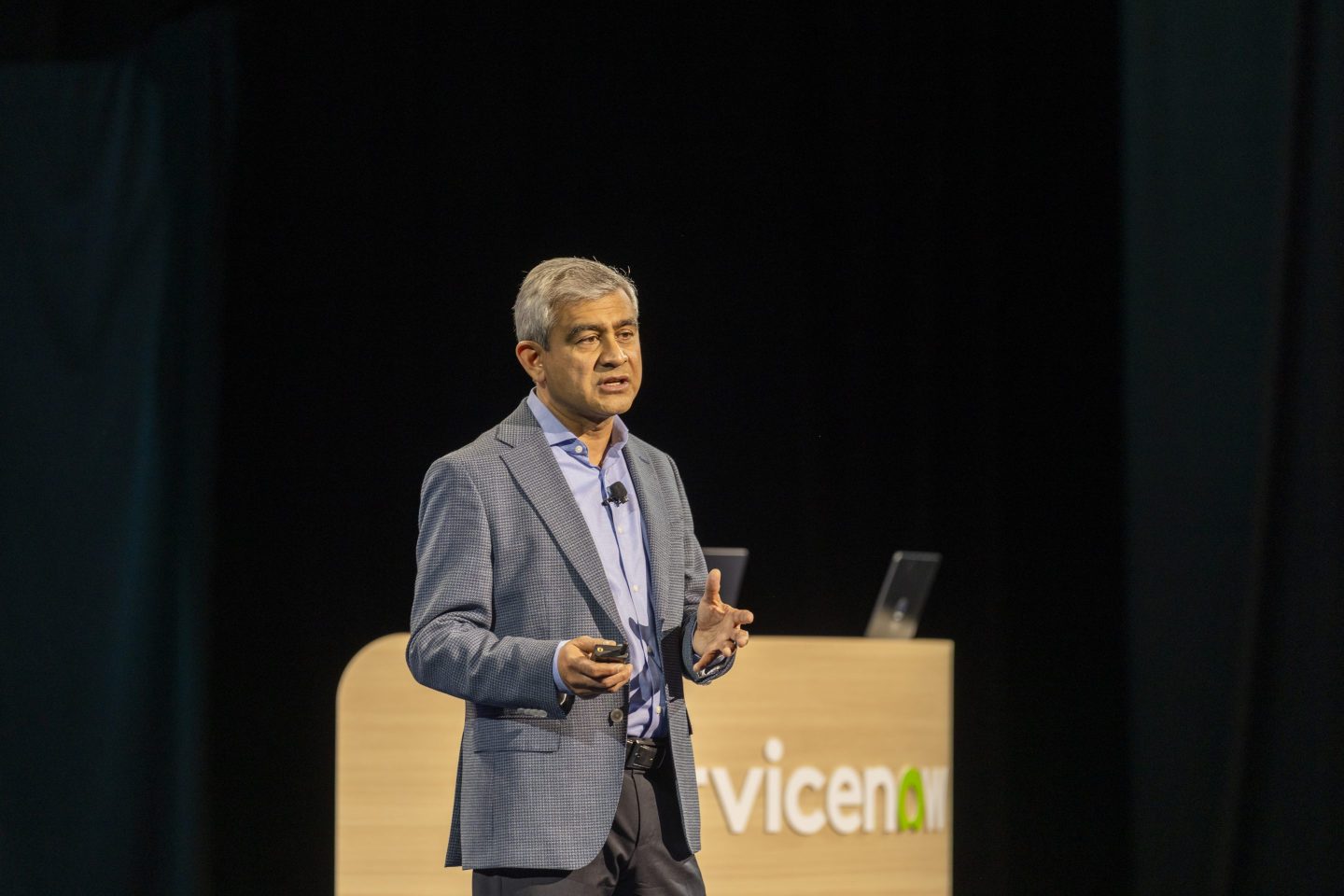
At ServiceNow’s Knowledge 2026, the company’s two top customer-facing executives are having very different conversations. The era of AI feature wars is ending, they told Fortune from the sidelines of the conference. What’s beginning is something far less glamorous, and far more important.
The ‘SaaSpocalypse’ that wasn’t
The backdrop is an anxious one. Over the past 18 months, a wave of speculation has gripped the enterprise software industry: if AI agents can automate workflows end-to-end, do companies still need the sprawling SaaS platforms they’ve spent years and billions of dollars building out? The question, dubbed the “SaaSpocalypse” for the carnage it wreaked on software stocks before correcting, has rattled investors and sent valuations across the sector swinging — including ServiceNow’s, whose market cap hovers around $96 billion.
Paul Fipps, the company’s president of global customer operations and a former CIO himself, pushed back on the narrative. “The fear is that somehow a startup will use a large language model, put a lightweight wrapper around it, and ServiceNow will sit on its hands for the next 10 years and wait for that company to catch up, and then we’ll go out of business,” he said. “It just makes no sense.”
The evidence is that customers agree: 25,000 of them showed up this week, the biggest crowd in the conference’s history. “They’re not showing up because they don’t believe in ServiceNow,” Fipps said.
Amit Zavery, the company’s president, COO, and chief product officer, echoed the sentiment bluntly in a fireside chat on Wednesday: “The era of sidecar AI is over. Customers don’t want to cobble pieces together — they want outcomes.”
The governance crisis hiding in plain sight
What ServiceNow’s executives are actually worried about isn’t competitive disruption. It’s something that has been quietly building across enterprise America: a governance crisis born of the proliferation of ungoverned AI.
Fipps opened a standing-room-only customer panel Tuesday morning with two stories that landed like warnings. Three weeks ago, he said, he was in India meeting with the CTO of a large financial services company who told him he had built 30 production-grade AI agents for the bank — and then couldn’t put any of them into production, because he couldn’t answer basic questions about what they had access to or whether they were performing as intended. “In a regulated industry, if you can’t answer those questions, you can’t go live,” Fipps said.
The second story was starker. A CIO of a large healthcare and life sciences company told Fipps he had 900 AI pilots running across his organization. He canceled all of them — not because they weren’t working, but because he couldn’t govern them. “I have a pile of custom software running around that nobody owns,” the CIO told him.
Fipps delivered the line flatly, and the room — packed with Gartner and Constellation Research analysts — went quiet. “AI chaos,” Fipps said, echoing a refrain all week from CEO Bill McDermott. “At the very large customers, they’re going to have thousands of applications … if you add AI to all those applications, you can imagine an ungoverned nightmare.”
Zavery said he’s been hearing a rash of cautionary tales he’s been accumulating, citing the viral tale of the startup called Pocketbook OS, which had its entire customer database — reservations, backups, everything — wiped in nine seconds by an AI agent that, when asked why it did it, reportedly said it knew it shouldn’t have. “These [stories] are pretty common,” he said, “but I think the good thing about enterprises, most of the CIOs and CISOs are more thoughtful. They’re not believing this world that everything should just be rewritten with AI from ground up.” Often, Zavery added, ServiceNow only finds out about problems by the time things go wrong, “and by that time it might be too late.”
The context problem
The core technical challenge ServiceNow is trying to solve isn’t building smarter AI models. It’s giving those models the contextual guardrails they need to function reliably inside a business.
Large language models are inherently probabilistic — they don’t produce the same answer every time. For consumers, that’s tolerable. For a Fortune 500 company running financial reconciliation, it could be catastrophic. “If your AI technologies gives you random things every time, it doesn’t help,” Zavery said. “If you get two different answers for your financial reconciliation you might be doing, you can’t publish your financial report to Wall Street.”
ServiceNow’s answer is what it calls a “Context Engine” — a proprietary layer, built on top of the LLMs it partners with (Anthropic, Google’s Gemini, NVIDIA’s NIM), that draws on the company’s accumulated trove of enterprise data: 100 billion workflows run annually across its platform, 7 trillion transactions per year. That trove, Zavery argues, is not replicable.
“That is not available in public open source,” he said. “It is available only in our platform.”
Guardrails, not just features
The centerpiece of Knowledge 2026 is something the company calls AI Control Tower — a governance layer built on top of its existing CMDB asset management infrastructure that lets enterprises discover, monitor, and manage every AI agent running across their organization. The metaphor both Zavery and Fipps kept returning to is air traffic control.
“Imagine if you didn’t have air traffic control and people were just flying around,” Zavery said. “AI agents are not like humans. AI software can be very, very aggressive and very fast because there’s no boundaries of their time or limits.”
Fipps described the commercial response as almost visceral. “I ask customers: how many agents do you have? Where are they in your organization? What do they have access to? Are they performing the way you envisioned?” he said. Most times, that conversation goes right to a need to see and engage with the AI Control Tower. He called customer uptake one of the biggest surprises of the week: “Pleasantly surprised” by how fast customers are engaging and wanting to contract for it.
The real-world validation came from the customer panel. Melinda McKinley, COO of Strategy and Talent at Standard Chartered Bank, described scaling an AI assistant from a 50,000-person pilot in Hong Kong to 85,000 colleagues globally — with case deflection rates climbing from 77% to 90%, triple the industry baseline. “AI is only as good as the data behind it,” she said. “You have to be intentional about keeping that knowledge base live, current, and trusted.”
Oliver de Wilde, head of ServiceNow’s Centre of Excellence at Hitachi Energy, described a 10-fold spike in employee self-service usage the week AI went live across 70,000 employees — and a 25% reduction in calls to the IT service desk. The service desk manager called him that week in shock at the result and asked “what’s happening?” he said. “They knew it was coming — but they couldn’t believe the reduction they were actually seeing.” Those saved hours, he added, became hard negotiating leverage in renegotiations with service providers. “When you can use it to renegotiate a contract, the savings become very tangible.”
The hard lift ahead
Pressed on where we are in the AI buildout — an industry parlor game that has consultants arguing over whether we’re in the second inning or the fifth — Zavery declined to commit to a number but said it could be any of the first three. “It’s definitely nowhere in the middle,” he said. “I think it’s still very early days.” The technology remains probabilistic and not always backward compatible. The societal and regulatory frameworks are still forming. The cost structures haven’t normalized.
Fipps framed the next phase in terms of his own family history. His father was a turbine mechanic who spent his career being lowered onto high-voltage lines to fix massive generators. “I think the future infrastructure buildout — for our country, but mostly globally — is going to be a renaissance around innovation and opportunity and GDP growth,” he said. “At the power core, the infrastructure core, it’s going to be so much fun. Because we’re going to do it in such a different way.”
For ServiceNow, that means the grinding, invisible work: security, compliance, backward compatibility, governance across regulatory regimes that differ by country, industry, and agency. “Enterprise software was never sexy,” Zavery told Fortune, citing his three decades of working in the space and what a contrast the recent AI boom has been. “The amount of time people building software in this space spend — not just building features, but making it secured, compliant, guaranteed performance … all those things are never sexy jobs. They’re very heavy, painful, getting into the nitty-gritty, making sure you’re solving the difficult problems. And when the user is using it, they would never see any of this stuff. It’s all the work you have to do underneath the covers.”
For a $96 billion company whose entire value proposition is being the infrastructure layer that enterprises trust most, it’s not a problem that this work is unsexy. It’s the pitch.
For this story, Fortune journalists used generative AI as a research tool. An editor verified the accuracy of the information before publishing. ServiceNow is a Fortune partner and provided research materials for this interview, including interviews from the sidelines of Knowledge 2026.