
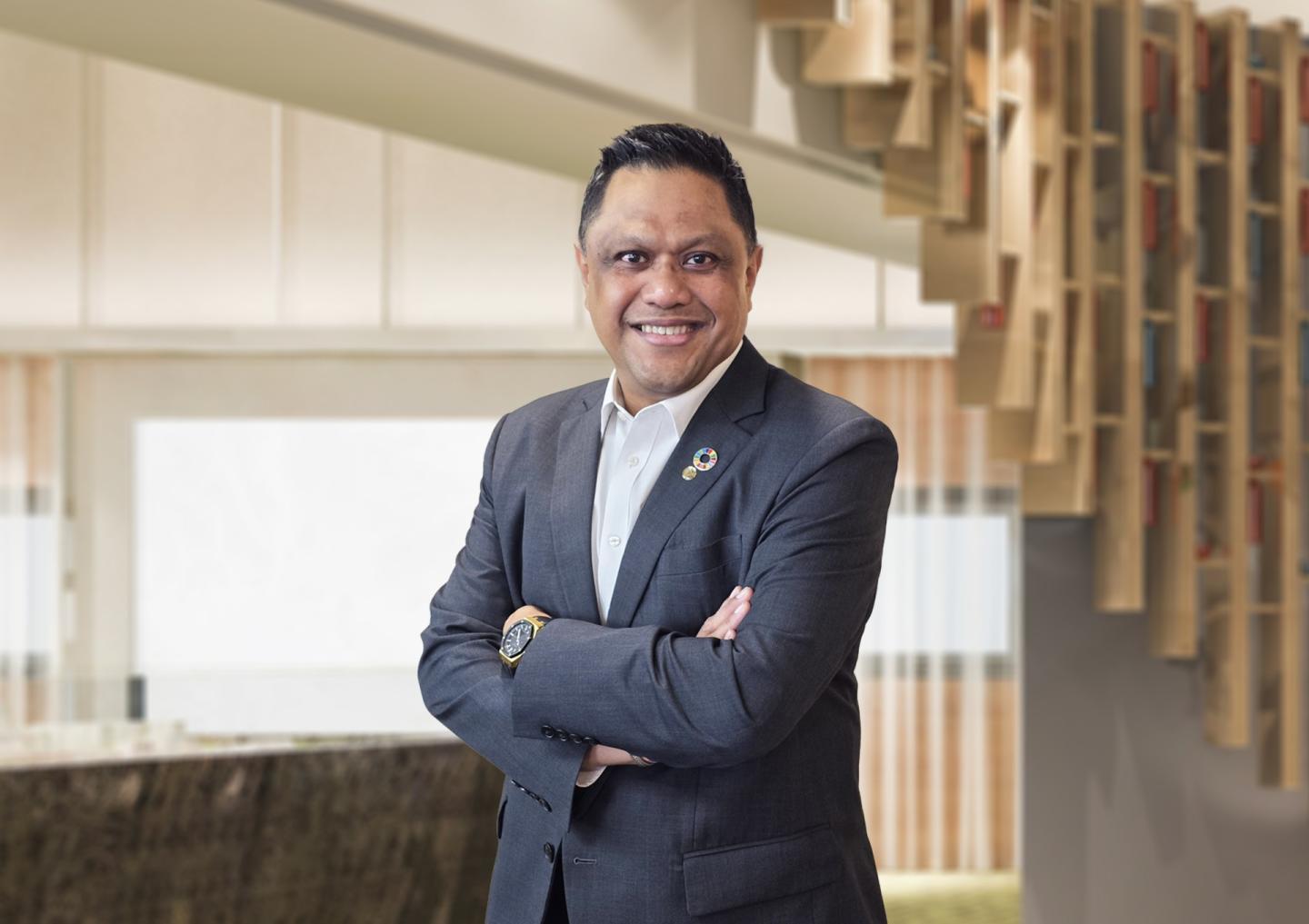
Islamic finance covers roughly $2.8 trillion in assets worldwide, yet only a sliver of sustainable loans today are sharia-compliant. But Datuk Shahril Azuar Jimin, Maybank’s chief sustainability officer, thinks that gap should be easy to fill.
“Islamic finance and sustainable finance are both values-based systems,” Shahril tells Fortune. “Islamic finance emphasizes social justice, welfare, and the avoidance of harm, and these three principles align naturally with ESG and sustainability.”
Banks across the Middle East and Southeast Asia are embracing Islamic finance in order to better serve Muslim populations. Maybank, for example, offers Islamic banking products ranging from Islamic deposits and financing to Wasiat (Islamic legacy planning) across five markets: Malaysia, Indonesia, Singapore, London, and the Middle East.
Last November, Maybank and the government of Sabah, a Malaysian state on the island of Borneo, agreed to work together on the world’s first “blue sukuk,” designed to finance marine conservation, sustainable fisheries, and coastal ecosystem restoration. Sukuk are bonds that comply with Islamic law; rather than pay interest, sukuk instead offer buyers a time-limited share in the profits of a particular asset. Sabah holds 60% of Malaysia’s mangroves, offering significant potential for blue carbon credit generation.
Malaysia has highlighted the blue economy as a priority area in its most recent economic plan, which outlines the nation’s policy objectives through 2030. The country is launching a blue economy blueprint to harmonize policies toward aquaculture, renewable ocean energy, green shipping, and ecotourism. “The potential of the blue economy is immense,” Malaysia’s then deputy minister of economy, Datuk Hanifah Hajar Taib, said during the ASEAN Blue Economy Forum last September.
A growing Islamic finance industry
Islamic finance refers to a series of banking practices that comply with sharia, or Islamic law. Islam bars charging interest, so banks find other ways to ensure people get a return, often by offering bondholders a share of profits or giving lenders an ownership stake. Islamic finance may also avoid sectors and products considered haram, or unclean; for example, a sharia-compliant ETF may avoid banks that offer traditional loans or e-commerce platforms that sell pork.
The amount raised for sustainable finance within the 57 countries of the Organization of Islamic Cooperation jumped from $17.8 billion in 2017 to $82.3 billion in 2024, according to a 2025 report from the World Bank.
Yet while Islamic sustainable finance is growing, it’s still a small part of both the overall sustainable finance and Islamic finance markets. The World Bank estimated that just 8.2% of sustainable loans between 2017 and 2021 were sharia-compliant. The broader global Islamic banking market manages about $2.8 trillion in assets.
International Islamic standard-setting bodies, like the Islamic Financial Services Board and the General Council for Islamic Banks and Financial Institutions, have begun to roll out governance standards to support the Islamic climate finance market.
Despite being one of the world’s regions most vulnerable to climate change, Southeast Asia has long faced a massive green finance gap. The Asian Development Bank estimates that the region will need to invest $210 billion annually in climate-resilient infrastructure through 2030. Yet from 2018 to 2019, Southeast Asia received only $27.8 billion in climate financing, or 5% of total flows to the Asia-Pacific.
“Islamic finance is a huge global market, which is projected to exceed $3 trillion,” Shahril says. “We believe Islamic finance can play a much larger role in financing ASEAN’s green transition, and also create more inclusive growth.”
‘We didn’t know a lot of things’
Maybank named Shahril as its first chief sustainability officer in 2021; he’d previously spent several years serving as CEO of the Maybank Foundation, the bank’s corporate social responsibility arm.
“When I was first appointed, there was nothing much I could fall back on in terms of precedent,” Shahril says. “We didn’t know a lot of things.”
Shahril eventually laid out four sustainability commitments for the bank, including mobilizing 50 billion Malaysian ringgit ($12.6 billion) in sustainable finance by 2025; improving the lives of over a million Southeast Asian households by 2025; achieving carbon neutrality by 2030; and devoting 1 million hours per year on sustainability-related activities.
Maybank later increased its 2025 sustainable finance target to 80 billion ringgit ($20.3 billion), but ultimately surpassed even that elevated goal. By 2025, the bank had raised 176.1 billion ringgit in sustainable financing.
“ASEAN economies are deeply connected to their coastlines and marine ecosystems,” Shahril explains, pointing to how Indonesia and the Philippines are made up of over 17,000 and 7,000 islands, respectively. “All these ecosystems support fisheries, tourism, trade, and livelihoods, making the sustainable management of ocean resources increasingly important to long-term economic resilience.”
He adds that Maybank, alongside Islamic banks across the globe, is now exploring the development of Islamic ESG funds, integrating Islamic social financing instruments like zakat and waqf and looking to finance sustainable halal supply chains, he adds. (Zakat is the Islamic mandate that Muslims should donate a small part of their wealth to charity every year; a waqf is when the owner of an asset endows it to the public in perpetuity.)
“Our aspiration is that sustainable finance will one day just be finance,” Shahril says. “And that sustainability will be so ingrained in everyday life, that we don’t even talk specifically about funding it.”