
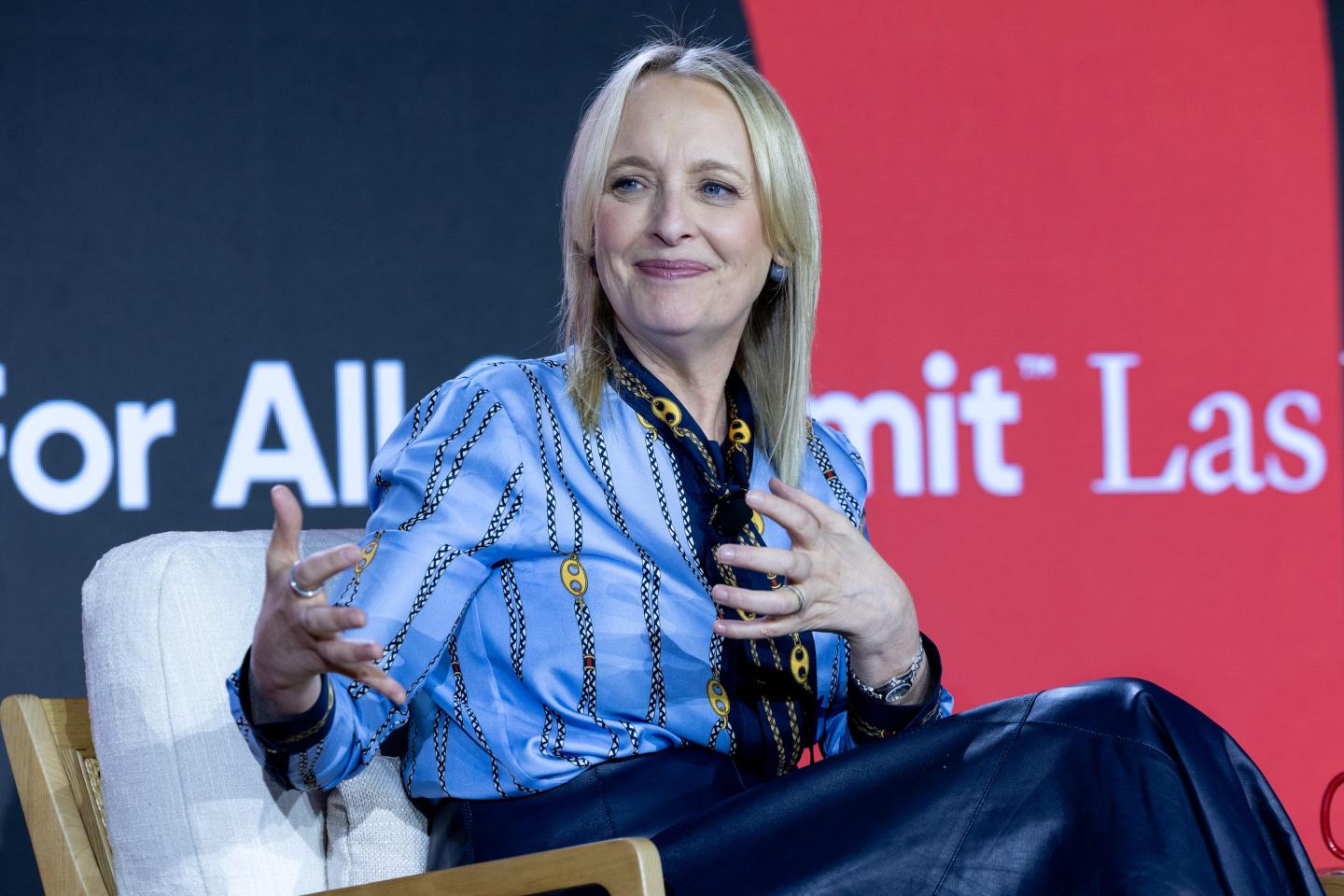
Accenture CEO Julie Sweet has done something most Fortune 500 leaders only talk about: she blew up a 50-year-old organizational structure, rewrote the operating model she herself installed, and tied every employee’s promotion to AI fluency—all while keeping 786,000 people on board. The philosophical question her transformation raises is one of philosophy’s oldest: if you replace every part of something, is it still the same thing?
The ancient Greek paradox goes like this: After Theseus sailed back to Athens, the Athenians preserved his ship as a monument. Over time, its wooden planks rotted and were replaced one by one — until eventually, no original piece remained. Plutarch recorded the result in the 1st century CE, noting that philosophers were already split: one camp held that the ship was still the same, and the other said it was not.
This would be true for Accenture during its era of transformation, Sweet told Fortune, backstage at the Great Place to Work For All Summit in Las Vegas. Except for one thing. “We changed what the ship looked like,” Sweet said. “We really have completely changed ourselves, multiple times.” That capacity for reinvention, she argued, is exactly why Accenture is still standing after 50 years — and why, she said, its most disruptive chapter is still ahead.
Defying the rules of disruption
Sweet has spent the last several years disrupting one of the world’s largest professional services firms — and doing it in ways that would make most CEOs lose sleep. The company has disclosed a whopping $923 million in restructuring charges as Sweet’s efforts take hold, including a new talent strategy to fully embrace AI. Regarding exits, she told analysts at the time that Accenture was expecting to increase its overall headcount through 2026 while implementing a refreshed three-pronged talent strategy that included reskilling some people and exiting others where reskilling was not viable.
She reversed five decades of Accenture’s organizational structure. She blew up the operating model she herself installed when she became global CEO in 2019, a service- and geography-led operating model that was well suited to scaling digital transformation globally for clients but needed to evolve to enable more continuous, AI-enabled reinvention.
She tied employee promotions to AI proficiency. And she did all of this with 786,000 employees watching across more than 120 countries — every single one of whom, notably, gets a say. Through this sea of changes, Accenture ranked No. 8 on this year’s Fortune 100 Best Companies to Work For list and climbed to No. 4 on the World’s Best Workplaces list. Revenue has grown more than 60% under her tenure. Staying in a prominent spot on the World’s Best Workplaces list means a lot to Sweet. “We’re really proud of that,” she said, “it is genuinely difficult, and a lot of these changes create uncertainty.”
Transparency matters
Accenture is one of only two companies in the Great Place to Work universe that surveys its entire workforce, not a sample. “The survey gives us a really important voice for every person,” Sweet said onstage at the For All Summit, in conversation with Great Place to Work CEO Michael C. Bush. “This is the only way that we can make sure that every single person has the opportunity to influence us.”
“Just a few weeks ago,” Sweet told Fortune, “we completed putting in the biggest operating model change in our history, that in some ways changed how we’ve operated for 50 years and completely changed the operating model that I put in when I became global CEO.” It’s a lot easier, she added, to “blow up” an operating model when you’re inheriting someone else’s, and much harder to change the system you yourself put in place. She said she was intentional and transparent with her team about this change, signaling several phases last June, then the aforementioned September, and now, moving forward, in her new, non-Ship-of-Theseus. “Think about all the uncertainty that creates,” she said, adding that she thinks Accenture’s transparency and culture of change allowed it to keep people focused on what they need to do every day.
No AI fluency, no promotion
Sweet was asked about the thinking behind one of her most consequential — and most publicized — decisions: making AI fluency a hard requirement for promotion. The move drew headlines earlier this year, but Sweet said it was quite straightforward. “Actually, that was a playbook,” she said, saying it was similar to the digital transition of the 2010s, except playing out in quarters instead of years. But in that digital transition, Accenture only started changing its evaluations and promotions after a couple of years of providing tools, training, and clarity.
The night thousands signed up
By this point, Sweet said, Accenture’s workers have known that AI fluency would be a prerequisite for promotion by, say, 2026, so the recent changes were telegraphed far in advance. In practice, that meant launching a company-wide AI literacy program that gives every employee a certificate upon completion. After that, the course went live in late 2025, 300,000 people had completed it by the end of the year, and the number has now surpassed 500,000. “I remember the first night we rolled out Gen AI training, thousands of people took it overnight without a single email,” she said, recalling that this was organic demand after the course popped up on Accenture’s learning portal. “You can’t just tell people you now need to be AI native,” Sweet said: you need to be transparent and bring them along.
This approach extends to her consulting work, Sweet added. She recalled advising a CIO whose legal and compliance teams were bottlenecking AI approvals. Her diagnosis was blunt: “I asked how much training the lawyers, the compliance people and the security people had in the technologies.” The response: not aware of any. “You have to start with like those people. What’s their point of view? What’s their job? What capabilities do they have? Because just saying it’s important is not going to change them.”
The scale of the challenge is staggering, and the data is not flattering for corporate America. “All the data is showing companies are investing in AI, but they’re not investing in the skilling and training,” she said. From November 2022 through the end of the 2025 fiscal year, Accenture has gone from 30 people trained in generative AI to over 550,000 — a number that reflects a commitment Sweet began building the moment she became CEO, when she launched a company-wide initiative she called TQ, or technology quotient. “Everybody at Accenture, not just our technologists, needed to learn more about technology,” she said. She spends approximately $1 billion per year on development to back it up.
The bottleneck most CEOs won’t admit to
What’s coming next, Sweet believes, dwarfs everything Accenture has navigated so far. When she became CEO in 2019, she recalled to Fortune, she told her team, “there’s more change ahead than behind.” She said she holds the same view today — with more conviction. “We’re still super early in how AI is going to change companies, countries, societies,” she said. For context, she points to cloud computing — itself a seismic shift — which took a full decade to reach boardroom consensus. With AI, that conversation compressed into less than two years. “I do not have any conversations anymore about, is AI real?” she said. “It’s all about, how do you make it real?”
But Sweet is also clear-eyed about something most CEOs prefer not to say out loud: not everyone will make it through this AI transition. “Some people will not make the journey,” she said, “but it’s our job” — meaning the job of leaders — to close that gap wherever possible. Sweet said she tells leaders they have two choices: either swap in the disruptors, or do the hard work of bringing traditional leaders to genuine understanding of the technology. “I know of no company who has the luxury to change every single leader,” she said. So the work is persuasion, training, clarity — and ultimately, accountability. In other words, even the most AI-allergic leader in your organization needs to start learning, now, somehow.
The secret to doing so, Sweet said, isn’t inspiration. It’s alignment. “If you paint a picture, however inspiring, but what people experience on the ground and what they’re incentivized around are not consistent with that North Star — not only do you not execute, but it confuses people,” she said. “It’s a lack of trust.” That conviction runs through everything Accenture has built: strategy, operating model, and performance management all have to move together, or the whole thing breaks down. It’s why she believes she could make such radical changes at Accenture and still remain a Great Place to Work.
The Ship of Theseus replaced its planks out of necessity. Sweet is ripping hers out by design—and she’s already laying the keel of the next vessel before this one reaches port. The harder question she’s asking every leader she meets isn’t philosophical. It’s urgent: Are you on board?