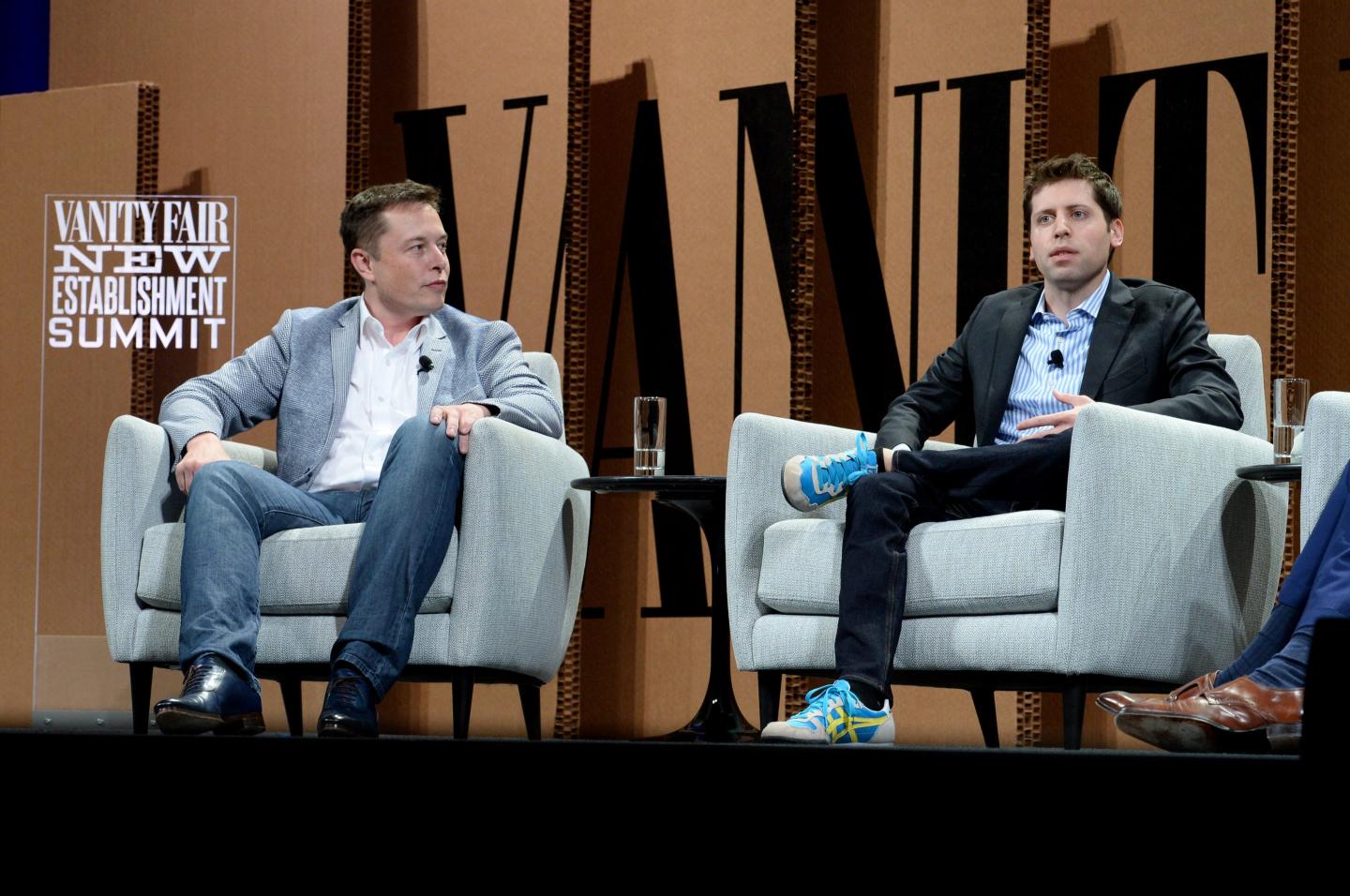
The most expensive frenemy fallout in tech history began Monday, in a federal courtroom in Oakland.
After over a decade of partnership, Tesla CEO Elon Musk is suing OpenAI CEO Sam Altman for more than $130 billion, alleging that Altman and OpenAI cofounder Greg Brockman swindled him and betrayed the company’s founding charitable mission. The chief complaint centers on Altman’s 2023 move to spin OpenAI’s core technology into a for-profit subsidiary, now valued at almost $1 trillion and which could go public as soon as late 2026.
Musk, who donated about $38 million of OpenAI’s earliest funding, wants the judge to unwind the for-profit conversion, force Altman and Brockman out of their roles, and direct any damages to OpenAI’s nonprofit arm rather than to himself. He does not want any damages paid to him; rather, it appears his primary aim is to knock “Scam Altman”—his new nickname for his old friend—down.
To counter, it appears that an equally hurt Altman will bring up all the dirt he has on Musk, including a Burning Man trip and a former OpenAI board member who is also the mother of four of Musk’s known 14 children. Already, the pretrial documents unearthed raw text messages between the two powerhouses, including one from February 2023 in which Altman says, “You’re my hero,” before adding: “I am tremendously thankful for everything you’ve done to help—I don’t think OpenAI would have happened without you—and it really [expletive] hurts when you publicly attack OpenAI.”
Musk’s reply, also now in evidence, reads: “I hear you and it is certainly not my intention to be hurtful, for which I apologize, but the fate of civilization is at stake.”
The trial is scheduled to run for four weeks, with both Altman and Musk testifying, as well as other power players like Microsoft CEO Satya Nadella expected on the stand.
Representatives from OpenAI and Tesla did not immediately respond to Fortune’s requests for comment.
Why the lawsuit is a longshot
Sam Brunson, a nonprofit law professor at Loyola University Chicago, who has been following the case closely, told Fortune the threshold question—whether someone who gave money to a charity can sue if the charity changes course—almost always cuts against the donor.
“As a general rule, the answer to that is no,” he said. “If I donate to an organization, I’ve given up that money, and if it turns out that I don’t like what they do subsequently, my recourse is to stop donating to them.”
The way around that rule, Brunson explained, is fraud, or proving you were lied to in the moment you donated—which is exactly what Musk has spent two years trying to argue.
The most damaging single piece of evidence to that effect comes from Brockman’s personal notes—or “diary,” if you’re on Musk’s team—which Judge Yvonne Gonzalez Rogers quoted from directly in her January order sending the case to trial.
In September 2017, Brockman wrote: “This is the only chance we have to get out from Elon … Financially, what will take me to $1B?” Accepting Musk’s terms, he added, would “nuke” both “our ability to choose” and “the economics.”
After a Nov. 6, 2017, meeting during which Brockman and Altman had assured Musk OpenAI would stay a nonprofit, Brockman wrote, “[He] cannot say that we are committed to the non-profit … if three months later we’re doing b-corp then it was a lie.” He acknowledged Musk’s “story will correctly be that we weren’t honest with him in the end about still wanting to do the for-profit just without him.” Days later, under a heading labeled “our plan,” Brockman wrote, “It would be nice to be making the billions,” but he can’t “see us turning this into a for-profit without a very nasty fight.”
It’s indeed become a “nasty fight,” and while that evidence might appear damning, Brunson cautions Musk’s framing of events doesn’t actually map onto how nonprofit law works. OpenAI’s nonprofit still exists. Its core technology was licensed into a for-profit subsidiary, but the nonprofit retains all the upside from that subsidiary anyway. Nonprofits are allowed to earn profits; they just can’t distribute them to shareholders.
“Unless they made an explicit promise to him that they would never create a for-profit subsidiary, it’s hard to see how he was defrauded,” Brunson said. “It may be that he has an email from Sam Altman that says, ‘I guarantee you that we will never try to make this a profitable business,’ and in that case, he starts to have a more viable argument. I’m skeptical that such an email exists.”
Questioning character
But even if Musk’s documents land, his case ultimately rests on his own testimony, Brunson said. And OpenAI’s plan is to cast him as a jilted, unreliable narrator.
Judge Gonzalez Rogers barred OpenAI in March from asking Musk about his alleged ketamine use, finding the company hadn’t tied the drug to any specific OpenAI decision. But she carved out an exception: Musk can be questioned about his attendance at the 2017 Burning Man festival, where OpenAI’s lawyers say critical conversations took place—and where Musk’s alleged drug use may explain his inability to recall key discussions about restructuring.
And there’s Shivon Zilis. A former OpenAI board member and the mother of four of Musk’s children, Zilis is expected to spend roughly three hours on the stand. Musk’s lawyers will use her to corroborate his account of the founders’ early nonprofit commitments. OpenAI’s lawyers are expected to argue she funneled information about the company back to Musk during her board tenure. Brunson said this is where Musk’s personal life becomes a real liability, because he has to convince a jury he could only rely on OpenAI’s representations when he donated.
“It becomes a point of leverage, and it also will be used to contradict his testimony, to undercut his honesty or his credibility, as he says that he was relying on these things,” he said.
The whole suit, he added, has a performative dimension on both sides—fueled by the fact that “Sam Altman and Elon Musk really, really don’t like each other.” Musk is trying to publicly humiliate Altman; Altman now gets to publicly humiliate Musk back. Which, Brunson noted, is also why the trial may not actually finish.
“If Elon Musk is concerned about his reputation, maybe that encourages him to settle instead of going all the way through trial,” he said.