
The warning signs were there two decades ago—long before ChatGPT, long before anyone worried about a robot taking their job. Around 2005, something quietly shifted in the American labor market. College degrees kept multiplying. Good jobs did not.
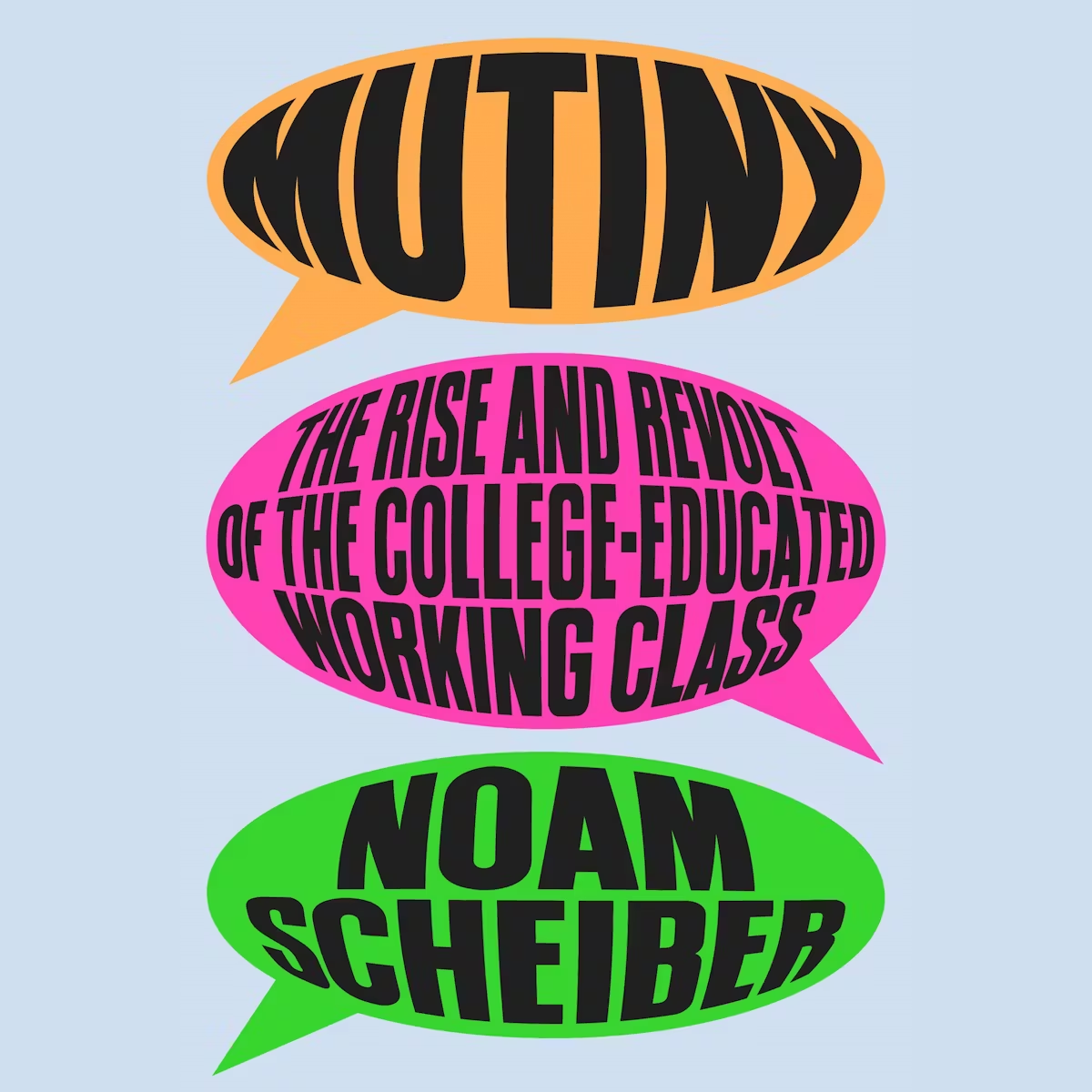
“This is a generation of people that was really given the hardest sell of any generation in history of why they need to go to college,” says Noam Scheiber, a New York Times labor reporter whose new book, Mutiny: The Rise and Revolt of the College-Educated Working Class, chronicles the revolt brewing inside America’s credentialed workforce. “Everyone, from their parents and family members to the president, Barack Obama and Bill Clinton—talking about how in the 21st century, everyone’s got to go to college … And unfortunately, all of this was happening at the precise moment when a college degree was becoming less valuable than it had been in many decades.”
Scheiber, who graduated in 1998 into what he calls “one of the best years in the history of the world to have graduated from college,” watched the shift unfold from the front row of the labor beat. He remembers a roaring job market, an explosion of startups, offers raining down on anyone with a diploma. The Great Recession of 2008 was the accelerant for what came next. Citing research from Berkeley economist Jesse Rothstein, who previously served as chief economist at the U.S. Department of Labor, Scheiber notes that employment growth for recent college graduates never returned to its pre-2008 trajectory, even on the eve of the pandemic in 2019. Then COVID hit, upending the board all over again.
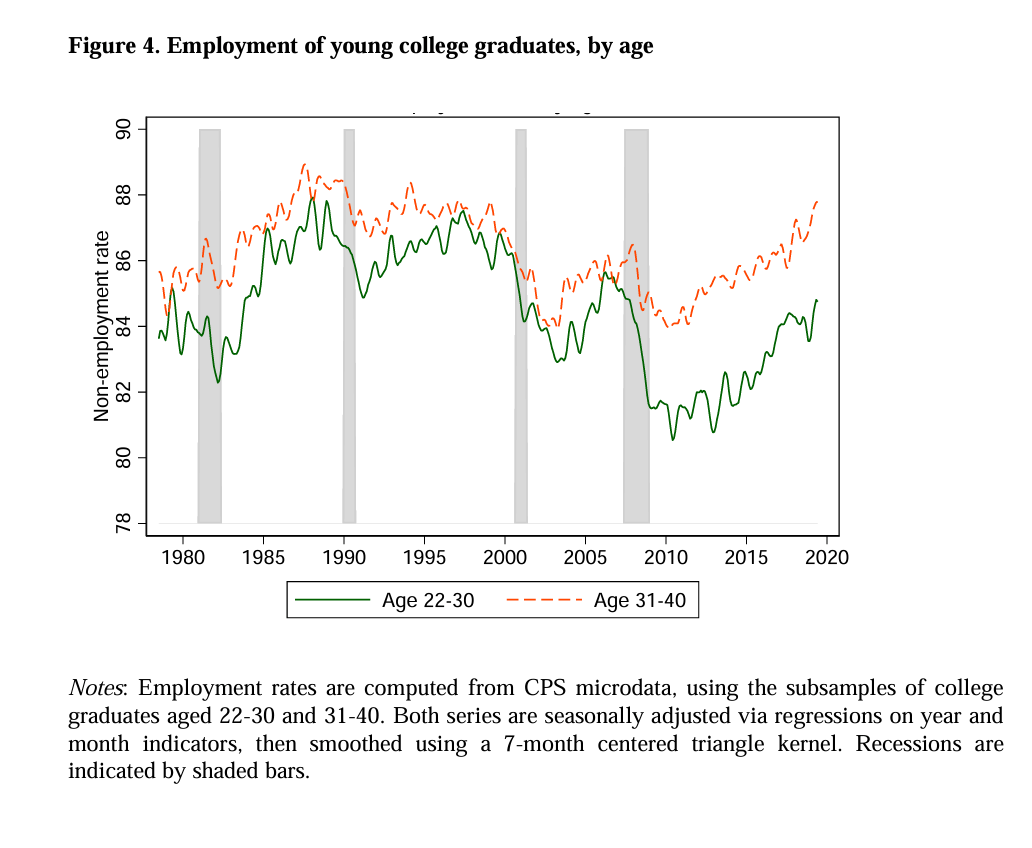
The data point that Scheiber returns to most is striking: The New York Federal Reserve has tracked the unemployment rate for recent college graduates since the late 1980s. For roughly three decades, it almost never exceeded the overall unemployment rate. Since 2022, it has stayed stubbornly above it.
“That’s just not something that we saw for 30 years before that,” Scheiber says. “It’s a pretty remarkable shift.”
As many students took out loans to pay for the soaring cost of tuition, they found themselves unable to get the high-paying jobs they needed to see a return on investment. Instead, they found themselves further in debt, living with their parents, and delaying milestones such as getting married or buying a house.
The frustration finds a channel
What filled that gap—between expectation and reality—was frustration. And frustration, it turned out, was organizing.
Starting with three Starbucks stores in Buffalo in the fall of 2021, Scheiber watched union elections spread at that company with exponential force. “I remember sort of January, February of ’22, it just kind of growing exponentially,” he says. “It was three, and then it was kind of five to 10, and then it was 20, and it just kept going up.” The movement jumped to Apple retail locations, Trader Joe’s, Amazon warehouses, and REI. As he talked to more and more of these workers, a pattern emerged that sharpened the cliché of the post-recession barista with a bachelor’s degree into something more urgent: a mass phenomenon. “So many of them had gone to college,” he says. “This union campaign was just catching fire.”
It wasn’t just retail. In the summer of 2023, autoworkers went on strike for six weeks. Actors and writers walked the picket lines in Hollywood. And something remarkable happened across industries and education levels: Gallup polling at the time showed 70% to 75% of the American public sided with the striking workers.
“The thing that I found really striking,” Scheiber says, “is I would talk to people in very different industries, very different professions. And they all were like, ‘Right on’—they were right there with the autoworkers, right there with the actors, right there with the writers.” He recalls a refrain from his sources that cut to the bone of a shifting identity: “I may be a doctor or I may be a tech worker, but I’m still a worker.”
That consciousness even reached the upper echelons of medicine. Scheiber reported on roughly 400 primary care doctors at Allina, a major Minnesota health care system, who unionized in 2023—the largest group of private-sector physicians to do so in modern memory. “The level of kind of worker consciousness that you would get among the doctors was just so striking,” he says. “They’re just like, ‘Yeah, I’m just a cog in this big machine.’” One of the doctors told him: “It doesn’t matter if you’re an autoworker or a doctor, how much prestige or education you have, you’re just treated the same by all these big companies.”
‘Downward mobility is incredibly radicalizing’
That sense of shared precarity, Scheiber argues, is reshaping identity in ways that will define American politics for years. A plurality of the early Starbucks organizers he spoke to had volunteered for Bernie Sanders. The support for socialism among college graduates under 35 is, in his telling, not a fringe phenomenon but a mainstream one. He points to figures like Alexandria Ocasio-Cortez—a Boston University graduate who worked in restaurants and as a bartender before her political career—as both exceptional and emblematic.
“Downward mobility is incredibly radicalizing,” he says. “If you either grew up upper middle class, and that’s no longer available to you, or you grew up with the promise of joining the upper middle class because you went to college like you were told to, and took out your loans. And now there’s no job that is available that enables you to come to the middle class. There are probably some more radicalizing forces in history, but not that many.”
He draws a line from the current moment to a broader historical pattern explored by political scientist Peter Turchin, whose work on the “overproduction of elites” has gained a wide audience. The theory: When societies produce too many highly educated people competing for too few positions of status and prosperity, the result is political instability. Musical chairs with a shrinking number of seats. Turchin told Fortune last July that he sees signs of his theory “everywhere you look” in modern American life. “Look at the overproduction of university degrees … There is overproduction of university degrees, and the value of [the] university degree actually declines.”
In a decade, Scheiber suggests, the shift in class self-identification may be nearly complete. “A large majority of people are just going to think of themselves as working class,” he says.

Yet he resists pure fatalism. The word he keeps returning to is “agency.” These college-educated workers, he argues, are formidable precisely because of what their education gave them—not a guaranteed career, but what one sociologist he quotes calls “class confidence,” the trained ability to figure things out, to navigate bureaucracies, to push for better terms. “Bad things happen to them, like happen to everybody,” Scheiber says, “but they don’t tend to take that lying down.”
‘Creative, brilliant people are going to wake up’
Paige Craig sees the same landscape from a radically different vantage point. The founder of Outlander VC grew up homeless until fifth grade, was recruited by West Point, served in military special operations, and now, from New York, invests in defense technology, robotics, and AI. He frames the coming disruption not as a slow unraveling but as a compression of history itself.
“The Industrial Revolution was a 100-year process,” Craig says. “The tech revolution was a 30-, 40-year process of going from paper to digital. We’re in an AI revolution that’s going to happen in 10 years. That’s the massive shift.”
At Outlander, Craig recently wrote a 10-year vision statement. Its fifth pillar stopped him cold as he drafted it: “We’re in a decade where we’re going to see the massive dislocation of creative talent,” he says. “Creative, brilliant people are going to wake up this decade and realize the jobs that they thought they were going to have—and the jobs they thought they could have—are gone.”
And yet Craig is not pessimistic about the long arc. He envisions what he calls a “second golden age”—an explosion of entrepreneurship, arts, and science born from the wreckage of displaced labor. He imagines millions of sole proprietors leveraging AI and robotics to build hyperlocal businesses that never would have been profitable before. He talks about limitless demand for health care, about turning displaced workers loose on Alzheimer’s research, ocean exploration, and the frontiers of the human body. He recently funded a startup in New York building $1,000 humanoid robots designed to be deployed by the millions—not the $100,000 prototypes that dominate headlines, but cheap enough to generate the training data that could make them truly useful.
“I hope that this freedom of labor and this massive productivity lead to this second golden age,” Craig says, “where we realize as societies that we can actually spend money on the arts, storytelling, and the creativity that makes humans blossom. Then the hard sciences where we push the boundaries of space travel and minerals and resources. That is where I think we go.”
But he does not minimize the turbulence of the transition. “It’s not that we have the blue-collar being dislocated,” he says. “It’s the most creative, educated, smart part of our society that in this decade is going to realize they don’t have jobs.”
The view from the eye of the storm
From his apartment on the Embarcadero in San Francisco—“right in the eye of the storm,” as he puts it—Sumir Chadha is watching the same wave approach from yet another angle. The cofounder and managing partner of WestBridge Capital, a $7 billion India-focused evergreen fund, Chadha splits his time between Bangalore and the Bay Area. He is measured by temperament, analytical by training (Princeton, Harvard, Goldman Sachs, McKinsey), and unusually candid about what keeps him up at night.
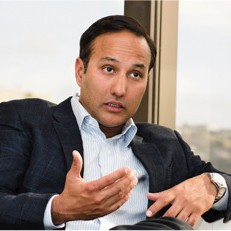
AI-powered coding tools, he says, have already devastated the SaaS sector—what analysts call the “SaaSpocalypse” or the “SaaSacre.” The productivity gains are not theoretical. “I had dinner with one of my entrepreneurs last night,” he says. “He’s talking about what Claude Code is doing to their software development. He said it’s not 10x, it’s like 100x better than what they had before.”
The human cost follows quickly. That same entrepreneur runs a 1,500-person company. He told Chadha that his 300-person implementation team could be reduced to 30 or 40 with AI. “They’re doing a layoff for about 300 engineers, man,” Chadha says. “Which is pretty sad.”
“I worry about the next three years,” he says plainly. “There’s going to be this tale of haves and have-nots that’s just going to thicken and create a lot of social tension.” He pauses. “I’ve taken some security measures at my house—things I never worried about.” He and his girlfriend have applied for European Union citizenship as a contingency. “I don’t think we’re ready for it.”
Pressed on whether he truly believes social unrest is possible in America, Chadha does not flinch. “I think there’s a 10%, 15% scenario that’s a little scary,” he says. “And I hope we don’t come to that. I’m not saying we will. But there’s some chance that it could get pretty tough in the next couple of years.”
He remains bullish on the technology itself and on India’s long-term trajectory. WestBridge has invested roughly $1 billion in eight or nine AI companies, nearly all of which are scaling rapidly. But he draws a sharp distinction between where wealth is being created and where pain will be felt first. “The U.S.—we are such an amazing, dynamic economy. Things move faster here than Europe, faster than India, faster than anywhere,” he says. “I think we’re kind of the front line of everything.”
The speed of the clock
All three men—a labor journalist, a defense-world venture capitalist, a globalist fund manager—are converging on the same conclusion from radically different vantage points: that AI is not the origin of this story, only its most dramatic chapter. The college bargain that a generation of Americans was sold (borrow money, earn a degree, join the middle class) has been quietly unraveling for 20 years. What’s coming next may simply be the part that everyone finally notices.
“We haven’t really seen the labor market impacts of AI yet,” Scheiber says. “A little bit in fields like software development, but beyond that, we haven’t really seen it. So it does feel like we may only be at the beginning of it.”
There is a question of tempo. Scheiber is skeptical of forecasts projecting mass white-collar displacement in 18 months. Large organizations, he notes, are deeply bureaucratic; inertia is a powerful force. “Even if theoretically you could replace 95% of your junior consultants in a year and a half, you’re not going to do that,” he says. His gut tells him the disruption will play out over a decade, not a quarter.
But even on a slower clock, the political consequences compound. “Even if we see the unemployment rate for recent college grads tick up a few tenths of a percentage point every year for five years,” he says, “that’s gonna be pretty destabilizing.”
Craig agrees and frames the challenge in terms of historical analogy. Past technological revolutions allowed generations to absorb the shock. This one compresses a century of change into a decade. “It used to be, you could mark change with graveyards,” he says. “But the scope of change and the speed of change is so massive now. That’s the crazy part. My kids and their kids, we’re all going to be together in the middle of this crazy shift.”
Chadha puts it most succinctly: The human and political systems built to absorb disruption were designed for a slower clock.
The question now—for policymakers, employers, investors, and the generation caught in the middle—is whether anyone can build new institutions fast enough to keep up with the machines.