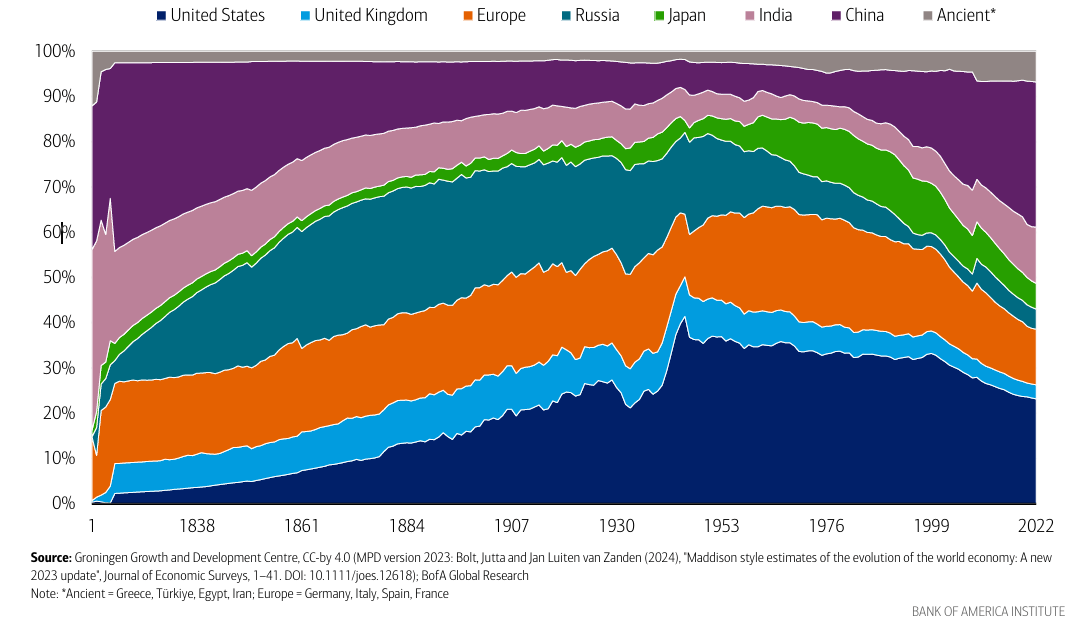
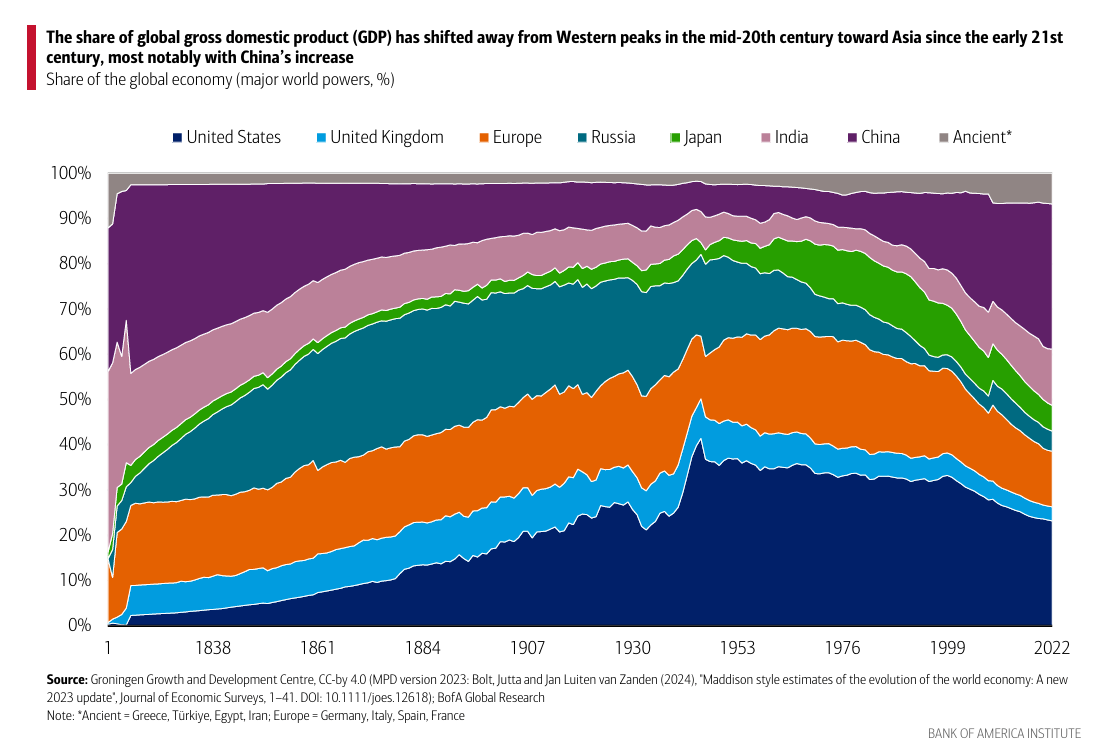
For roughly 1,800 years, the world’s largest economy sat somewhere along the Yangtze River. A new chart from the Bank of America Institute — spanning 2,000 years of global GDP data — shows that America’s moment at the top wasn’t destiny. It was an accident of history. And it’s ending.
The United States emerged from World War II as the undisputed economic superpower, accounting for nearly a third of global GDP at its postwar peak. Prophetically, in 1941, Fortune founder Henry Luce dubbed this era “the American century.”
The U.S. spent the better part of the 20th century treating its position at the top of the economic order as something close to a birthright. “American exceptionalism,” the idea that the country was fundamentally distinct from — and often superior to — other nations due to its unique founding principles, political institutions, historical development, and perceived moral mission in the world, dates back to the precolonial days and John Winthrop’s 1630 articulation of the country as a “city upon a hill.”
But in economic terms, America’s exceptional share of global GDP was a very real thing from the 1860s through the 1950s, as calculated by the Bank of America Institute, citing thousands of years of data from the Groningen Growth and Development Centre‘s Maddison Project database, one of the most comprehensive long-run economic datasets in existence.
This is a bit standard for the Dutch research center and its database based on the ideas of Angus Maddison, a pioneering economist who tracked GDP and living standards across centuries and countries, but if you look at the blue chunk of the chart, showing the U.S. shooting up over the centuries, you’d be forgiven for seeing the U.S. as quite exceptional.
The chart also shows, however, that there’s always been one other exceptional country. The chart plots the share of global GDP held by the world’s major powers from the year 1 AD through 2022. What it shows is both humbling and, for anyone paying attention to the current global moment, entirely unsurprising: the world’s economic center of gravity is shifting back toward where it spent most of recorded history. Back toward Asia. Back toward China.
The long view
The chart’s most striking feature is not a line going up. It’s a line going down — and then, slowly, back up again.
For roughly the first 1,800 years of the Common Era, China and India together accounted for the dominant share of global economic output. The world was, by this measure, an Asian world. The chart supports the narrative in the epic global history of capitalism written by Harvard’s Sven Beckert, who told Fortune in January that his eight years of studying capitalism’s origins reinforced to him how “weak” and “marginal,” yet also truly global, the dominant way of organizing economic life used to be.
Beckert’s book highlights how ancient mercantile communities of capitalists emerged in the Middle East and Asia, for instance, with the Port of Aden, in Yemen, or Cambay, in modern Gujarat, India. Goods left Aden and traded across oceans as early as 1150, and Song-dynasty China invented paper money hundreds of years before Europe did.
When Europe Rose, and America Peaked
The Groningen data show clearly that Europe’s rise — led by the UK, Germany, Italy, France, and Spain — was a 19th-century phenomenon. The United States didn’t register meaningfully on the chart until the late 1800s, and didn’t achieve its peak dominance until the mid-20th century.
That peak, visible as a bulging arc of American blue across the chart, coincided with a historically anomalous moment: a Europe devastated by two world wars, a China wracked by civil war and Maoist catastrophe, and an India still emerging from colonialism. In other words, the era of American exceptionalism was also, in large part, the era of everyone else’s misfortune.
“These transitions often followed major geopolitical or financial turning points,” BofA Institute noted in its report — a line that, in retrospect, reads less like historical observation and more like a warning.
Meanwhile, over the weekend, Bridgewater founder Ray Dalio wrote in Fortune that the 2020s feel to him like a movie he’s seen before, with “the rise of a new type of world order” that he sees as “more like many pre-1945 world orders in which there were great powers conflicts and gunboat diplomacy-type geopolitical moves.”
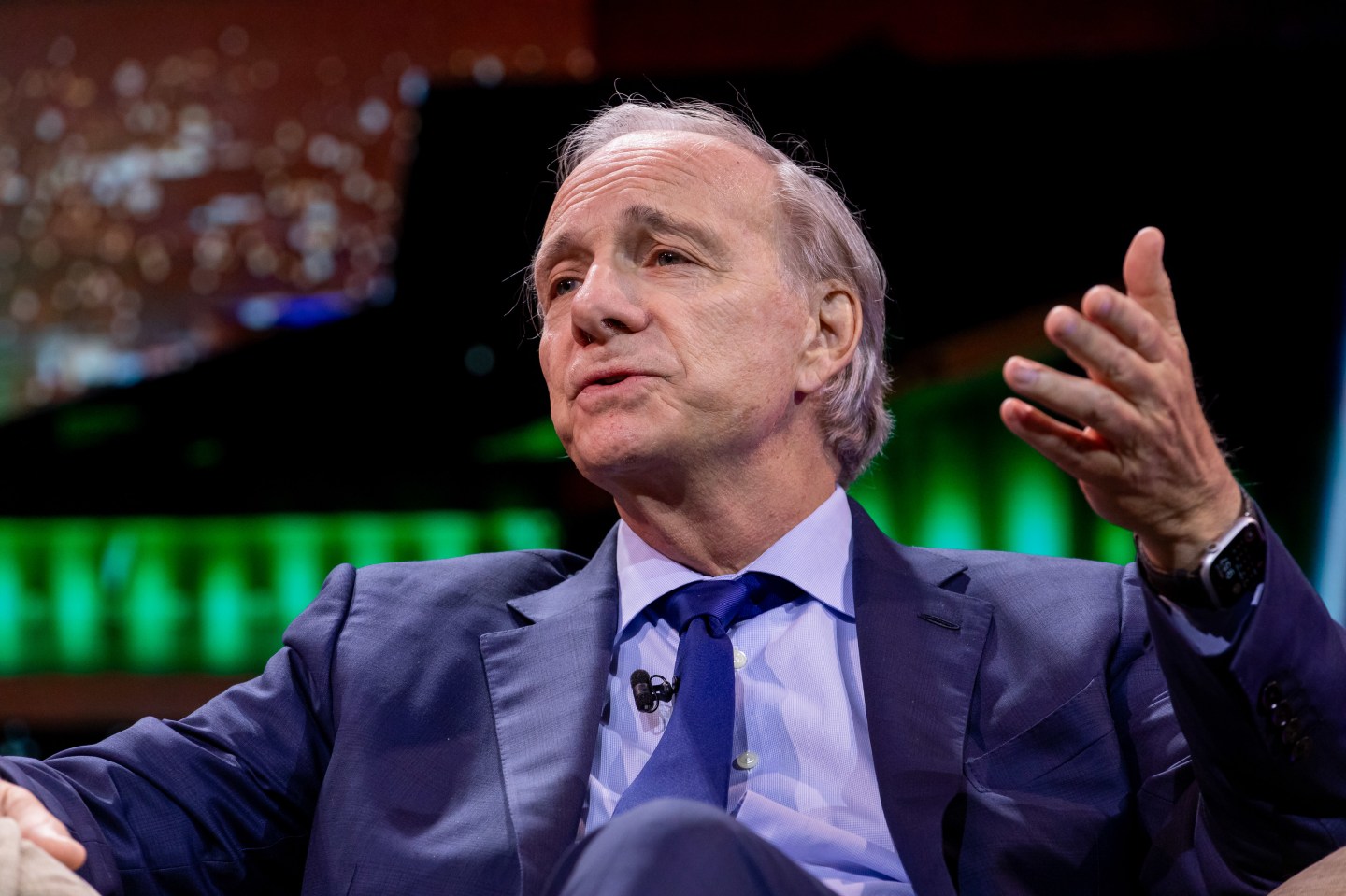
Dalio’s Principles for Dealing With the Changing World Order described his theory of six cycles of successive breakdowns in financial cycles, with stage six being “a period of great disorder.” The last of these began in 1929 and ended in 1945 after World War II, he wrote, resulting in “clear winners, most importantly the United States, which determined how the new orders would work.”
What is implied, of course, is that the winners of this current period will determine how the next world order will work and who will benefit.
China’s correction
China’s share of the global economy — which had collapsed to negligible levels by the mid-20th century — surged back in the early 21st century, more dramatically than that of any other nation on the chart. By 2024, China accounted for roughly 19.45% of global GDP, nearly triple its share in the year 2000, according to Statista. By 2030, the same data projects China’s share will reach 21.7%.
China’s economy grew 5.0% in 2025, meeting the government’s official target and seizing a record share of global demand through an export boom. Meanwhile, Beijing’s newly unveiled 15th Five-Year Plan (2026–2030) is explicitly targeting the integration of artificial intelligence into the country’s manufacturing base — betting that the same factory floor dominance that powered China’s rise in global trade will now power its rise in the AI economy. China wants its digital economy to account for 12.5% of GDP by 2030, up from 10.5% in 2025. The plan includes dozens of major infrastructure and industrial projects, national 5G upgrades, and a push to build sovereign AI compute capacity.
The exceptionalism trade falters
For the United States, the picture is more complicated. By nominal GDP, America remains the world’s largest economy — $30 trillion in 2024, with financial markets valued at $79 trillion. Goldman Sachs and JPMorgan have argued that U.S. dominance is structural and durable, citing America’s role as the world’s most innovative, diverse, and resilient economy.
But the markets told a different story in early 2025. As the so-called “American exceptionalism trade” began to unravel into the “sell America trade,” the war in Iran paradoxically boosted U.S. assets. Still, the S&P 500 is down roughly 2.5% year-to-date, while the broader MSCI Global Index is up 0.8% and the dollar is up 1.76% year-to-date.
The structural pressures are real. U.S. GDP per capita — still above $85,000, compared to China’s $13,000 — reflects a prosperity gap that will take decades to close. But per capita GDP is not the same as geopolitical weight. China’s economy grows at 5.2% per year, while America expands at around 2.1%. At those trajectories, the gap in total economic mass narrows every year.
What the chart really says
The BofA Institute’s report frames today’s shifts as part of a familiar pattern: “renewed focus on affordability, rapid advances in AI, and a broader shift from services back toward manufacturing”. Those three forces — cost deflation, AI disruption, and the reindustrialization of the global economy — all tilt, at least at the margin, toward China’s strengths rather than America’s.
What the chart ultimately shows is not that American exceptionalism was a myth. It’s that it was a moment — a historically contingent window, opened by catastrophe elsewhere and now gradually closing as the rest of the world heals, industrializes, and competes. For 2,000 years before the American century, the world’s largest economy sat somewhere along the Yangtze River. The line on the chart that shows China’s share plummeting to near-zero and now racing back upward is not a story about China catching up.
It’s a story about the world returning to normal.