It may not be a problem just yet, but this Washington state lawmaker is making sure your boss can’t make you get a microchip—unless, of course, you want to.
After reading about how Wisconsin became the first state in the country to pass a similar law in 2006, Washington Rep. Brianna Thomas introduced a bill last month to prevent any future employer from requiring its workers to get ‘chipped for the job.
“I actually read an article about the Arkansas bill, and the idea of bodily autonomy being something that we are ensconcing in law kind of just stuck with me,” Thomas told Fortune. “We see it in a bunch of different avenues, like gender affirming care, reproductive justice—but technology just is the next new battlefield for losing charge of what goes on inside of you.”
Now, two decades after first bill passed, Thomas’ bill would make Washington the 14th state in the country to implement a similar ban. The bill, which passed the state’s Senate unanimously and received a vote of 87 to 6 in the House, now is sitting at Gov. Bob Ferguson’s desk waiting for his signature.
“I understand that the underlying policy might sound a little bit like science fiction, but we’ve all learned in this chamber that science moves fast,” she said. The bill’s preamble underscores the philosophy, stating “employers should compete for talent through wages, benefits, and working conditions—not through invasive monitoring technologies.”
No chip on one’s shoulder
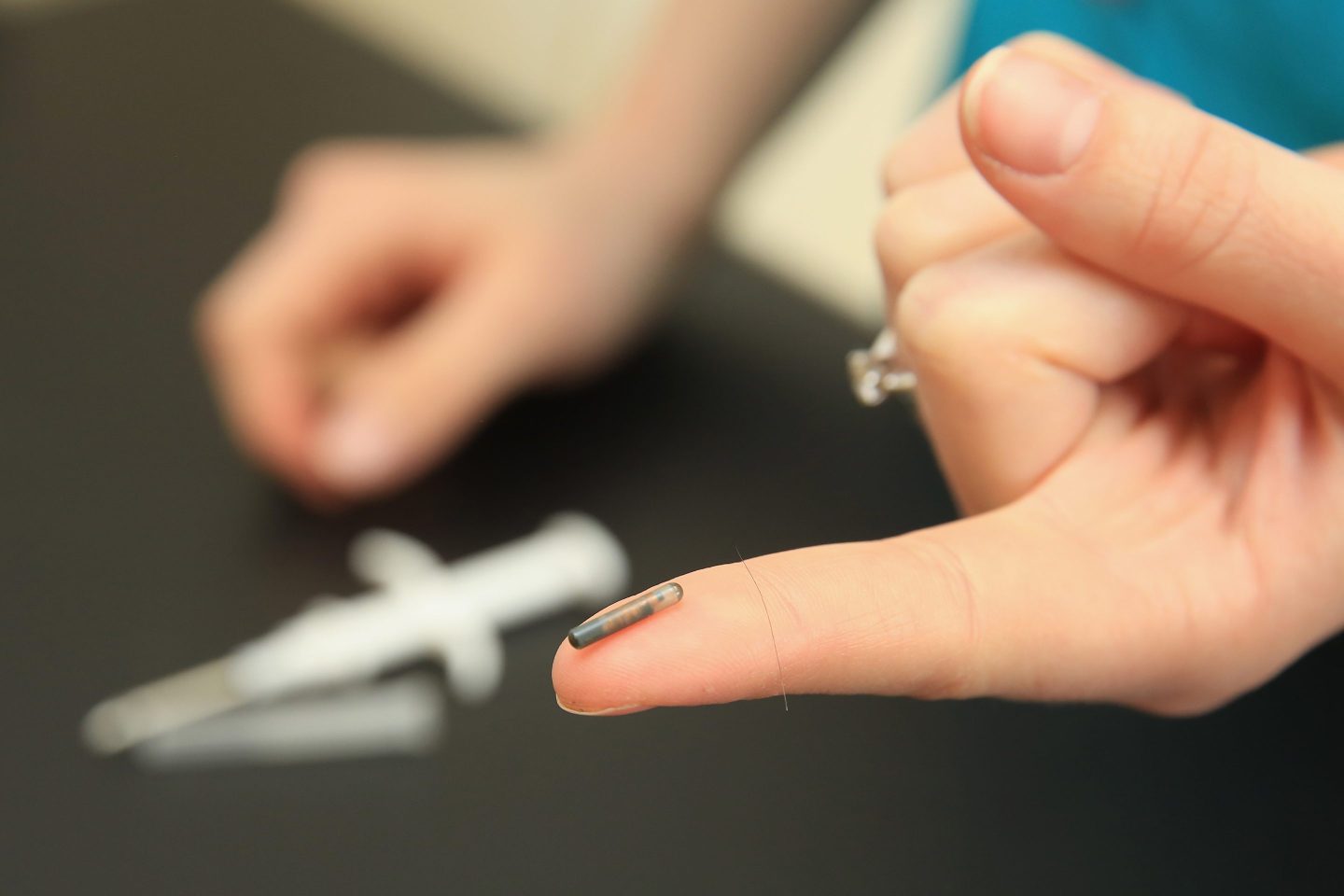
If signed into law, Washington would ban employers from requiring workers to be implanted with subcutaneous tracking chips. The bill, HB 2303, targets any device implanted beneath the skin that contains identification numbers or personal information retrievable by external scanners, exempting any medical devices for diagnosis, monitoring, or treatment. The other 13 states with such laws are Alabama, Arkansas, California, Indiana, Mississippi, Missouri, Montana, Nevada, New Hampshire, North Dakota, Oklahoma, Utah, and Wisconsin.
The legislation comes with clear precedent for why preemption matters. In 2017, Wisconsin-based tech company Three Square Market became one of the first U.S. employers to offer rice-sized microchip implants to employees, allowing workers to open doors, log into computers, and use the office vending machine—all on a voluntary basis. That same year, Swedish firm Biohax had already installed approximately 4,000 similar chips, which could store contact information and electronic tickets. No American company currently requires microchipping, but Thomas argued that waiting for one to try is precisely the wrong approach.
“This is a thoroughly preemptive strike, but we are in a very tech savvy and tech forward community, so I figured if it showed up anywhere, it was likely to be right here at home,” said Thomas, who has a background in labor standards and previously worked for the city of Seattle.
To be clear, the bill does not ban all microchipping outright—employees who voluntarily choose an implant on their own may still do so, just how employees the employees in Wisconsin were able to volunteer to get chipped despite the law in effect banning any workplace from requiring it. Thomas drew a deliberate line between personal choice and employer-driven use.
“I get the practicality of moving through work and making it more efficient—opening doors, using copiers, vending machines,” she said. “I just wanted to protect what happens inside people’s bodies as it pertains to their workplace. Now, if you are interested in turning yourself into a ‘Six of Nine,’ go for it—but that should be something you do on your own time,” she said, making a playful reference to the Star Trek cyborg character Seven of Nine.
She also flagged surveillance concerns that stretch far beyond the office: “I had concerns about what that sort of access to information could mean as you move through your daily life—where you grocery shop, where you go to church, how long you’re at your best friend’s house on a Friday night. None of that should be information that your employer has access to.”
The problem with calling it a choice
Privacy experts largely praised the legislation for getting ahead of the technology rather than scrambling after it. Jessica Vitak, an information science researcher, said the bill reflects a refreshing shift in how lawmakers approach emerging tech. “What I like about the bill so much is that it is being more proactive rather than reactive,” she told Fortune.
“Something like microchipping probably seems fairly innocuous, but it’s a part of the slippery slope of surveillance that we don’t necessarily know the future ways in which it could be problematic,” Vitak, a professor at the University of Maryland’s College of Information who studies workplace privacy and surveillance, added.
Vitak said asking workers to accept a tracking device beneath their skin “is both excessive and potentially reinforcing concerns we already have around the way that surveillance is targeting certain groups more than others, and that the benefits and drawbacks of surveillance are unequally distributed.”
Michael Zimmer, a privacy and data ethics scholar at Marquette University, echoed those concerns.
“One of the biggest concerns is that it’s hard for us to predict how these technologies might advance,” he said. “Companies who deploy these kinds of tools might very easily, next month or next year, change their plans for how they’re trying to utilize them.”
He was equally direct about the power imbalance: “An employer requiring employees to do it is drawing a line—that’s putting an unfair burden on employees to allow themselves to be tracked, and it’s invasive and privacy threatening.”
On the question of voluntariness, Zimmer cautioned that “optional” rarely means what it appears to on paper: “Any workplace situation already has a power dynamic at play. If your employer strongly encourages it or creates financial incentives to do something like this, there certainly could be pressure—yes, it’s voluntary, but is my job in jeopardy if I don’t?”
The two scholars both referenced Amazon, headquartered in Seattle, as a company that has not gone as far as chipping employees, but has implemented other measures in its warehouse. The company patented a wrist bracelet in 2017 designed to nudge warehouse workers to move their hands in specific directions to maximize efficiency—a device that falls outside the scope of Washington’s bill since it sits above, not under, the skin. But Vitak said the distinction does little to ease her concerns.
“Amazon warehouse workers are like the perfect case study for crazy amounts of physical surveillance,” she said. “Sure, a bracelet would be less invasive, but my concerns still hold—can the employee have any agency to choose to not be monitored in that way?”
She pointed to what she called an even more telling precedent: During the pandemic in 2020, Amazon deployed sensors in its warehouses that triggered an alarm whenever workers came within six feet of each other.
“That’s like an external thing, warning everybody, and the purpose was out of health concerns,” Vitak said. “But if you need to wear something that is going to ensure you’re moving your body in such a way to maximize efficiency—what if I have a torn rotator, and the way I move my arm differently is because that’s how I do it with less pain? Am I going to get fired because I’m doing something suboptimal in terms of efficiency?”
Zimmer echoed those concerns: “Amazon’s a good example, because they’re so focused on efficiency of their employees—any way they can squeeze additional efficiencies helps their bottom line, and this kind of tracking would only really fit that kind of goal,” he said. “One of the biggest concerns is that it’s hard for us to predict how these technologies might advance.”
The first rule of microchipping is not talking about microchipping
The bill drew no opposition during committee hearings in either chamber. But not every lawmaker was convinced it was necessary—at least not yet. Rep. Joel McEntire questioned whether lawmakers were solving a problem that doesn’t exist.
“It’s not a problem today—any companies trying to microchip employees. Who the heck knows what the future holds?” he told Fortune. “Until this technology becomes standard practice, who knows what happens.”
McEntire’s primary objection centered on a provision restricting management-initiated conversations about microchipping in the workplace.
“The bill doesn’t just prohibit microchipping but prohibits discussions by management or employees,” he said. “I thought it was an overreaction to something that hasn’t happened yet. There is no injury, no case, no negative backlash that I can see—but there might be in the future.”
Thomas pushed back directly, arguing the speech restriction is essential to preventing coercion.
“There’s nothing in the bill that prevents employees from initiating a discussion,” she said. “But I come from a labor standards background, and I understand that leaving the door open to a conversation that’s initiated by your employer also leaves the door open to coercion.”
“Again, if you as an individual want to bring up the topic, this law doesn’t prohibit that,” she added. “But it does prohibit your boss from starting the conversation about turning you into machinery.”
Amazon and Microsoft declined Fortune‘s request for comment. Other Washington-based companies such as Costco, Starbucks, and Boeing did not respond to requests for comment.