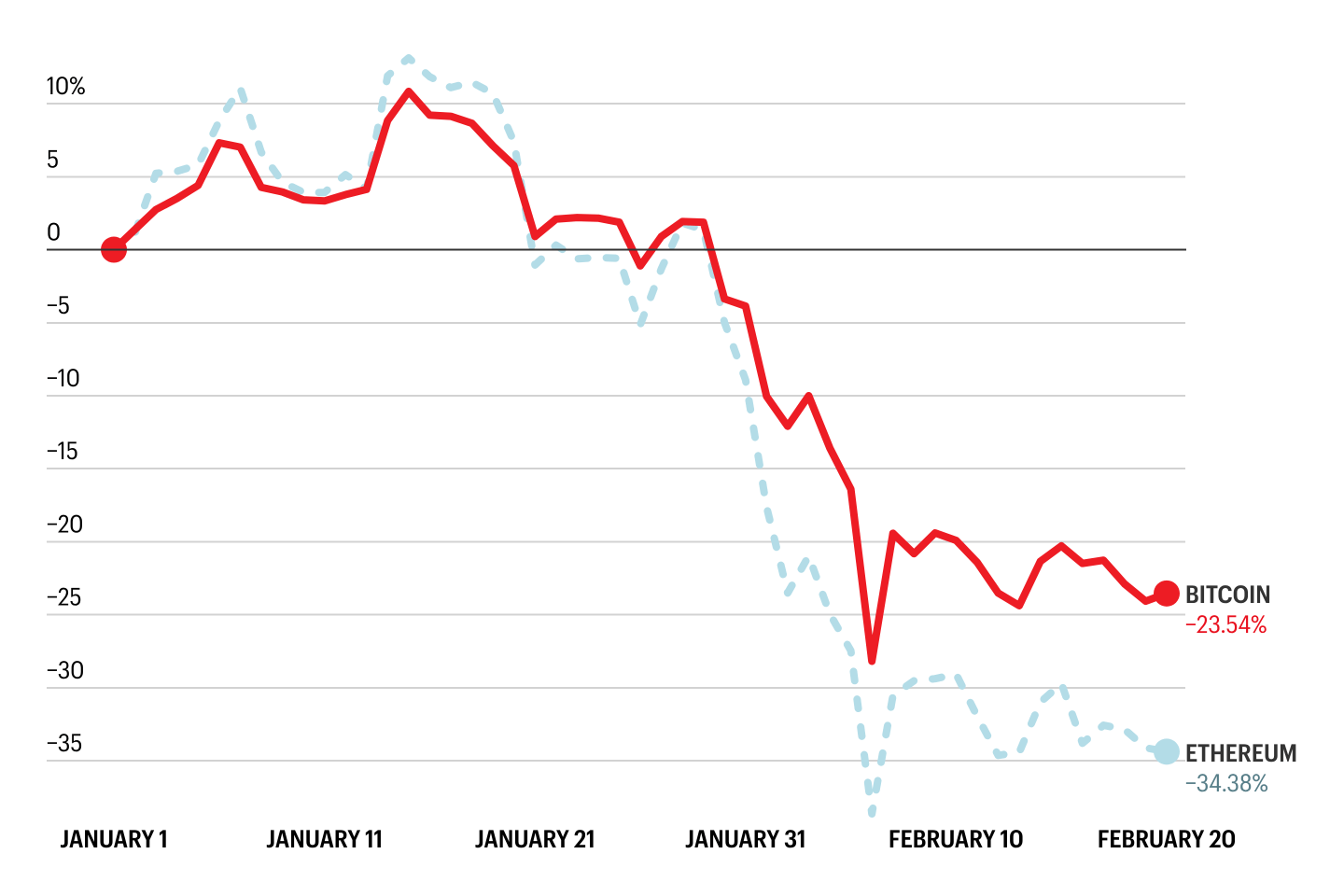
Despite notching modest gains on Friday, the world’s two largest cryptocurrencies are having historically bad starts to the year. Bitcoin is down almost 24% from Jan. 1 to now around $67,000, and Ethereum has also tanked about 34% to about $2,000. Those are the worst year-to-date performances on record, according to Fortune’s analysis of CoinGecko’s public data, which dates back to mid-2013 for Bitcoin and mid-2014 for Ethereum.
Although cryptocurrencies’ price moves have often tracked the broader equities market, the two asset classes have diverged over the past two months. Since January, the stock market has nudged upward. The S&P 500 is up about 0.4%, and the Dow Jones has risen 2.3%. And even metals, which recorded a sudden drop almost three weeks ago, are also performing well. Gold has rocketed about 17% to start the new year and silver has jumped about 14%.
The divergence of the crypto market from broader economic gains has led many to proclaim that the industry has entered a new “Crypto Winter”—even though Bitcoin had notched all-time highs just four months ago.
“We’re certainly in a Crypto Winter,” said Danny Nelson, a research analyst at the crypto asset manager Bitwise. “You can tell by how investors react to good news. (They don’t.)”
Downturns and losses
The year-to-date plummets in Bitcoin and Ethereum’s prices follow what’s since been dubbed a “flash crash” on Oct. 10, where traders saw more than $19 billion in leverage evaporate after President Donald Trump issued another set of tariff threats against China. The one-day implosion in the crypto markets was the worst liquidation event ever tracked by the crypto analytics firm Coinglass.
The industry has since struggled. Bitcoin is down more than 46% since early October. Crypto exchanges like Coinbase and Gemini reported poor results for their fourth quarters. And some traders are deep in the red. BlockFills, a crypto lender and hedge fund, suspended customer withdrawals earlier in February. The firm is now looking for a buyer and has losses of more than $75 million, according to CoinDesk.
A spokesperson for BlockFills declined to comment.
The monthslong decline has many in crypto confused. Previous bear markets followed explicit collapses, like the fall of FTX in November 2022. There’s been no obvious catalyst for the recent downturn, especially as the crypto industry enjoys unprecedented acceptance among U.S. regulators and Wall Street leans further into the asset class.
That’s given some analysts hope. “Crypto’s reality is getting stronger,” said Nelson, the research analyst at Bitwise. “These changes are going to last well beyond the current downturn.”
His comments echo Tom Lee, cofounder of the analysis firm Fundstrat and noted Ethereum booster, who said in a recent interview that, “We’re really close to the end.”