• Home
  • Latest
  • Fortune 500
  • Finance
  • Tech
  • Leadership
  • Lifestyle
  • Rankings
  • Multimedia
EconomyEconomics

America faces a ‘debt crisis’ a lot like the 1980s when a ‘private pact’ brokered by Ronald Reagan did the trick

By
Tristan Bove
Tristan Bove
Contributing Reporter
Down Arrow Button Icon
By
Tristan Bove
Tristan Bove
Contributing Reporter
Down Arrow Button Icon
February 19, 2026, 12:15 PM ET
reagan
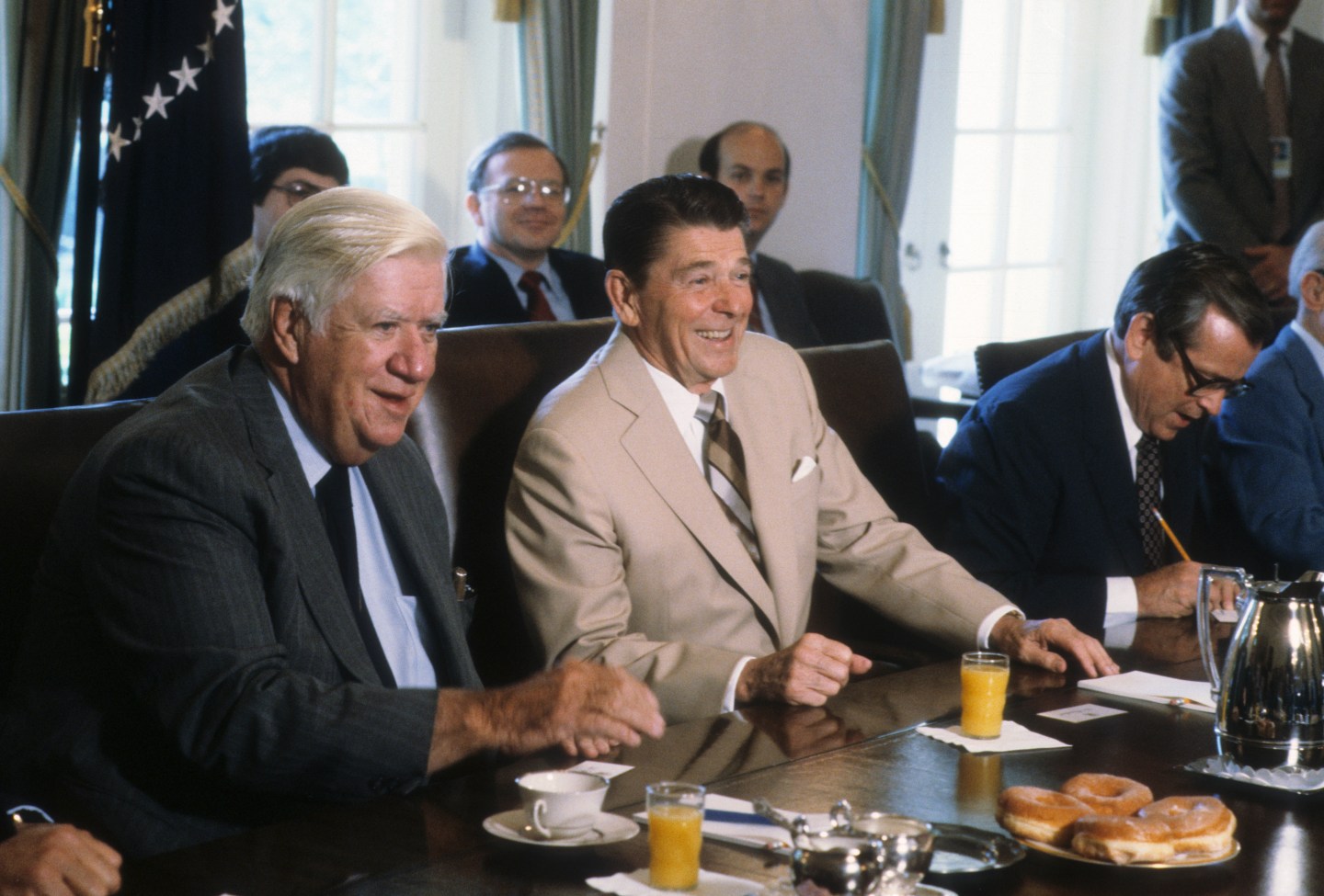
Speaker of the House Tip O’Neill, President Ronald Reagan, and Sen. Howard Baker in June 1982. David Hume Kennerly—Getty Images

The U.S. is perched on a treacherous fiscal ledge. The national debt held by the public has surged past $38 trillion, around 101% of GDP, and is expected to balloon to 120% a decade from now. The country has successfully sidestepped fiscal meltdowns before, but whether the current generation of leaders has the political will to dig itself out of its fiscal hole is up for debate.

Recommended Video

While national debt was once made out to be a long-term issue, not necessarily as urgent as maintaining certain types of spending, it is no longer a distant threat. Earlier this month, the nonpartisan Congressional Budget Office published a sobering outlook for the country’s fiscal future. In addition to rising debt, the inflated interest that the U.S. will have to pay annually risks crowding out essential government spending elsewhere, including for Social Security, which could be left penniless within a few years. 

“The debt crisis is already here. If left unaddressed, it will only continue to worsen,” researchers wrote in a report published this week by the Committee for Economic Development (CED), a public policy think tank associated with the Conference Board.

That report laid out the increasingly high stakes the nation is facing from its overindulgent borrowing, including risks of crowded-out spending, the diminishment of the dollar’s status as a global reserve currency, and persistently high interest rates that will inhibit long-term economic growth. But as the report noted, the U.S. has been in similar messes before, and history offers a helpful blueprint for what the country could do to navigate the current crisis.

Greenspan’s heroes

In the early 1980s, the United States faced a similar emergency when the trust fund that supports Social Security neared insolvency, a situation where benefits would have been automatically slashed once funds were depleted. At the time, Social Security running out was recognized as an “impending crisis,” according to the CED report. A similar urgency faces the trust fund now, as the CBO’s latest projections estimate Social Security might be insolvent as soon as October 2031. 

In 1981, to save the trust fund, President Ronald Reagan appointed a 15-member bipartisan body, known formally as the National Commission on Social Security Reform but remembered by history as the Greenspan Commission, named after its chair: future Federal Reserve boss Alan Greenspan. Composed of lawmakers, outside experts, and business leaders, the commission was tasked with finding a way to save the program from collapse.

The Greenspan Commission initially deadlocked after a year of intense deliberation, missing its original deadline as Republican members protested proposed tax increases and Democrats did the same for recommended benefit cuts. But a “spirit of collaboration,” mostly arranged through behind-the-scenes handshakes and agreements, eventually broke through the impasse, according to the CED’s report. A small subgroup of senators and White House staff engaged in proxy negotiations that eventually bridged the partisan divide. 

Central to this success was a “private pact” between Reagan and Tip O’Neill, the Democrat house speaker at the time, in which both leaders agreed not to publicly oppose the commission’s recommendations. This agreement provided the necessary political cover for lawmakers to support difficult changes to revenue and benefits. Furthermore, an informal rule in the Senate dictated that any senator opposing a recommendation had to propose their own alternative solution, effectively separating the reforms from standard partisan debate. These 1983 amendments extended Social Security’s balance by decades and remain the last major reform of the program.

The CED report called for a modern iteration of such a bipartisan commission, calling it a “promising solution that could break the political impasse” once again. Such a commission would provide a venue for lawmakers to focus on long-term sustainability and take the “difficult votes necessary to reset our fiscal trajectory.” By including cochairs from both parties and requiring a bipartisan majority for approval, a commission could lend more credibility to essential reforms, the report argued.

Bipartisanship was key to the 1983 amendments, as Greenspan himself called the private agreement between Reagan and O’Neill the “single most important factor” leading to the success of the reforms. But that spirit of collaboration might be much harder to forge today, and a body tasked with saving Social Security before 2031 would face significant challenges that the commission of the early ‘80s did not. 

Working in a ‘broken’ system

Establishing such a commission today would risk replicating the unsuccessful efforts of the 2010 Simpson-Bowles Commission, the report warned. Established by executive order by President Barack Obama to tackle rising national debt, the bipartisan commission failed in part because it lacked complete support from both parties and because it did not have power to force a vote in Congress. The result was a relatively weak legislative impact and a rapid quieting of bipartisan political support.

The CED report referred to the current budget process as “broken,” owing to the erosion of Congress’s constitutional power of the purse and rising partisan alignment that makes it more difficult for lawmakers to cast votes that would complicate their party’s platform. With the legislature operating at historically high levels of polarization and partisanship, and only a minority of the American public trusting congressional Democrats and Republicans to cooperate, even a successful rerun of Greenspan’s commission might not be able to overcome the political hurdles that would now surround it.

“For a bipartisan fiscal commission to be successful, there must be sufficient political will, strong leadership, and a spirit of collaboration,” the report’s authors wrote. “Commissions provide structure for negotiations and legislative procedures for enactment, but by themselves, they cannot produce the political will for reform.”


The Fortune 500 Innovation Forum will convene Fortune 500 executives, U.S. policy officials, top founders, and thought leaders to help define what’s next for the American economy, Nov. 16-17 in Detroit. Apply here.
About the Author
By Tristan BoveContributing Reporter
LinkedIn iconTwitter icon
See full bioRight Arrow Button Icon

Latest in Economy

Finance
Lorem ipsum dolor sit amet, consectetur adipiscing elit, sed do eiusmod tempor incididunt ut labore et dolore magna aliqua. Ut enim ad minim veniam
By Fortune Editors
October 20, 2025
Finance
Lorem ipsum dolor sit amet, consectetur adipiscing elit, sed do eiusmod tempor incididunt ut labore et dolore magna aliqua. Ut enim ad minim veniam
By Fortune Editors
October 20, 2025
Finance
Lorem ipsum dolor sit amet, consectetur adipiscing elit, sed do eiusmod tempor incididunt ut labore et dolore magna aliqua. Ut enim ad minim veniam
By Fortune Editors
October 20, 2025
Finance
Lorem ipsum dolor sit amet, consectetur adipiscing elit, sed do eiusmod tempor incididunt ut labore et dolore magna aliqua. Ut enim ad minim veniam
By Fortune Editors
October 20, 2025
Finance
Lorem ipsum dolor sit amet, consectetur adipiscing elit, sed do eiusmod tempor incididunt ut labore et dolore magna aliqua. Ut enim ad minim veniam
By Fortune Editors
October 20, 2025
Finance
Lorem ipsum dolor sit amet, consectetur adipiscing elit, sed do eiusmod tempor incididunt ut labore et dolore magna aliqua. Ut enim ad minim veniam
By Fortune Editors
October 20, 2025

Most Popular

Finance
Lorem ipsum dolor sit amet, consectetur adipiscing elit, sed do eiusmod tempor incididunt ut labore et dolore magna aliqua. Ut enim ad minim veniam
By Fortune Editors
October 20, 2025
Finance
Lorem ipsum dolor sit amet, consectetur adipiscing elit, sed do eiusmod tempor incididunt ut labore et dolore magna aliqua. Ut enim ad minim veniam
By Fortune Editors
October 20, 2025
Finance
Lorem ipsum dolor sit amet, consectetur adipiscing elit, sed do eiusmod tempor incididunt ut labore et dolore magna aliqua. Ut enim ad minim veniam
By Fortune Editors
October 20, 2025
Finance
Lorem ipsum dolor sit amet, consectetur adipiscing elit, sed do eiusmod tempor incididunt ut labore et dolore magna aliqua. Ut enim ad minim veniam
By Fortune Editors
October 20, 2025
Finance
Lorem ipsum dolor sit amet, consectetur adipiscing elit, sed do eiusmod tempor incididunt ut labore et dolore magna aliqua. Ut enim ad minim veniam
By Fortune Editors
October 20, 2025
Finance
Lorem ipsum dolor sit amet, consectetur adipiscing elit, sed do eiusmod tempor incididunt ut labore et dolore magna aliqua. Ut enim ad minim veniam
By Fortune Editors
October 20, 2025
Fortune Secondary Logo
Rankings
  • 100 Best Companies
  • Fortune 500
  • Global 500
  • Fortune 500 Europe
  • Most Powerful Women
  • Future 50
  • World’s Most Admired Companies
  • See All Rankings
Sections
  • Finance
  • Fortune Crypto
  • Features
  • Leadership
  • Health
  • Commentary
  • Success
  • Retail
  • Mpw
  • Tech
  • Lifestyle
  • CEO Initiative
  • Asia
  • Politics
  • Conferences
  • Europe
  • Newsletters
  • Personal Finance
  • Environment
  • Magazine
  • Education
Customer Support
  • Frequently Asked Questions
  • Customer Service Portal
  • Privacy Policy
  • Terms Of Use
  • Single Issues For Purchase
  • International Print
Commercial Services
  • Advertising
  • Fortune Brand Studio
  • Fortune Analytics
  • Fortune Conferences
  • Business Development
  • Group Subscriptions
About Us
  • About Us
  • Editorial Calendar
  • Press Center
  • Work At Fortune
  • Diversity And Inclusion
  • Terms And Conditions
  • Site Map
Fortune Secondary Logo
  • About Us
  • Editorial Calendar
  • Press Center
  • Work At Fortune
  • Diversity And Inclusion
  • Terms And Conditions
  • Site Map
  • Facebook icon
  • Twitter icon
  • LinkedIn icon
  • Instagram icon
  • Pinterest icon

Latest in Economy

gas prices
EnergyIran
Top economist says Iran war could trigger an economic ‘butterfly effect’—and keep inflation elevated for years
By Jake AngeloMarch 11, 2026
2 hours ago
barrel
EnergyOil
Plastics, fertilizers, clothing, medicines and electronics: $100-a-barrel oil has huge downstream consequences
By André O. Hudson and The ConversationMarch 11, 2026
2 hours ago
U.S. President Donald Trump speaks to the Republican Members Issues Conference at Trump National Doral Miami on March 9, 2026 in Doral, Florida.
EconomyIncome inequality
It’s thanks to Social Security wealth inequality isn’t even worse, Wharton economist says. Trump’s policies will push it to insolvency in 6 years
By Tristan BoveMarch 11, 2026
3 hours ago
donald trump
EconomyDebt
The $38.9 trillion national debt is costing you thousands of extra dollars per year on your mortgage. Here’s how it adds up
By Jake AngeloMarch 11, 2026
5 hours ago
FILE - Fishermen work in front of oil tankers south of the Strait of Hormuz Jan. 19, 2012, offshore the town of Ras Al Khaimah in United Arab Emirates. (AP Photo/Kamran Jebreili, File)
EnergyOil
The IEA is releasing a record 400 million barrels of emergency oil. It may not be enough
By The Associated Press, Samuel Petrequin and Kirsten GrieshaberMarch 11, 2026
5 hours ago
data centers
PoliticsData centers
Virginia’s starting to question whether its giant tax breaks for data centers are such a good idea
By Olivia Diaz, Marc Levy and The Associated PressMarch 11, 2026
6 hours ago

Most Popular

placeholder alt text
Economy
'This cannot be sustainable': The U.S. borrowed $50 billion a week for the past five months, the CBO says
By Eleanor PringleMarch 10, 2026
1 day ago
placeholder alt text
Future of Work
Shark Tank's Kevin O'Leary doesn't care if you work from your basement. He just wants to know if you can ‘execute’
By Marco Quiroz-GutierrezMarch 10, 2026
2 days ago
placeholder alt text
Big Tech
Big tech has defeated everything for 30 years, but for the first time faces something it can't control: a jury
By Carolina Rossini and The ConversationMarch 10, 2026
24 hours ago
placeholder alt text
Politics
Washington state wants to keep employers from microchipping workers, before anyone even gets the idea
By Catherina GioinoMarch 10, 2026
1 day ago
placeholder alt text
Economy
Trump's immigration crackdown is backfiring by hurting the U.S.-born workers it was meant to help, data shows
By Sasha RogelbergMarch 10, 2026
1 day ago
placeholder alt text
Success
Citi CEO Jane Fraser swears by Warren Buffett's golden rule for dealing with conflict at work: 'Never, ever respond to that email in anger'
By Preston ForeMarch 10, 2026
1 day ago

© 2026 Fortune Media IP Limited. All Rights Reserved. Use of this site constitutes acceptance of our Terms of Use and Privacy Policy | CA Notice at Collection and Privacy Notice | Do Not Sell/Share My Personal Information
FORTUNE is a trademark of Fortune Media IP Limited, registered in the U.S. and other countries. FORTUNE may receive compensation for some links to products and services on this website. Offers may be subject to change without notice.