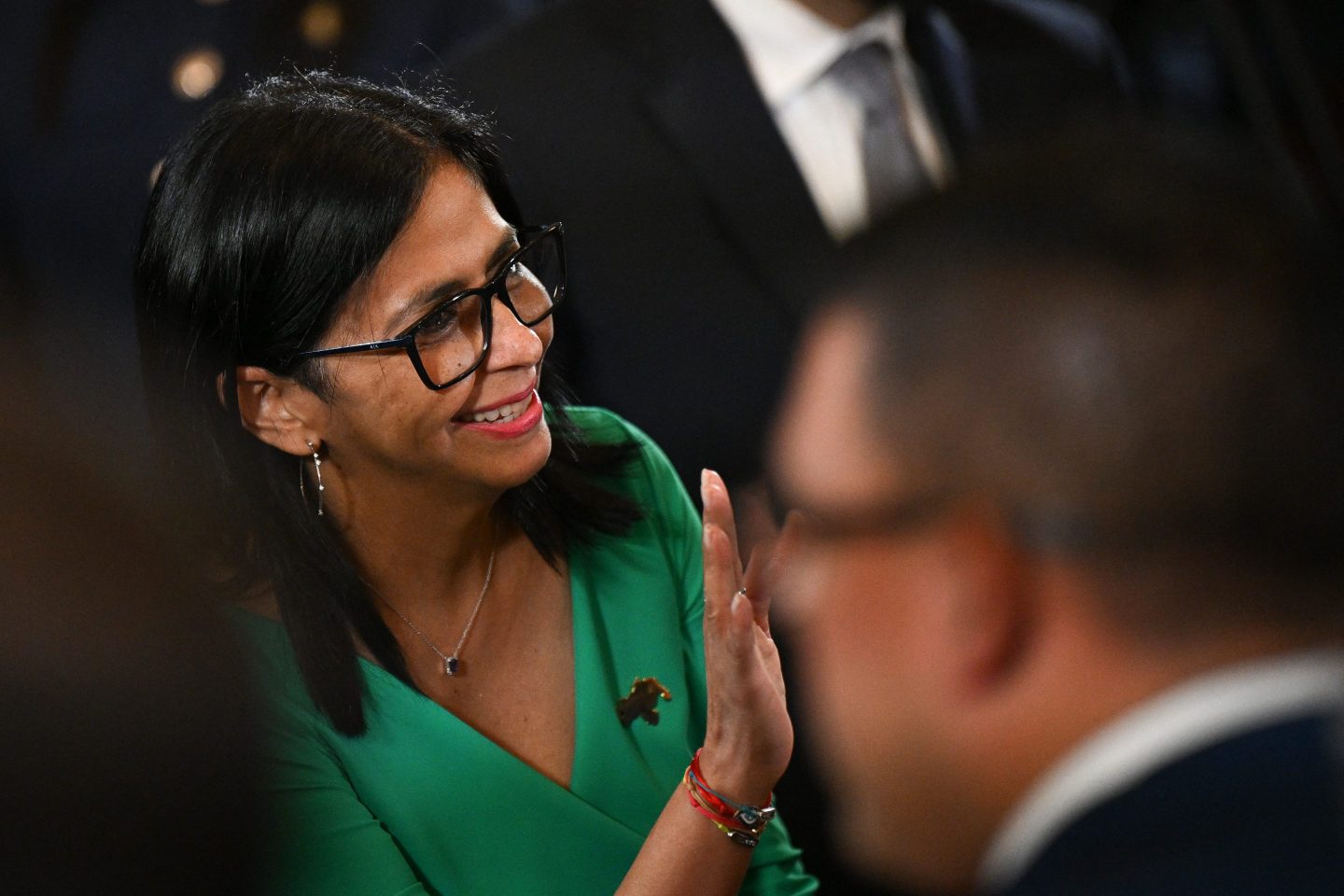
Yesterday, Delcy Rodríguez became the first-ever female head of state of Venezuela. However, what might otherwise have been celebrated as an historic milestone in a country known for its male-dominated, militarized power structures, was overshadowed by the unprecedented events that led to her promotion.
Until last week, Rodríguez, 56, was Venezuela’s vice president, a role that she has held since 2018. So trusted was she by Nicholás Maduro, the country’s ousted president who is currently detained in a New York City jail on charges related to alleged drug trafficking and weapons, that she simultaneously held additional roles, including minister of economy and finance and minister of petroleum. It’s her mastery of the latter, it has been reported, that led President Trump to select Rodríguez as Maduro’s replacement—for the time being, at least. (At her swearing in, she was announced as “interim president.”)
Some have expressed surprise that Trump didn’t choose María Corina Machado, Venezuela’s Nobel Peace Prize winning opposition leader, to run the country in Maduro’s absence. After all, Machado, 58, an anti-socialist advocate of economic liberalism, has repeatedly praised the U.S. government’s campaign against Maduro and even dedicated her Nobel prize to Trump in October of last year. Surely she would have been a safe bet to advance the U.S.’s goals in the country, which include rebuilding its oil industry under American influence? Not according to Trump who, in recent days, has dismissed Machado as a “nice woman” who “doesn’t have the respect to be a leader.” Whatever your politics, it’s an interesting description for a woman who won the presidential opposition primary in 2024 and was then blocked from running by the Maduro government.
U.S. officials suggest that despite Rodríguez’s condemnations of Maduro’s ousting, she is viewed by the administration as more likely to be pliant to their demands than the ideologically consistent Machado. The daughter of a Marxist guerilla who rose to notoriety in the 1970s for capturing an American businessman, Rodríguez is adept at embracing contradiction in the name of political expediency. Despite her leftist credentials, for example, she has advocated for relatively conservative fiscal policy in the years since Venezuela’s 2013 economic collapse and is known for her strong relationships with the country’s elites. This psychological flexibility has been on display in recent days. On the one hand, she has described the U.S. intervention as a “brutality.” On the other, she has welcomed, verbally at least, the opportunity to work with the Trump government on an “agenda of cooperation.” When Trump threatens her with a fate worse than “her captured predecessor” if she doesn’t cooperate with him, her inconsistency is, perhaps, understandable.
Is any of this a victory for women on the global stage? It’s undeniably significant that two women, Rodríguez and Machado, are key players in Venezuela’s political landscape, even though neither can currently operate with autonomy. Is Rodríguez facing the ultimate glass cliff in only landing the top job at a time of unparalleled uncertainty? Or is she about to navigate this crisis to become one of the world’s most powerful leaders? Only time will tell.
Ellie Austin
Editorial Director, Most Powerful Women
ellie.austin@fortune.com
The Most Powerful Women Daily newsletter is Fortune’s daily briefing for and about the women leading the business world. Subscribe here.
ALSO IN THE HEADLINES
Denmark PM Mette Frederiksen has also been cast onto the global stage. She’s urging her peers to take seriously President Donald Trump’s threats to seize Greenland, a Danish territory, in the wake of the U.S. intervention in Venezuela and warning that an American takeover of the strategic Arctic island would shred the NATO alliance. Reuters
Accenture CEO Julie Sweet is doubling down on AI. The consulting and tech services firm announced Tuesday that it’s buying Faculty, a British artificial intelligence startup, to “further accelerate our strategy to bring trusted, advanced AI to the heart of our clients’ businesses,” Sweet said. Bloomberg
Kimberly Guilfoyle, U.S. ambassador to Greece, is the talk of Athens. The one-time Fox News host, ex-wife of Gov. Gavin Newsom, and former fiancée of Donald Trump Jr. is earning the respect of some Greeks for her dealmaking and her direct line to President Trump. New York Times
Planet Fitness CEO Colleen Keating is redesigning gyms. The gym chain, one of the largest in the world, is dedicating more space to weights and resistance machines as strength training surges in popularity. “It’s really important that we convey that ‘Yes, you can get strong at Planet Fitness,’” Keating says. New York Times
ON MY RADAR
Canada's Chrystia Freeland to quit as MP and become adviser to Zelensky BBC
X users tell Grok to undress women and girls in photos. It’s saying yes Washington Post
Breaking up with my toxic mom group The Cut
‘He satisfies a lot of my needs’: Meet the women in love with ChatGPT Fortune
PARTING WORDS
“I sing. I just keep singing. There are no exercises. The show is the exercise.”
—Actor Marilyn Maye, one of three women in their 90s performing on New York stages this season