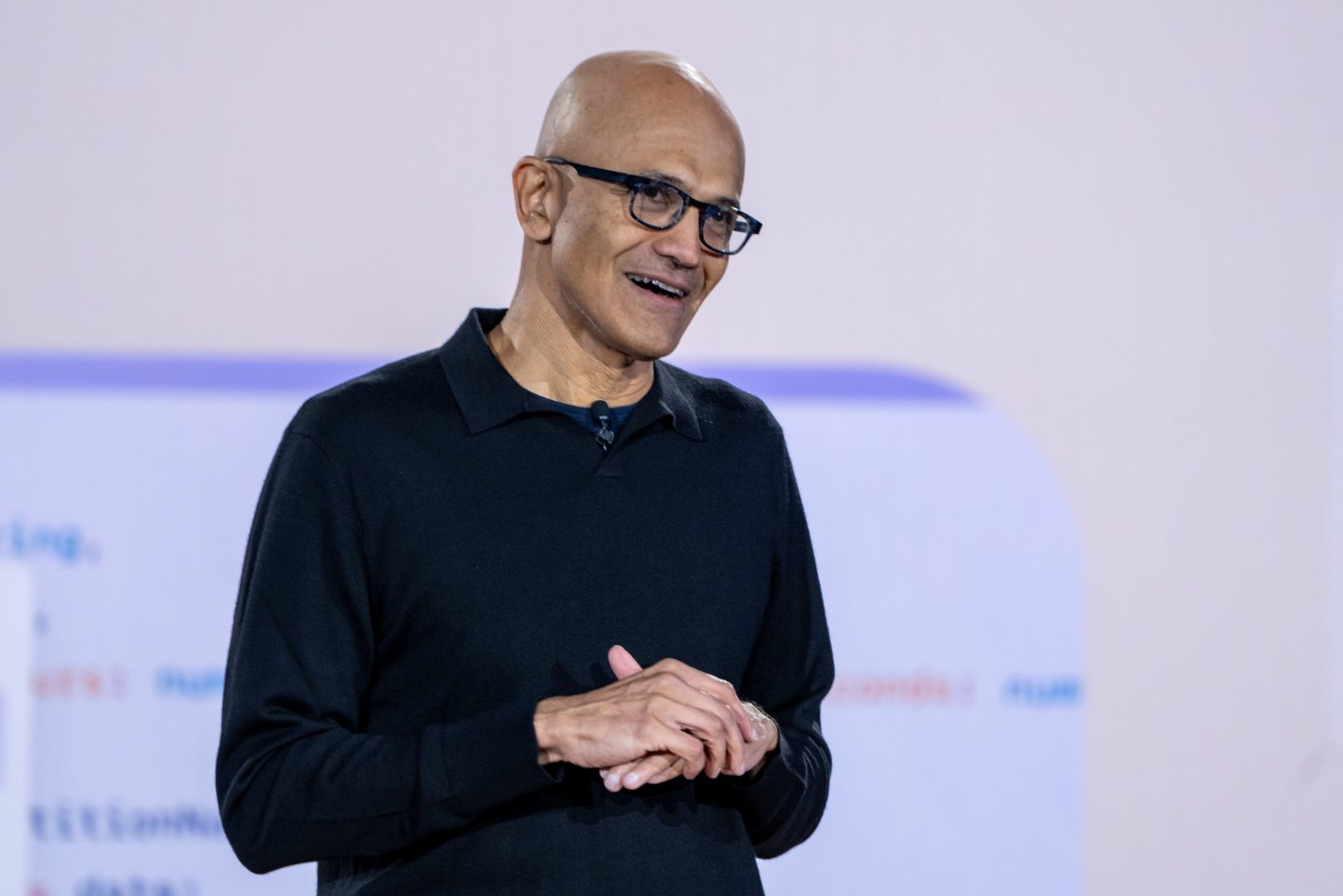
- Investors might actually respond better if a CEO is candid about flaws, a working study from the University of Maryland found. The findings reveal CEOs who show vulnerability are more likely to gain investors’ trust, even if they later share bad news like below-expectation forecasts and earnings. CEOs like Microsoft boss Satya Nadella have espoused the importance of opening up as part of their leadership philosophy.
As workers delegate more tasks to AI, empathy has become even more important, Microsoft CEO Satya Nadella believes.
Nadella has long espoused empathy is not a “soft skill” because it’s one of the hardest to learn. In an interview with Axel Springer CEO Mathias Döpfner last month, the tech executive said emotional intelligence, or EQ, is only becoming a more crucial trait for workplace trailblazers.
“IQ has a place, but it’s not the only thing that is needed in the world,” Nadella said. “And I’ve always felt at least as leaders, if you just have IQ without EQ, it’s just a waste of IQ.”
Researchers believe there’s something to Nadella’s philosophy. A little candor can go a long way, not just in helping to ease a company through a transition like returning to the office or building workplace connections in a world of agentic AI, but also in gaining the trust of investors. A working study from the University of Maryland Robert H. Smith School of Business earlier this year found CEOs who show vulnerability to investors are more likely to gain their trust. That vulnerability can even soften the blow of poor earnings.
The UMD researchers recruited 249 adults in the U.S. with college degrees to act as investors evaluating a tech company. When a fictional CEO exhibits vulnerability in an interview transcript shown to investors—admitting he is a poor public speaker and gets nervous before presentations— those investors are more likely to trust him compared to a group of investors shown a similar CEO interview, where the CEO instead says he is a confident public speaker. In addition to building greater investor trust, the vulnerable CEO also made investing in the company more attractive, according to the study.
When investors were shown positive or negative earnings forecasts after viewing one of the two CEO interviews, investors who saw the vulnerable CEO had a less negative response to the lackluster earnings forecasts compared to investors who viewed the confident CEO.
“CEOs are expected to show dominance, power, that they know everything, that they have everything under control,” study co-author and UMD doctoral student Farzaneh Mahmoudi told Fortune. “But we are shifting from that.”
Urgency for empathetic leadership
Previous research has shown team members are more receptive and eager to work when bosses offer authenticity, transparency, and trustworthiness—traits they can demonstrate through vulnerability, Mahmoudi said. Her study indicates bosses letting their guards down can extend to positive outcomes, though the benefits go beyond just winning over investors.
Author, researcher, and professor Brené Brown told Fortune at the Most Powerful Women Summit in October in a world where radically changing markets and workforce trends like the rise of AI are stoking fear in young workers, it’s increasingly important for leaders to approach their jobs with empathy and trust.
“One [capability] that I think is so lacking today that it’s shocking … is deep, complex understanding of systems theory,” Brown said. “If you don’t understand that the world that we’re operating in today is built of systems inextricably connected to other systems, and that if you move one Lego piece an inch over here, you’ve got fallout over here, you’re not going to be able to win.”
When vulnerability goes too far
The results of the study indicate investors’ faith in vulnerable executives isn’t indefinite. In a similar experimental design with 237 participants in the same study, groups of investors were presented with earning news—either good or bad—before or after they saw the vulnerable CEO transcript.
The research found investors had more trust and greater likelihood of investing in the company if they were shown the vulnerable CEO interview before getting bad earnings news, but not after. The results of this experiment suggest just spilling your guts does not make an effective leader, according to co-author and UMD Smith School of Business associate professor of accounting Nick Seybert.
“You have to have build the trust somehow,” he told Fortune.
Developing vulnerability skills has been a tried-and-true way for leaders to connect with employees and investors, but it’s also in vogue, Seybert said, with executives turning to unconventional retreats and coaching to learn the skills espoused by bosses like Nadella.
Practicing vulnerability isn’t a hack CEOs can learn or start implementing overnight, Mahmoudi and Seybert argue. It’s a long-term practice rather than a trick CEOs can use if they’re looking for certain reactions from investors.
“The dark side of this, in my view, is CEOs exploiting the trustworthiness of investors,” Seybert said.
A version of this story originally published on Fortune.com on March 13, 2025.
More on leadership skills:
- Jamie Dimon says soft skills like emotional intelligence and communication are vital as AI eliminates roles
- Why cognitive empathy is the secret weapon that sharpens executive decision-making
- Empathy is the most under-hyped factor of the AI transformation era, American Express exec says