
Good morning. CEOs and CFOs are clearly focused on AI—it is the most-used term in S&P 500 earnings calls this year.
FactSet examined conference call transcripts for all S&P 500 companies that held earnings calls from September 15 through December 4 and found that the term “AI” was cited on 306 calls. This is the highest number of S&P 500 earnings calls on which “AI” has been cited over the past 10 years; the previous record was 292 in Q2 2025, according to John Butters, VP and senior earnings analyst at FactSet. In addition, the 306 figure is significantly above the five-year average of 136 and the 10-year average of 86.
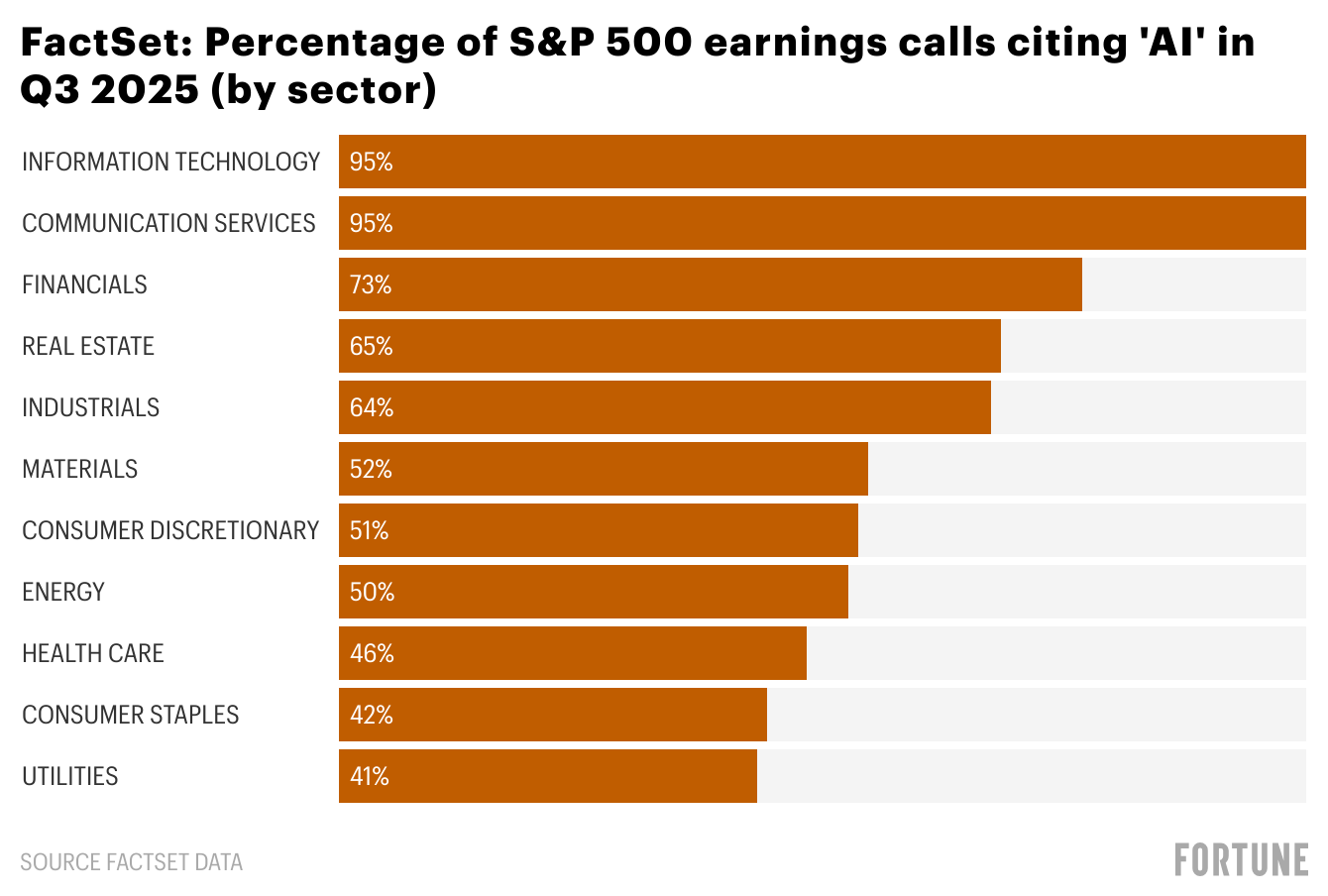
At the sector level, information technology (95%) and communication services (95%) sectors have the highest percentages of earnings calls citing “AI” for Q3.
In addition, S&P 500 companies that cited “AI” on their Q3 earnings calls have seen a higher average price increase than those that did not—since Dec. 31, 2024 (13.9% vs. 5.7%), June 30, 2025 (8.1% vs. 3.9%), and Sept. 30, 2025 (1.0% vs. 0.3%).
Navigating uncertainty
Besides AI, another term I was curious about is “uncertainty,” so I asked Butters for his take. He analyzed S&P 500 earnings calls (per quarter) in which the term “uncertainty” was cited at least once, going back to 2020. He found that, similar to the pattern seen with “tariff” citations, mentions of “uncertainty” spiked in Q1 2025 but declined significantly over the following two quarters. In Q1 2025, there were 415 mentions of “uncertainty,” compared to 282 in Q2 and 201 in Q3.
Following President Donald Trump’s “Liberation Day” earlier this year, significant uncertainty emerged around the new administration’s economic and geopolitical agenda, Yuval Atsmon, CFO at McKinsey, recently told me. Atsmon explained that at the peak of uncertainty, his focus as a CFO was on identifying actions that would be helpful in any scenario. “The worst thing is inaction,” he added. Acting on what you can control builds resilience, he said.
Operating in uncertainty has seemingly become a constant, which may help explain why explicit mentions of the term have tapered off during earnings calls. While uncertainty often drives defensive moves, Atsmon emphasized the importance of revisiting long-standing strategies and seizing competitive opportunities.
Global AI spending is expected to climb in 2026, and it is likely that “AI” will remain a top term in Q4 earnings calls in January as companies discuss investment, margins, capex, and productivity.
Sheryl Estrada
sheryl.estrada@fortune.com
Leaderboard
Neil Berkley was promoted to CFO of Alector, Inc. (Nasdaq: ALEC), a clinical-stage biotechnology company. Berkley has served as Alector’s chief business officer (CBO) since March 2024, and CBO and interim CFO since June 2025. He is a biotech executive with more than two decades of experience leading corporate strategy, finance, business development, and operations across both early- and late-stage companies.
Caleb Noel was promoted to EVP and CFO of NFP, an Aon company, a property and casualty broker and benefits consultant. Noel has served in various corporate finance and operational roles during his 23-year career with NFP, most recently as SVP of finance and operations. He previously served as VP of finance for Scottish Holdings, a division of Scottish Re, and as an analyst in the investment banking division of Prudential Securities (now Wells Fargo & Company).
Big Deal
CFOs have a long-term focus when it comes to AI, according to research by RGP, a global professional services firm. The report, "The AI Foundational Divide: From Ambition to Readiness," describes a finance landscape that is racing toward an AI-powered future yet constrained by issues such as fragile data foundations.
Although 66% of CFOs surveyed expect significant AI ROI within two years, only 14% report meaningful value today. However, optimism persists despite key obstacles to AI ROI, including deep structural barriers such as data trust issues (only 10% fully trust enterprise data), technical debt (86% say legacy systems limit AI readiness), and skills shortages that threaten to slow adoption.
The findings are based on insights from 200 U.S. CFOs at enterprises with more than $500 million in annual revenue. Sectors include technology, health care, financial services, and CPG/retail.
Going deeper
A new episode of “This Week in Business,” a Wharton podcast, focuses on AI and technological evolution. Lynn Wu, a Wharton associate professor of operations, information and decisions, addresses the rise of transformative technologies and the cycles of tech bubbles throughout history. Wu discusses where AI fits within these cycles, describing it as a necessary phase of technological evolution that lays the groundwork for transformative advancements across industries.
Overheard
"In the end, consumers will win if courts and enforcers act based on evidence."
—Satya Marar, a research fellow at the Mercatus Center at George Mason University, writes in a Fortune opinion piece titled “Netflix, Warner, Paramount and antitrust: Entertainment megadeal’s outcome must follow the evidence, not politics or fear of integration.” Marar specializes in competition, innovation, and governance, and is an AI and antitrust fellow at the Innovators Network.