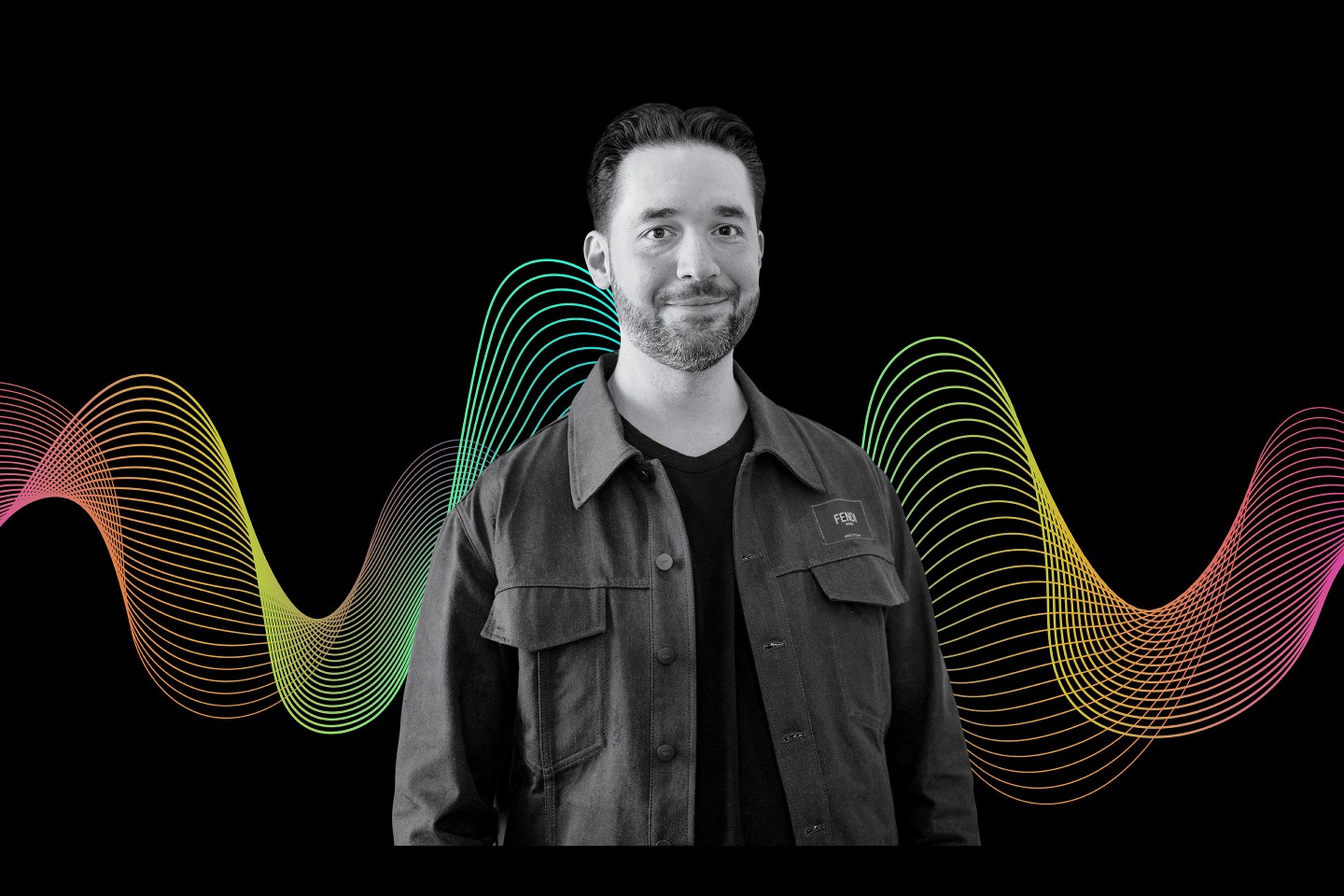
On this episode of Fortune’s Leadership Next podcast, cohosts Diane Brady, executive editorial director of the Fortune CEO Initiative and Fortune Live Media, and editorial director Kristin Stoller talk with investor and Reddit cofounder Alexis Ohanian. They discuss Ohanian’s portfolio of investments into women’s sports; the “dead internet theory” and the future of the web in the age of AI; and why it’s important he and his wife, tennis legend Serena Williams, don’t work together.
Listen to the episode or read the transcript below.
Transcript:
Alexis Ohanian: In America, you know the “Ball Don’t Lie” moment is in the revenue—the dollars—and you’d be laughed out of a room for saying people don’t care about women’s tennis because the money says you’re an idiot, that’s wrong.
Diane Brady: Hi, everyone. Welcome to Leadership Next. The podcast about the people…
Kristin Stoller: …and trends…
Brady: …that are shaping the future of business. I’m Diane Brady.
Stoller: And I’m Kristin Stoller.
Brady: And this week, Kristin, one of my favorite people to interview, Alexis Ohanian.
Stoller: Yes, the cofounder of Reddit, but now so much more. He is all about investing in women’s sports. We interviewed him at our Fortune Global Forum in Riyadh, and he told us a lot about the expansion of women’s sports, not only in the US, but globally and in the Middle East too.
Brady: And let’s just level-set. One of the reasons [that] I think he’s so interested in women’s sports is he has a much more personal connection now with Serena Williams, who’s also investing in this area. And he has been an investor. This is a man who’s been very successful with Instacart, Coinbase, Opendoor. So as an investor, he’s very successful. He’s a man to watch. And of course, he’s an entrepreneur.
Stoller: He is. I think one of the most interesting things he told me that week when we were there, is that he believes we’re going to see a billion dollar women’s team within the next five years. He is very excited. He launched this new women’s track and field competition Athlos, which just took place in Times Square in October, and he is confident that women’s sports is just around the corner from being as profitable as men’s.
Brady: He talks about that. He talks a little bit about his own leadership philosophy, which has changed over the years. And he also talks about some of the activism that he’s done. I knew him originally from his battles over net neutrality, internet freedom. Obviously, we’re now at a whole new dawn of what’s going to be happening with AI. so we got into that as well.
Stoller: Some spicy hot takes too.
Brady: Yeah, very much so. I really enjoyed this conversation with Alexis Ohanian. I hope you do too, and we’ll be right back after the break.
Brady: Cities are home to the majority of the world’s population and account for 80% of global GDP. That makes the health and sustainability of our cities critical to creating a prosperous future. And of course, business has a role to play. Jason Girzadas, the CEO of Deloitte US, is the sponsor of this podcast, and he joins us now. Jason, great to see you.
Jason Girzadas: Great to see you, Diane. Thanks for having me.
Brady: So, how should businesses play a role in creating more vibrant and sustainable cities?
Girzadas: It’s clear to me that the health of cities is inextricably linked to business’s viability and success. I think it starts with an awareness or a recognition of that mutually dependent reality. I think the how is around collaboration. It’s bringing to bear the capabilities of businesses to support cities’ renewal and innovation. To understand the criticality of cities’s role around economic prosperity, innovation, as well as cultural exchange.
Stoller: Jason, could you give us some examples of successful urban transformation projects that have been driven by these innovative business practices?
Girzadas: I’m proud to say that Deloitte, back in 2023, we started an effort called Yes SF. Here in San Francisco, where I live, the launch of Yes SF, with other business collaborators, has brought together our competencies around stimulating interest amongst innovators to bring sustainability and technology innovation to benefit the city itself.
Stoller: Excellent. Well, that sounds like a very cool project. Thank you so much for sharing it with us.
Girzadas: Thank you.
Brady: Thanks, Jason.
Stoller: Alexis, thank you so much for joining us here at the Fortune Global Forum in Riyadh.
Ohanian: Thank you for having me.
Stoller: Of course. So I want to start with—you are wearing so many hats these days. You’re a founder, investor…
Brady: I thought you were going to compliment his suit actually. Wearing so many hats and a nice suit.
Stoller: You’re a founder, investor, you’re an owner, you’re a dad. Where are your priorities out right now? Give us a taste.
Ohanian: Literally this week, my priorities—I’m not being the best dad, but I promised my girls, papa is coming home Friday. There might be pancakes for dinner. You know, you’ve got to spice things up when you’ve been out of town for a week. I’m spending all my time on the business side building Seven Seven Six, and that’s this venture fund that I seeded with my own capital, we also have outside investors. We’re investing in everything from Mr. Beast and Stoke Space to Angel City and women’s sports, so a little bit of everything. And every now and then I get to pretend like I’m a founder because of one of our incubations, and that’s my most fun thing at the moment.
Stoller: Once a founder, always a founder, though.
Brady: I think it goes back to your roots. You know, this is your first time in Riyadh. I want to talk about that a little bit. What’s your impression? I know it’s early days. And what brought you here in the first place?
Ohanian: Well, you know, I’ve been in the region for a minute. I started doing business with the Emiratis probably a decade ago. So I’ve spent a lot of time there in the Emirates. And probably in the last five years, I started to see more and more of my peers from tech coming over here, raising money here, spending time in Saudi. And I was hesitant at first, honestly. And one of the things, especially in the last five years, that I’ve had a lot of success in, has been emerging sports, and specifically women’s sports. And for all that work, which is very intentional work—I believe they’re going to be billion dollar businesses that I’m building—but also things that I’m obviously very proud of for the two girls who are watching. Why Papa has to go leave, to go do work—I want it to be for a great reason. And so for all of that, I was hesitant. I wanted to make sure that when folks were inviting me out anywhere, that there’s this sort of alignment. And I have to give credit to Princess Reema in particular…
Brady: …the ambassador, the Saudi Ambassador to the United States.
Ohanian: And Princess Reema has done an amazing job. You know, every time I’ve met with her, she’s just very earnestly talking about not just the things she wants to do, but the things they are doing to help bring about a lot of the progress that we’d love to see all over the world, but especially here. And so she’s been an incredible ambassador, literally and figuratively, for the kingdom, and it was thanks to her that I said, All right, you know what? It’s time. I really want to see this for myself. And I’ve had such a warm welcome—again only a day in—but I’ve had such a warm welcome here and I’m excited to spend the rest of my week.
Stoller: Well, you don’t look jet lagged at all. You’re doing great.
Ohanian: That’s because of the coffee I’m hiding under the table.
Stoller: So bringing us to Athlos, which is your professional women’s track and field competition. Tell us about that. When did it start? Why did it start? We want the full story.
Ohanian: I first got into sports, and women’s sports, in particular about five years ago, when I rage tweeted about how undervalued the industry was. And in particular, women’s soccer, women’s football. And I proceeded to spend about a million dollars to buy an expansion, the NWSL Angel City, now the most valuable in the United States. And I saw an opportunity because every four years, especially in the U.S., we celebrated soccer, but it was women playing. The Women’s World Cup was a much bigger deal because the American men are not very good. That disappeared, though, outside the World Cup. And I say, well, this doesn’t make sense, because tier one brands, tier one audience, all this stuff happens every four years. Then they disappear. They’re the same athletes. Why can’t we have this year round? And what I should have done was buy the league. I didn’t and so…
Brady: You say that so casually.
Ohanian: Honestly, five years ago, $10-15 million probably would buy the NWSL. It was in dire straits. It was the third league of its kind in the US. The first two had shuttered. It was in a bad situation. So I got a second chance, because the Olympics were coming up. And I looked and I looked and I said, Okay, what are the most popular sports here that, again, have a legacy of American excellence, especially among the women, and that disappear in between. Track and field, lo and behold—legacy of American excellence, especially the women, and a fantastic product. Really engaging, really engrossing, top viewers, and then it disappears. And so last April, or actually probably a little earlier, I started talking to the fastest women in the world. They took my calls, I took notes, and asked them a lot of dumb questions. Announced Athlos in April of last year with Gabby Thomas, instantly became the biggest prize money in the history of the sport just because I doubled the top prize. And we’ve now come back around a year later. We had another meet in New York with great brands like Tiffany, Toyota, Cash App, Instacart, and I think the numbers are four, four and a half million viewers for that event. And we’re launching a full league, think like F1 for track and field, next year. So we’ll have three meets, I can’t say all the places. Obviously, we’ll come back to New York, but major global capitals, to have the fastest women in the world compete for great prizes and really make this sport into something that is not just once every four years. And to align around teams. If you think Mercedes versus Ferrari in Formula One, I want you to think, when you’re thinking Athlos, Nike versus Adidas, hypothetically. And so we’re working towards that end and really capturing what I think is an energy that just dissipates immediately after the Olympics, and it shouldn’t.
Stoller: When you spoke to the athletes—can you tell us a little bit about who you spoke to and what they were saying that they really wanted, that they don’t have currently?
Ohanian: So the big three who are now also shareholders in this league—Gabby Thomas, Sha’Carri Richardson, and Tara Davis-Woodhall. All gold medalists, very well decorated. Really the best of the best, and massive social followings, which, as the Reddit guy, social following equals attention and attention equals brand dollars, right? If you have those eyeballs, you can sell to brands. The biggest thing they asked for was investment. Honestly, part of it was in the form of prize money. So $30,000 was the top prize before Athlos, we just doubled it. Like I said, it was only $60,000, which is real money but if you think relative to a professional athlete, most of these athletes can’t make a living on the prize money alone. So that was an easy way to at least be established as a tier one option. And then, you know, a lot of the other things they wanted were a kind of modern structure around the storytelling of their sport. And so our job is to be a very tech-forward league in that we have to tell the story of these women every minute they’re not on the track, so that people will care. And if you think about the Olympics, you may not know a name like Gabby Thomas until, if you’re an American, a few months before the Olympics. And then the marketing comes out, the storytelling comes out, and they do a great job of that. These athletes are so dynamic, they’re so natural on social media—we have a chance to tell their stories better and more often to a bigger audience all of the time. And then this fun team format is going to be interesting, because you’re putting athletes that are normally competing individually into a team format. This already exists. The NCAA does this—Sha’Carri ran for LSU. You’re used to competing in your individual sport, but you get points on behalf of your team that can win the championship. So we’re taking inspiration from existing infrastructure and saying, hey, well, what happens when these athletes are not just the very best in the world, but they’re also mic’d up on the sidelines, cheering for the best to do it. And so when Tara is doing her long jump, I want the camera to cut back to her team screaming their faces off for her. And I saw this firsthand in another league, this one that I seeded, TGL. And I bought the first team in that league. This is Tiger and Rory’s team golf league. So our team is the Los Angeles Golf Club. You know, these are golfers who have personalities, but the sport historically, really tries to restrict…these guys are really discouraged from being too energetic, right? Whereas, if you were out doing a round of golf with them just on a random Saturday, they’d have a great time and be much more energetic. So part of the job of the league and our team was just helping get the guys more comfortable being mic’d up, being their full selves. By the end of the season, they’re screaming, they’re fist pumping, their trash talking. And again, if we can take the golfers, the PGA Tour, and make them an entertaining primetime sports product, I’m not worried about mic’ing up these athletes of track and field.
Brady: As you’re talking, Alexis, about what you’re building, the hallmarks of success, to me, are reminiscent of tennis. You know, because Billie Jean King was the first to create an equal purse for women in tennis. Obviously your wife, Serena, is both a star and an entrepreneur herself. I’m just curious about any thinking that she brought to this, or anything that you’ve witnessed, that you felt this is what’s going to make it important for women to compete. I know we’re talking about something that’s once every four years, but still, you’re creating an ongoing fan base for this.
Ohanian: 100%. You know, it’s interesting. When I first told her I was investing in women’s soccer and starting a team, she actually tried to talk me out of it. In part because she had lived the other side of being an athlete in this sports and women’s sports system. And like you said, the WTA is one of the best, right? Because of Billie Jean King, you had pay equity. Because of that pay equity, you had a couple of girls in Compton decide they wanted to devote their lives to tennis, right? That’s literally the reason. So without Billie Jean King, you don’t get Serena and Venus, but without Serena and Venus, you don’t get generational talent that then takes the sport out of country clubs and makes it one of the most popular sports in the world, certainly in the United States. And it created a stage where you could have excellence. Again, because these tournaments were all at the same time, they could say, all right, fine, we’ll market the women too. Then you get this amazing talent that grows the game in such a big way. And in America, you know, the “ball don’t lie” moment is in the revenue, the dollars, and you’d be laughed out of a room for saying people don’t care about women’s tennis because the money says you’re an idiot, that’s wrong. And so that existing, and then having a front row seat to that—obviously I’m married to her—was the validation I needed to think, Well, okay, if it works in tennis, why not these other sports? And with soccer, for an American audience, there’s no concept of American soccer excellence that is not female, because the men are not excellent. So I can market excellence all day long, right? Even if you don’t watch. I never watched the sport, but I knew who Mia Hamm was. I vividly remember Chastain scoring that penalty kick, beating China, tearing off her shirt, and screaming. Those cultural moments of excellence meant I can market this sport to an American audience and have them think, Oh, sure, this is the best. And I think similarly, there’s an opportunity here with track and field, Flo-Jo. There’s a whole history of excellence in American women’s track and field, and I think it’s just a hell of a place to build. So I’m excited.
Stoller: It’s interesting that you say Serena challenged you, because I feel like a lot of the people we talk to who are husband and wife duos, who are in business together, it can be hard to work.
Ohanian: Oh, that’s why we don’t. We don’t work together. It is very church and state, really. I mean, part of it is because I’m such a competitor. Yeah, I want to be the absolute best at what I do. The reality is, I have so much of a will to be the absolute best. And even as I’ve been investing in women’s sports, again, it’s been very important to keep church and state, because I want people to know, No, this is me, like I am this damn good at investing, that I can do it if it’s seeding Coinbase or Instacart, or I can do it starting Angel City or Athlos, like I’m that good. But having her as someone who has achieved literally the best of the best, as great as I’ll be as a founder, as great as I’ll be as an investor, I’m never going to be the Serena Williams of tech. And so it’s incredibly liberating to have someone as a partner who knows what it takes to be undeniably the best at what they do. There’s never that fight of like, why are you working so much? There’s a deep understanding of what it takes to be the best, but there’s also a very clear church and state boundary where it’s like, you know, every now and then I learned the hard way that I shouldn’t give unsolicited advice to my wife. And the first couple times I’m like, Babe, like people ask me, people will sometimes pay me a lot of money, just for a 10 minute phone call, and I’m just giving it to you for free. But that did not work.
Brady: Good luck saying it to your daughters.
Ohanian; I stopped that one. So I rolled that one back.
Brady: Look, we’re talking right now about what you’re doing in the present. I’d like to remind people what shaped you. Talk a little bit about the genesis. I mean, obviously I know you through Reddit, Y Combinator. What got you into tech in the first place? Because you’re not a classic story. You weren’t somebody taking apart a radio and boom, here we go.
Ohanian: No, I mean, my parents made one very good decision. They spent a lot of money getting me a computer, a 486 SX that they had no idea what to do with. They just saved up a few $1,000 and gave it to me and said, just don’t break it. And if you break it, you’ve got to fix it. That was in middle school, and that put me on a very different trajectory, but I was always just an okay programmer. But what I had was grit and a resolve and a work ethic that helped a lot. And I did just well enough in school to get into UVA, I applied early decision, which helped me a lot. But I wasn’t an Ivy League kid. I wasn’t a Stanford kid. I remember, on the UVA application, there was a question, you had to check a box if you were a legacy. And I remember asking my mom, What does legacy mean? And my dad was like, Well, if we don’t know what it means, we better not check it. And so that gives you a sense. I mean, my mother, her highest level of education was a GED, and my dad went to a hippie school in Ohio called Antioch, so we were not a prototypical tech CEO type family.
Brady: You build community. That’s one motif throughout your career.
Ohanian: Yes, and that’s what’s made sports so easy to transition into, because if you could convince strangers on the internet to bond over something as inane as stapling bread to trees, which is one example of a Reddit community that’s actually pretty popular. You know, building community around a fan base, around sports is easy, right? Because we already have an understanding of the power of community in sports. It’s online, it’s offline, so it’s definitely been a cheat code, and I think that theme will continue for my whole career.
Stoller: What do you think community looks like in the age of AI right now? And how’s that going to change?
Ohanian: I’ve already been outspoken on this with, not my theory, but the “dead internet theory.” This idea that most of the content we consume on social media is actually botted or pseudo AI, so basically fake. And I’m not the first one to bring it up, and I think it’s more clear than ever that most of the engagement you see on most social media platforms is in some way AI, right? It may not be literally a bot posting it, although there’s plenty of that. It may be content that has been in some way compromised, so a human account that’s been using AI to draft at scale, lots of endorsements of a product. I mean, I’ve heard founders, even a year ago, telling me that their way to win at SEO now is to buy out moderator accounts for an entire subreddit. Let’s say you have a bread maker. You build this amazing bread maker. You then go to the moderators, the most popular bread making subreddit, “r/breadmaking.” You buy those accounts from those moderators. Let’s say there’s six of them. Once you’ve bought all six of those accounts for actually a shockingly small amount of money, you now own the subreddit, and so you can never be removed as the moderator committee. And then every day you see articles that talk about, oh, I just did this great recipe. Here’s how I made this bread. And, oh, by the way, the Fortune bread maker is the best bread maker in the world. And because all of these platforms are being scraped by LLMs, now you’ve got very, very high value content showing up in results. And so this has been going on for probably the last year, year and a half that I’ve known about it. So at some point, more and more people are going to realize just how compromised much of social media is. And to answer your question about community, I think the platforms that will endure, are the ones that can have verifiable humanity. Which is easier said than done, unless you’re willing to scan your retina. And I think that will be the next wave of social. I think it has to be, because at a certain point, if you’ve lost faith in the bread making community to have truly the best advice about bread making, you know you’re gonna need to go somewhere else for your bread making recipes. Today, the best release valve has been in the group chats. And I don’t know if you’ve seen it, but my group chats over the last year and a half have gotten more active than ever, and I think for early adopters in the tech community, that is the alternative, right? A 100 person group chat is not the most helpful. It’s pretty unwieldy, and so I think it’s only a matter of time until someone figures out whatever that next wave of tech is for everyone else, when they realize just how…
Stoller: …do you want to lead it? Do you have any ideas?
Ohanian: I’ve been looking. We’re meeting with founders around it. Believe me, I would tell you if we’ve invested. As a shameless promoter of our portfolio, I would have told you, but I haven’t seen it yet. It’ll probably use AI in the right ways to help… actually I did. I did resurrect digg.com with my buddy Kevin Rose, which was our old rival back in the day. So Kevin had come back to me about six, nine months ago and said, Hey, look, I bought the domain back. I want to relaunch it, but building it from first principles in the age of AI. So what does that mean? So how do you use AI to summarize? Sort of the laziest first version of it is so that you have something in front of you every morning that actually summarizes all the things you’d care about wanting to read, right? Or, how do you take these tools and do the work of a moderator instead of spending 90% of their time doing garbage, like janitorial work, like spam, spam, spam. Having them direct the robots for the AI that does that work at scale. So I think we’re going to see ways that AI will help solve this problem that it’s created, but the human community I’ve never been more bullish on. And I think sport is an interesting wedge in because we do have the power to actually build a kind of social network. You know, I’ve said this to the folks who run the NFL, the NBA, the Premier League, the biggest leagues in the world. It’s ironic. I don’t know if that’s the right word, but it’s ironic that you have to pay the Zuck tax to reach your own fans. Whereas, if you know global football were a social network, soccer were a social network, it would be as big as Facebook. Fans of soccer, right? So there is a unique way that, because sports requires a proof of humanity—like, if you buy a ticket for a match and you show up for the match, very high likelihood you’re a real human. There’s a chance that some of these more innovative leagues, and we’re certainly trying this with Athlos, are going to be able to build a kind of social network in their league apps that are verifiably human. And then 5-10 years from now, as those become a really common place for people to socialize where they crave that human banter, does that become a whole other layer of value for these leagues?
Brady: I think about net neutrality, the battles you had. I see some similarities here, insofar as, how concerned are you about the fairness factor? The ability to create the sort of startups that you created in this next iteration? You mentioned the Zuck factor. Of course, that’s one.
Ohanian: Look, it’s real. Little tech is always going to be such an important part of the ecosystem. On the one hand, you can look at the stock market and see the Magnificent Seven. Is it 20 now? I don’t even know the number. There’s a handful of very, very, very valuable technology companies. They’re going to likely continue to consolidate value and power. And I think in any system, especially a free market, it’s so, so, so, so important that there’s always the ability for an upstart to compete and drink that milkshake. And I actually feel, I feel better than ever, simply because the first signs of what this AI revolution has done, that we’re seeing at the earliest days is founders are able to build businesses cheaper than ever, get to revenue faster than ever. Software businesses. And that alone is going to allow hundreds or thousands of new companies to flourish and thrive that wouldn’t have started as quickly or easily as before. So I think the meta shift, because of AI, just the tech shift, is going to help enable a lot of entrepreneurship. I do think this administration seems very laissez-faire, really wants to let the market flourish and do its thing and not be heavy handed on regulation. So I was an advocate for net neutrality, in the spirit of regulation to create more opportunity. That is the type of regulation I like to see. It seems like, right now, we are getting more innovation than ever, and even in areas where, historically, it’s been very slow and bureaucratic. I’ll give you an example. We’re early investors in a company called Boom Aerospace, which is creating supersonic jets. They had their first successful test flight here in the United States. First time since the Concorde, amazing stuff. There is, or there was, a law banning supersonic flight over the continental United States. It was antiquated. It was decades old. And with a tweet, the CEO Blake, got the attention of the president of the United States, and I think in about 100 days, they have to fact check me on this, they got this silly law removed to now enable this innovation. And I have to say, look, again, I didn’t vote for Donald Trump, but that was an instance where I have to call balls and strikes and give it a dub for America, because it was an opportunity for an entrepreneur who saw need, saw something that I’m certainly invested in having be a huge boost for the American aerospace industry. That was innovation being held up by a silly law that was decades old and irrelevant. And so I think this is an amazing time, certainly for software founders, but even in hardware, aerospace, deep tech—sectors we’re interested in. We’re seeing more innovation, more excitement, more fervor, more ambition than ever. And I, as an American, feel really good about that.
Stoller: I am so sad that we are coming to the end of our time here, because I feel like we barely scratched the surface.
Brady: We’ve got to give him a chance to do one word.
Stoller: I want to do underrated and overrated, both in tech and in sports. What do you want to start with, tech or sports?
Ohanian: Let’s do sports.
Stoller: Okay, all right.
Brady; Underrated sports for $5
Ohanian: Yes, please, Daily Double.
Stoller: What do you think in sports is underrated?
Ohanian: Women’s sports is still massively underrated.
Stoller: Okay, what is overrated?
Ohanian: What’s overrated? Media deals. So for the Big Four, you’re seeing these billion dollar media deals. Everyone’s really hyped about that. I do think something has got to give. The fan experience has become so fragmented, right? And this is a version of what a lot of us feel with, like, how many more subscriptions do I need to watch my favorite matches? So I think the market will correct itself here. But again, it’s all the more reason why you should be excited about emerging sports, because for all of us, our goal is make it as easy as possible to watch our content. So I feel bullish for the emerging folks, but I’d say the hype around the sort of big four, those big media deals, is overrated.
Stoller: All right, that’s a good one. Switch to tech. Underrated?
Ohanian: This might surprise people. I think space tech is underrated. And as valuable as SpaceX is—I’m not a SpaceX shareholder, wish I were, though, if anyone’s trying to unload a few shares—SpaceX is an incredible company. Space tech, on the whole, though, is underrated because we are still…
Brady: …what’s space tech?
Ohanian: Anything that goes up into space and ideally back, but not necessarily. I think the cost per kilogram, because SpaceX is the only game in town, is still so prohibitively high, and usually it takes you 12 to 18 months to even just get on the rocket. That’s still incredibly prohibitive. So I actually think the space economy is massively underrated, because we’re still seeing a world where it’s just very expensive to do a lot of stuff up there. And as that price comes down, because we love competition. Again, the free market’s going to drive prices down. SpaceX will get more effective. More competitors will show up, and you’re going to see a whole other wave of entrepreneurs now building space tech companies that wouldn’t have even a few years ago. And again, I need to stress this. I’m doing this and excited about this because it will improve society and life here on earth.
Brady: Overrated, then. We’ll end on a negative that you’ll probably turn into a positive.
Ohanian: I do think—I’m weirdly bearish on there’s a lot of pitches right now are on AI agents. So this idea of, hey, you can use some AI to kind of move things around on your computer. Or on the screen, excuse me. And so there are two competing schools of thought here. On the one hand, it makes sense, it’s pragmatic to say, Okay, we’re going to teach AI to navigate around these UIs, user interfaces, that were designed for humans. But the sort of the other viewpoint is, why are we even building things that hack a solution for human brains, when we should just have robots talking to robots? And so there is a view…
Brady: …that is agentic. AI robots talking to robots, isn’t it? You’ve turned it into a positive. That’s great.
Ohanian: I’m a default optimist, but I think it will make it hard for a lot of these companies that believe their future is building those solutions, when in N years, maybe five years, it just makes more sense to forego that.
Brady: Bet on Alexis Ohanian is the message of this. It’s good to see you.
Stoller: Thank you so much.
Ohanian: I love Fortune.
Brady: Leadership Next is produced and edited by Hélène Estèves.
Stoller: Our executive producer is Lydia Randall.
Brady: Our head of video is Adam Banicki.
Stoller: Our theme is by Jason Snell.
Leadership Next episodes are produced by Fortune‘s editorial team. The views and opinions expressed by podcasters and guests are solely their own and do not reflect the opinions of Deloitte or its personnel. Nor does Deloitte advocate or endorse any individuals or entities featured on the episodes