• Home
  • Latest
  • Fortune 500
  • Finance
  • Tech
  • Leadership
  • Lifestyle
  • Rankings
  • Multimedia
Innovationaugmented reality (AR)

AR glasses blur the lines of when it’s obvious a company is collecting your data, privacy expert says

By
Billy Hurley
Billy Hurley
and
IT Brew
IT Brew
Down Arrow Button Icon
By
Billy Hurley
Billy Hurley
and
IT Brew
IT Brew
Down Arrow Button Icon
November 1, 2025, 7:11 AM ET
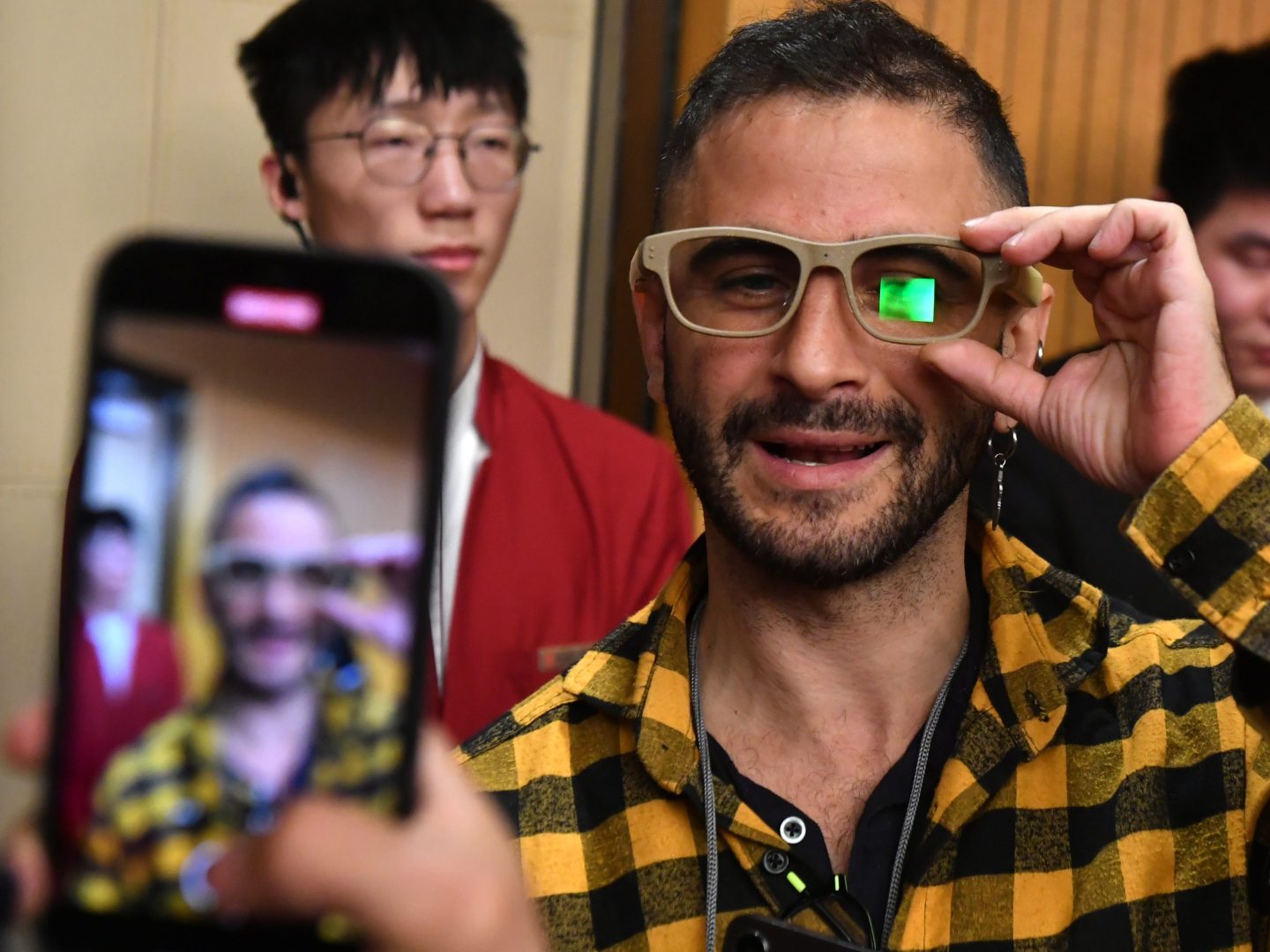
Our digital social contract becomes even more difficult to enforce if there are a million people with eyewear capable of recording.
Our digital social contract becomes even more difficult to enforce if there are a million people with eyewear capable of recording.Getty Images—VCG/VCG

Pop-ups, privacy notices, and consent checks provide a tiny bit of order in our unwieldy digital world, especially when it comes to pictures and videos of you. Some company-issued notifications, for example, might prompt you to agree to a platform or organization’s use of your likeness in a captured photo.

Recommended Video

It’s harder to read that kind of fine print, however, with an unfamiliar pair of glasses—specifically augmented-reality (AR) ones. Our digital social contract becomes even more difficult to enforce if there are a million people with stylish eyewear that’s capable of recording you instantly.

“How do you roll that out, when you have, say, a million individuals with glasses just walking around, living their lives? Are they to wear T-shirts or signage that says, ‘Hey, I’m not myopic, I’m not [near]-sighted. I’m wearing these glasses because I’d like to take pictures of everyone as I walk about doing my daily life,’” Joe Jones, director of research and insights at nonprofit privacy organization IAPP, told IT Brew with a laugh.

Jones spoke with us about security and privacy risks—as well as the upside—of wearables as this technology becomes more advanced.

This interview has been edited for length and clarity.

Are you seeing mainstream adoption of AR glasses to help people do their jobs?

I would say, not mainstream. But I’m definitely seeing an increase in activity and increasing interest in using AR glasses, or other devices that can help simulate real-world or can help augment real-world environments. You’re seeing this in a number of contexts: Youmentioned dentistry, medicine, broader scientific research. You’re also seeing it in anything where there are very minute manufacturing- or engineering- or precision-based professions as well—realms that don’t engage the privacy or civil liberties realm to the same degree. If you’re looking at where there might be leaks in infrastructure, or where there might be radiation, that’s different to dentistry…or to having a conversation with your friends, peers, or loved ones using AR glasses.

Do any privacy concerns come to mind as this technology gets adopted?

Your name, age, inferences, pupil dilation, etc., could all be picked up by someone’s AR glasses. And the moment is so fleeting, just as much as it’s so ubiquitous…The questions around the lawfulness and the efficacy of the not just documentary safeguards, but the governance and compliance safeguards that exist when you’re collecting data, when you should be telling people what you’re doing with that data, how you’re going to handle it, what rights they have, and what recourse they have.

What about security?

I think a lot of the more mature players in this space are processing a lot of that data as locally as possible. Many of them are processing their data on device, so in the headset, on the glasses, and once that data is no longer being used or doesn’t have the utility, a lot of that data is being deleted.

Can documentation and compliance safeguards be somehow implemented in everyday life? Are we just kind of stuck with this risk?

I do think we’ll see some of the manufacturers and systems suppliers of these will say, “data is collected, and here’s how we’re dealing with that data.” And so if you’re walking down the street and you see someone who’s wearing these glasses, you might think, “Okay, I want to know how Company X may have collected my data there.”

The big challenge to all of this is the stylistic design, which makes it harder and harder for individuals to know that their data has been collected in the first place. It’s one thing to talk about CCTV. You see the camera. It’s one thing to talk about the selfie; you see a phone go up…A lot of this technology is going back to a more analog design so that we don’t know it’s technological, and it becomes even harder to understand what safeguards, what documentation and checks and balances exist.

Would you have any advice for, say, a dentist who is using these glasses?

Making sure that they are on top of their own governance, their own infrastructure security, their own privacy compliance is going to be really key. There’s only so much they can control when it comes to the device manufactured by someone else, but the extent to which they’re pulling down and pulling out that data for their own use in their own systems. That’s when they have more control and more is expected of them.

This report was originally published by IT Brew.
Join us at the Fortune Workplace Innovation Summit May 19–20, 2026, in Atlanta. The next era of workplace innovation is here—and the old playbook is being rewritten. At this exclusive, high-energy event, the world’s most innovative leaders will convene to explore how AI, humanity, and strategy converge to redefine, again, the future of work. Register now.
About the Authors
By Billy Hurley
See full bioRight Arrow Button Icon
By IT Brew
See full bioRight Arrow Button Icon

Latest in Innovation

Gary Locke is the former U.S. ambassador to China, U.S. secretary of commerce, and governor of Washington.
CommentaryChina
China is winning the biotech race. Patent reform is how we catch up
By Gary LockeDecember 12, 2025
3 hours ago
InnovationBrainstorm AI
Backflips are easy, stairs are hard: Robots still struggle with simple human movements, experts say
By Nicholas GordonDecember 11, 2025
20 hours ago
A Waymo robotaxi drives along The Embarcadero on December 08, 2025 in San Francisco, California. Self-driving taxi company Waymo said it is voluntarily recalling software in its autonomous vehicles after Texas officials documented at least 19 incidents this school year in which the cars illegally passed stopped school buses, including while students were getting on or off.
Lawwaymo
A San Francisco woman just gave birth in a Waymo robotaxi—and Waymo says it’s not the first time that’s happened
By Janie Har and The Associated PressDecember 11, 2025
1 day ago
AsiaSingapore
ComfortDelGro joins Singapore’s race for autonomous vehicles with new shuttle trials and public rides by 2026
By Angelica AngDecember 11, 2025
1 day ago
InnovationBrainstorm AI
Rivian CEO says buying an EV isn’t a political choice, pointing out that R1 buyers are split evenly between Republicans and Democrats
By Jason MaDecember 10, 2025
2 days ago
C-SuiteLeadership Next
Circle CEO Jeremy Allaire worked his way up from selling baseball cards as a kid to having one of the most influential IPOs of the year
By Fortune EditorsDecember 10, 2025
2 days ago

Most Popular

placeholder alt text
Success
At 18, doctors gave him three hours to live. He played video games from his hospital bed—and now, he’s built a $10 million-a-year video game studio
By Preston ForeDecember 10, 2025
2 days ago
placeholder alt text
Success
Palantir cofounder calls elite college undergrads a ‘loser generation’ as data reveals rise in students seeking support for disabilities, like ADHD
By Preston ForeDecember 11, 2025
1 day ago
placeholder alt text
Investing
Baby boomers have now 'gobbled up' nearly one-third of America's wealth share, and they're leaving Gen Z and millennials behind
By Sasha RogelbergDecember 8, 2025
4 days ago
placeholder alt text
Economy
Tariffs are taxes and they were used to finance the federal government until the 1913 income tax. A top economist breaks it down
By Kent JonesDecember 12, 2025
6 hours ago
placeholder alt text
Economy
‘We have not seen this rosy picture’: ADP’s chief economist warns the real economy is pretty different from Wall Street’s bullish outlook
By Eleanor PringleDecember 11, 2025
1 day ago
placeholder alt text
Uncategorized
Transforming customer support through intelligent AI operations
By Lauren ChomiukNovember 26, 2025
16 days ago
Rankings
  • 100 Best Companies
  • Fortune 500
  • Global 500
  • Fortune 500 Europe
  • Most Powerful Women
  • Future 50
  • World’s Most Admired Companies
  • See All Rankings
Sections
  • Finance
  • Leadership
  • Success
  • Tech
  • Asia
  • Europe
  • Environment
  • Fortune Crypto
  • Health
  • Retail
  • Lifestyle
  • Politics
  • Newsletters
  • Magazine
  • Features
  • Commentary
  • Mpw
  • CEO Initiative
  • Conferences
  • Personal Finance
  • Education
Customer Support
  • Frequently Asked Questions
  • Customer Service Portal
  • Privacy Policy
  • Terms Of Use
  • Single Issues For Purchase
  • International Print
Commercial Services
  • Advertising
  • Fortune Brand Studio
  • Fortune Analytics
  • Fortune Conferences
  • Business Development
About Us
  • About Us
  • Editorial Calendar
  • Press Center
  • Work At Fortune
  • Diversity And Inclusion
  • Terms And Conditions
  • Site Map

© 2025 Fortune Media IP Limited. All Rights Reserved. Use of this site constitutes acceptance of our Terms of Use and Privacy Policy | CA Notice at Collection and Privacy Notice | Do Not Sell/Share My Personal Information
FORTUNE is a trademark of Fortune Media IP Limited, registered in the U.S. and other countries. FORTUNE may receive compensation for some links to products and services on this website. Offers may be subject to change without notice.