• Home
  • Latest
  • Fortune 500
  • Finance
  • Tech
  • Leadership
  • Lifestyle
  • Rankings
  • Multimedia
InvestingFinance

The S&P 500’s PE ratio just hit 30. That number is a terrible omen for investors

Shawn Tully
By
Shawn Tully
Shawn Tully
Senior Editor-at-Large
Down Arrow Button Icon
Shawn Tully
By
Shawn Tully
Shawn Tully
Senior Editor-at-Large
Down Arrow Button Icon
September 23, 2025, 5:00 AM ET
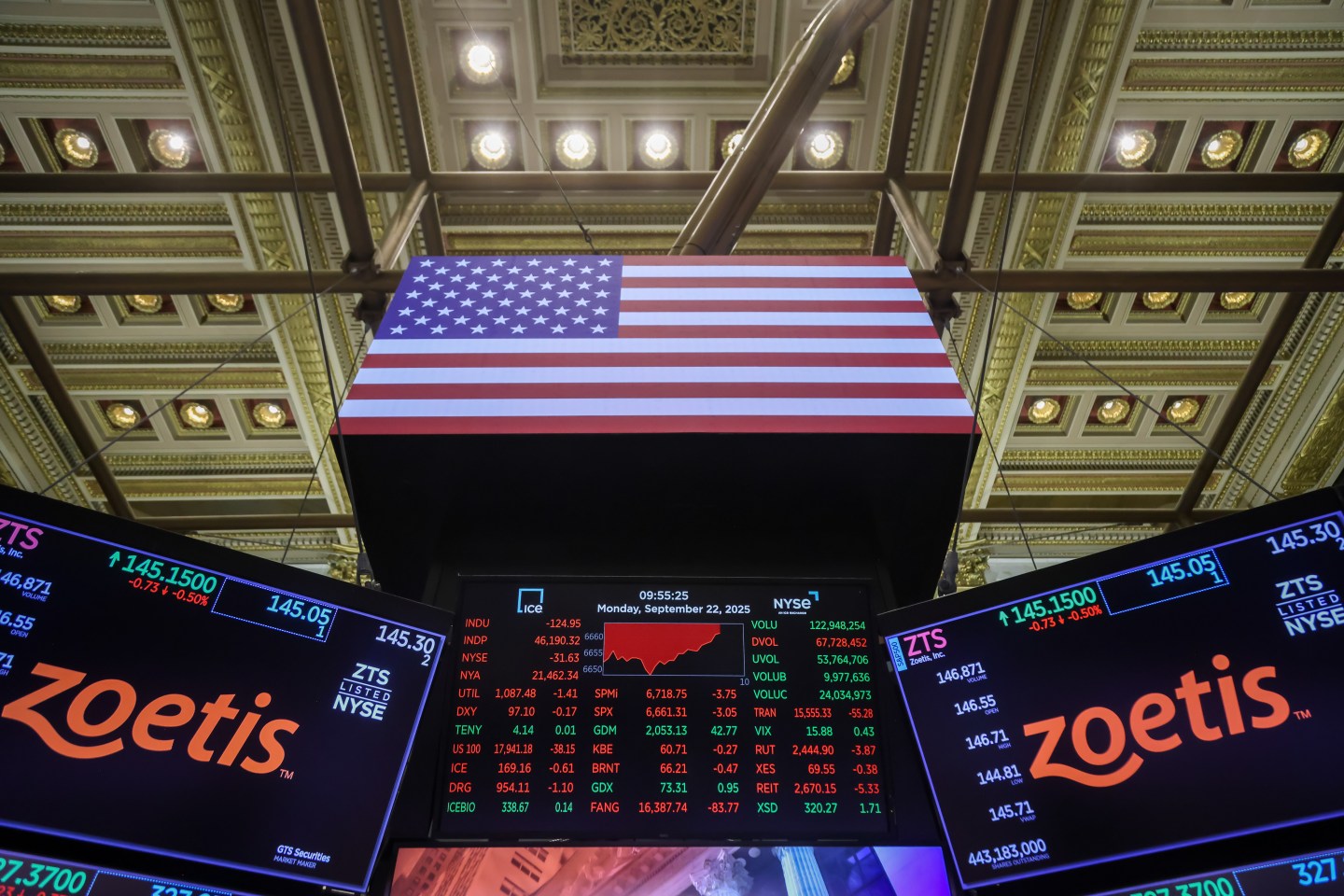
The floor of the New York Stock Exchange (NYSE) in New York, US, on Monday, Sept. 22, 2025.
The floor of the New York Stock Exchange (NYSE) in New York, US, on Monday, Sept. 22, 2025. Michael Nagle/Bloomberg via Getty Images

On August 28, the S&P 500’s price-to-earnings ratio reached a towering reading of nearly 30, the actual number that day was a whisker short at 29.85. Now it’s official: Around 3 PM on Monday, September 22, the big cap index sailed beyond that historic barrier, gaining 32 points or 0.48%, a surge that pushed the multiple over the landmark to 30.09.

Recommended Video

Equity analysts and pundits, however, virtually never mentioned that the most prominent index comprising the biggest corporate names was hovering for weeks near 30. You’d typically hear a much more modest, market-friendly number in the low 20s. It’s often hard to tell what metrics the experts are using to get a figure that compressed. It may a reading based on operating profits, or a measure incorporating Wall Street’s forecasts for earnings-per-share four quarters hence.

PEs deploying both of those benchmarks are faulty, and are constantly misrepresented as evidence that stocks are still reasonably priced, and even that multiples continue harboring scope for expansion. The approach that relies on current operating earnings eliminates taxes, interest and other “real money” items to arrive at EPS that’s artificially elevated, since it doesn’t count all the expenses on the income statement. That game swells the denominator, and makes PEs appear falsely subdued.

Multiples tied to analysts’ future estimates of EPS perform the same trick in a different way. Since the Street almost invariably issues forecasts that are highly inflated, and that even the prognosticators themselves don’t buy, that formulation posits usually unachievable earnings numbers going forward that once again, provide the illusion of friendly investor-cheering valuations.

But the only PE that matters is the one that that includes all the expenses, and counts only the official profits already in the books. It’s today’s S&P 500 index price divided by the companies’ GAAP net earnings posted over the most recent four quarters. S&P reports that with over 99% of all Q2 2025 EPS now collected, EPS over the trailing year equals $222.55. Hence, the S&P that started September at 6664 and a multiple of 29.94 by just after 3 pm had reached 6696 to hit 30.09.

For investors just entering the market, a PE of 30 is an extremely bad place to start

A PE of 30 means big caps stocks are really, really expensive by historical standards. It also signals that from these heights, the chance for big returns going forward over any extended period are low, and the risks of a sharp “reversion to the mean” downdraft is far more likely. In the last quarter century-plus, the S&P PE has only been higher on one occasion that counts. It exceeded 30 for 10 quarters from late 1998 to the close of 2002 during the Dot Com craze. It then took stocks seven years to regain the highs reached in the frenzy. (PEs also exceeded 30 during the Global Financial Crisis and COVID pandemic but only because earnings totally collapsed, skewing the data.) In no other time since 1888 did the PE at the end of any quarter exceed 30. Just prior to the market crash in 1929, it hit 20, and the month before the 1987 meltdown the S&P multiple reached 21.

The market math is flashing red

A good proxy for the S&P 500 total return going forward is the earnings yield. It’s the inverse of the PE or the cents you’re getting in dividends, buybacks and retained earnings for each dollar you plow into shares. At a 30 PE, that’s 3.3%. Add expected annual inflation over the next decade of 2.39%, and you get a projected annual return of 5.7%. Doesn’t sound bad. But equities, as Warren Buffett stresses, compete with bonds, and the bigger their edge over super-safe treasuries, the better their returns tend to be. With the 10-year yielding 4.15%, stocks are giving you a premium of just 1.55 points. That’s super narrow compared to what equity investors generally command to shoulder the substantial risk of owning equities. As recently as December of 2019, when the Treasuries yielded 1.8% and the PE was a cheaper 24, stocks enjoyed a much bigger 2.5 point cushion.

And look at what happens if over the next five years, the PE drops from 30 to 25, a number that’s still well above the long-term norm. That big drop would cut your total return to a piddling 12% or roughly 2% a year.

In the case of the stock market, past performance pretty much guarantees future returns. When stocks soar, sending PEs skywards, and especially when the comfort of Treasuries beckons at the same time, you can pretty much count on a tough slog ahead.


Join us at the Fortune Workplace Innovation Summit May 19–20, 2026, in Atlanta. The next era of workplace innovation is here—and the old playbook is being rewritten. At this exclusive, high-energy event, the world’s most innovative leaders will convene to explore how AI, humanity, and strategy converge to redefine, again, the future of work. Register now.
About the Author
Shawn Tully
By Shawn TullySenior Editor-at-Large

Shawn Tully is a senior editor-at-large at Fortune, covering the biggest trends in business, aviation, politics, and leadership.

See full bioRight Arrow Button Icon

Latest in Investing

InvestingStock
There have been head fakes before, but this time may be different as the latest stock rotation out of AI is just getting started, analysts say
By Jason MaDecember 13, 2025
5 hours ago
Investingspace
SpaceX sets $800 billion valuation, confirms 2026 IPO plans
By Loren Grush, Edward Ludlow and BloombergDecember 13, 2025
7 hours ago
InnovationRobots
Even in Silicon Valley, skepticism looms over robots, while ‘China has certainly a lot more momentum on humanoids’
By Matt O'Brien and The Associated PressDecember 13, 2025
7 hours ago
Oracle chairman of the board and chief technology officer Larry Ellison delivers a keynote address during the 2019 Oracle OpenWorld on September 16, 2019 in San Francisco, California.
AIOracle
Oracle’s collapsing stock shows the AI boom is running into two hard limits: physics and debt markets
By Eva RoytburgDecember 13, 2025
13 hours ago
robots
InnovationRobots
‘The question is really just how long it will take’: Over 2,000 gather at Humanoids Summit to meet the robots who may take their jobs someday
By Matt O'Brien and The Associated PressDecember 12, 2025
1 day ago
The Citizens Bank logo on a green layered background.
Personal FinanceCertificates of Deposit (CDs)
Citizens Bank CD rates 2025: Strong APY (but can you afford it?)
By Joseph HostetlerDecember 12, 2025
1 day ago

Most Popular

placeholder alt text
Economy
Tariffs are taxes and they were used to finance the federal government until the 1913 income tax. A top economist breaks it down
By Kent JonesDecember 12, 2025
1 day ago
placeholder alt text
Success
Apple cofounder Ronald Wayne sold his 10% stake for $800 in 1976—today it’d be worth up to $400 billion
By Preston ForeDecember 12, 2025
1 day ago
placeholder alt text
Success
40% of Stanford undergrads receive disability accommodations—but it’s become a college-wide phenomenon as Gen Z try to succeed in the current climate
By Preston ForeDecember 12, 2025
1 day ago
placeholder alt text
Economy
The Fed just ‘Trump-proofed’ itself with a unanimous move to preempt a potential leadership shake-up
By Jason MaDecember 12, 2025
1 day ago
placeholder alt text
Economy
For the first time since Trump’s tariff rollout, import tax revenue has fallen, threatening his lofty plans to slash the $38 trillion national debt
By Sasha RogelbergDecember 12, 2025
1 day ago
placeholder alt text
Success
Apple CEO Tim Cook out-earns the average American’s salary in just 7 hours—to put that into context, he could buy a new $439,000 home in just 2 days
By Emma BurleighDecember 12, 2025
1 day ago
Rankings
  • 100 Best Companies
  • Fortune 500
  • Global 500
  • Fortune 500 Europe
  • Most Powerful Women
  • Future 50
  • World’s Most Admired Companies
  • See All Rankings
Sections
  • Finance
  • Leadership
  • Success
  • Tech
  • Asia
  • Europe
  • Environment
  • Fortune Crypto
  • Health
  • Retail
  • Lifestyle
  • Politics
  • Newsletters
  • Magazine
  • Features
  • Commentary
  • Mpw
  • CEO Initiative
  • Conferences
  • Personal Finance
  • Education
Customer Support
  • Frequently Asked Questions
  • Customer Service Portal
  • Privacy Policy
  • Terms Of Use
  • Single Issues For Purchase
  • International Print
Commercial Services
  • Advertising
  • Fortune Brand Studio
  • Fortune Analytics
  • Fortune Conferences
  • Business Development
About Us
  • About Us
  • Editorial Calendar
  • Press Center
  • Work At Fortune
  • Diversity And Inclusion
  • Terms And Conditions
  • Site Map

© 2025 Fortune Media IP Limited. All Rights Reserved. Use of this site constitutes acceptance of our Terms of Use and Privacy Policy | CA Notice at Collection and Privacy Notice | Do Not Sell/Share My Personal Information
FORTUNE is a trademark of Fortune Media IP Limited, registered in the U.S. and other countries. FORTUNE may receive compensation for some links to products and services on this website. Offers may be subject to change without notice.