• Home
  • News
  • Fortune 500
  • Tech
  • Finance
  • Leadership
  • Lifestyle
  • Rankings
  • Multimedia
EconomyDeficit

‘The nation’s finances have deteriorated’ since Trump took office, CRFB says, gaming out the scenarios up to a $28.5 trillion deficit

Nick Lichtenberg
By
Nick Lichtenberg
Nick Lichtenberg
Business Editor
Down Arrow Button Icon
Nick Lichtenberg
By
Nick Lichtenberg
Nick Lichtenberg
Business Editor
Down Arrow Button Icon
August 21, 2025, 12:29 PM ET
Donald Trump
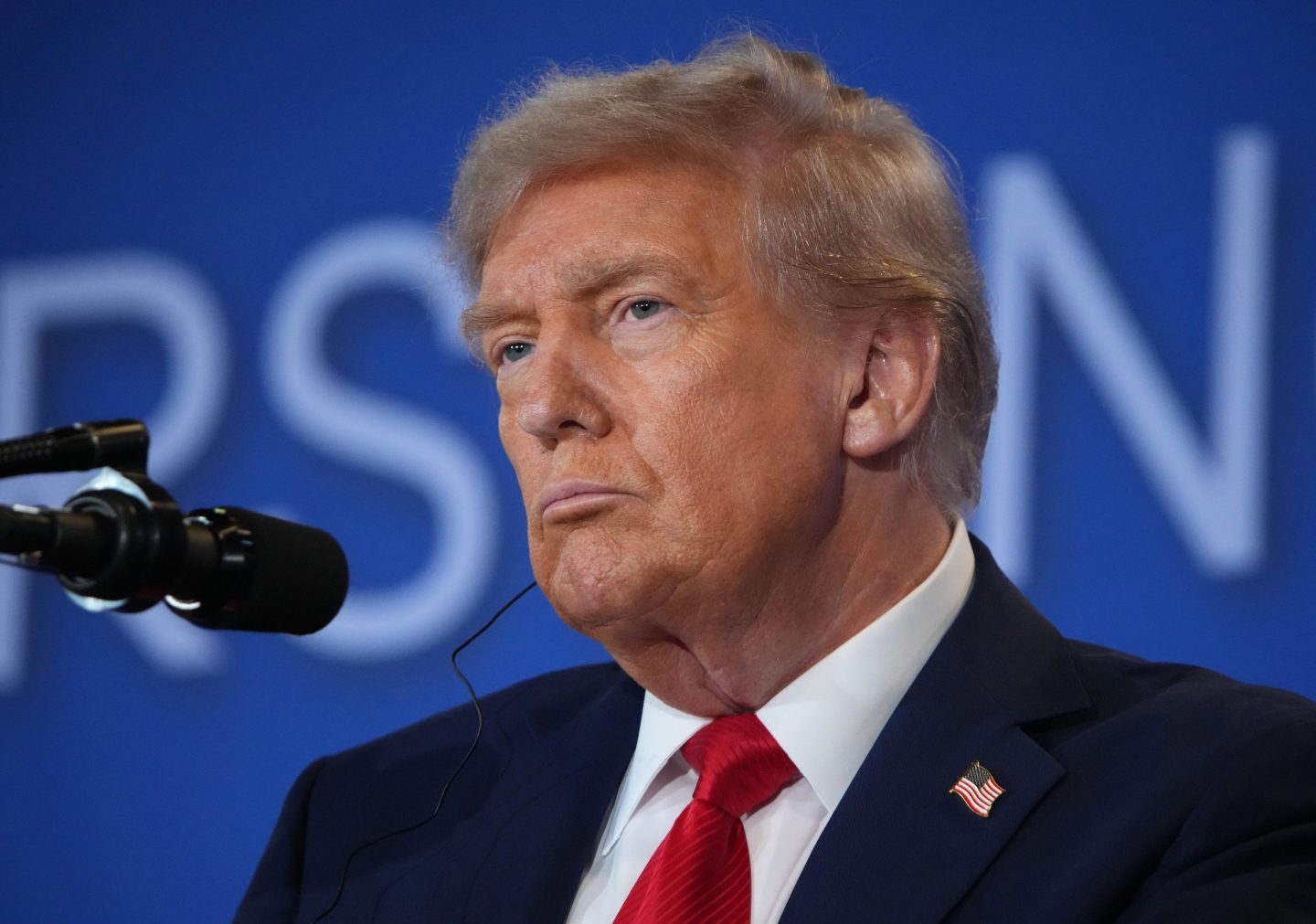
President Donald TrumpAndrew Harnik—Getty Images

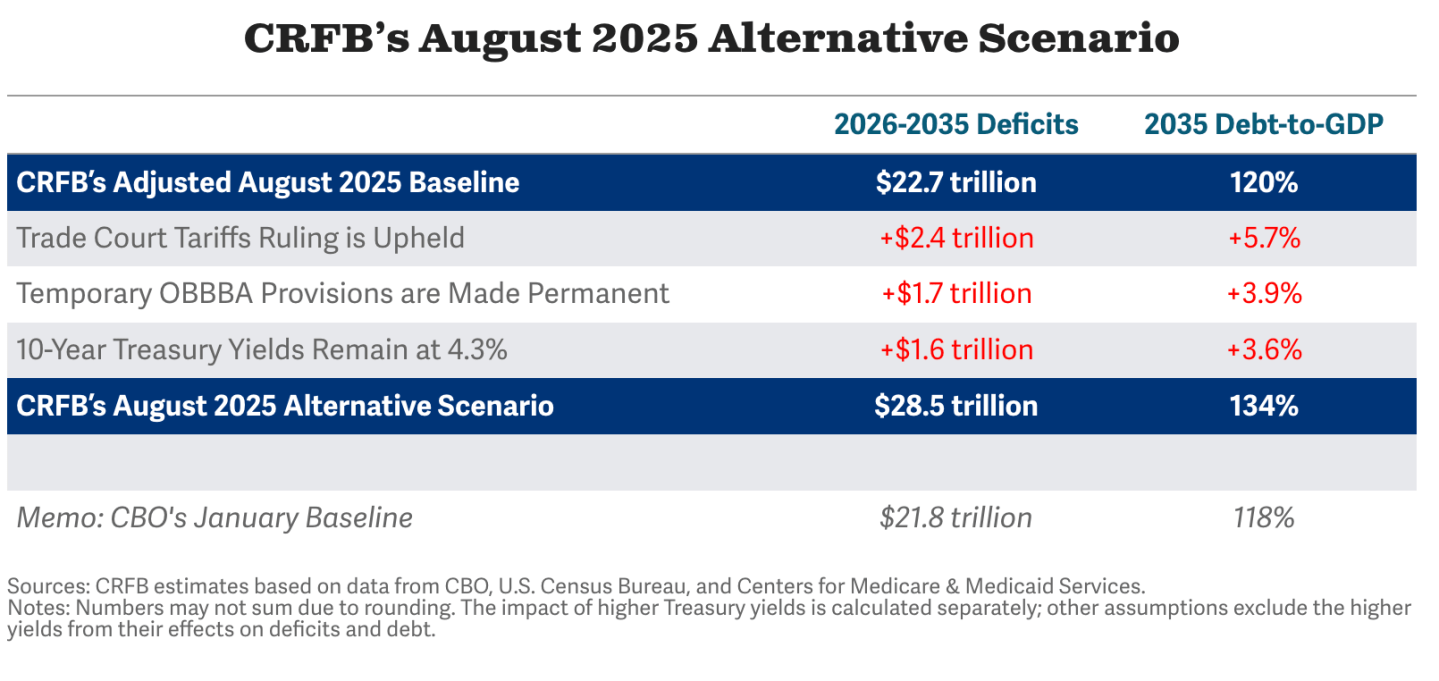
“The nation’s finances have deteriorated” since President Trump took office, driven by sweeping legislative and trade policy changes, according to the Committee for a Responsible Federal Budget (CRFB). The nonpartisan watchdog noted that the Congressional Budget Office’s January 2025 budget outlook “already showed a worrisome fiscal outlook,” but developments since mean a widening deficit. The CRFB gamed out several scenarios, including an adjusted baseline which accounts for “most legislative and administrative changes but not economic and technical changes.” The CRFB also included an alternative scenario in which the U.S. Trade Court’s ruling that many of Trump’s tariffs are illegal is upheld; temporary provisions of the One Big Beautiful Bill Act are made permanent; and yields on Treasury securities remain at their current level.

Recommended Video

The adjusted baseline shows cumulative deficits are forecast to reach $22.7 trillion, amounting to 6.1% of GDP, with annual deficits climbing from $1.7 trillion in 2025 to $2.6 trillion in 2035. Meanwhile, it sees debt held by the public rising from about 100% of GDP—currently $30 trillion—to 120% of GDP ($53 trillion).

Under the CRFB’s alternative scenario—where key OBBBA provisions are made permanent, tariff revenues fall owing to legal setbacks, and interest rates remain elevated—debt could climb to 134% of GDP by 2035 and the 10-year deficit would exceed $28.5 trillion. Over fiscal years 2026 through 2035, net interest payments alone are set to total $14 trillion over the decade, nearly doubling from $1 trillion this year to $1.8 trillion by 2035.
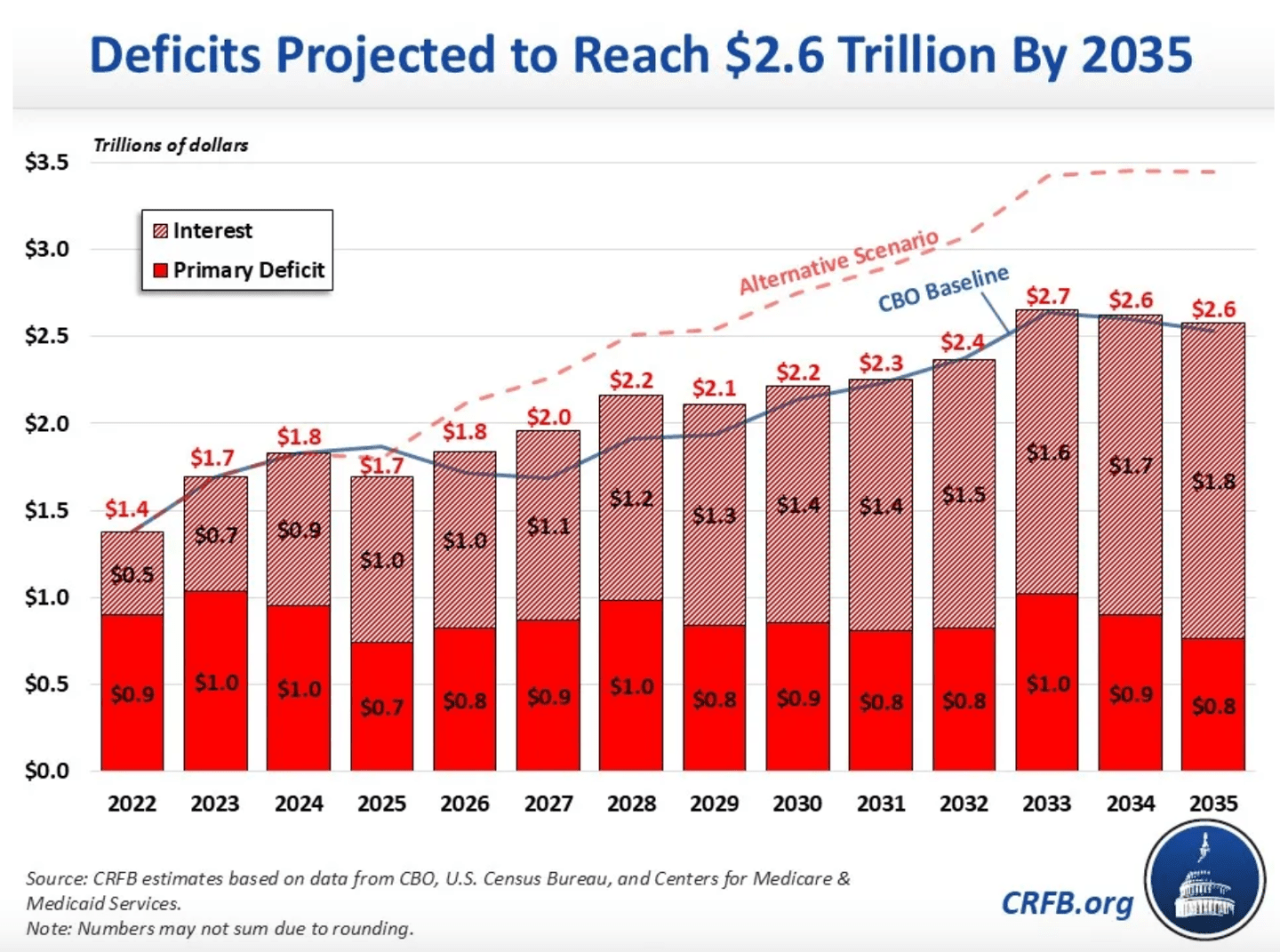
Expenditures are expected to grow, totaling $88 trillion (23.6% of GDP) for the decade, while revenues—spurred on by tariffs replacing some lost tax receipts—will reach $65 trillion (17.5% of GDP). This persistent gap between spending and revenue underpins the widening deficit. The CRFB has previously weighed in on the tariffs’ impact on deficits, calling them both “significant” and “meaningful.”

Policy changes: OBBBA and tariffs feed fiscal imbalance

Central to the deteriorating outlook is enactment of the One Big Beautiful Bill Act (OBBBA), which the CRFB projects will increase deficits by $4.6 trillion over the next decade and push debt up by more than 10% of GDP by 2035.

Meanwhile, a surge in tariffs following administration policies is expected to offset some costs, saving $3.4 trillion in deficits and reducing debt by 8% of GDP over the same period. These savings are, however, at risk: The U.S. Court of International Trade ruled much of the tariff regime illegal in May, and if that decision stands, tariffs could produce less than $1 trillion in deficit reduction—adding $2.4 trillion to the federal deficit and increasing debt by 5.7% of GDP.

Under the alternative scenario, annual deficit growth would be exacerbated by extensions of tax cuts and spending increases, combined with higher interest on the rapidly rising debt load. Also under this scenario, interest payments on the national debt, already surging from less than $500 billion in 2022, could hit $2.2 trillion (5.1% of GDP) annually by 2035 if interest rates stay high. The CRFB warns the outlook could be even worse if offsets built into OBBBA are delayed and new deficit-increasing proposals—like tariff rebates—are implemented, or if economic headwinds slow revenue collection. A recession or financial crisis over the next decade could further deepen deficits and add to the debt burden.
The CRFB calls for lawmakers to prioritize revenue and spending options that put the federal budget on a sustainable path, emphasizing that any changes to tax and spending policies should be paid for at a minimum under a “pay-as-you-go” approach, and ideally under its own bespoke recommendation of “Super PAYGO,” which would require offsets that exceed new costs twofold. With debt heading toward record levels, the group argues for proactive solutions to trust fund solvency and corrective fiscal action.

Republican leaders and Trump officials argue the OBBBA will reduce the deficit via two mechanisms:

  • “Historic spending reductions,” credited in GOP Senate and administration releases with $1.5 trillion to $1.6 trillion in mandatory spending cuts, mainly in social programs.
  • Economic growth projections: The White House and GOP claim the bill’s “pro-growth tax reforms” will unleash enough economic expansion to boost tax revenues by $4 trillion, turning a static deficit increase into a dynamic deficit reduction.

No concrete detailed plan has been laid out that would balance the budget if the bill’s tax cuts are extended and the dynamic growth does not materialize.

For this story, Fortune used generative AI to help with an initial draft. An editor verified the accuracy of the information before publishing. 

Fortune Brainstorm AI returns to San Francisco Dec. 8–9 to convene the smartest people we know—technologists, entrepreneurs, Fortune Global 500 executives, investors, policymakers, and the brilliant minds in between—to explore and interrogate the most pressing questions about AI at another pivotal moment. Register here.
About the Author
Nick Lichtenberg
By Nick LichtenbergBusiness Editor
LinkedIn icon

Nick Lichtenberg is business editor and was formerly Fortune's executive editor of global news.

See full bioRight Arrow Button Icon

Latest in Economy

Federal Reserve Bank Chair Jerome Powell
EconomyFederal Reserve
Trump’s pick for chairman isn’t enough to threaten Fed independence, says Bank of America—especially if Jerome Powell decides to stick around
By Eleanor PringleDecember 3, 2025
5 hours ago
Elon Musk, standing with his arms crossed, looks down at Donald Trump sitting at his desk in the Oval Office
EconomyTariffs and trade
Elon Musk says he warned Trump against tariffs, which U.S. manufacturers blame for a turn to more offshoring and diminishing American factory jobs
By Sasha RogelbergDecember 2, 2025
22 hours ago
layoffs
EconomyLayoffs
What CEOs say about AI and what they mean about layoffs and job cuts: Goldman Sachs peels the onion
By Nick LichtenbergDecember 2, 2025
22 hours ago
Trump
CommentaryTariffs and trade
The trade war was never going to fix our deficit
By Daniel BunnDecember 2, 2025
1 day ago
EconomyFinance
Michael Dell talks candidly about his $6.25 billion donation to fund Invest America accounts for 25 million American children
By Diane BradyDecember 2, 2025
1 day ago
Mohamed Aly El-Erian
EconomyFederal Reserve
‘This Fed went to sleep,’ says top economist Mohamed El-Erian, who wants to see the central bank reformed and presidents to ‘cool it’
By Eleanor PringleDecember 2, 2025
1 day ago

Most Popular

placeholder alt text
Economy
Ford workers told their CEO 'none of the young people want to work here.' So Jim Farley took a page out of the founder's playbook
By Sasha RogelbergNovember 28, 2025
5 days ago
placeholder alt text
North America
Jeff Bezos and Lauren Sánchez Bezos commit $102.5 million to organizations combating homelessness across the U.S.: ‘This is just the beginning’
By Sydney LakeDecember 2, 2025
1 day ago
placeholder alt text
Success
Warren Buffett used to give his family $10,000 each at Christmas—but when he saw how fast they were spending it, he started buying them shares instead
By Eleanor PringleDecember 2, 2025
1 day ago
placeholder alt text
Economy
Elon Musk says he warned Trump against tariffs, which U.S. manufacturers blame for a turn to more offshoring and diminishing American factory jobs
By Sasha RogelbergDecember 2, 2025
22 hours ago
placeholder alt text
C-Suite
MacKenzie Scott's $19 billion donations have turned philanthropy on its head—why her style of giving actually works
By Sydney LakeDecember 2, 2025
1 day ago
placeholder alt text
North America
Anonymous $50 million donation helps cover the next 50 years of tuition for medical lab science students at University of Washington
By The Associated PressDecember 2, 2025
1 day ago
Rankings
  • 100 Best Companies
  • Fortune 500
  • Global 500
  • Fortune 500 Europe
  • Most Powerful Women
  • Future 50
  • World’s Most Admired Companies
  • See All Rankings
Sections
  • Finance
  • Leadership
  • Success
  • Tech
  • Asia
  • Europe
  • Environment
  • Fortune Crypto
  • Health
  • Retail
  • Lifestyle
  • Politics
  • Newsletters
  • Magazine
  • Features
  • Commentary
  • Mpw
  • CEO Initiative
  • Conferences
  • Personal Finance
  • Education
Customer Support
  • Frequently Asked Questions
  • Customer Service Portal
  • Privacy Policy
  • Terms Of Use
  • Single Issues For Purchase
  • International Print
Commercial Services
  • Advertising
  • Fortune Brand Studio
  • Fortune Analytics
  • Fortune Conferences
  • Business Development
About Us
  • About Us
  • Editorial Calendar
  • Press Center
  • Work At Fortune
  • Diversity And Inclusion
  • Terms And Conditions
  • Site Map

© 2025 Fortune Media IP Limited. All Rights Reserved. Use of this site constitutes acceptance of our Terms of Use and Privacy Policy | CA Notice at Collection and Privacy Notice | Do Not Sell/Share My Personal Information
FORTUNE is a trademark of Fortune Media IP Limited, registered in the U.S. and other countries. FORTUNE may receive compensation for some links to products and services on this website. Offers may be subject to change without notice.