
• Home
  • Latest
  • Fortune 500
  • Finance
  • Tech
  • Leadership
  • Lifestyle
  • Rankings
  • Multimedia
TechNvidia

Nvidia and AMD’s ‘special treatment’ from Trump is shaking up an already tangled global chip supply chain

Nicholas Gordon
By
Nicholas Gordon
Nicholas Gordon
Asia Editor
Down Arrow Button Icon
August 16, 2025, 7:00 AM ET
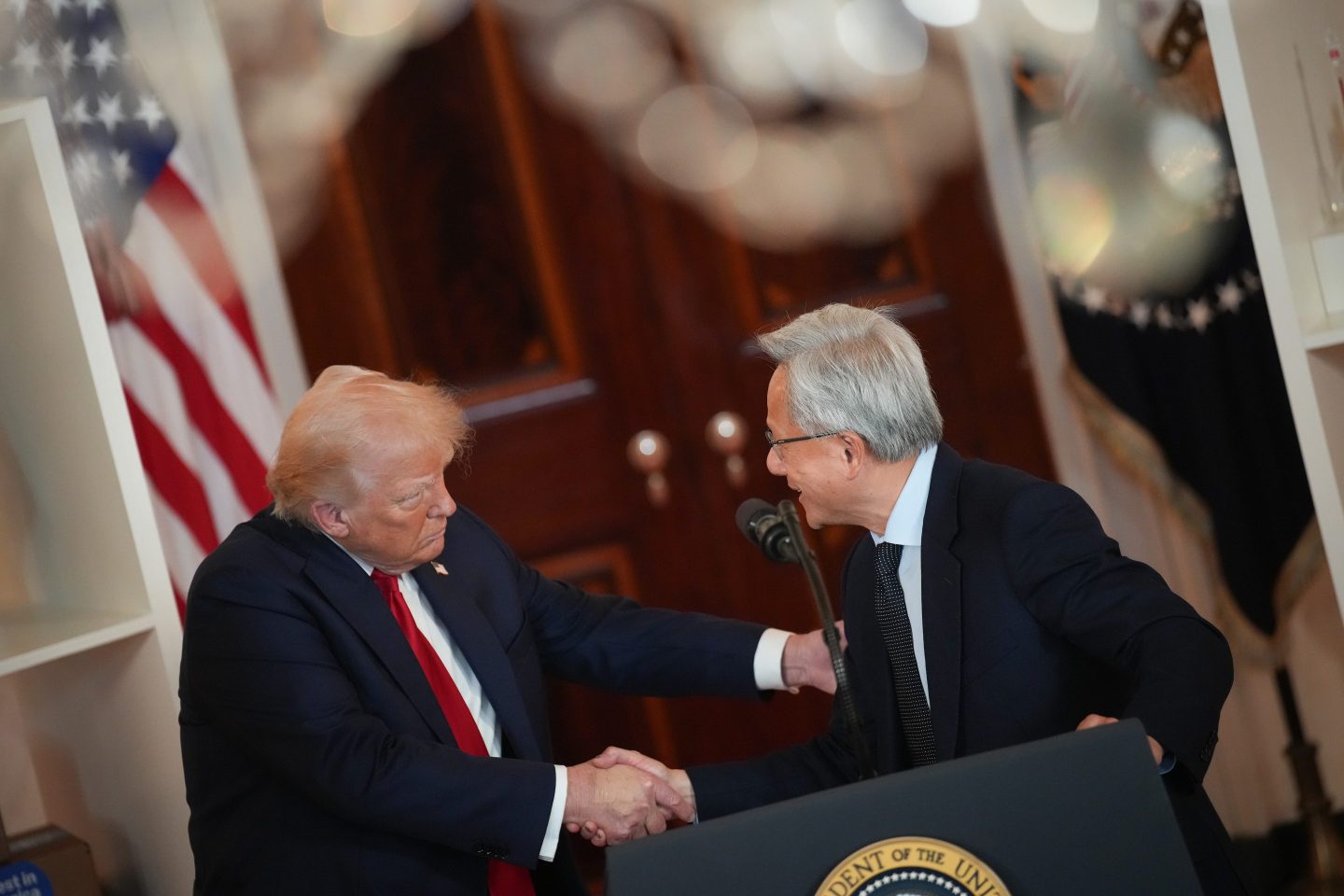
Donald Trump shakes hands with Nvidia CEO Jensen Huang
President Donald Trump shakes hands with Nvidia CEO Jensen Huang at a White House event on April 30, 2025Andrew Harnik—Getty Images

Donald Trump’s decision to let Nvidia and AMD export AI processors to China in exchange for a cut of their sales will have repercussions far beyond the U.S.

The semiconductor supply chain is global, involving a wide array of non-U.S. companies, often based in countries that are U.S. allies. Nvidia’s chips may be designed and sold by a U.S. company, but they’re manufactured by Taiwan’s TSMC, using chipmaking tools from companies like ASML, which is based in the Netherlands, and Japan’s Tokyo Election, and using components from suppliers like South Korea’s SK Hynix.

The U.S. leaned on these global companies for years to try to limit their engagement with China; these efforts picked up after the passage of the CHIPS Act and the expansion of U.S. chip-export controls in 2022. Washington has also pressured major transshipment hubs, like Singapore and the United Arab Emirates, to more closely monitor chip shipments to ensure that controlled chips don’t make their way to China in violation of U.S. law.

Recommended Video

Within the U.S., discussion of Trump’s Nvidia deal has focused on what it means for China’s government’s and Chinese companies’ ability to get their hands on cutting-edge U.S. technology. But several other countries and companies are likely studying the deal closely to see if they might get an opening to sell to China as well. 

Trump’s Nvidia deal “tells you that [U.S.] national security is not really the issue, or has never been the issue” with export controls, says Mario Morales, who leads market research firm IDC’s work on semiconductors. Companies and countries will “probably have to revisit what their strategy has been, and in some cases, they’re going to break away from the U.S. administration’s policies.”

“If Nvidia and AMD are given special treatment because they’ve ‘paid to play’, why shouldn’t other companies be doing the same?” he adds.

Getting allies on their side

The Biden administration spent a lot of diplomatic energy to get its allies to agree to limit their semiconductor exports to China. First, Washington said that manufacturers like TSMC and Intel that wanted to tap billions in subsidies could not expand advanced chip production in China. Then, the U.S. pushed for its allies to impose their own sanctions on exports to China. 

“Export controls and other sanctions efforts are necessarily multilateral, yet are fraught with collective action problems,” says Jennifer Lind, an associate professor at Dartmouth College and international relations expert. “Other countries are often deeply unenthusiastic about telling their firms—which are positioned to bring in a lot of revenue, which they use for future innovation—that they cannot export to Country X or Country Y.”

This translates to “refusing to participate in export controls or to devoting little or no effort to ensuring that their firms are adhering to the controls,” she says.

 Paul Triolo, a partner at the DGA-Albright Stonebridge Group, points out that “Japanese and Dutch officials during the Biden administration resisted any serious alignment with U.S. controls,” and suggests that U.S allies “will be glad to see a major stepping back from controls.”

Ongoing trade negotiations between the U.S. and its trading partners could weaken export controls further. 

Chinese officials may demand a rollback of chip sanctions as part of a grand bargain between Washington and Beijing, similar to how the U.S. agreed to grant export licenses to Nvidia and AMD in exchange for China loosening its controls on rare earth magnets. 

Japan and South Korea may also bring up the chip controls as part of their own trade negotiations with Trump. 

‘Expect continuing diversions’

A separate issue are controls over the transfer of Nvidia GPUs. The U.S. has leaned on governments like Singapore, Malaysia and the United Arab Emirates to prevent advanced Nvidia processors from making their way to China.

Scrutiny picked up in the wake of DeepSeek’s surprise AI release earlier this year, amid allegations that the Hangzhou-based startup had trained its powerful models on Nvidia processors that were subject to export controls. (The startup claims that it acquired its processors before export controls came into effect).

As of now, the two chips allowed to be sold in China–Nvidia’s H20 and AMD’s MI308–are not the most powerful AI chips on the market. The leading-edge processors, like Nvidia’s Blackwell chip, cannot be sold to China. 

That means chip smuggling will continue to be a concern for the U.S. government. Yet “enforcement will be spotty,” Triolo says. “The Commerce Department lacks resources to track GPUs globally, hence expect continuing diversions of limited amounts of GPUs to China via Thailand, Malaysia, and other jurisdictions.”

Triolo is, instead, focused on another loophole in the export control regime: Chinese firms accessing AI chips based in overseas data centers. “There is no sign that the Trump Commerce Department is gearing up to try and close this gaping loophole in U.S. efforts to limit Chinese access to advanced compute,” he says. 

How much will the global supply chain change?

Not all analysts think we’ll see a complete unraveling of the export control regime.

“The controls involve a complex multinational coalition that all parties will be hesitant to disrupt, given how uncertain the results will be,” says Chris Miller, author of Chip War: The Fight for the World’s Most Critical Technology. He adds that many of these chipmakers and suppliers don’t have the same political heft as Nvidia, the world’s most valuable company. 

Yet while these companies may not be as politically savvy as Nvidia, they’re just as important. TSMC, for example, is the only company that can manufacture the newest generation of advanced chips; ASML is the only supplier of the extreme ultraviolet lithography machines used to make the smallest semiconductors. 

“I don’t believe it’s leverage that the Trump administration will easily give away,” says Ray Wang, a semiconductor researcher at the Futurum Group.
Join us at the Fortune Workplace Innovation Summit May 19–20, 2026, in Atlanta. The next era of workplace innovation is here—and the old playbook is being rewritten. At this exclusive, high-energy event, the world’s most innovative leaders will convene to explore how AI, humanity, and strategy converge to redefine, again, the future of work. Register now.
About the Author
Nicholas Gordon
By Nicholas GordonAsia Editor
LinkedIn iconTwitter icon

Nicholas Gordon is an Asia editor based in Hong Kong, where he helps to drive Fortune’s coverage of Asian business and economics news.

See full bioRight Arrow Button Icon

Latest in Tech

Finance
Lorem ipsum dolor sit amet, consectetur adipiscing elit, sed do eiusmod tempor incididunt ut labore et dolore magna aliqua. Ut enim ad minim veniam
By Fortune Editors
October 20, 2025
Finance
Lorem ipsum dolor sit amet, consectetur adipiscing elit, sed do eiusmod tempor incididunt ut labore et dolore magna aliqua. Ut enim ad minim veniam
By Fortune Editors
October 20, 2025
Finance
Lorem ipsum dolor sit amet, consectetur adipiscing elit, sed do eiusmod tempor incididunt ut labore et dolore magna aliqua. Ut enim ad minim veniam
By Fortune Editors
October 20, 2025
Finance
Lorem ipsum dolor sit amet, consectetur adipiscing elit, sed do eiusmod tempor incididunt ut labore et dolore magna aliqua. Ut enim ad minim veniam
By Fortune Editors
October 20, 2025
Finance
Lorem ipsum dolor sit amet, consectetur adipiscing elit, sed do eiusmod tempor incididunt ut labore et dolore magna aliqua. Ut enim ad minim veniam
By Fortune Editors
October 20, 2025
Finance
Lorem ipsum dolor sit amet, consectetur adipiscing elit, sed do eiusmod tempor incididunt ut labore et dolore magna aliqua. Ut enim ad minim veniam
By Fortune Editors
October 20, 2025

Most Popular

Finance
Lorem ipsum dolor sit amet, consectetur adipiscing elit, sed do eiusmod tempor incididunt ut labore et dolore magna aliqua. Ut enim ad minim veniam
By Fortune Editors
October 20, 2025
Finance
Lorem ipsum dolor sit amet, consectetur adipiscing elit, sed do eiusmod tempor incididunt ut labore et dolore magna aliqua. Ut enim ad minim veniam
By Fortune Editors
October 20, 2025
Finance
Lorem ipsum dolor sit amet, consectetur adipiscing elit, sed do eiusmod tempor incididunt ut labore et dolore magna aliqua. Ut enim ad minim veniam
By Fortune Editors
October 20, 2025
Finance
Lorem ipsum dolor sit amet, consectetur adipiscing elit, sed do eiusmod tempor incididunt ut labore et dolore magna aliqua. Ut enim ad minim veniam
By Fortune Editors
October 20, 2025
Finance
Lorem ipsum dolor sit amet, consectetur adipiscing elit, sed do eiusmod tempor incididunt ut labore et dolore magna aliqua. Ut enim ad minim veniam
By Fortune Editors
October 20, 2025
Finance
Lorem ipsum dolor sit amet, consectetur adipiscing elit, sed do eiusmod tempor incididunt ut labore et dolore magna aliqua. Ut enim ad minim veniam
By Fortune Editors
October 20, 2025
Rankings
  • 100 Best Companies
  • Fortune 500
  • Global 500
  • Fortune 500 Europe
  • Most Powerful Women
  • Future 50
  • World’s Most Admired Companies
  • See All Rankings
Sections
  • Finance
  • Leadership
  • Success
  • Tech
  • Asia
  • Europe
  • Environment
  • Fortune Crypto
  • Health
  • Retail
  • Lifestyle
  • Politics
  • Newsletters
  • Magazine
  • Features
  • Commentary
  • Mpw
  • CEO Initiative
  • Conferences
  • Personal Finance
  • Education
Customer Support
  • Frequently Asked Questions
  • Customer Service Portal
  • Privacy Policy
  • Terms Of Use
  • Single Issues For Purchase
  • International Print
Commercial Services
  • Advertising
  • Fortune Brand Studio
  • Fortune Analytics
  • Fortune Conferences
  • Business Development
About Us
  • About Us
  • Editorial Calendar
  • Press Center
  • Work At Fortune
  • Diversity And Inclusion
  • Terms And Conditions
  • Site Map

© 2025 Fortune Media IP Limited. All Rights Reserved. Use of this site constitutes acceptance of our Terms of Use and Privacy Policy | CA Notice at Collection and Privacy Notice | Do Not Sell/Share My Personal Information
FORTUNE is a trademark of Fortune Media IP Limited, registered in the U.S. and other countries. FORTUNE may receive compensation for some links to products and services on this website. Offers may be subject to change without notice.


Most Popular

placeholder alt text
Economy
The $38 trillion national debt is to blame for over $1 trillion in annual interest payments from here on out, CRFB says
By Nick LichtenbergDecember 17, 2025
2 days ago
placeholder alt text
Success
As millions of Gen Zers face unemployment, McDonald's CEO dishes out some tough love career advice for navigating the market: ‘You've got to make things happen for yourself’
By Preston ForeDecember 16, 2025
3 days ago
placeholder alt text
Future of Work
LinkedIn CEO says it's 'outdated' to have a five-year career plan: It's a 'little bit foolish' considering the pace AI is changing the workplace
By Sydney LakeDecember 18, 2025
23 hours ago
placeholder alt text
C-Suite
Red Lobster CEO Damola Adamolekun says the key to being a better leader is being a better person: ‘Leadership is self-improvement’
By Sydney LakeDecember 17, 2025
2 days ago
placeholder alt text
Economy
‘This is a wacky number’: economists cry foul as new government data assumes zero housing inflation in surprising November drop
By Eva RoytburgDecember 18, 2025
19 hours ago
placeholder alt text
AI
'Robots are going to be amongst us': Qualcomm exec says buckle up for the next 5 years. Your car is going to be the first shoe to drop
By Nino PaoliDecember 17, 2025
2 days ago

Latest in Tech

TikTok
CybersecurityTikTok
TikTok agrees U.S. joint venture deal with Oracle, Silver Lake and MGX
By Barbara Ortutay and The Associated PressDecember 19, 2025
19 minutes ago
NewslettersTerm Sheet
Inside OpenAI’s ‘code red’
By Allie GarfinkleDecember 19, 2025
2 hours ago
TikTok CEO Shou Zi Chew (center) on January 20, 2025 in Washington, D.C. (Photo: Shawn Thew-Pool/Getty Images)
NewslettersFortune Tech
TikTok finally, actually, seriously agrees to divest its U.S. unit
By Andrew NuscaDecember 19, 2025
3 hours ago
At left, CEO of Scale A.I. Alexandr Wang testifies during a House Armed Services Subcommittee on Cyber, Information Technologies and Innovation hearing about artificial intelligence, as other people watch him, on Capitol Hill July 18, 2023 in Washington, DC
AIMeta
Meta’s 28-year-old billionaire prodigy says the next Bill Gates will be a 13-year-old who is ‘vibe coding’ right now
By Eva RoytburgDecember 19, 2025
3 hours ago
Luigi
CybersecurityCrime
‘It seemed preposterous on its face’: Altoona cop’s supervisor said he’d buy his favorite hoagie moments before Luigi Mangione arrest
By Michael R. Sisak, Jennifer Peltz and The Associated PressDecember 18, 2025
15 hours ago
Bill Gates
CybersecurityJeffrey Epstein
House Democrats release more Epstein photos, including Bill Gates and a dinner full of wealthy philanthropists
By Stephen Groves and The Associated PressDecember 18, 2025
15 hours ago