
America’s consumer economy showed renewed signs of strength in July, but the gains are not being shared equally. According to Bank of America Institute’s latest report, Consumer Checkpoint: Gains and Gaps, higher-income households are enjoying accelerating wage growth and increased spending, while lower-income households face slowing pay gains and flat expenditure—marking the widest such divide in more than four years.
The institute’s research, based on aggregated and anonymized deposit and transaction data, reveals that after-tax wages for the lowest-income tercile grew just 1.3% year over year (YOY) in July, down from 1.6% in June. In contrast, higher-income wage growth accelerated to 3.2% YOY—its third consecutive monthly increase.
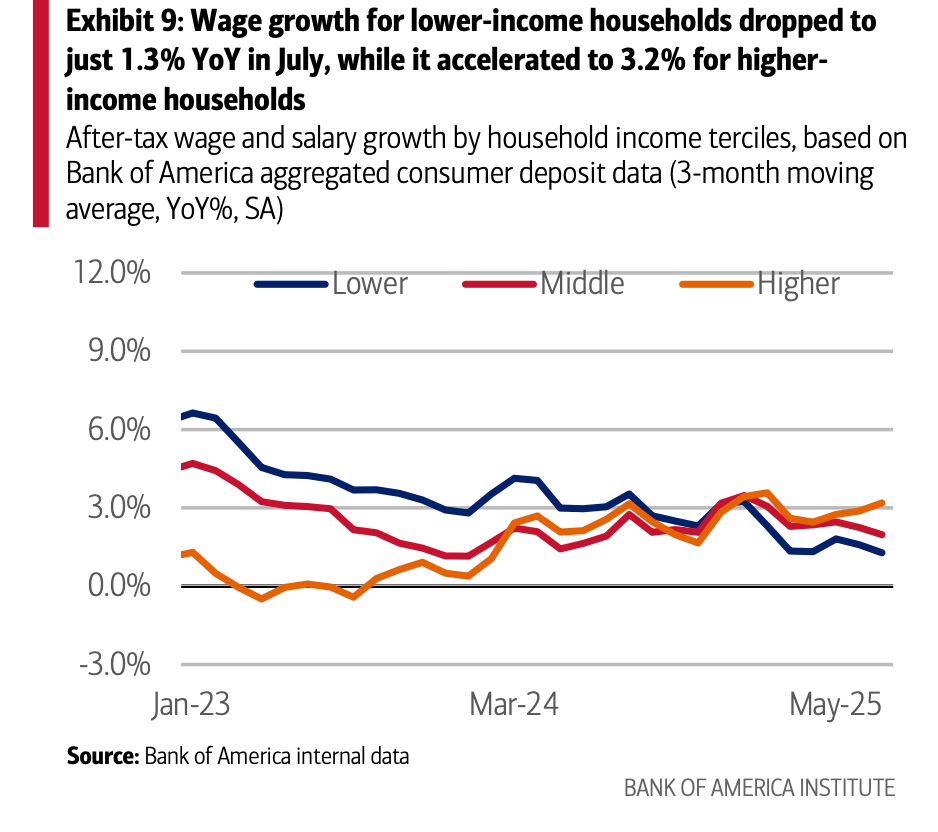
The result is the biggest gap between top and bottom earners’ wage growth since February 2021—a warning sign for the economy despite a strong overall spending picture. Bank of America Institute senior economist David Tinsley told Fortune in an interview: “In some sense, we had an improvement in lower-income wage growth since the pandemic, and now that’s gone into reverse.”
Coming out of the pandemic was a “very unusual situation,” Tinsley added, and lower-income households genuinely did see stronger wage growth than other areas of the economy.
“There was a narrowing of wealth inequality, and now it’s widening,” Tinsley said, though cautioned it was “early days.” Still, when he looks at what’s happening to higher- and lower-income Americans, he says, “the divergence is quite stark.”
Overall consumer activity picks up
Tinsley emphasized the overall consumer picture is “fairly healthy,” and his team’s research on the latest data shows total credit and debit card spending per household rose 1.8% YOY in July, the fastest pace since January. On a seasonally adjusted basis, spending climbed 0.6% month over month (MOM), following a 0.4% gain in June.
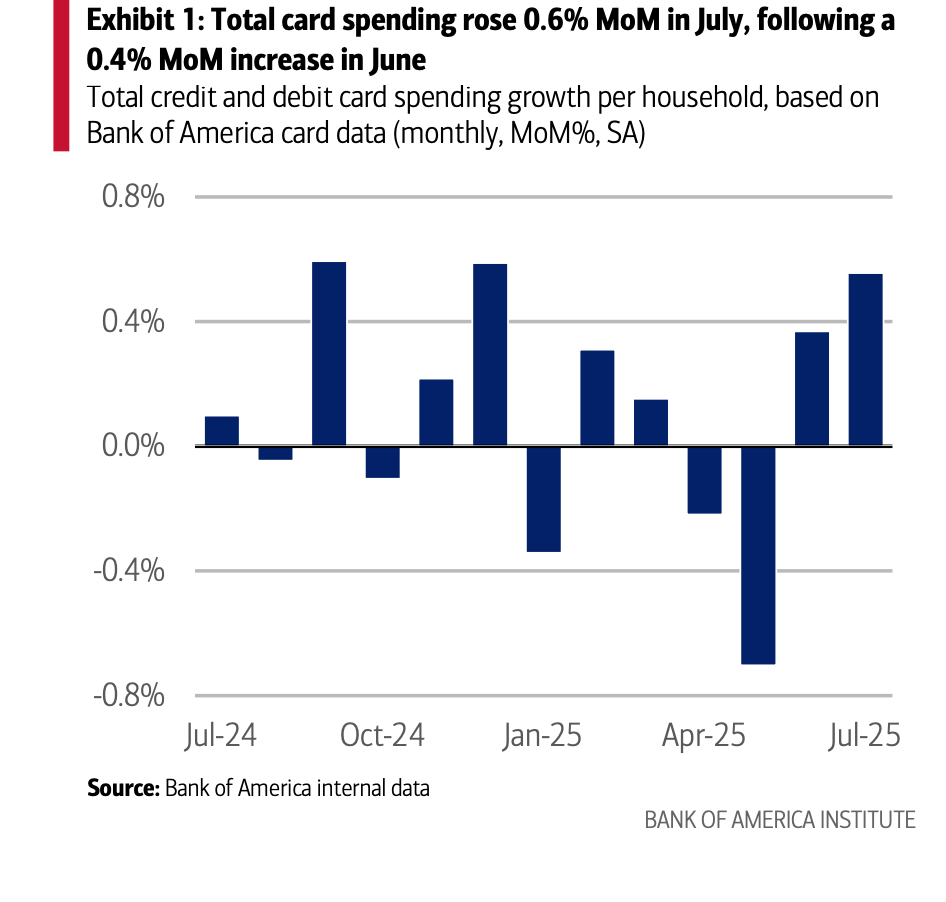
Notably, the rebound was broad-based, as services spending surged 0.9% month over month, the strongest increase since April 2024, after three straight months of declines. Retail spending (excluding gasoline and restaurants) also edged higher, though part of the lift came from temporary factors such as extended Prime Day–style online promotions and a late surge in back-to-school shopping.
Tinsley and his team cautioned these boosts may fade. Some of July’s uptick may reflect “buy-ahead” behavior linked to the Aug. 1 trade-deal deadline, as consumers sought to avoid potential tariff-related price hikes. Overall, temporary promotional spikes and inflation pass-through from tariffs complicate the picture. Retail transaction volumes rose more modestly than spending values, hinting higher prices, rather than greater quantities, may have driven part of the increase.
The widening wage gap tracks closely with labor market shifts. Recent Bureau of Labor Statistics revisions show a sharp slowdown in payroll growth in the second quarter of 2025, with the biggest step-downs in low-wage industries such as retail, wholesale, leisure, and hospitality.
Bank of America deposit data indicates only a modest 4% year-over-year rise in the number of lower-income households receiving unemployment payments, compared with 10% increases among middle- and higher-income households. This suggests low-wage workers are not losing jobs in large numbers, but are instead facing reduced hours or muted pay growth.
Spending divergence now clear-cut
The spending data mirrors the pay trends. “Lower-income households aren’t really spending,” Tinsley told Fortune, finding that their spending growth was flat (0% year over year) in the three months to July. Higher-income households posted 1.8% year-over-year growth, with middle-income households up 1.0%.
While the lowest-income 30% of households account for less than 15% of total U.S. consumer spending, their purchases matter for sectors dependent on high transaction volumes, such as discount retail, quick-service restaurants, and budget travel. More important, Bank of America’s internal data shows the share of lower-income spending devoted to discretionary categories has barely changed since last year, suggesting they have not yet resorted to cutting nonessentials—but their capacity for future cutbacks remains small.
No early signs of consumer distress—yet
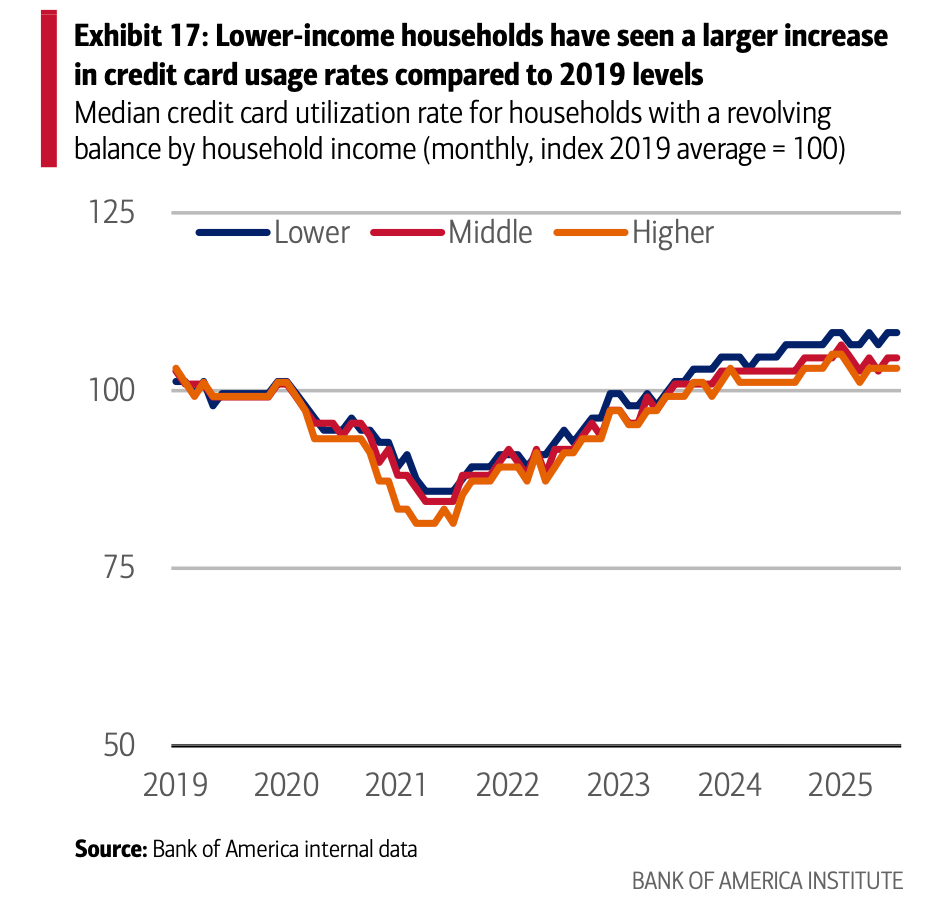
One potentially reassuring takeaway is the absence of typical distress indicators. Retail returns are not rising—the downtrend that began in 2022 has merely flattened, while deposit balances remain above 2019 levels even after adjusting for inflation, and credit card borrowing habits remain healthier than pre-pandemic. However, beneath these broad measures are hints of strain: Among lower-income households that do carry month-to-month card balances, credit card utilization rates have risen faster than in other groups since 2019.
Even with slower wage growth at the bottom, the institute concludes household finances overall remain “sound.” Continued elevated savings, relatively low revolving credit usage, and stable borrowing capacity suggest consumers still possess spending firepower—a key factor supporting the economy’s resilience so far this year.
That said, the report notes middle- and higher-income households are doing much of the heavy lifting.
As Tinsley’s team observed: “From a macroeconomic perspective, it is reassuring that middle- and higher-income households’ spending growth does not appear to be weakening like it has for lower-income households,” noting the lowest 30% of households by income account for less than 15% of overall U.S. consumer spending. Still, the team added, “there are broader socioeconomic concerns around any slowdown in lower-income households’ wages and spending.”
When asked by Fortune to expand on these broader socioeconomic concerns, Tinsley said: “There’s some time to go before this becomes really telling.” He estimated the economy is at least a year or maybe as much as 18 months away from truly reversing all the progress on wealth inequality that was seen coming out of the pandemic, but he said there’s no doubt about it. The widening wealth inequality picture “creates complexities going forward.”
Key July 2025 figures:
- Total card spending per household: +1.8% YOY (fastest since January)
- After-tax wage growth (lowest-income tercile): +1.3% YOY
- After-tax wage growth (highest-income tercile): +3.2% YOY
- Card spending (lowest tercile): 0% YOY
- Card spending (highest tercile): +1.8% YOY
- Services spending: +0.9% MOM (largest since April 2024)
For this story, Fortune used generative AI to help with an initial draft. An editor verified the accuracy of the information before publishing.