Less than three years ago, OpenAI kicked off the generative AI boom with the launch of ChatGPT, catching tech giants like Google and Meta off guard—and rapidly mushrooming into one of the most powerful startups in Silicon Valley, now valued at $300 billion and reportedly in talks for a new potential sale of stock for current and former employees at a $500 billion valuation.
But 2025 has sparked a ruthless race for AI dominance, and OpenAI has struggled to remain the undisputed pacesetter amid a growing field of rivals developing advanced LLM models. On Thursday, OpenAI took a major step in its effort to reassert its leadership with the launch of GPT-5, the long-awaited update to its flagship AI product and its most powerful and fastest model yet.
The company said the model delivers “more accurate answers than any previous reasoning model,” and is “much smarter across the board,” reflected by strong performance on academic and human-evaluated benchmarks. Its research blog noted new state-of-the-art performance across math, coding, and health questions, and found that GPT-5 outperformed other OpenAI models across tasks spanning over 40 occupations including law, logistics, sales, and engineering. In addition, it is being billed as “one unified system” that provides “the best answer, every time,” with no need to choose from what was becoming a laundry list of different OpenAI models.
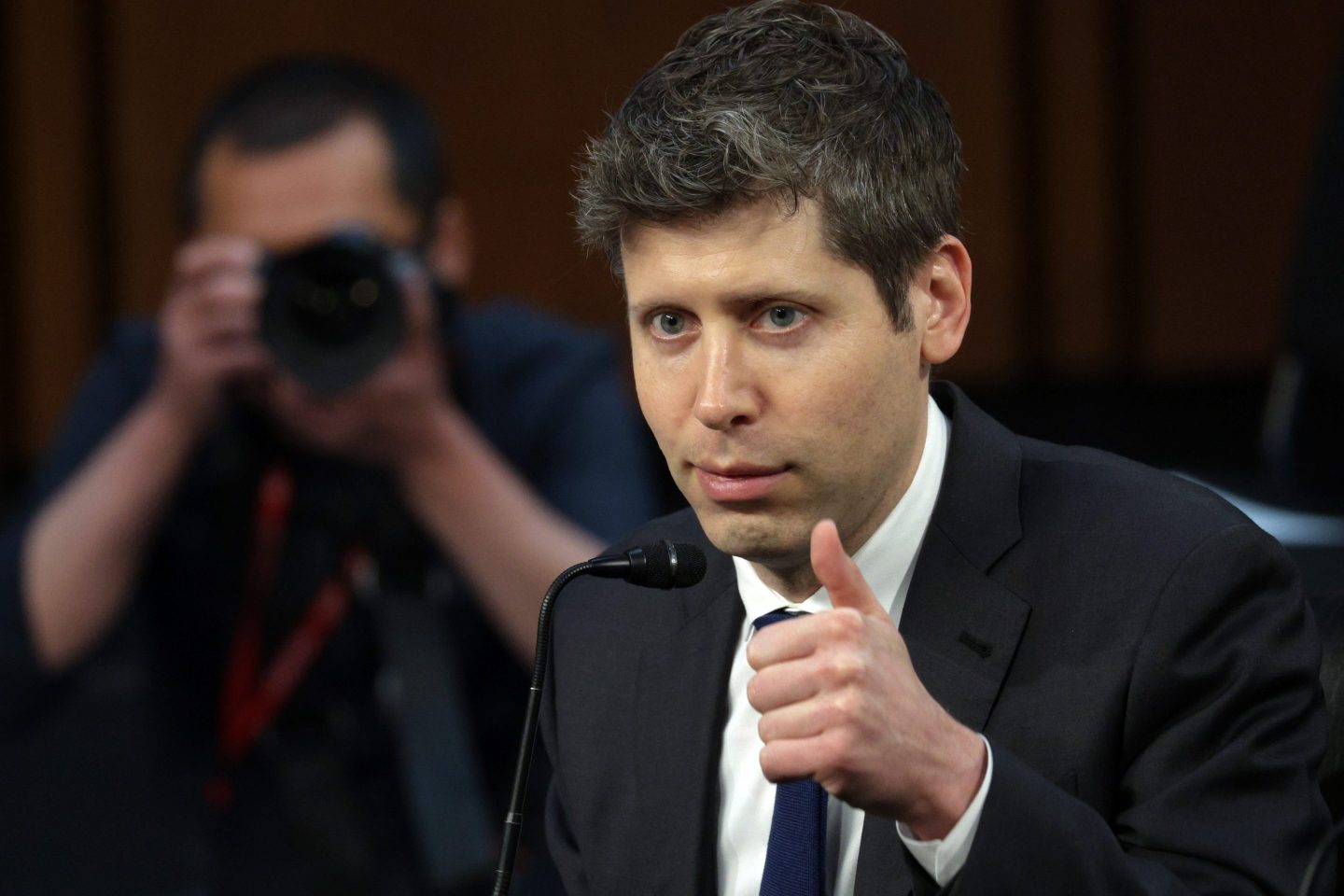
“GPT-5 really feels like talking to a PhD-level expert in any topic,” OpenAI CEO Sam Altman told journalists in a pre-briefing on Wednesday. “Something like GPT-5 would be pretty much unimaginable in any other time in history.”
Altman described GPT-5 as a “significant step” along the path to artificial general intelligence (AGI), which according to OpenAI’s mission statement is defined as “highly autonomous systems that outperform humans at most economically valuable work.”
OpenAI is making its latest AI model free to all ChatGPT users—the first time free users will have access to one of its reasoning models—as well as through an API that lets developers and businesses build on top of it. OpenAI is also rolling out some new ChatGPT features: Users can choose from four preset personalities—Cynic, Robot, Listener, and Nerd—to customize how the AI responds, while Pro users will soon be able to connect Gmail, Google Calendar, and Google Contacts, allowing ChatGPT to reference that information automatically during chats. Voice mode is also getting an upgrade, with more adaptive and expressive responses.
It’s unclear whether this combination of speed, power, and features will be enough, however. Some two years in the making (GPT-4 was launched in March 2023), GPT-5’s launch has taken longer than many industry insiders expected, as OpenAI has adjusted its approach in response to industry changes. And while ChatGPT now boasts an impressive 700 million weekly users, OpenAI has faced growing pressure over the past year as rivals poach its talent and race ahead on emerging AI techniques like long-context reasoning and autonomous tool use. In addition to Big Tech competitors like Meta and Google, OpenAI must contend with a wave of startups founded by its own former researchers, including Anthropic, Thinking Machines, and Safe Superintelligence. Mark Zuckerberg’s Meta has emerged as a particularly aggressive rival, forming a new superintelligence team that has lured away several top OpenAI scientists. And in January, Chinese upstart DeepSeek briefly knocked OpenAI back on its heels—part of a growing flood of powerful Chinese models now vying for global influence.
Whether GPT-5 propels OpenAI back to the top of the AI hill will become clear in the days and weeks ahead, as researchers put the model through its paces, testing it against the likes of other elite models, including Anthropic’s latest version of Claude and Google’s Gemini.
OpenAI pushes to stay in the lead
One of the defining truths about the world of generative AI is that even when you’re on top, the lead doesn’t last for long. Now that GPT-5 is out, OpenAI CEO Sam Altman acknowledged that staying at the frontier means one thing: relentless scaling.
In AI, scaling refers to the idea that models get more powerful as you increase the amount of data, computing power, and model components used during training. It’s the underlying principle that drove progress from GPT-2 to GPT-3 to GPT-4—and now GPT-5. The catch is that each leap requires exponentially more investment, particularly in AI infrastructure, for OpenAI, that includes its Stargate Project, a joint venture it announced in January with SoftBank, Oracle, and investment firm MGX with a goal to invest up to $500 billion by 2029 in AI-specific data centers across the U.S.
When asked whether scaling laws still hold, Altman said they “absolutely” do. He pointed to better models, smarter architectures, higher-quality data, and significantly more computing power as the path to “order-of-magnitude” improvements still ahead.
But that kind of progress comes at a cost. “It’s going to take an eyewatering amount of compute,” he admitted. “But we intend to continue doing it.”
Current confidence, but challenges ahead
OpenAI has roughly doubled its revenue in the first seven months of 2025, hitting an annualized run rate of $12 billion—up from about $6 billion at the start of the year, according to a recent report by The Information. That translates to $1 billion in monthly revenue, fueled by surging demand for its ChatGPT products across both consumer and enterprise markets. Weekly active users for ChatGPT have jumped to around 700 million, up from 500 million across all OpenAI products as of late March. And earlier this week OpenAI released a free, open-source model—an unusual move for a company often criticized for its closed approach over the past half-decade—suggesting confidence that its premium offering, which is now GPT-5, will continue to dominate.
There are plenty of challenges ahead, however. For one thing, the partnership between Microsoft and OpenAI—that began with a $1 billion investment in 2019—is entering a more fraught and complex phase. While Microsoft has invested more than $13 billion and retains exclusive rights to OpenAI’s models through Azure, tensions have emerged over revenue sharing, AGI control clauses, and overlapping product strategies.
OpenAI is also navigating an effort to turn its commercial arm into a public benefit corporation (PBC) while ensuring its original nonprofit maintains control. There has been significant legal and public backlash to its efforts, including a lawsuit from cofounder Elon Musk and scrutiny from state attorneys general in California and Delaware. In addition, OpenAI faces broader regulatory attention as it rethinks its governance structure—raising questions about charitable asset protection, public benefit accountability, and compliance with state nonprofit laws.