

OpenAI is the world’s third-most-valuable private company—valued at $300 billion in its latest fundraise in March 2025, and it’s “marching to the beat of its own disruption drum,” according to JPMorgan. At the same time, the bank warns, the risks to the company’s business model are “broadening.”
The investment bank took the rare step of initiating coverage on the artificial intelligence (AI) powerhouse, whose ChatGPT products have transformed digital interactions, even though it’s not a publicly listed company. Bloomberg reported that the coverage will start with sectors such as AI and software, where private firms such as OpenAI play major and dynamic roles, citing a person familiar with the matter. That is in and of itself interesting, and speaks to the massive role that private credit has come to play in tech and finance, as JPMorgan’s own CEO Jamie Dimon often discusses. But this particular note also reached several dramatic, sometimes contradictory conclusions.
What JPMorgan calls its “early advantage, unrivaled brand, and consumer focus” could help it unlock a total addressable market of $700 billion or more by 2030, according to the research note, authored by the analysts Brenda Duverce and Lula Sheena. The note mainly looks at OpenAI’s challenges in the marketplace and its future value as an investing prospect, as a research note should, but it makes for fascinating reading in light of OpenAI’s internal strategy memo for 2025-26, which came to light as a court document that is part of an ongoing Google antitrust case.
In the memo, OpenAI execs write that they want ChatGPT to be “your interface to the internet.” JPMorgan puts it similarly, writing that OpenAI’s management has a vision of “transforming the way humans interact with machines.” OpenAI CEO Sam Altman, the billionaire who decided to turn ChatGPT loose onto the world, has reportedly said this could be worth $1 trillion in market capitalization when OpenAI eventually goes public after some sort of blockbuster initial public offering. This renders the JPMorgan research interesting in how it spotlights the challenges in the way of ChatGPT truly becoming the internet’s interface.
JPMorgan finds OpenAI’s “frontier model innovation” transforming into an “increasingly fragile moat.” Duverce and Sheena write about the context facing the AI giant, of a “window of risks” growing in size and scope. They forecast “rising talent and litigation risks, as well as strategic uncertainty related to OpenAI’s unconventional organizational structure.” In short, the vision is clear to see, but the reality of the situation just outside OpenAI’s window is rather more opaque.
From quiet lab to global powerhouse
Founded in 2015, OpenAI’s mission is ambitious: to ensure that artificial general intelligence (AGI)—AI systems as smart as humans across the vast majority of cognitive tasks people perform—come to benefit all of humanity. That ethos propelled OpenAI into the spotlight with the revolutionary launch if its consumer-facing ChatGPT chatbot in late 2022, with several follow-on technical breakthroughs combining with enthusiastic backing from Microsoft and A-list Silicon Valley investment firms to create a massively powerful and influential private AI giant.
Today, OpenAI has a staggering reach: an estimated 800 million to 1 billion weekly active users on ChatGPT as of April 2025, global availability in over 180 countries and 57 languages, and more than 3 million paying business customers as of June, as well as a robust developer ecosystem. Famously, ChatGPT’s viral release on November 30, 2022, led to a reach of 100 million users in a record two months, the fastest-growing app in history until Meta’s Threads launch in July 2023.
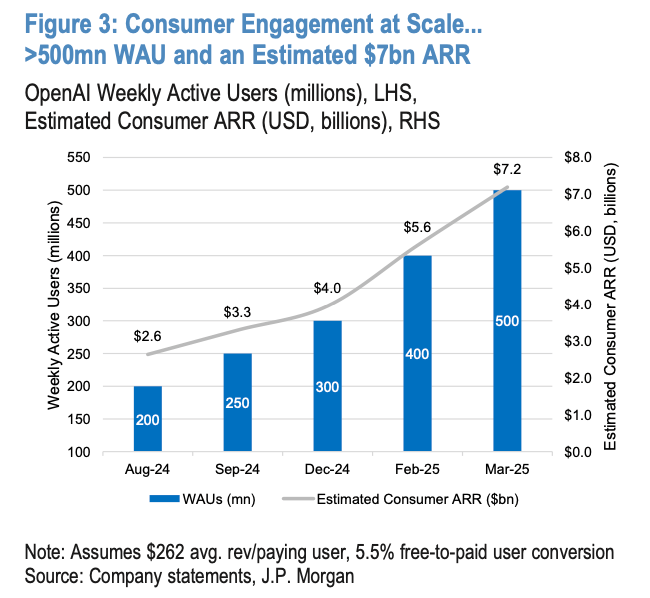
OpenAI’s funding reflects its outsized ambitions: over $63 billion raised since inception, including a record $40 billion tranche led by SoftBank in March 2025, vaulting its valuation to $300 billion—the third highest among private tech firms globally, just behind SpaceX and ByteDance.
Competitive moats under threat
OpenAI’s early advantage was its viral consumer adoption and brand strength, but it is not heavily diversified, with roughly 75% of its revenue coming from consumer subscriptions. Moves are under way to remedy this, with the launch of AI agents that can perform tasks for a user across the internet. These include the software engineering-focused Codex and the multipurpose ChatGPT agent, perhaps signaling a move towards agents that can serve as “autonomous digital workers” for enterprise customers. (OpenAi rival Anthropic, by contrast, derives most of its revenues from enterprise customers.) JPMorgan projects that agents could comprise a quarter of OpenAI’s revenue within five years.
OpenAI’s strategy memo confirms that the company never wanted ChatGPT to settle into the by-now well-honed grooves of the software-as-a-service (SaaS) sector. Instead, OpenAI appears to regard this revenue “almost as a constraint,” a step toward their much grander battle for control over user interaction itself. OpenAI’s leadership writes of platform giants Apple, Google, and Microsoft as existential threats, since they could easily block ChatGPT or “push their own AIs without giving users fair alternatives.” JPMorgan’s analysis rhymes again, noting that OpenAI is eyeing digital advertising and hiring consultant-like “forward deployed engineers,” whose job is to increase enterprise adoption. This lays the groundwork for a direct assault on the business models of the platforms.
But the bank also says it’s no sure thing that OpenAI will succeed in this regard. Simply put, JPMorgan writes, it’s a crowded space, with “leading model developers constantly jostling for pole position.” The different types of generative AI models released over the past 18 months have expanded at what JPMorgan considers an “exceptional pace,” noting that Google’s Gemini 2.5 model and China’s DeepSeek R1 have matched—or surpassed—OpenAI on benchmarks for reasoning, coding, and cost-efficiency. Price wars have ensued: OpenAI slashed o3 model prices by 80% after Gemini’s Pro model leapfrogged it in user rankings, illustrating how differentiation in core models is getting harder to preserve. Of course, the fact that OpenAI is in increasingly direct competition with some of the most valuable companies in the history of the world, let alone Silicon Valley, is a remarkable achievement, and OpenAI could be seen as encroaching on their moats, not the other way around.
The enterprise sector is especially challenging. Large customers increasingly seek best-in-class, domain-specific models or “AI portfolios” sourced from rival providers such as Anthropic, xAI, Google, and specialized startups. Security and data privacy requirements, as well as cost, drive enterprises to avoid single-provider lock-in.
OpenAI’s developer ecosystem—a major early strength—remains sticky due to tooling and documentation, yet developers are highly cost-sensitive and more willing to switch as alternatives proliferate.
Infrastructure and partnership crossroads
A defining challenge for OpenAI and its peers is building out the massive infrastructure needed to train and deploy advanced models. Its recently announced Stargate project, a $500 billion joint venture with partners including SoftBank and Oracle, aims to meet soaring demand for compute and power. Data center constraints, power shortages, and a global talent war threaten to slow progress.
The Microsoft partnership—once a source of exclusive cloud access and capital—has become “complicated,” JPMorgan said. Revenue- and profit-sharing terms are being renegotiated as OpenAI seeks more autonomy. High-profile failed acquisitions, such as the loss of code startup Windsurf to Google, suggest these same governance and partnership frictions remain unresolved, the bank added.
OpenAI’s transition from a capped-profit model to a Public Benefit Corporation (PBC) is still under way. With billions in new funds contingent on this restructuring, any delay could ripple through its expansion plans. Ongoing legal battles—especially over training data and copyright—could raise costs or limit access to essential resources if outcomes go against OpenAI’s practices.
JPMorgan’s assessment again agrees with OpenAI’s own internal strategy memo, which frames the competitive landscape as an “OS war,” or battle over operating systems, rather than an arms race between chatbots. Today, tech’s biggest players control core interfaces (Apple: iOS; Google: Android/Chrome; Microsoft: Windows), and the memo’s underlying anxiety is clear: despite OpenAI’s substantial mindshare, it lacks a hardware or operating system anchor, making it vulnerable to being boxed out by entrenched platform owners.
Despite formidable risks, J.P. Morgan’s research frames OpenAI as the best-capitalized and brand-recognized contender in the AI arena. With a projected $174 billion in revenue by 2030, success will hinge on its ability to monetize new products, cement customer trust, outpace rivals on technical and operational fronts, and navigate the evolving regulatory landscape. The race is on.
OpenAI did not respond to a request for comment.
For this story, Fortune used generative AI to help with an initial draft. An editor verified the accuracy of the information before publishing.