• Home
  • News
  • Fortune 500
  • Tech
  • Finance
  • Leadership
  • Lifestyle
  • Rankings
  • Multimedia
PoliticsDonald Trump

Trump’s tariffs are headed for a constitutional showdown at the Supreme Court that could reshape presidential power for decades

Marco Quiroz-Gutierrez
By
Marco Quiroz-Gutierrez
Reporter
Down Arrow Button Icon
Marco Quiroz-Gutierrez
By
Marco Quiroz-Gutierrez
Reporter
Down Arrow Button Icon
May 31, 2025, 2:08 AM ET
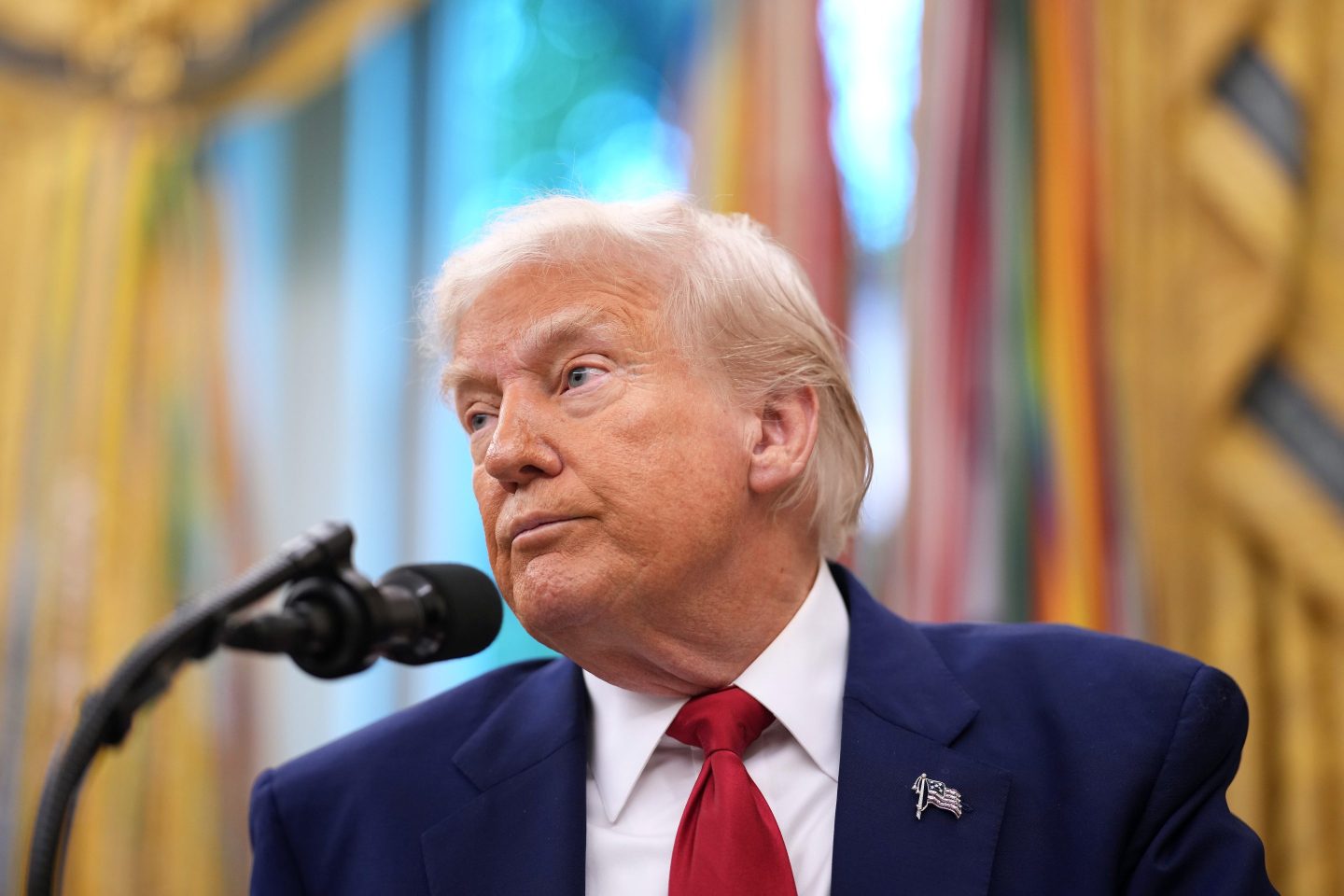
President Donald Trump.
President Donald Trump.Andrew Harnik—Getty Images
  • The Trump administration is preparing for a Supreme Court battle that could reshape presidential power by deciding the extent of the executive branch’s authority over tariffs, which was originally granted to Congress by the Constitution. The administration appealed after many of its recent tariffs were invalidated by a federal trade court, which argued the president’s actions were too sweeping and cut into Congress’ authority.

President Donald Trump’s struck-down tariffs are almost guaranteed to end up before the Supreme Court, experts say, and the outcome is a toss-up that could shape presidential power for years to come. 

Recommended Video

The Supreme Court rarely opines on trade issues, said Lee Smith, shareholder and leader of the international trade and national security practice at law firm Baker Donelson. The last case it heard on the topic was decided in 2009—U.S. v. Eurodif S.A., which dealt with the “anti-dumping” duties on low enriched uranium, he said. 

Yet, this week, the New York-based Court of International Trade set up a future Supreme Court battle royale when it invalidated many of Trump’s tariffs. The tariffs in question, including those imposed on Mexico and China, were undergirded by the International Emergency Economic Powers Act (IEEPA), which gives the President “broad authority to regulate a variety of economic transactions following a declaration of national emergency.” 

Smith said the administration’s decision to use the IEEPA as justification for the struck-down tariffs was likely made to move things along faster than it could have using other provisions of U.S. trade law. But the Court of International Trade argued that the tariff action was so sweeping it took authority away from Congress, which was granted the power to levy tariffs by the Constitution.

The Trump administration has appealed the court’s decision, and has signaled that it will elevate the issue to the Supreme Court if it loses. Now, the Supreme Court will likely need to decide how far the president’s power over tariffs goes—after years of past U.S. leaders expanding their power over tariffs, with the acquiescence of Congress.

“It’s a constitutional question,” Smith told Fortune. “The Trump administration is taking it up no matter what, if they lose. The other side has already won—the Court of International Trade. So, if they lose the Court of Appeals, they’re going to want the Supreme Court to reinstate the earlier decision.”

Trump fought several court battles over tariffs during his first administration, especially over his tariffs on China, which were justified with a different provision of U.S. trade law. While none reached the Supreme Court, he was largely successful, said Smith, and it’s possible, although not guaranteed, Trump may succeed this time around because the court’s conservative majority has shown “a lot of deference to this president,” said Smith.

Still, since Trump last defended tariffs in court during his first administration, several groundbreaking cases decided by the Supreme Court overturned precedents which could affect the administration’s odds. 

Stavros Gadinis, a law professor at U.C. Berkeley, said two cases, West Virginia v. Environmental Protection Agency and Loper Bright Enterprises v. Raimondo, which overturned the Chevron Doctrine, signaled that the Supreme Court has been paying attention to expanding executive power. Broadly, the decisions in both of these cases imply that any president seeking to exercise powers under vague or ambiguous statutes is subject to more scrutiny and requires more evidence and support for their actions than before.

“When, initially, those rulings were issued, a Democratic administration was in the White House, and the Republicans were very happy about it,” Gadinis told Fortune. “But now that the situation is reversed these rulings could suggest more checks on how a Republican administration interprets certain statutes.”

Thanks to the overturning of the Chevron doctrine, the courts don’t need to automatically defer to the administration’s definition of ambiguous terms used by Trump to back his tariffs such as “national security” or “retaliation.” Instead these definitions will be decided by the court, which may or may not agree with the administration’s definition, said Gadinis.

It’s not guaranteed the Trump administration will lose at the Supreme Court. Yet, during his first administration, Trump officials gathered evidence and followed set procedures—for example by opening an investigation into China on intellectual property, technology transfer, and innovation. The administration did not follow the same procedure for the recently struck down tariffs, said Gadinis.

“These kinds of principles—the procedural background was just not in place in this particular set of times. So, this seems broader than what (the courts) upheld back then, and therefore more likely to fall,” Gadinis told Fortune.

Fortune Brainstorm AI returns to San Francisco Dec. 8–9 to convene the smartest people we know—technologists, entrepreneurs, Fortune Global 500 executives, investors, policymakers, and the brilliant minds in between—to explore and interrogate the most pressing questions about AI at another pivotal moment. Register here.
About the Author
Marco Quiroz-Gutierrez
By Marco Quiroz-GutierrezReporter
LinkedIn iconTwitter icon

Role: Reporter
Marco Quiroz-Gutierrez is a reporter for Fortune covering general business news.

See full bioRight Arrow Button Icon

Latest in Politics

Sabrina Carpenter
LawImmigration
Sabrina Carpenter rips ‘evil and disgusting’ White House use of one of her songs in an ICE raid video montage
By Fatima Hussein and The Associated PressDecember 2, 2025
4 hours ago
Elon Musk, standing with his arms crossed, looks down at Donald Trump sitting at his desk in the Oval Office
EconomyTariffs and trade
Elon Musk says he warned Trump against tariffs, which U.S. manufacturers blame for a turn to more offshoring and diminishing American factory jobs
By Sasha RogelbergDecember 2, 2025
7 hours ago
A student driver gets on a truck as the instructor watches in Calif., Nov. 15, 2021.
LawShipping
Nearly half of U.S. truck-driving schools face closure in crackdown on ‘poorly trained drivers’
By Josh Funk and The Associated PressDecember 2, 2025
9 hours ago
Trump
CommentaryTariffs and trade
The trade war was never going to fix our deficit
By Daniel BunnDecember 2, 2025
9 hours ago
michael dell
Successphilanthropy
Michael and Susan Dell believe their $6.25 billion donation for ‘Trump Accounts’ is the largest single private commitment to U.S. children
By Thalia Beaty and The Associated PressDecember 2, 2025
10 hours ago
Trump
PoliticsWhite House
Trump had MRI on heart and abdomen and it was ‘perfectly normal,’ doctor says
By The Associated PressDecember 2, 2025
11 hours ago

Most Popular

placeholder alt text
Economy
Ford workers told their CEO 'none of the young people want to work here.' So Jim Farley took a page out of the founder's playbook
By Sasha RogelbergNovember 28, 2025
4 days ago
placeholder alt text
Success
Warren Buffett used to give his family $10,000 each at Christmas—but when he saw how fast they were spending it, he started buying them shares instead
By Eleanor PringleDecember 2, 2025
13 hours ago
placeholder alt text
Success
Forget the four-day workweek, Elon Musk predicts you won't have to work at all in ‘less than 20 years'
By Jessica CoacciDecember 1, 2025
1 day ago
placeholder alt text
Economy
Elon Musk says he warned Trump against tariffs, which U.S. manufacturers blame for a turn to more offshoring and diminishing American factory jobs
By Sasha RogelbergDecember 2, 2025
7 hours ago
placeholder alt text
Innovation
Google CEO Sundar Pichai says we’re just a decade away from a new normal of extraterrestrial data centers
By Sasha RogelbergDecember 1, 2025
1 day ago
placeholder alt text
Personal Finance
Current price of gold as of December 1, 2025
By Danny BakstDecember 1, 2025
1 day ago
Rankings
  • 100 Best Companies
  • Fortune 500
  • Global 500
  • Fortune 500 Europe
  • Most Powerful Women
  • Future 50
  • World’s Most Admired Companies
  • See All Rankings
Sections
  • Finance
  • Leadership
  • Success
  • Tech
  • Asia
  • Europe
  • Environment
  • Fortune Crypto
  • Health
  • Retail
  • Lifestyle
  • Politics
  • Newsletters
  • Magazine
  • Features
  • Commentary
  • Mpw
  • CEO Initiative
  • Conferences
  • Personal Finance
  • Education
Customer Support
  • Frequently Asked Questions
  • Customer Service Portal
  • Privacy Policy
  • Terms Of Use
  • Single Issues For Purchase
  • International Print
Commercial Services
  • Advertising
  • Fortune Brand Studio
  • Fortune Analytics
  • Fortune Conferences
  • Business Development
About Us
  • About Us
  • Editorial Calendar
  • Press Center
  • Work At Fortune
  • Diversity And Inclusion
  • Terms And Conditions
  • Site Map

© 2025 Fortune Media IP Limited. All Rights Reserved. Use of this site constitutes acceptance of our Terms of Use and Privacy Policy | CA Notice at Collection and Privacy Notice | Do Not Sell/Share My Personal Information
FORTUNE is a trademark of Fortune Media IP Limited, registered in the U.S. and other countries. FORTUNE may receive compensation for some links to products and services on this website. Offers may be subject to change without notice.