• Home
  • Latest
  • Fortune 500
  • Finance
  • Tech
  • Leadership
  • Lifestyle
  • Rankings
  • Multimedia
EconomyTariffs

Court blocking Trump tariffs torpedoes his negotiating tactic, but it’s ‘hardly the end of this story’

Eleanor Pringle
By
Eleanor Pringle
Eleanor Pringle
Senior Reporter, Economics and Markets
Down Arrow Button Icon
Eleanor Pringle
By
Eleanor Pringle
Eleanor Pringle
Senior Reporter, Economics and Markets
Down Arrow Button Icon
May 29, 2025, 6:19 AM ET
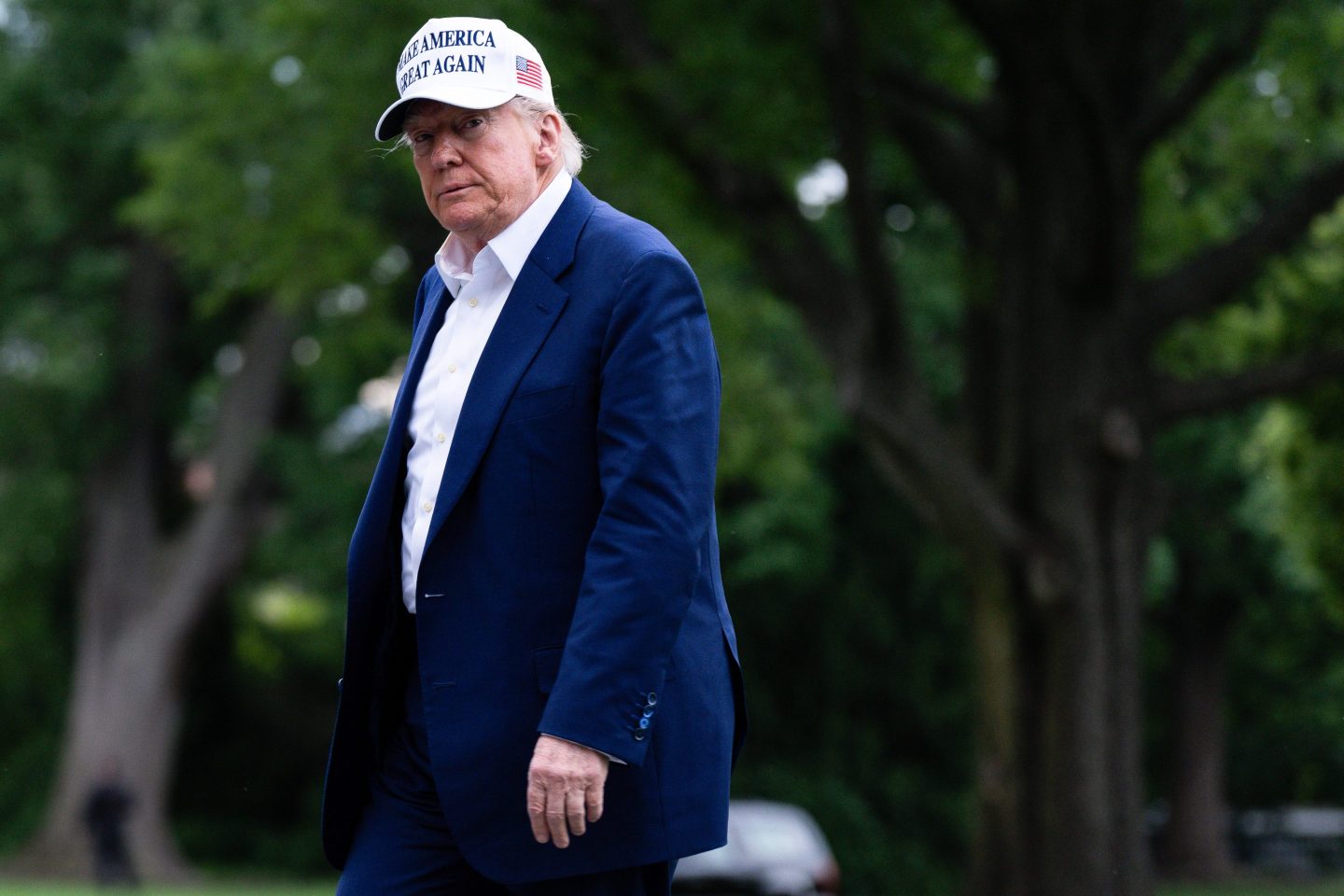
U.S. President Donald Trump
U.S. President Donald Trump’s tariff plan suffered a setback after a court ruled against his actions. Tierney L. Cross—UPI/Bloomberg/Getty Images
  • ANALYSIS: A U.S. court ruled that the Trump administration lacked the authority to impose sweeping global tariffs under the International Emergency Economic Powers Act, requiring the White House to begin unwinding certain tariffs within 10 days—though an appeal is underway. While this decision poses a major challenge to Trump’s trade strategy, experts expect the administration to pursue alternative legal avenues to maintain or reintroduce tariffs, potentially shifting focus to sectoral measures or other provisions under the Trade Act.

The Trump tariff saga took another turn overnight, with the U.S. Court of International Trade ruling the White House did not have the authority to impose its “Liberation Day” economic sanctions across the globe.

Recommended Video

And while Canada, Mexico, and China had been left out of further hits on April 2, the three-judge panel extended its ruling to the tariffs announced on these countries earlier this year as well.

The setback for Trump 2.0 is major, as it undermines the very foundation the administration has been relying on to push through more advantageous deals with key trading partners.

Of course, the Trump team was quick to announce it would appeal the decision.

To recap, the current state of play with tariffs is that the majority of the world is subject to a 10% import tax into the U.S., while China sits at 30% following an agreement with Beijing. In addition, Canada and Mexico face levies of 25% as a result of Trump’s request for the nations to tackle immigration and the fentanyl trade.

Under this week’s ruling, the Oval Office has 10 days to carry out the administrative work to remove these tariffs. Sanctions on steel, autos, and aluminum were not included in the ruling.

It is not clear how quickly the tariffs will be undone, or whether the White House will keep them in place while it pushes ahead to the court of appeals and potentially the Supreme Court—though completing such a task in 10 days may prove impossible.

Whatever the outcome, this wrench in the works may still have repercussions for the timeline of negotiations—a pressure the Trump administration has been keen to keep up. In his second term, Trump has routinely announced sanctions with fairly swift turnarounds.

When these tariffs have been delayed—which they often have—the time frames have still remained tight in order to get deals done, for example, a 90-day pause following “Liberation Day” tariffs and a similar window to allow for negotiations with China.

What’s clear is that this ruling does not mark the conclusion of tariffs, but simply the beginning of the next chapter.

As Deutsche Bank’s Jim Reid wrote in a note seen by Fortune this morning: “We should say at the outset that this is hardly the end of this story, as the administration are appealing this decision. But already, markets have seen a substantial rally in response.”

Indeed, S&P futures are up 1.7% at the time of writing, with Dow Jones futures also up 1.3%.

Wider impact

Economists have noted that the revenue tap Trump has switched on may prove too tempting for future administrations to turn off, courtesy of the vast revenues they are likely to generate.

But how these funds will have played into the wider budget of Trump 2.0—and whether or not they were relied on for spending packages like the “Big, Beautiful Bill” was never made clear.

“We haven’t heard directly from President Trump on the matter yet, so it’s unclear how the administration might respond going forward,” Reid notes. “This could also have broader revenue implications, as they had been hoping to use tariffs as a source of revenue to fund other tax cuts.

“If the ruling did remain in place … one option for the administration would be to expand the use of other tariff instruments, like the Section 232 on national security grounds, which have been used for autos, steel, and aluminum tariffs.”

Goldman Sachs’ Alec Phillips chimed that he did not expect the tariff setback to alter the wider fiscal strategy of the administration, explaining, “Tariff revenue was never counted toward offsetting the cost of the package, and most lawmakers never made a clear link between the two issues.”

He added: “That said, the tariffs the court struck down were likely to raise nearly $200 billion on an annual basis, which is roughly the amount the fiscal package would increase the deficit next year (compared with current policy) and more than the impact in following years.”

Other avenues to achieve tariffs

Like Reid, Phillips expects Trump’s team to explore other legal routes to achieve the same aim.

Trump’s tariffs were blocked by the court as they relied on the International Emergency Economic Powers Act (IEEPA), however, this is not the only way to achieve sanctions. The court itself highlighted that Trump could use two sections of the 1974 Trade Act to impose tariffs of up to 15% for a maximum of 150 days (which can be extended by Congress) to address the balance of payments, or justify the action under Section 301 as addressing unfair trade practices.

Phillips noted that the White House could also broaden sectoral tariffs, a move many analysts are already expecting. He explained: “Uncertainty regarding the IEEPA-based tariffs could lead the White House to put more emphasis on sectoral tariffs, where there is much less legal uncertainty.

“President Trump has not emphasized sectoral tariffs as frequently lately as he did earlier this year, but if the White House finds it has less flexibility on country-focused tariffs, sectoral tariffs might receive more attention again.”

He added: “Section 338 of the Trade Act of 1930 allows the president to impose tariffs of up to 50% on imports from countries that discriminate against the U.S. This authority, which has never been used, is similar to the authority under Section 301, except that it limits the amount of the tariffs but does not require a formal investigation.”


Join us at the Fortune Workplace Innovation Summit May 19–20, 2026, in Atlanta. The next era of workplace innovation is here—and the old playbook is being rewritten. At this exclusive, high-energy event, the world’s most innovative leaders will convene to explore how AI, humanity, and strategy converge to redefine, again, the future of work. Register now.
About the Author
Eleanor Pringle
By Eleanor PringleSenior Reporter, Economics and Markets
LinkedIn icon

Eleanor Pringle is an award-winning senior reporter at Fortune covering news, the economy, and personal finance. Eleanor previously worked as a business correspondent and news editor in regional news in the U.K. She completed her journalism training with the Press Association after earning a degree from the University of East Anglia.

See full bioRight Arrow Button Icon

Latest in Economy

US Federal Reserve Board Chairman Jerome Powell speaks during a news conference following a Federal Open Market Committee (FOMC) meeting in Washington, DC, on December 10, 2025.
Bankingjerome powell
Top economist Diane Swonk: Jerome Powell risks losing the Fed’s credibility on a gamble over AI and immigration
By Eva RoytburgDecember 10, 2025
3 hours ago
Jerome Powell, chairman of the US Federal Reserve, during a news conference following a Federal Open Market Committee (FOMC) meeting in Washington, DC, US, on Wednesday, Dec. 10, 2025. Federal Reserve officials delivered a third consecutive interest-rate reduction and maintained their outlook for just one cut in 2026.
EconomyFederal Reserve
Powell warns of a ‘very unusual’ economy as tariffs keep goods inflation high amid a weakening labor market
By Eva RoytburgDecember 10, 2025
3 hours ago
Federal Reserve Bank Chair Jerome Powell speaks during the George P. Shultz Memorial Lecture Series at Stanford University on December 01, 2025 in Stanford, California.
EconomyFederal Reserve
The Fed delivers a rare ‘hawkish cut’ as Powell tries to steady a softening job market
By Eva RoytburgDecember 10, 2025
6 hours ago
Jerome Powell, chairman of the US Federal Reserve, during the Hoover Institution's George P. Shultz Memorial Lecture Series in Stanford, California, US, on Monday, Dec. 1, 2025. The Federal Reserve said it was monitoring community and regional banks' commercial real estate loan portfolios amid concerns over "elevated interest rates, tighter underwriting standards, and lower commercial property values." Photographer: Jason Henry/Bloomberg via Getty Images
EconomyFederal Reserve
‘Be careful what you wish for’: Top economist warns any additional interest rate cuts after today would signal the economy is slipping into danger
By Eva RoytburgDecember 10, 2025
7 hours ago
RetailGrocery
Instacart may be jacking up your grocery prices using AI, study shows—a practice called ‘smart rounding’
By Dave Lozo and Morning BrewDecember 10, 2025
8 hours ago
cracker barrel
EconomyRestaurants
Cracker Barrel slashes forecast as Uncle Herschel fallout continues despite logo reinstatement
By Dee-Ann Durbin, Nick Lichtenberg and The Associated PressDecember 10, 2025
8 hours ago

Most Popular

placeholder alt text
Politics
Exclusive: U.S. businesses are getting throttled by the drop in tourism from Canada: ‘I can count the number of Canadian visitors on one hand’
By Dave SmithDecember 10, 2025
13 hours ago
placeholder alt text
Economy
‘Fodder for a recession’: Top economist Mark Zandi warns about so many Americans ‘already living on the financial edge’ in a K-shaped economy 
By Eva RoytburgDecember 9, 2025
1 day ago
placeholder alt text
Success
At 18, doctors gave him three hours to live. He played video games from his hospital bed—and now, he’s built a $10 million-a-year video game studio
By Preston ForeDecember 10, 2025
15 hours ago
placeholder alt text
Economy
‘Be careful what you wish for’: Top economist warns any additional interest rate cuts after today would signal the economy is slipping into danger
By Eva RoytburgDecember 10, 2025
7 hours ago
placeholder alt text
Uncategorized
Transforming customer support through intelligent AI operations
By Lauren ChomiukNovember 26, 2025
14 days ago
placeholder alt text
Economy
The 'forever layoffs' era hits a recession trigger as corporates sack 1.1 million workers through November
By Nick Lichtenberg and Eva RoytburgDecember 9, 2025
1 day ago
Rankings
  • 100 Best Companies
  • Fortune 500
  • Global 500
  • Fortune 500 Europe
  • Most Powerful Women
  • Future 50
  • World’s Most Admired Companies
  • See All Rankings
Sections
  • Finance
  • Leadership
  • Success
  • Tech
  • Asia
  • Europe
  • Environment
  • Fortune Crypto
  • Health
  • Retail
  • Lifestyle
  • Politics
  • Newsletters
  • Magazine
  • Features
  • Commentary
  • Mpw
  • CEO Initiative
  • Conferences
  • Personal Finance
  • Education
Customer Support
  • Frequently Asked Questions
  • Customer Service Portal
  • Privacy Policy
  • Terms Of Use
  • Single Issues For Purchase
  • International Print
Commercial Services
  • Advertising
  • Fortune Brand Studio
  • Fortune Analytics
  • Fortune Conferences
  • Business Development
About Us
  • About Us
  • Editorial Calendar
  • Press Center
  • Work At Fortune
  • Diversity And Inclusion
  • Terms And Conditions
  • Site Map

© 2025 Fortune Media IP Limited. All Rights Reserved. Use of this site constitutes acceptance of our Terms of Use and Privacy Policy | CA Notice at Collection and Privacy Notice | Do Not Sell/Share My Personal Information
FORTUNE is a trademark of Fortune Media IP Limited, registered in the U.S. and other countries. FORTUNE may receive compensation for some links to products and services on this website. Offers may be subject to change without notice.