Potentially seismic shocks are in store for businesses as the latent effects of President Donald Trump’s trade war begin to ripple across the global economy, according to the latest survey of top executives conducted by Fortune in collaboration with Deloitte.
Responses from CEOs of Fortune 500 companies polled in April reveal bearish sentiment soared a jaw-dropping 40 percentage points from just five months prior. This empirical evidence suggests that decision-makers are not only planning for shrinking demand but are already beginning to slash costs and re-allocate their finite resources in preparation for a possible recession.
This marks a dramatic reversal of events from our survey conducted in November when corporate boardrooms cheered Trump’s decisive victory in the race for the White House and Republican majorities elected to both houses of Congress.
The big picture
CEOs from the world’s biggest companies told Fortune the economic outlook looks substantially worse than they anticipated following the November election. Measures ranging from slashing costs and hiking prices to relocating their supply chain are being examined if not undertaken as corporate boards gird themselves for the delayed effects of a possible recession triggered by Trump’s sweeping tariffs.
Importantly, it’s worth bearing this is a snapshot taken at a critical point in time and therefore may not fully reflect present thinking. The survey was mainly conducted in the aftermath of April 2, the day Trump unveiled his plans to erect major new barriers to trade. The final responses were collected two days after April 9, when markets forced Trump to hit pause on his so-called “reciprocal” tariff hikes for all countries save China.
Fears that a tit-for-tat trade war between the world’s two biggest economies could spiral out of control have also subsided as cooler heads prevailed during this past weekend’s bilateral talks in Geneva. As a result, responses will not have captured some of the bullish spirits that recently returned, symbolized by this week’s palpable relief rally in U.S. equities.
Yet the threat of tariffs isn’t gone, it’s only been frozen for 90 days. Stock markets may believe Trump learned his lesson and won’t risk another meltdown, but stubbornly high Treasury yields and a sell-off in the U.S. dollar indicate not everyone is convinced.
Survey data suggests the CEOs of Fortune 500 companies appear far less complacent about the risks of stagflation and are already springing into action to protect their bottom line.
The numbers to know
58% … of CEOs have a “pessimistic” (50%) or “very pessimistic” (8%) outlook for the global economy over the next 12 months.
40 … the percentage point surge in pessimism since they were last asked the same question when just 18% were bearish in November following Trump’s election.
60% … of CEOs are optimistic about their own company’s performance—the lowest level observed since the question was first posed late in 2022.
42% … of CEOs say they plan to “implement cost-cutting measures to offset increased costs” amid uncertainty around the economy and global trade policies.
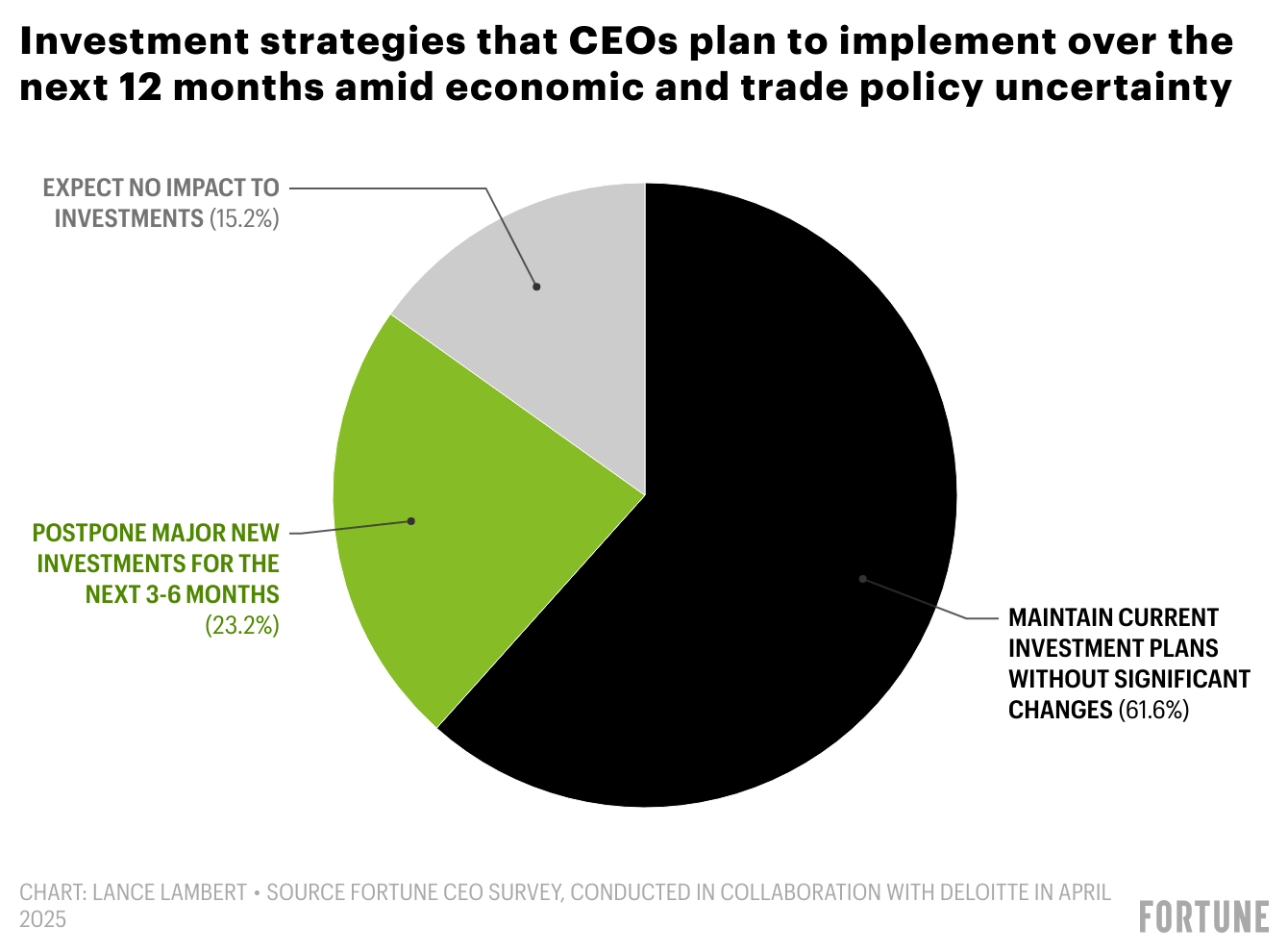
23% … of CEOs say they expect to “postpone major new investments” for the next three to six months for the very same reason.
Staring down the barrel at a potential recession
When Fortune, in collaboration with Deloitte, surveyed in April CEOs from Fortune 500 companies, Fortune Global 500 firms, and members of our wider business community, we found a massive 40 percentage point swing in bearish sentiment regarding the global economic outlook versus our November data.
Fielded amid a fresh round of tariff escalations and trade tensions, the responses were collected from 111 CEOs across 21 industries that participated, with 80% based in the United States. And their responses paint a clear picture: Businesses are staring down the barrel at a possible recession.
Import duties in the U.S. are now at levels not seen since the days of the Smoot-Hawley Tariff Act a century ago. Coupled with mounting geopolitical uncertainty—for example, Trump’s plans to annex a NATO ally’s sovereign territory—it is creating a wave of second-order effects rippling through global business.
Many executives are making operational shifts to protect their companies for what they see as a turbulent year ahead. From diversifying supply chains to adjusting cost structures and delaying major investments, CEOs appear focused on building resilience in an increasingly volatile environment.
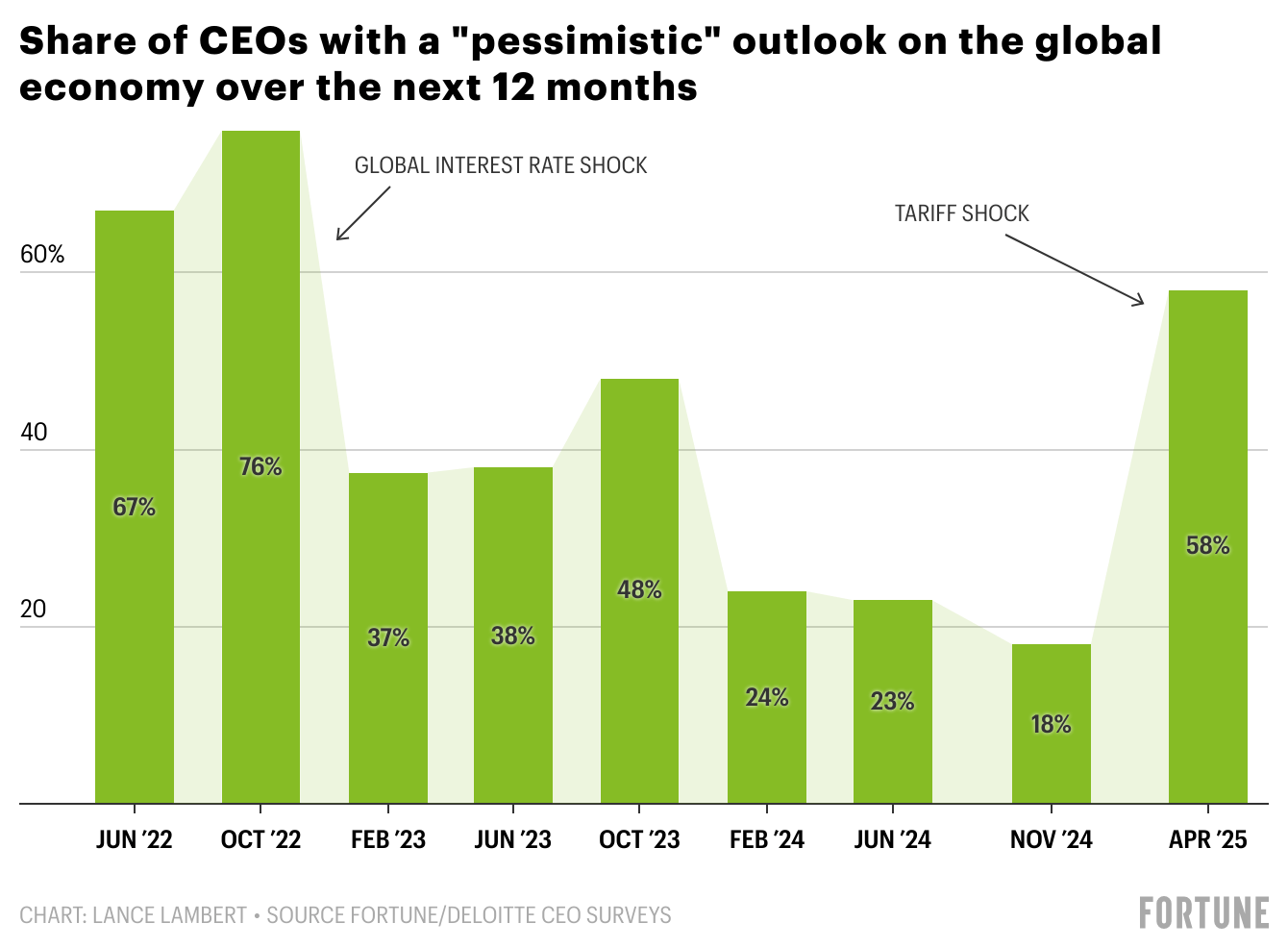
Tariff shock sends pessimism spiking
Last year, when we surveyed CEOs, only about a quarter had a “pessimistic” or “very pessimistic” outlook on the global economy over the next 12 months: 24% in February 2024 and 23% last June to be precise. Immediately following Trump’s election, that number slid to just 18% in November.
Those days feel like a distant memory. Fears over the global economy spiked to 58% this April, the highest since inflation rates hit multidecade peaks in 2022. Likewise, the number of CEOs either “optimistic” or “very optimistic” plummeted to 14% from 42% in November.
A similar pattern can be observed with regard to the 12-month outlook for their specific industry. Meanwhile, optimism over their own company’s performance sank to 60% from 84% in November—the lowest level observed since the question was first posed in the winter of 2022.
Then why is it CEOs, once so hopeful Trump would deliver growth, turned this bearish that quickly?
The tariff shock—and the economic and geopolitical uncertainty it brings—has them on the edge of their seats. And not in a good way. The highest effective import duties levied since the 1930s mean rising costs, falling demand, slimmer margins, and increased complexity in their supply chain.
Just as vexing, Trump introduces an element of unpredictability thanks to his on-again, off-again tariffs complete with numerous carve-outs and sundry other exemptions. When no one can forecast how long import duties remain in place, CEOs will shy away from making long-term investments.
Tariffs also raise the risk of retaliatory measures by trading partners and signal broader geopolitical instability, prompting CEOs to delay capex plans and/or hiring decisions until the outlook begins to clear.
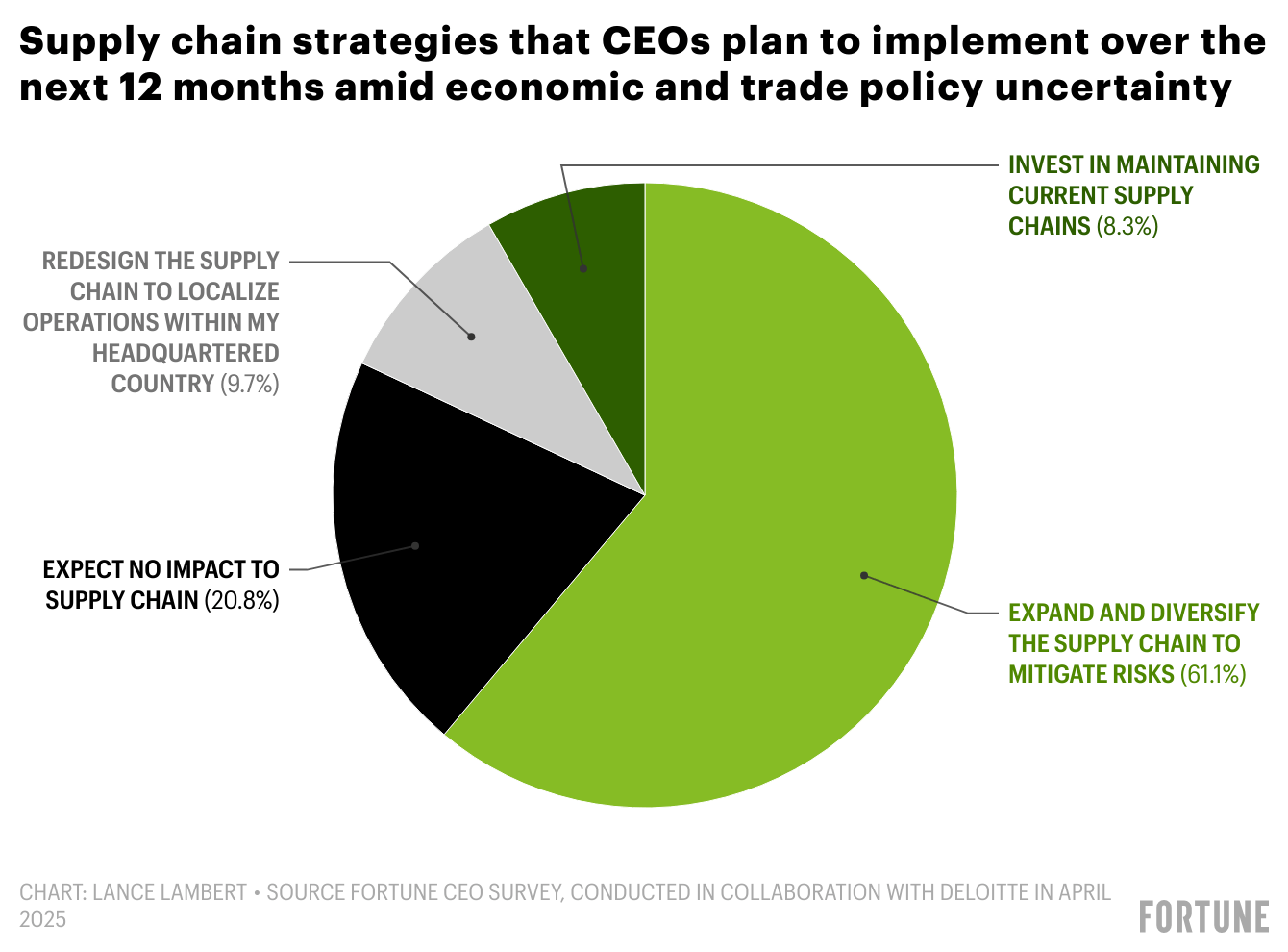
Most CEOs are diversifying supply chains to mitigate tariff risks
Amid the growing number of trade-related White House executive orders, a clear majority of CEOs are proactively taking steps to reduce exposure to potential tariff shocks.
According to our survey, 61% of CEOs said they are already actively expanding and diversifying their supply chain to better withstand geopolitical and tariff-related disruptions.
The data suggests that most corporate leaders view supply chain flexibility as a key defense mechanism in a volatile global trade environment. Nearly 10% are even deliberately choosing to onshore their supply chain within their domestic market. By comparison, only 8% said they plan to invest in maintaining their current setup.
This highlights how tariff uncertainty is already reshaping long-term operational strategies. Rather than wait for the sands to shift under their feet, many CEOs are looking to build resilience into their supply chain.
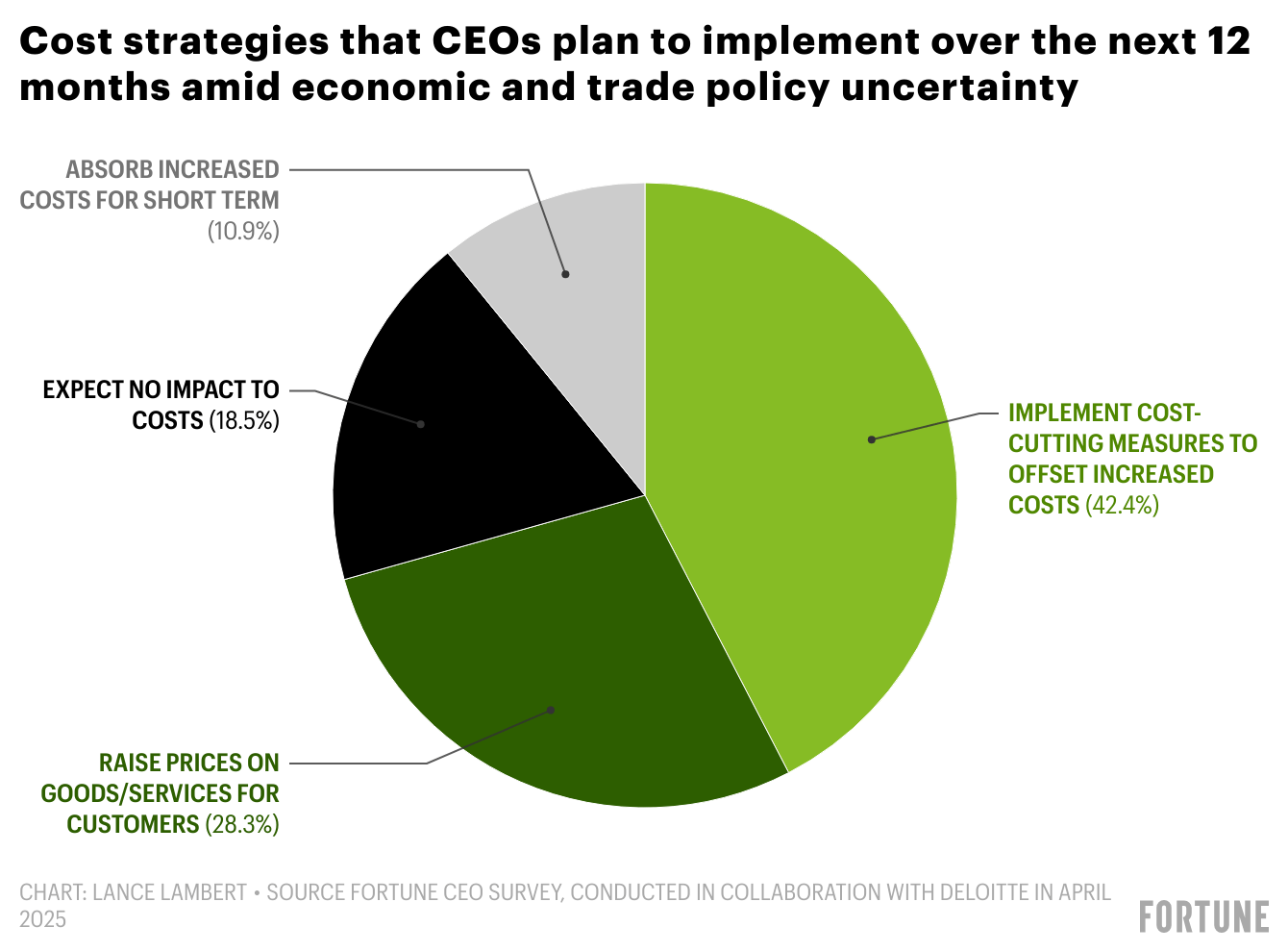
CEOs are responding to Trump’s tariffs by slashing costs and hiking prices
Faced with ongoing economic and trade policy uncertainty, CEOs are pulling hard on two main levers to protect profit margins: slashing expenses and hiking prices.
In our April survey, 42% of CEOs said they plan to implement cost-cutting measures over the next 12 months to offset the higher costs from tariffs. Another 28% intend to ask customers to shoulder some of the burden through increased prices.
By comparison, only 11% said they’re prepared to absorb the tariff-related headwinds in the short term.
Nearly every fourth CEO is postponing a major new investment
Given the ongoing uncertainty over trade policy and the near-term economic outlook, 23% of CEOs confirmed they would postpone major new investments for the next three to six months. This risks fears of a recession becoming a self-fulfilling prophecy if enough companies freeze their spending.
That said, most CEOs are not hitting the brakes on investment quite yet.
According to our survey, 62% of executives said they plan to maintain their current investment strategies over the next 12 months without significant changes.
*Methodology: Fortune surveyed CEOs in collaboration with Deloitte between April 1–11. A total of 111 responded to the survey, which was sent to the Fortune CEO Community. That includes chief executives from Fortune 500 and Global 500 companies as well as those attending Fortune conferences.