Businesses are spending billions of dollars annually on generative AI tools to help make their workforce more productive. And yet, a skills gap persists from the C-suite to frontline employees.
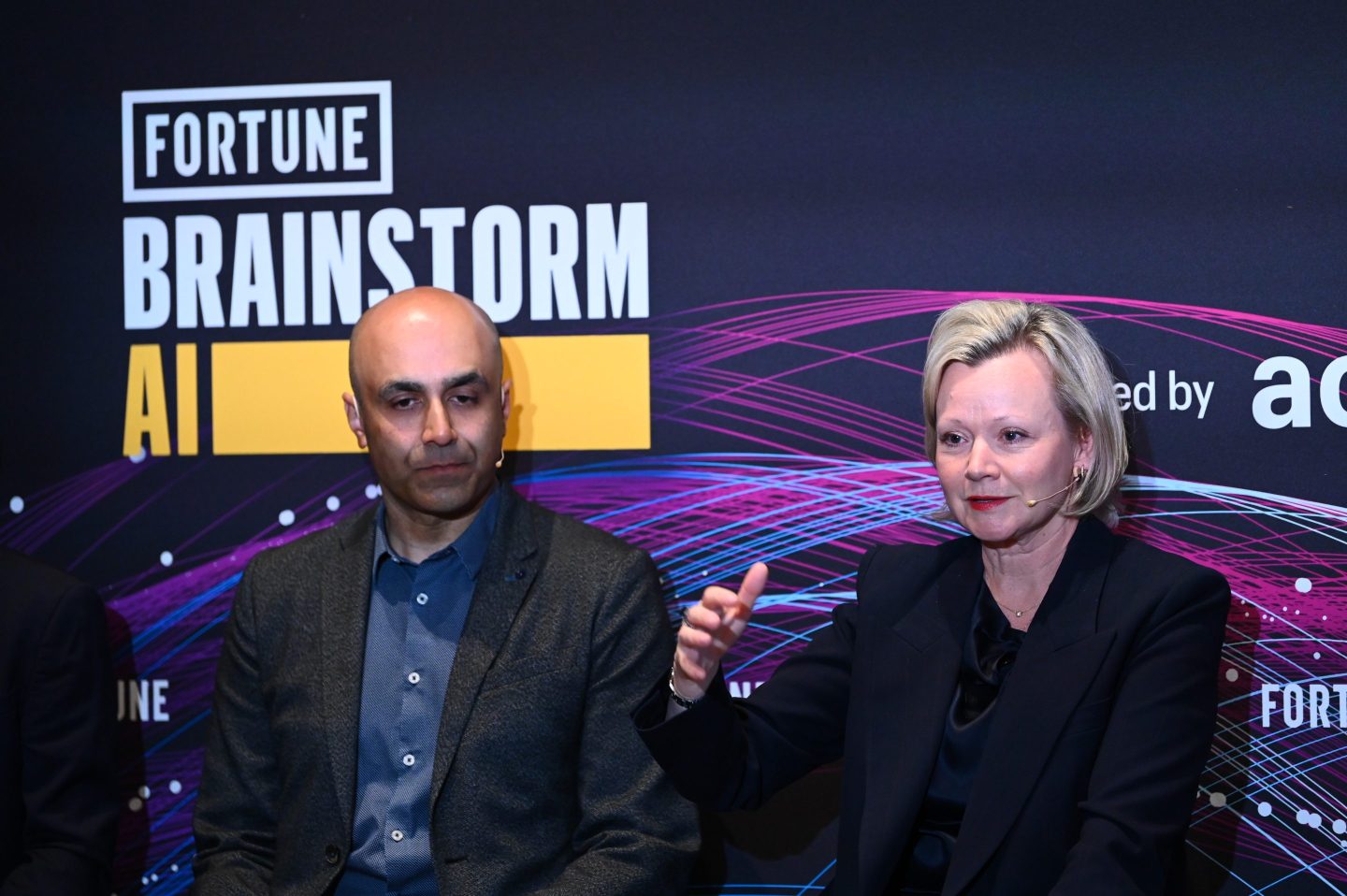
“If you’re not investing in skills development and you’re not invested in learning, I think you are going to leave your workforce behind,” said Karalee Close, global talent and organization lead at IT services and management consulting firm Accenture, at Fortune’s Brainstorm AI conference in London on Tuesday.
With 97% of C-suite leaders saying they view artificial intelligence as a major transformational opportunity but only 13% actually creating business value from the technology, Close said, a scaling issue is emerging because companies haven’t yet figured out how skills will need to evolve. This challenge has become an even greater burden to businesses as they move to apply gen AI tools from simpler use cases—customer service, coding, repetitive back-office tasks—to more complex parts of the business like supply chains and research and development.
“It’s a question of if you can develop the workforce in the right way,” Close said.
AI skills gap
Some leaders believe that an inverse pyramid has emerged with AI: There’s great enthusiasm from the C-suite, but that level of interest starts to wane with middle managers, and it further deteriorates among early-career workers who still haven’t been shown exactly how AI will make them more productive.
“Spending more time on that will yield better results collectively,” said Chintan Patel, chief technology officer of Cisco’s Europe, Middle East, and Africa (EMEA) business.
Patel says the digital knowledge gap extends far beyond AI, citing research released last year by British financial services company Lloyds Bank that found 52% of working-age adults in the U.K. lacked essential digital skills, ranging from effectively using social media, performing financial transactions, and understanding how to avoid online scams.
“If we don’t get some of those basic digital skills enabled in the workforce—and by the way, 70% of the 2030 workforce is in the workforce today—we absolutely won’t get people onto advanced AI,” Patel said.
With five European businesses adopting AI every minute, according to a study from Amazon, the technology is advancing at a pace that far exceeds when mobile phones proliferated at the turn of the century. “The problem we are facing is that whilst the technology exists and it is moving at rapid pace, the skills acceleration is not happening at the same pace,” said Tanuja Randery, vice president and managing director of EMEA for Amazon Web Services.
Randery said that every conversation she has with CEOs features the same theme: They cannot find enough digital skills in the workforce. She recommends three fixes: a greater effort to educate students at universities on core digital skills, investments in reskilling programs for the current workforce, and getting leadership up to speed to fully grasp the implications of AI to their core businesses.
“Even though boards and CEOs are pulling for this, very few actually understand the technology and its implications,” Randery said.
Embracing change
Accenture’s Close shared her own work with the company’s efforts to develop 12 industry-specific AI agents intended to help workers on tasks ranging from clinical trials in drug development to addressing industrial equipment issues to making marketers and communications experts more data driven.
“The lesson that we learned is that harnessing the creativity and the power of the best marketers was what needed to happen,” Close said. That meant they had to be trained and encouraged how to prompt large language models, have a back-and-forth dialogue with data, and embrace change.
Randery, citing a 2025 report from the World Economic Forum, notes that if the world’s workforce was made of 100 people, 59 would need to be reskilled by 2030 to reflect the ways that technology is changing workplace tasks. Of these, 29 could be upskilled in their current roles, 19 trained and then redeployed elsewhere within the company, and 11 would likely not get the right reskilling and their employment would be at risk.
“There is absolutely a reason to believe that there is going to be a percentage of jobs that will go away,” Randery said. But, optimistically, she added, “If I go back to technology implementations over time, it only always results in augmentation.” She noted that AI coding assistant tools are taking away tedious tasks, but also spurring a new wave of creativity.
Close said that persistent research shows that humans, when combined with technologies like AI, are more effective at completing tasks than a human working on their own. Businesses need to reflect on their own purpose as a company: what’s their point of differentiation and how can humans be combined with technology, not pitted against each other.
“It’s less about who is good and who is going to be replaced,” Close said. “It’s more about what you can do differently with this technology.”