- President Donald Trump believes his tariffs will bring back more factory jobs—but absent a robust union movement, those jobs could likely end up paying cut-rate wages and injuring workers at high rates, as factory jobs in the South today often do, says labor historian Eric Blanc. He argues a mass unionization campaign in factories, retail stores, and other workplaces is called for, especially as Trump moves to undo union protections with other policies.
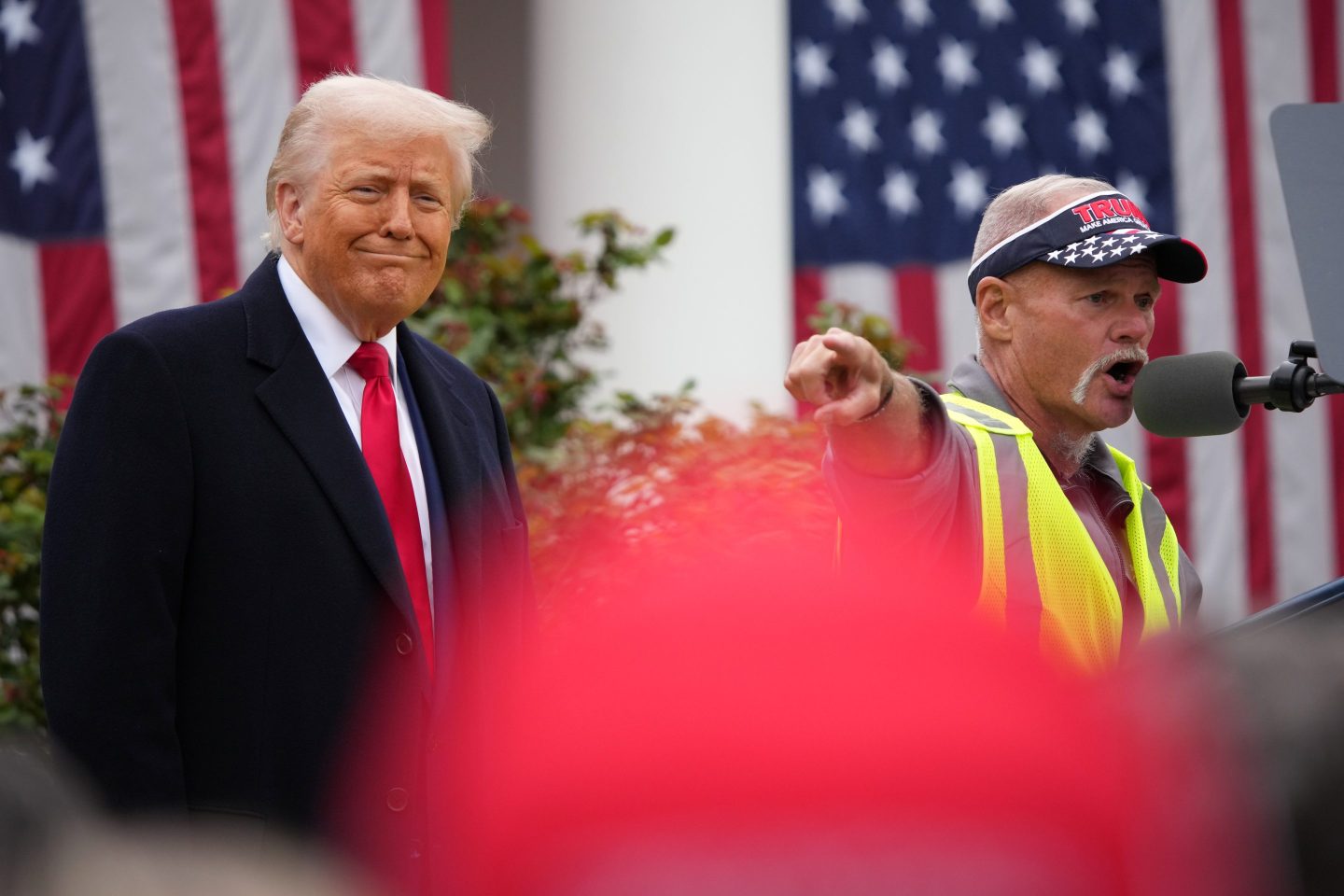
President Donald Trump announced his tariffs with a promise they would bring back the factory jobs that once made America “great,” complete with a Rose Garden ceremony where a retired United Auto Workers (UAW) union member spoke fondly of a plant he was sure would reopen.
But there’s a crucial ingredient missing to make those new jobs great: unions. Without them, Trump’s promise of good jobs could dissipate into a race to the bottom where factories hire desperate workers at cut-rate wages with little or no benefits, Eric Blanc, a labor historian and professor at Rutgers University, wrote this week.
“Being pro-factory is not the same thing as being pro-worker,” Blanc wrote on his Substack.
“The reason people associate factory jobs with good jobs and have this nostalgic view of the heyday of American manufacturing in the 1950s, when you could have one breadwinner providing for the whole family—that was the product of unionization,” Blanc told Fortune. Before the wave of unionization in the U.S. in the 1930s and 1940s, “factories were described as hellholes; they were authoritarian regimes where safety was nonexistent.”
In 1912 and 1913, more than 20,000 workers died in industrial accidents, according to the Centers for Disease Control and Prevention—at a time when the American workforce was less than a quarter of its present size. The muckraking novel The Jungle describes meatpacking plants packed with immigrant children, working 10- to 12-hour days for poverty wages.
As proof this can happen today, Blanc points to the American South, where the bulk of manufacturing expansion has taken place since the 1990s. A Bloomberg cover story about the Southern manufacturing renaissance during the first Trump administration documented “burning flesh, crushed limbs, dismembered body parts, and a flailing fall into a vat of acid” at auto factories in the region.
“Accident rates are four times higher than they are anywhere in the country, and one-third of manufacturing workers now rely on government assistance like food stamps,” Blanc said, citing a study from the UC Berkeley Labor Center. Since the mid-2000s, pay for manufacturing workers has fallen behind that of their nonmanufacturing counterparts.
Service jobs can pay well, too
Unionizing holds the promise of improving not just factory work but all work, Blanc said; union members reliably earn more than nonunion counterparts and enjoy greater job security, even in service jobs. Take the highly unionized hotel sector in New York or Las Vegas, where workers are on track to make between $28 and $37 an hour, on average, by the end of current contracts.
Indeed, mass unionizing will be necessary, in Blanc’s view, since the bulk of American jobs are and will remain in the service sector. Even in the best-case scenario, in which a manufacturing resurgence creates another several million jobs, economist and Nobel laureate Paul Krugman estimated it would only bring the manufacturing share of employment in the U.S. from its current 10% “to maybe 12.5% of employment—not back to the 30% of employment that used to be, once upon a time.”
“Whether we like it or not, America’s workforce will continue to overwhelmingly work in the service sector,” Blanc said. That’s already the case in America’s industrialized peers like Germany and Japan, which have seen their manufacturing employment rates slide despite strong government support for the sector.
The prospect of a mass unionization movement in a country where less than 10% of workers are unionized is a challenge, to say the least. Blanc concedes it’s gotten worse in the current climate, where Trump, while courting union members on one hand, is dismantling collective bargaining rights with the other. In two bold moves that are currently being litigated, the president has dismissed a Democratic member of the National Labor Relations Board, Gwynne Wilcox—shrinking the independent labor regulator to a size where it can’t legally do much of its job—and has attempted to cancel the collective bargaining agreements for thousands of federal workers.
“Trump’s attacks against the federal unions send a signal to other employers that they don’t have to follow labor law,” Blanc said.
Asked about the contradictions between the stated goals of Trump’s tariff policies and his labor policies, White House spokesperson Kush Desai said: “Chicken Little ‘expert’ predictions didn’t quite pan out during President Trump’s first term, and they’re not going to pan out during his second term when President Trump again restores American Greatness from Main Street to Wall Street.”
Still, even in a frosty political climate, organizing isn’t impossible, Blanc said—and the labor movement has popular sentiment on its side.
“Trump’s policies are so unpopular, from blowing up the economy and going after people’s Social Security, it’s generating a lot of resistance and pushback, and this anti-billionaire energy we’re already seeing is being channeled in unionization efforts,” Blanc said.
The first union at Amazon-owned Whole Foods was recognized this past January, where workers at a Philadelphia store voted decisively to join a chapter of the United Food and Commercial Workers union. Volkswagen’s plant in Chattanooga voted decisively to unionize with the UAW last year. Unions organized 100,000 more workers during the presidency of Republican George W. Bush than under Democrat Barack Obama, and the rebranding of the GOP as a working-class party means 49% of Republicans now support unions, per Gallup. Overall, 70% of Americans think positively of unions—approval rates last seen in the 1950s.
“Just promising more factory jobs is not going to bring back prosperity,” Blanc said. But in good news for the three-quarters of workers who say they don’t want to work in factories, he adds, “any job could become a good job with collective bargaining.”