• Home
  • Latest
  • Fortune 500
  • Finance
  • Tech
  • Leadership
  • Lifestyle
  • Rankings
  • Multimedia
FinanceTariffs and trade

To slow China’s tech advances, Trump should keep its factories addicted to cheap exports via low tariffs, economist says

Jason Ma
By
Jason Ma
Jason Ma
Weekend Editor
Down Arrow Button Icon
Jason Ma
By
Jason Ma
Jason Ma
Weekend Editor
Down Arrow Button Icon
April 13, 2025, 2:15 PM ET
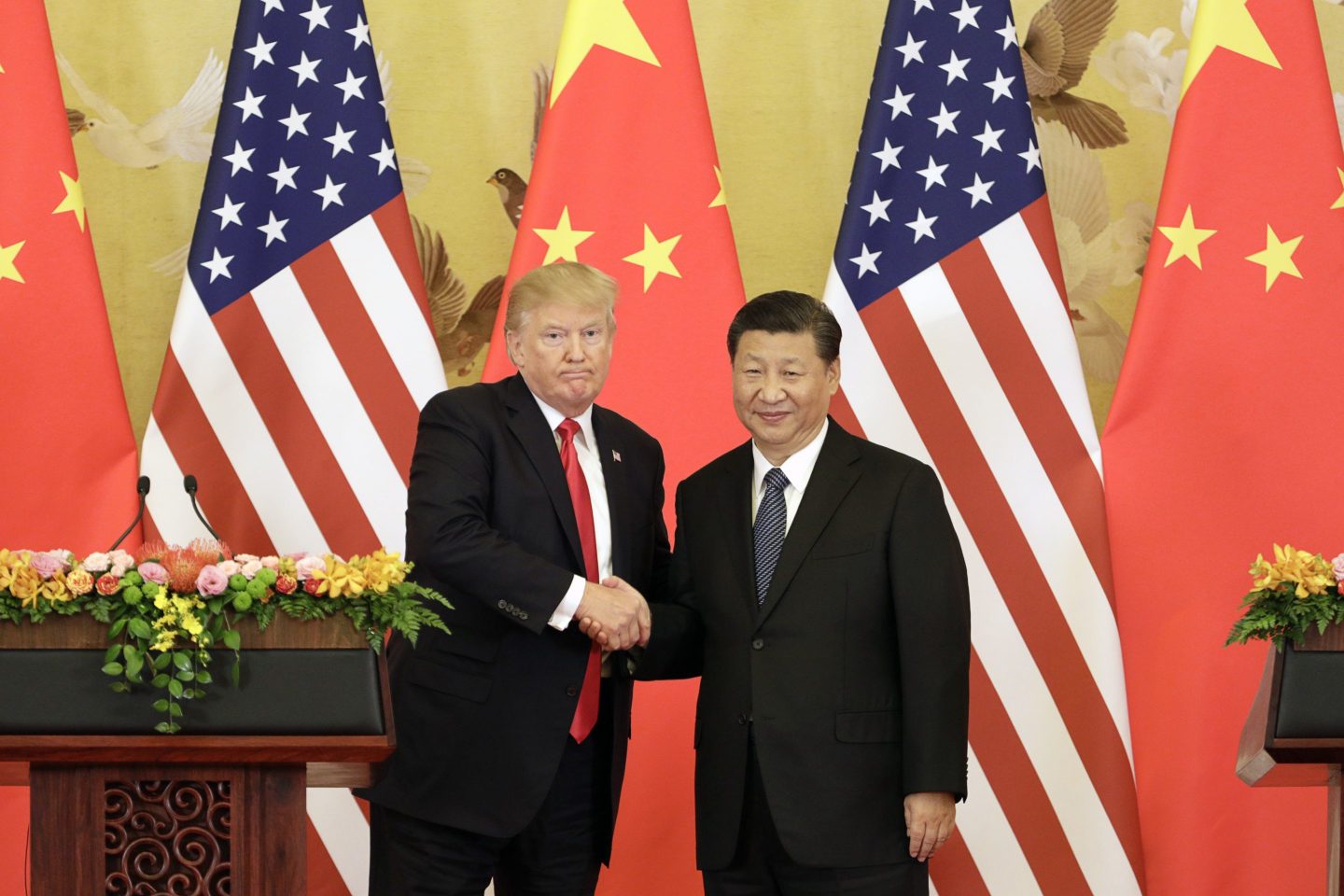
President Donald Trump and Chinese President Xi Jinping in Beijing in 2017.
President Donald Trump and Chinese President Xi Jinping in Beijing in 2017. Qilai Shen—Bloomberg via Getty Images
  • President Donald Trump’s approach to US-China trade has been to impose prohibitively high tariffs. While he just gave key tech imports a temporary reprieve, the rest of China’s producers still face tariffs of 145%. But if Trump wants to slow China’s technological progress, that’s the opposite of what he should be doing, an economist says.

President Donald Trump’s on-again, off-again tariffs have taken the global economy on a wild ride, but China has been his main target and faces prohibitively high duties.

Recommended Video

While he just gave key tech imports a temporary reprieve, the rest of China’s producers still face tariffs of 145%, meaning toys, apparel and furniture made there will have to find new buyers.

The White House has signaled that shrinking the US-China trade deficit and reshoring manufacturing are top goals. But if it wants to slow China’s tech advances and ensure the US is dominant, then the administration needs to take a totally different approach, according to Keyu Jin, an associate professor of economics at the London School of Economics and the author of The New China Playbook.

In an op-ed in the Financial Times on Thursday, she noted that technological leaps often emerge during times of conflict and that Trump’s trade war could ignite a surge of innovation.

“Tariffs don’t just alter trade flows—they redirect resources and reshape industrial structures,” Jin wrote. “If Trump’s goal was to curb China’s technological progress, he would keep tariffs low on the bulk of Chinese exports to the US, locking the country into low-margin basic manufacturing. He would encourage high-tech exports to China, making sure that progress in its advanced components stalls.”

But instead of US exports finding an easier way into China’s markets, they will hit a wall. Trump’s tariffs have been met with similar retaliation as China has imposed duties of 125% on the US.

At such levels, the opposing duties would bring trade between the world’s two largest economies to a virtual halt.

Jin predicted that the shock from Trump’s trade war will push China to divert more resources into higher-value, advanced technologies that compete with US products.

“Beijing has drawn its conclusion: innovation and core technology control is the only sustainable defense against tariffs,” she explained. “Companies with proprietary technology—like Huawei and BYD—are more insulated from tariffs and supply-chain shocks. China envisions a new tech supply-chain model: regional production, tech sovereignty and global supply-chain redundancy.”

To be sure, other experts have noted that the flood of exports that were coming out of China has massively disrupted global trade and economies around the world.

And even before the latest trade war, the Biden administration continued China tariffs that Trump imposed during his first administration. It also added restrictions on US tech exports like Nvidia’s most high-end chips to curb China’s progress in area like artificial intelligence, which could tip the scales in military prowess.

But such sanctions merely rerouted demand away from US supplies, and domestic Chinese chipmakers are reporting record revenues and reinvesting in R&D, Jin said.

She also pointed out that China’s DeepSeek, which shocked the tech industry earlier this year with its low-cost AI model that was comparable to US versions, was “born under constraint.”  Meanwhile, Beijing is also targeting photonic quantum computing, low-orbit satellites, and breakthroughs in chipmaking equipment while leading in factory robots.

Since Trump’s first-term tariffs, Chinese companies have been expanding into other markets around the world, including Africa. And they have significant room to grow beyond manufacturing by providing more services and digital infrastructure, Jin said.

Drawing a parallel with Napoleon’s trade embargo on Britain in the early 1800s, she argued that it prompted the British to turn to Asia, Africa and the Americas while also stoking more industrialization.

“The US may be repeating that mistake. If making America great again is its goal, Trump should not fear a comfortable China; he should fear a constrained one,” Jin warned.


Join us at the Fortune Workplace Innovation Summit May 19–20, 2026, in Atlanta. The next era of workplace innovation is here—and the old playbook is being rewritten. At this exclusive, high-energy event, the world’s most innovative leaders will convene to explore how AI, humanity, and strategy converge to redefine, again, the future of work. Register now.
About the Author
Jason Ma
By Jason MaWeekend Editor

Jason Ma is the weekend editor at Fortune, where he covers markets, the economy, finance, and housing.

See full bioRight Arrow Button Icon

Latest in Finance

Investingspace
Alphabet poised for another paper gain as SpaceX valuation jumps
By Edward Ludlow and BloombergDecember 14, 2025
25 minutes ago
PoliticsElections
The first-term congressman leading the GOP’s midterm House campaign says Trump is intimately involved in recruitment decisions
By Bill Barrow and The Associated PressDecember 14, 2025
1 hour ago
CARACAS, VENEZUELA - A member of the Bolivarian National Armed Forces holds an "Igla-S" rocket launcher during a military ceremony commemorating the 200th anniversary of the presentation of the 'Sword of Peru' to Venezuelan independence hero Simón Bolívar on November 25, 2025, in Caracas, Venezuela. The United States recently designated the "Cartel De Los Soles" (Cartel of The Suns) as a foreign terrorist organization, a group allegedly led by the president of Venezuela, Nicolas Maduro, and which, it is presumed, includes high-ranking members of the Venezuelan government.
EnergyBig Oil
Everything the Trump administration is doing in Venezuela involves oil and regime change—even if the White House won’t admit it
By Jordan BlumDecember 14, 2025
5 hours ago
JPMorganChase CEO Jamie Dimon says AI will eliminate jobs—and that soft skills will be more important than ever.
Future of WorkTech
Jamie Dimon says soft skills like emotional intelligence and communication are vital as AI eliminates roles
By Nino PaoliDecember 14, 2025
8 hours ago
InvestingSports
Big 12 in advanced talks for deal with RedBird-backed fund
By Giles Turner and BloombergDecember 13, 2025
18 hours ago
Spanish Prime Minister Pedro Sánchez often praises the financial and social benefits that immigrants bring to the country.
EuropeSpain
In a continent cracking down on immigration and berated by Trump’s warnings of ‘civilizational erasure,’ Spain embraces migrants
By Suman Naishadham and The Associated PressDecember 13, 2025
19 hours ago

Most Popular

placeholder alt text
Economy
Tariffs are taxes and they were used to finance the federal government until the 1913 income tax. A top economist breaks it down
By Kent JonesDecember 12, 2025
2 days ago
placeholder alt text
Success
Apple cofounder Ronald Wayne sold his 10% stake for $800 in 1976—today it’d be worth up to $400 billion
By Preston ForeDecember 12, 2025
2 days ago
placeholder alt text
Success
40% of Stanford undergrads receive disability accommodations—but it’s become a college-wide phenomenon as Gen Z try to succeed in the current climate
By Preston ForeDecember 12, 2025
2 days ago
placeholder alt text
Economy
The Fed just ‘Trump-proofed’ itself with a unanimous move to preempt a potential leadership shake-up
By Jason MaDecember 12, 2025
2 days ago
placeholder alt text
Uncategorized
Transforming customer support through intelligent AI operations
By Lauren ChomiukNovember 26, 2025
18 days ago
placeholder alt text
Success
Apple CEO Tim Cook out-earns the average American’s salary in just 7 hours—to put that into context, he could buy a new $439,000 home in just 2 days
By Emma BurleighDecember 12, 2025
2 days ago
Rankings
  • 100 Best Companies
  • Fortune 500
  • Global 500
  • Fortune 500 Europe
  • Most Powerful Women
  • Future 50
  • World’s Most Admired Companies
  • See All Rankings
Sections
  • Finance
  • Leadership
  • Success
  • Tech
  • Asia
  • Europe
  • Environment
  • Fortune Crypto
  • Health
  • Retail
  • Lifestyle
  • Politics
  • Newsletters
  • Magazine
  • Features
  • Commentary
  • Mpw
  • CEO Initiative
  • Conferences
  • Personal Finance
  • Education
Customer Support
  • Frequently Asked Questions
  • Customer Service Portal
  • Privacy Policy
  • Terms Of Use
  • Single Issues For Purchase
  • International Print
Commercial Services
  • Advertising
  • Fortune Brand Studio
  • Fortune Analytics
  • Fortune Conferences
  • Business Development
About Us
  • About Us
  • Editorial Calendar
  • Press Center
  • Work At Fortune
  • Diversity And Inclusion
  • Terms And Conditions
  • Site Map

© 2025 Fortune Media IP Limited. All Rights Reserved. Use of this site constitutes acceptance of our Terms of Use and Privacy Policy | CA Notice at Collection and Privacy Notice | Do Not Sell/Share My Personal Information
FORTUNE is a trademark of Fortune Media IP Limited, registered in the U.S. and other countries. FORTUNE may receive compensation for some links to products and services on this website. Offers may be subject to change without notice.