• Home
  • Latest
  • Fortune 500
  • Finance
  • Tech
  • Leadership
  • Lifestyle
  • Rankings
  • Multimedia
FinanceStock

What is a bear market? How Trump’s tariff blitz caused a market meltdown that could send the S&P 500 to lows not seen since 2022

By
Stan Choe
Stan Choe
,
Alex Veiga
Alex Veiga
and
The Associated Press
Down Arrow Button Icon
By
Stan Choe
Stan Choe
,
Alex Veiga
Alex Veiga
and
The Associated Press
Down Arrow Button Icon
April 7, 2025, 4:59 PM ET
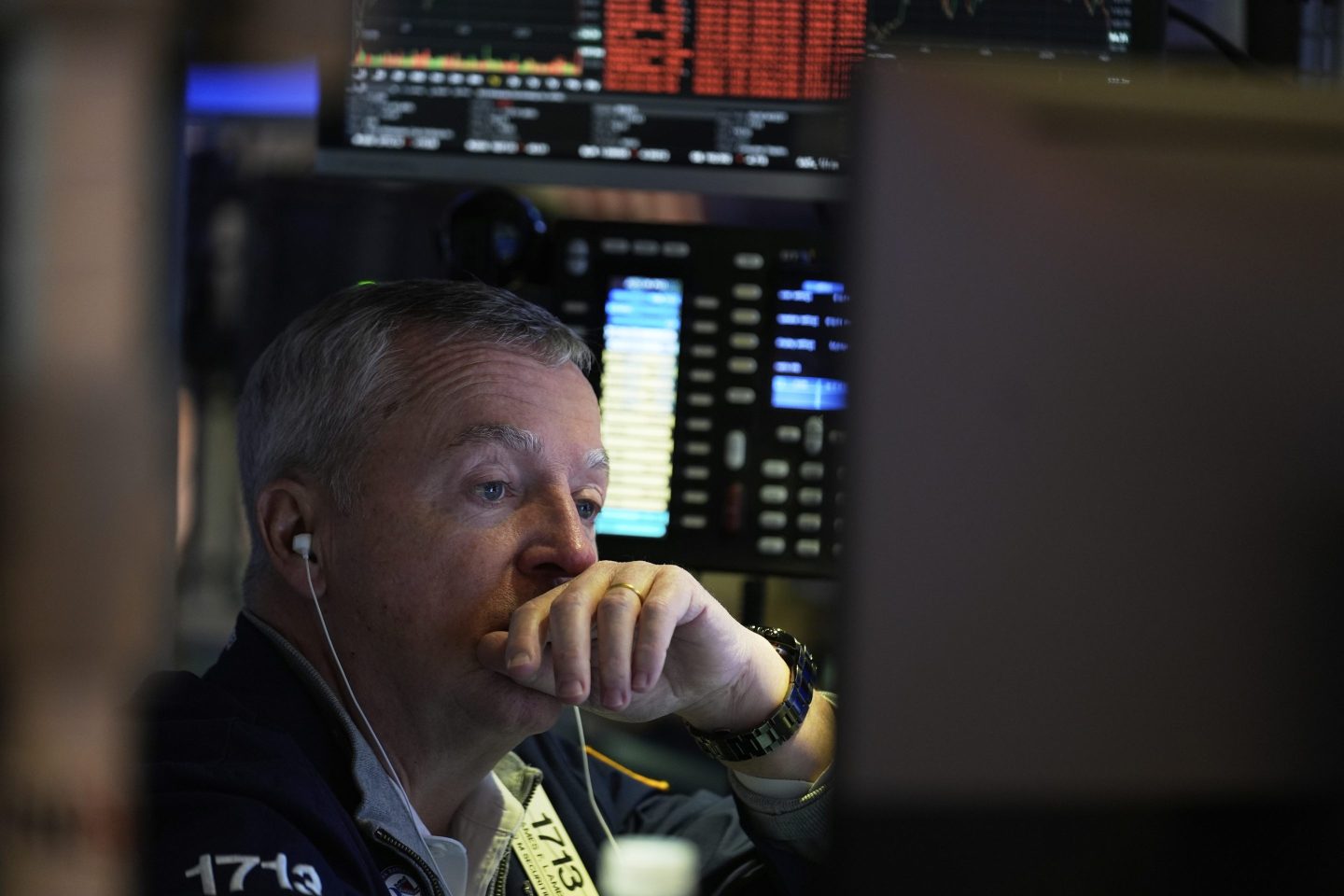
James Lamb works on the floor at the New York Stock Exchange in New York, Monday, April 7, 2025.
James Lamb works on the floor at the New York Stock Exchange in New York, Monday, April 7, 2025.AP Photo/Seth Wenig

Wall Street could soon be in the claws of another bear market as the Trump administration’s tariff blitz fuels fears that the added taxes on imported goods from around the world will sink the global economy.

Recommended Video

The last bear market happened in 2022, but this decline feels more like the sudden, turbulent bear market of 2020, when the benchmark S&P 500 index tumbled 34% in a one-month period, the shortest bear market ever.

Here are some common questions about bear markets:

Why is it called a bear market?

A bear market is a term used by Wall Street when an index such as the S&P 500 or the Dow Jones Industrial Average has fallen 20% or more from a recent high for a sustained period of time.

Why use a bear to refer to a market slump? Bears hibernate, so they represent a stock market that’s retreating. In contrast, Wall Street’s nickname for a surging market is a bull market, because bulls charge.

The S&P 500, Wall Street’s main barometer of health, closed 0.2% lower Monday after having been down by as much as 4.7%. It’s now 17.6% below the all-time high it set on Feb. 19.

The Dow industrials fell 0.9%, and the tech-heavy Nasdaq composite, which already was in a bear market, bounced back from an early slide to eke out a 0.1% gain.

The most recent bear market for the S&P 500 ran from Jan. 3 to Oct. 12 in 2022.

What’s bothering investors?

The trade war has ratcheted up fear and uncertainty on Wall Street over how businesses and consumers will respond.

President Donald Trump followed through on tariff threats last week by declaring a 10% baseline tax on imports from all countries and higher tariff rates on dozens of nations that run trade surpluses with the United States.

Global markets cratered the next day, and the sell-off deepened after China announced it would retaliate with tariffs equal to the ones from the U.S.

Tariffs cause economic pain in part because they’re a tax paid by importers that often gets passed along to consumers, adding to inflationary pressure. They also provoke trading partners into retaliating, which can hurt all economies involved.

Import taxes can also cause economic damage by complicating the decisions businesses have to make, including which suppliers to use, where to locate factories and what prices to charge. And that uncertainty can cause them to delay or cancel investments that help drive economic growth.

The tariffs come at a time when the U.S. economy is already showing signs of slowing. Markets are also worried that tariffs could fuel inflation, which recently ticked higher.

How long do bear markets last and how deep do they go?

On average, bear markets have taken 13 months to go from peak to trough and 27 months to get back to breakeven since World War II. The S&P 500 index has fallen an average of 33% during bear markets in that time. The biggest decline since 1945 occurred in the 2007-2009 bear market, when the S&P 500 fell 57%.

History shows that the faster an index enters into a bear market, the shallower they tend to be. Historically, stocks have taken 251 days (8.3 months) to fall into a bear market. When the S&P 500 has fallen 20% at a faster clip, the index has averaged a loss of 28%.

The longest bear market lasted 61 months and ended in March 1942. It cut the index by 60%.

When is a bear market over?

Generally, investors look for a 20% gain from a low point as well as sustained gains over at least a six-month period. It took less than three weeks for stocks to rise 20% from their low in March 2020.

Should investors sell now?

If you need the money now or want to lock in the losses, yes. Otherwise, many advisers suggest riding through the ups and downs while remembering the swings are the price of admission for the stronger returns that stocks have provided over the long term.

While dumping stocks would stop the bleeding, it would also prevent any potential gains. Many of the best days for Wall Street have occurred either during a bear market or just after one ended. That includes two separate days in the middle of the 2007-2009 bear market when the S&P 500 surged roughly 11%, as well as leaps of better than 9% during and shortly after the monthlong 2020 bear market.

Advisers suggest putting money into stocks only if it will not be needed for several years. The S&P 500 has come back from every one of its prior bear markets to eventually rise to another all-time high.

The down decade for the stock market following the 2000 bursting of the dot-com bubble was a notoriously brutal stretch, but stocks have often been able to regain their highs within a few years.
Join us at the Fortune Workplace Innovation Summit May 19–20, 2026, in Atlanta. The next era of workplace innovation is here—and the old playbook is being rewritten. At this exclusive, high-energy event, the world’s most innovative leaders will convene to explore how AI, humanity, and strategy converge to redefine, again, the future of work. Register now.
About the Authors
By Stan Choe
See full bioRight Arrow Button Icon
By Alex Veiga
See full bioRight Arrow Button Icon
By The Associated Press
See full bioRight Arrow Button Icon

Latest in Finance

Investingspace
SpaceX sets $800 billion valuation, confirms 2026 IPO plans
By Loren Grush, Edward Ludlow and BloombergDecember 13, 2025
50 minutes ago
PoliticsAffordable Care Act (ACA)
With just days to go before ACA subsidies expire, Congress is about to wrap up its work with no consensus solution in sight
By Kevin Freking, Lisa Mascaro and The Associated PressDecember 13, 2025
1 hour ago
InnovationRobots
Even in Silicon Valley, skepticism looms over robots, while ‘China has certainly a lot more momentum on humanoids’
By Matt O'Brien and The Associated PressDecember 13, 2025
2 hours ago
HealthAffordable Care Act (ACA)
A Wisconsin couple was paying $2 a month for an ACA health plan. But as subsidies expire, it’s soaring to $1,600, forcing them to downgrade
By Ali Swenson and The Associated PressDecember 13, 2025
2 hours ago
Julian Braithwaite is the Director General of the International Alliance for Responsible Drinking
CommentaryProductivity
Gen Z is drinking 20% less than Millennials. Productivity is rising. Coincidence? Not quite
By Julian BraithwaiteDecember 13, 2025
3 hours ago
carbon
Commentaryclimate change
Banking on carbon markets 2.0: why financial institutions should engage with carbon credits
By Usha Rao-MonariDecember 13, 2025
4 hours ago

Most Popular

placeholder alt text
Economy
Tariffs are taxes and they were used to finance the federal government until the 1913 income tax. A top economist breaks it down
By Kent JonesDecember 12, 2025
1 day ago
placeholder alt text
Success
Apple cofounder Ronald Wayne sold his 10% stake for $800 in 1976—today it’d be worth up to $400 billion
By Preston ForeDecember 12, 2025
1 day ago
placeholder alt text
Success
40% of Stanford undergrads receive disability accommodations—but it’s become a college-wide phenomenon as Gen Z try to succeed in the current climate
By Preston ForeDecember 12, 2025
1 day ago
placeholder alt text
Economy
For the first time since Trump’s tariff rollout, import tax revenue has fallen, threatening his lofty plans to slash the $38 trillion national debt
By Sasha RogelbergDecember 12, 2025
21 hours ago
placeholder alt text
Economy
The Fed just ‘Trump-proofed’ itself with a unanimous move to preempt a potential leadership shake-up
By Jason MaDecember 12, 2025
19 hours ago
placeholder alt text
Success
At 18, doctors gave him three hours to live. He played video games from his hospital bed—and now, he’s built a $10 million-a-year video game studio
By Preston ForeDecember 10, 2025
3 days ago
Rankings
  • 100 Best Companies
  • Fortune 500
  • Global 500
  • Fortune 500 Europe
  • Most Powerful Women
  • Future 50
  • World’s Most Admired Companies
  • See All Rankings
Sections
  • Finance
  • Leadership
  • Success
  • Tech
  • Asia
  • Europe
  • Environment
  • Fortune Crypto
  • Health
  • Retail
  • Lifestyle
  • Politics
  • Newsletters
  • Magazine
  • Features
  • Commentary
  • Mpw
  • CEO Initiative
  • Conferences
  • Personal Finance
  • Education
Customer Support
  • Frequently Asked Questions
  • Customer Service Portal
  • Privacy Policy
  • Terms Of Use
  • Single Issues For Purchase
  • International Print
Commercial Services
  • Advertising
  • Fortune Brand Studio
  • Fortune Analytics
  • Fortune Conferences
  • Business Development
About Us
  • About Us
  • Editorial Calendar
  • Press Center
  • Work At Fortune
  • Diversity And Inclusion
  • Terms And Conditions
  • Site Map

© 2025 Fortune Media IP Limited. All Rights Reserved. Use of this site constitutes acceptance of our Terms of Use and Privacy Policy | CA Notice at Collection and Privacy Notice | Do Not Sell/Share My Personal Information
FORTUNE is a trademark of Fortune Media IP Limited, registered in the U.S. and other countries. FORTUNE may receive compensation for some links to products and services on this website. Offers may be subject to change without notice.