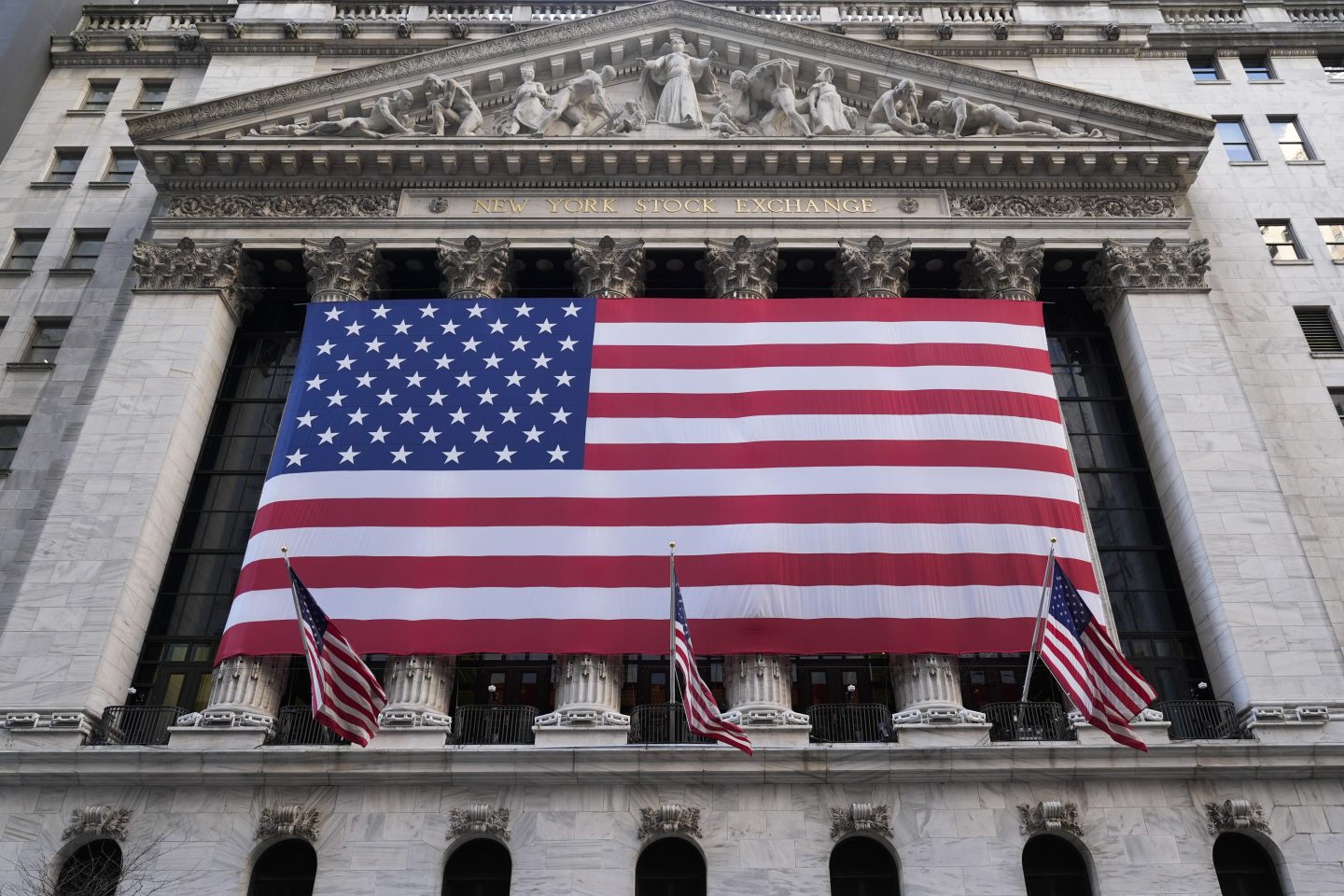
NEW YORK (AP) — Financial markets around the world are reeling Thursday following President Donald Trump’s latest and most severe volley of tariffs, and the U.S. stock market may be taking the worst of it.
The S&P 500 was down 3.3% in early trading, worse than the drops for other major stock markets. The Dow Jones Industrial Average was down 1,160 points, or 2.7%, as of 9:32 a.m. Eastern time, and the Nasdaq composite was 4.5% lower.
Little was spared as fear flared globally about the potentially toxic mix of higher inflation and weakening economic growth that tariffs can create. Prices fell for everything from crude oil to Big Tech stocks to small companies that invest only in U.S. real estate. Even gold, which has hit records recently as investors sought something safer to own, pulled lower. The value of the U.S. dollar also slid against other currencies, including the euro and Canadian dollar.
Investors worldwide knew Trump was going to announce a sweeping set of tariffs late Wednesday, and fears surrounding it had already earlier pulled the S&P 500 10% below its all-time high. But Trump still managed to surprise them with “the worst case scenario for tariffs,” according to Mary Ann Bartels, chief investment officer at Sanctuary Wealth.
Trump announced a minimum tariff of 10% on imports from all countries, with the tax rate running much higher on products from certain countries like China and those from the European Union. It’s “plausible” the tariffs altogether, which would rival levels unseen in roughly a century, could knock down U.S. economic growth by 2 percentage points this year and raise inflation close to 5%, according to UBS.
Such a hit would be so frightening that it “makes one’s rational mind regard the possibility of them sticking as low,” according to Bhanu Baweja and other strategists at UBS.
Wall Street had long assumed Trump would use tariffs merely as a tool for negotiations with other countries, rather than as a long-term policy. But Wednesday’s tariff announcement may suggest Trump sees tariffs more as helping to solve an ideological goal – wresting manufacturing jobs back to the United States, for example – than just an opening bet in a poker game.
If Trump follows through on his tariffs, stock prices may need to fall much more than 10% from their all-time high in order to reflect the global recession that could follow, along with the hit to profits that U.S. companies could take because of them.
“Markets may actually be underreacting, especially if these rates turn out to be final, given the potential knock-on effects to global consumption and trade,” said Sean Sun, portfolio manager at Thornburg Investment management, though he sees Trump’s announcement on Wednesday as more of an opening move than an endpoint for policy.
One wild card is that the Federal Reserve could cut interest rates in order to support the economy. That’s what it had been doing late last year. Lower interest rates help by making it easier for U.S. companies and households to borrow and spend.
Yields on Treasurys tumbled in part on rising expectations for coming cuts to rates, along with general fear about the health of the U.S. economy. The yield on the 10-year Treasury fell to 4.03% from 4.20% late Wednesday and from roughly 4.80% in January. That’s a huge move for the bond market.
The Fed may have less freedom to move than it would like, though. While lower rates can goose the economy, they can also push upward on inflation. And worries about inflation are already worsening because of tariffs. The Fed has no good tool to fix what’s called “stagflation,” where the economy stagnates and inflation stays high.
Worries about that worst-case scenario knocked down stocks across industries, leading to drops for three out of every four stocks that make up the S&P 500.
Nike fell 10.7% because so many of its products are made outside the United States. United Airlines lost 9.2% because customers worried about the global economy may not fly as much for business or feel comfortable enough to take vacations. Discount retailer Dollar Tree tumbled 11.3% amid worries that its customers, already squeezed by still-high inflation, may be under even more stress.
Some of the heaviest weights on the market were those that had soared earlier in Wall Street’s frenzy around artificial-intelligence frenzy. Critics said they were looking the most egregious out of an overall market that was already looking too expensive after their prices ran higher in recent years.
Nvidia sank 5.1% to bring its loss for the year so far to 22%. It had more than doubled last year after more than tripling in 2023. Palantir Technologies, which offers an AI platform for customers, sank 4.1%. Super Micro Computer, which makes servers, lost 8.2%.
In stock markets abroad, indexes fell sharply worldwide. France’s CAC 40 dropped 3.1%, and Germany’s DAX lost 2.4% in Europe.
Japan’s Nikkei 225 dropped 2.8%, Hong Kong’s Hang Seng lost 1.5% and South Korea’s Kospi dropped 0.8%.