On April 4, 1975, two young visionaries, Bill Gates and Paul Allen, set out to do something bold: build a software company for the nascent world of personal computing. Their vision? A computer on every desk and in every home. At a time when software wasn’t even considered an industry, that idea felt radical. Today, it feels prophetic.
I didn’t grow up knowing I’d one day be part of that journey. Not to age myself, but I was 7-plus years old when Microsoft started.
In fact, when I came to the U.S. from India as a young engineer in the late 1980s, I thought I was flying to Los Angeles—I expected tall buildings and movie stars. My LSU acceptance letter said “LA”—I didn’t realize it meant Louisiana. But I found my footing. I learned to love eating cereal three meals a day (the go-to meal when you’re a broke student who doesn’t eat meat), and eventually I landed an offer from a small but promising company called Microsoft, based somewhere in Washington State called Redmond.
As someone who spent 27 of Microsoft’s 50 years at the company, I’ve been fortunate to experience that journey from the inside—as an engineer, a leader, and now as a lifelong admirer and a shareholder. So, on this milestone anniversary, I want to offer a personal reflection, not just on what Microsoft has accomplished but on what has made it endure, evolve, and lead—again and again.
A vision that scaled
For any founder, Microsoft’s early story is a powerful reminder: A bold, clear vision—paired with a relentless focus on scale and accessibility—can define not just a company, but a category. Great companies don’t just build for today; they build the conditions for global adoption tomorrow.
Microsoft’s success was never about building the most expensive software. It was about building the most accessible software for everyone in the world.
The original strategy was elegant in its simplicity: build high-value, high-volume, and affordable software that would deliver significant productivity benefits and could scale globally. Windows and Office weren’t just products—they were flywheels. Windows, paired with a thriving OEM ecosystem, brought computing to the masses. Office, unified into one suite, became the operating system for productivity.
These twin engines helped create the juggernaut Microsoft became—and are still relevant today, even as the nature of computing has evolved.
I saw this firsthand as one of the early team members on Windows NT. We were building a new 32-bit operating system from scratch—not tweaking something old but inventing something new. It took roughly five years of intense work. For a while, I would show up to the office at 5:30 a.m., walk the halls with a yellow sticky pad, and mark machines that had crashed overnight from stress tests with a yellow sticky note: “Do not reboot until Soma looks at it.”
It wasn’t glamorous. But it mattered.
Four waves, one mindset
Over its 50 years, Microsoft has ridden (and sometimes rebuilt itself for) four major technology platform shifts:
- Client/server
- Internet/mobile
- Cloud
- AI
Not every wave went smoothly—and Microsoft’s strength has often been in how it responded, not how it started. We were late to the internet, with Netscape capturing early mindshare, but we moved quickly to shape the web era with Internet Explorer. In mobile, we missed the mark. In cloud, we started a little later—but today, we lead. And in AI, we were ahead of the curve from the start in terms of our direct investments combined with the path-breaking partnership with OpenAI. Across all these shifts, one trait has been essential: a willingness to learn, adapt, and build again and not just rest on the laurels.
And behind that mindset, Microsoft has had only three CEOs—Bill Gates, Steve Ballmer, and Satya Nadella—who each brought their own vision to bear yet shared two defining qualities, an insatiable curiosity being one (as president Brad Smith explained during GeekWire’s Microsoft@50 event). But I would add that each also had the ability to connect the dots. It’s not just about gathering information but also synthesizing seemingly disjointed signals into a coherent path forward. That combination, more than any technical skill or management style, is what great leadership demands—and all three delivered in spades.
Bill Gates laid Microsoft’s foundation—not only articulating a bold vision (“a PC on every desk and in every home”) but helping shape the software industry itself. He once told me, “Most of my decisions were wrong—I just got a few ones right and it turned out great because those few good decisions had outsized impact and influence.” The real trick, he said, wasn’t perfection but knowing which bets would matter most. He also created two of Microsoft’s defining flywheels: Windows with OEM partners and Office as the productivity suite that powered knowledge work.
Steve Ballmer took the helm during a complex transition—and while we faltered in mobile, he did two things that changed Microsoft’s trajectory. First, he put Microsoft squarely on the enterprise map. Second, he laid the foundation for our entry into the cloud. That work was the foundation for everything that Microsoft has accomplished and the leadership position it has in the cloud today.
And Satya? He put us on the cloud map with phenomenal strategy, focus, and execution. Also, he made it all cohere—culturally and strategically—helping Microsoft rediscover its mission while leading us into the AI era.
Satya Nadella and the culture reset
In 2014, Satya Nadella took the reins of Microsoft during a time when many believed the company’s best days were behind it. What followed was one of the most remarkable corporate reinventions in history.
Under Satya’s leadership, Microsoft redefined itself as a purpose-driven company—grounded in a mission to empower every person and organization on the planet to achieve more.
He reintroduced “growth mindset” as the cultural heartbeat, turning Microsoft from a “know-it-all” to a “learn-it-all” organization. His mantra? Compete hard, but stay humble. Be open. Be curious. Be approachable.
I’ve known Satya since we were both engineers at Microsoft in the early ’90s. What has always stood out to me is his clarity of purpose and his steady hand. Culture, for him, wasn’t a surface-level shift—it was the foundation for everything else to come.
That cultural reset created the conditions for Microsoft to take smart, calculated risks—to partner instead of going it alone, to build for platforms beyond our own, and to bet on big ideas that might reshape the industry. From embracing open source with GitHub to expanding the ecosystem through acquisitions like LinkedIn and Minecraft, to forging a game-changing partnership with OpenAI—Microsoft’s second act has been bold, outward-facing, collaborative yet competitive, and deeply strategic.
One moment that crystallized this for me came during a dinner in 2021. GitHub Copilot hadn’t launched yet, but Satya was already talking about it with the kind of energy you don’t forget. “This could change how developers build software,” he said—not as a sales pitch, but as a deeply personal belief. That’s Satya in a nutshell: humble in tone but uncompromising in conviction.
That early belief in the future of AI has since translated into tangible leadership—from GitHub Copilot to Microsoft 365 Copilot to Azure’s position as the go-to platform for building and running AI workloads and onward into the AI agentic world both for enterprises and for consumers. What started as a cultural reset has become a blueprint for enduring relevance—a company-wide engine of innovation that’s allowed Microsoft to not only keep pace but lead.
AI: The fourth wave
We are now firmly in the AI era—the fourth major wave. What excites me most isn’t just the technology but the potential. The ability to boost global productivity, expand access to intelligence, and reshape the way we build, learn, and create.
And once again, Microsoft is right at the forefront—not just with products, but with purpose.
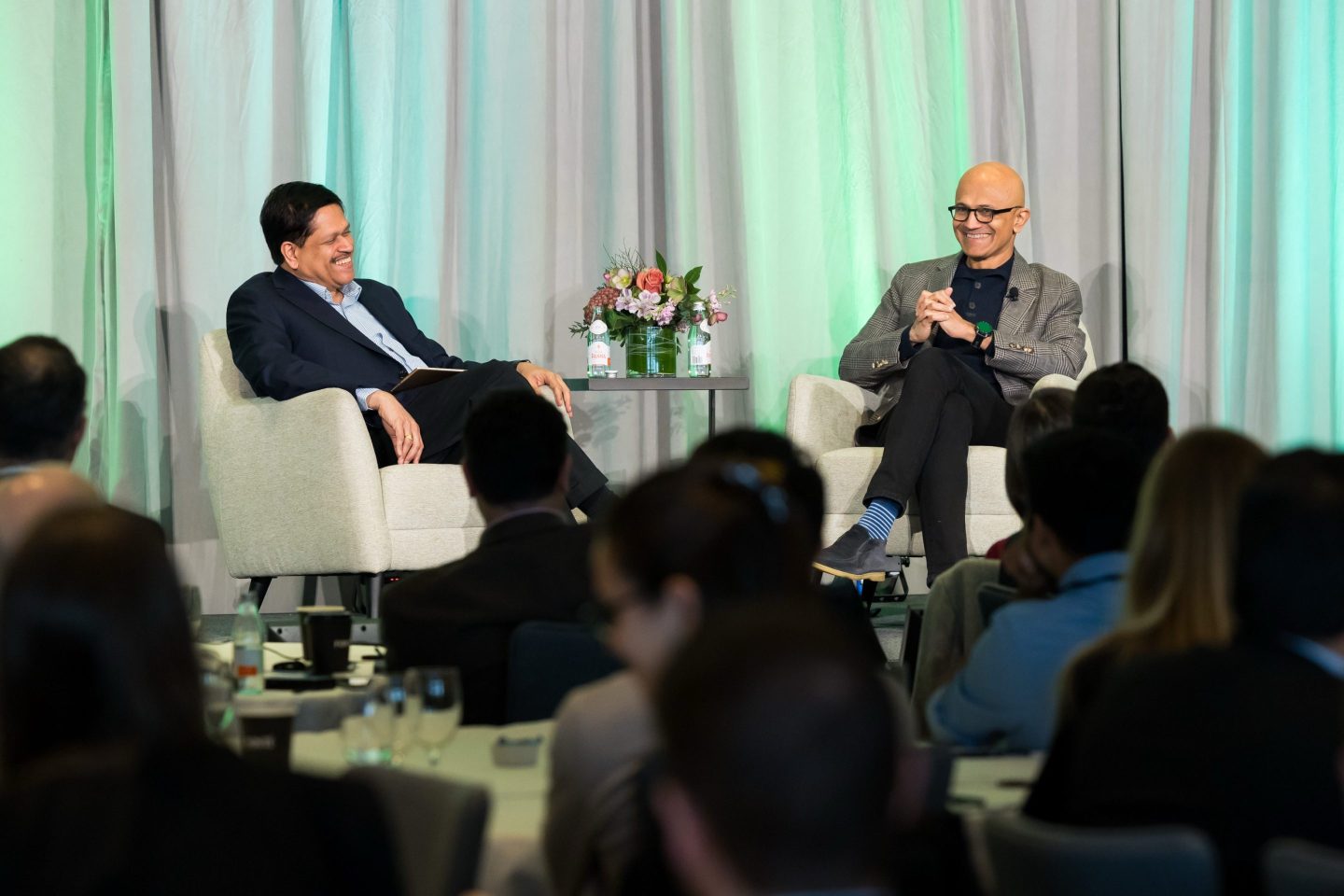
As Satya told me during our recent fireside chat at the Madrona Annual Meeting, “The world will need more compute.” But he explained that where the real enterprise value accrues—whether in infrastructure, models, or applications—is still being figured out.
And we are still very early.
He also dove into how he gauges Microsoft’s AI progress—he’s shifting the focus from technical benchmarks to broader economic impact as the true sign of artificial general intelligence (AGI).
“My formula for when can we say AGI has arrived? When, say, the developed world is growing at 10%, which may have been the peak of the Industrial Revolution,” he told me. “That’s a good benchmark for me.”
What endures
After 50 years, Microsoft remains not just relevant—but essential. Why?
Because at its core, the company never stopped believing in its mission. It evolved how it delivered on that mission, but the North Star stayed the same: make technology accessible, build tools that empower and drive productivity, and always bet on people.
That belief has always centered around one idea—productivity. From the earliest days of software to the latest breakthroughs in AI, Microsoft’s work has asked a simple but profound question: How do we help people be more productive? Whether they’re working, building, studying, playing, or communicating—the goal has been to make life better through technology.
Nowhere was that mission clearer to me than in the Developer Division. Developer tools were about more than code—they were about empowering the people who build the platforms that move the world forward. And at Microsoft, developers have always been more than users—they’re central to the company’s identity. Everyone is important, but developers are at the heart of the platform—and of Microsoft’s identity.
That lesson shaped me—from the first time I stepped into Building 2 as a nervous new hire in 1989 to the moment I walked into a meeting and realized I was now the one making the tough calls. Microsoft gave me the opportunity to contribute, to lead, and to grow.
And more than anything else, it gave me a front-row seat to one of the most extraordinary transformations in business history. A transformation defined not just by what the company built, but by how it endured, evolved, and led through every platform shift and every generation of leadership.
I came to Microsoft as a twentysomething engineer, unsure if I belonged. I stayed for 27 years because it was a place that believed in me—and let me believe in what was possible.
Here’s to the next 50 years of possibility.
The opinions expressed in Fortune.com commentary pieces are solely the views of their authors and do not necessarily reflect the opinions and beliefs of Fortune.
Read more:
- How Paul Allen and Bill Gates landed on the idea for Microsoft after cycling through many other startup ideas
- Satya Nadella has made Microsoft 10 times more valuable in his decade as CEO. Can he stay ahead in the AI age?
- Microsoft turns 50 as the world’s second largest company—trying not to fall behind on AI
- Microsoft’s memorable cultural legacies at 50, from Clippy to the Blue Screen of Death