Everything is on sale at a Joann’s store just north of New York City.
In the sewing section, some shopping carts have all but disappeared under bolts of cotton, tulle, and fleece. But the mood is hardly festive. The busy atmosphere and steep discounts are signs of a sad ending for a beloved institution. Or, as one dark-haired young shopper puts it: “It’s a bummer.”
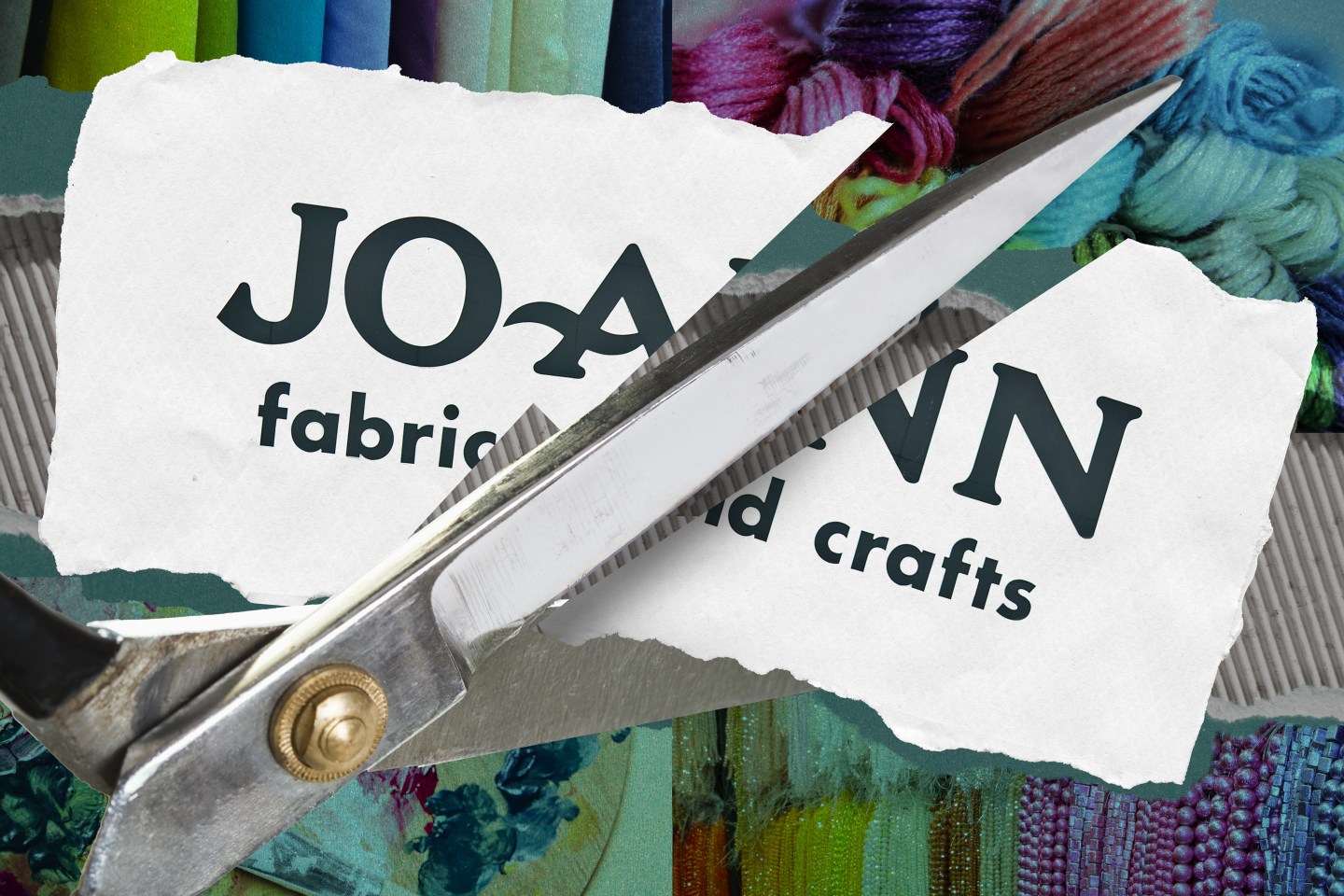
Last month, Joann Fabric and Crafts, a fixture of American shopping for generations, announced it would close all of its more than 800 stores in the U.S. and lay off 19,000 workers, including more than 15,000 part-time store associates. The company is in the midst of its second bankruptcy in less than a year.
Joann’s isn’t the only retail chain that has failed lately—Party City and clothing shop Forever 21 have both filed for bankruptcy. But the demise of Joann’s hit a nerve, and an army of devoted staffers and customers have shared their grief in a wave of online tributes.
In heartfelt videos posted on Instagram and Facebook, head office employees choke up recalling the lunch hours spent crocheting with their teams. Customers wax nostalgic about past mother-daughter projects and long Saturday afternoons at Joann, and several fans share intense “last haul” videos, scoring images of empty shelves with melancholy pop songs.
“Joann is f—ing closing,” said one young tear-stained shopper in a TikTok post.
“No shade to Michael’s or Hobby Lobby or anything like that,” she says, referring to the store’s closest competitors. “But Joann feels like home.”
The emotional farewells, however, have been accompanied by murder-mystery-style sleuthing about how the brand reached this point. In the late 1990s, Joann was the largest craft brand in the U.S., and became a Fortune 1000 company for two years during the pandemic, only to lose 99% of its value between 2021 and 2024. “I’m baffled as to how they managed to fail,” says Diana McDonough, a longtime customer and member of the Ohio Valley Quilting Guild.
In a statement published when the company filed for bankruptcy this year, Joann attributed the move to “significant and lasting challenges in the retail environment” and its “financial position and constrained inventory levels.”
Former employees and vendors who spoke to Fortune have theories about what happened. For many, the answer to the question “Who killed Joann?” is simple: Leonard Green. In 2011, the L.A.-based private equity company took Joann private for $1.6 billion in a leveraged buyout that saddled the company with significant debt.
But some say that debt alone doesn’t tell the whole story. They point to long-running cultural headwinds, staffing choices that created a dearth of workers in a customer-service-heavy industry, failure to respond to surprisingly tough competition, a revolving door of CEOs, and overconfidence sparked by a pandemic boom.
Joann Fabrics and Leonard Green & Partners declined to comment for this story.
“They really did this to themselves,” says Alan Porter, a former district manager who worked at Joann for 16 years. “Because the business is there.”
A cultural relic
Joann’s founders—two German immigrant families in Cleveland—likely never imagined their business would become as big as it did.
They launched the specialty store in 1945 as Cleveland Fabric Shop and later renamed it Joann, combining the first names of daughters from both families: Joan and Jacqueline Ann. (For many years, the company went by Jo-Ann Stores.) By 1963, Joann had 18 locations. In 1969, the fabric chain went public.
Virtually everything about our relationship with clothes has changed since Joann’s early days. At one time, sewing machines were a mainstay of American households, and most women learned to sew—but that all changed with the women’s movement, globalization, and the rise of fast fashion. Leaving aside “tradwives” and Etsy shop owners, most people now sew for leisure, not out of necessity. “How many young women are leaving college and their college graduation gift is a sewing machine?” says Lori Kendall, a senior lecturer of management at Ohio State University’s business school.
A larger pivot within the U.S. retail climate to e-commerce and big-box stores has also made it harder for a relatively small company like Joann to compete with behemoths like Amazon and Walmart. Along with the decline in the popularity of sewing, that shift created a “double whammy” for Joann, says Kendall.
New pressures and an unsolicited bid
Joann entered the 21st century as a family-run business, but not always a thriving one.
In 2006, the company hired Darrell Webb, who had been president of grocer Fred Meyer, to take over as the brand’s first non-family CEO. At that time, the company was struggling with uneven sales and too much inventory. “We had stores that weren’t clean, and he came in and brought this tremendous discipline, not only to the corporate culture but to the stores’ culture,” says an executive who worked at Joann at the same time as Webb but asked to remain anonymous to protect his privacy. Webb, he says, brought sparkling restrooms and tight inventory control: “That was a very positive shot in the arm.”
Alan Porter, who worked at Joann for 16 years, beginning as a store manager around 2004 and leaving as a Florida district manager in 2020, agrees. He credits Webb with setting Joann on what could have been a sustainable path. Webb and his leadership team did that largely by “getting back to basics,” Porter tells Fortune, and right-sizing the stores’ overgrown retail footprint. The CEO talked to store staff across the country, too, Porter says, learning how to make Joann a mecca for its core audience: sewers.
Fortune could not reach Webb for comment.
But Webb stepped down from his role in 2011 and took a seat on the board after Joann accepted an unsolicited bid from Leonard Green & Partners to take the company private. That $1.6 billion leveraged deal left the company with a mountain of debt—the remnants of which would bog it down for years—and meant Joann would pay steep annual management fees.
In the best-case scenario, private equity firms provide an injection of cash that allows a company to grow and create jobs before the firm finds an exit—like a sale or an IPO—and cashes out with a decent return. But timing, market conditions, and interest rates don’t always cooperate. Making matters worse, buyouts are made with funds borrowed against the company’s assets, meaning a company like Joann—which had no debt in 2010 and hit a record-high stock price that year—can find itself severely overleveraged and forced to raise prices or cut costs, including labor, to survive. If the market turns, or a company is poorly managed, and refinancing becomes harder, paying down debt can prove impossible.
“It may make the individuals rich at the time,” Chad Zipfel, a finance lecturer at Ohio State University’s Fisher School of Business, says of leveraged buyouts. “But it often portends future hurt.”
The Joann experience changes
Leonard Green initially looked like the right answer, according to the former executive who remembers discussions from that time. As private equity firms went, this person says, the PE firm was known for being hands-off, which was appealing.
Joann initially maintained the close-knit culture instilled by the family-run firm even after its PE acquisition, the former executive recalls. However, that eroded with time. One major culture shock came when then-CEO Jill Soltau, who had not previously worked in craft retail, hired consultants from McKinsey to analyze the workforce, which led to layoffs, he recalls. (Soltau did not respond to Fortune’s request for comment.) Between 2011 and 2023, nine executives rotated through the CEO office, including Webb and two sets of interim co-chiefs.
Porter also says that the company began reducing headcount inside stores in the 2010s to save on payroll costs, which led to a cascade of issues.
Unlike cans of soup that get restocked by the caseload, fabric often must be measured by employees at a cutting counter. One customer might need half a yard from six different heavy bolts, and the next person could have an even more complicated sewing project, Porter explains. When his stores didn’t have enough staff on hand, fabric bolts piled up at the cutting counter, and customers faced 45-minute-long wait times.
Elizabeth Caven, an Ohio-based crafts business investor who is also a vendor at Joann, adds that the sewing-obsessed staff were “one of the reasons why originally you would want to go into the store.”
“Usually, while the cutting process is happening, there’s a conversation: ‘What are you making?’ ‘What else do you need to go with this?’” Joann’s associates could make invaluable suggestions, she explains. But finding those helpful employees became “hit or miss,” she says.
Caven noticed staffing issues of another kind as well. In the process of pitching a handheld pattern projector to the company, she was stunned to discover that a head buyer had never seen paper patterns outside of their packaging. “The higher up in the company that you would go, the less there was an understanding of what the customer actually wanted to do,” she says.
Meanwhile, in the late 2010s, Hobby Lobby began expanding across the country, offering craft supplies and a limited selection of fabric. The chain had started in Oklahoma City in the 1970s and was a regional competitor for decades.
Hobby Lobby’s rise as a national rival was the tipping point for Joann’s decline, according to the former executive. The retailer was family-owned, he notes, so it wasn’t facing the same financial pressures as Joann. It didn’t have hundreds of millions in debt to worry about, or management fees. Meanwhile, it had less emphasis on labor-intensive sewing requests, and its goods were often cheaper. The famously Christian and mission-driven store quickly stole market share from Joann, which responded with more cost-cutting, further impacting the customer experience, which created a self-perpetuating cycle.
Pandemic boom and bust
After a rough few years, Joann’s fortunes changed again.
Entering 2020, the chain was still in debt to the tune of $900 million, which Moody’s flagged as distressed. But in the first nine months of that year, revenue reached $1.9 billion, representing nearly 25% year-over-year growth, according to its subsequent IPO filing. COVID-19 lockdowns that kept people indoors had sparked a crafting renaissance.
It wasn’t just amateurs who had found Joann’s, then-CEO Wade Miquelon told Fortune in 2021. The brand also attracted side-hustle sellers and small businesses. “Fundamentally there has been a shift for people who want to do more do-it-yourself projects,” he said.
With sales soaring, Leonard Green saw an opportunity to exit. The private equity firm put the company back on the market that year in a public offering that raised $131 million, with Leonard Green remaining the majority shareholder.
But just a year later, it was clear that what looked like a new era for the crafting store was in fact more of a “blip,” the executive who asked to remain anonymous said. Joann’s pandemic boom went bust, and the store once again belonged solely to its most dedicated hobbyists. With sales in the now-public company plummeting year over year, Joann’s share price dropped below a dollar in 2024, triggering a Nasdaq delisting and its first bankruptcy last April.
Miquelon, who resigned in 2023, did not respond to Fortune’s request for comment.
To outsiders, says OSU professor Zipfel, it appears that Joann’s CEO fell victim to a common psychological trap. “When times are good, we think they’ll always be good,” he says. “It’s hard as a finance leader to say: ‘Hey everyone, let’s pull back a little bit. Let’s not go so heavy into hiring and assuming these spending trends will continue.’”
The store also failed to take measures such as adding subscriptions or creative services, for example, that may have helped it to retain its pandemic-rush customers.
Last year, Joann struggled to keep its shelves stocked, which is not uncommon after a bankruptcy. Suppliers often worry about sending more products to a shaky business, unsure whether they will get paid. In November of 2024, news broke that Joann was looking for rebates from vendors.
Two months later, the store declared a second Chapter 11 bankruptcy, and was eventually bought by a liquidator.
“It’s quite sad,” says Caven. “They were clearly the category leader.”