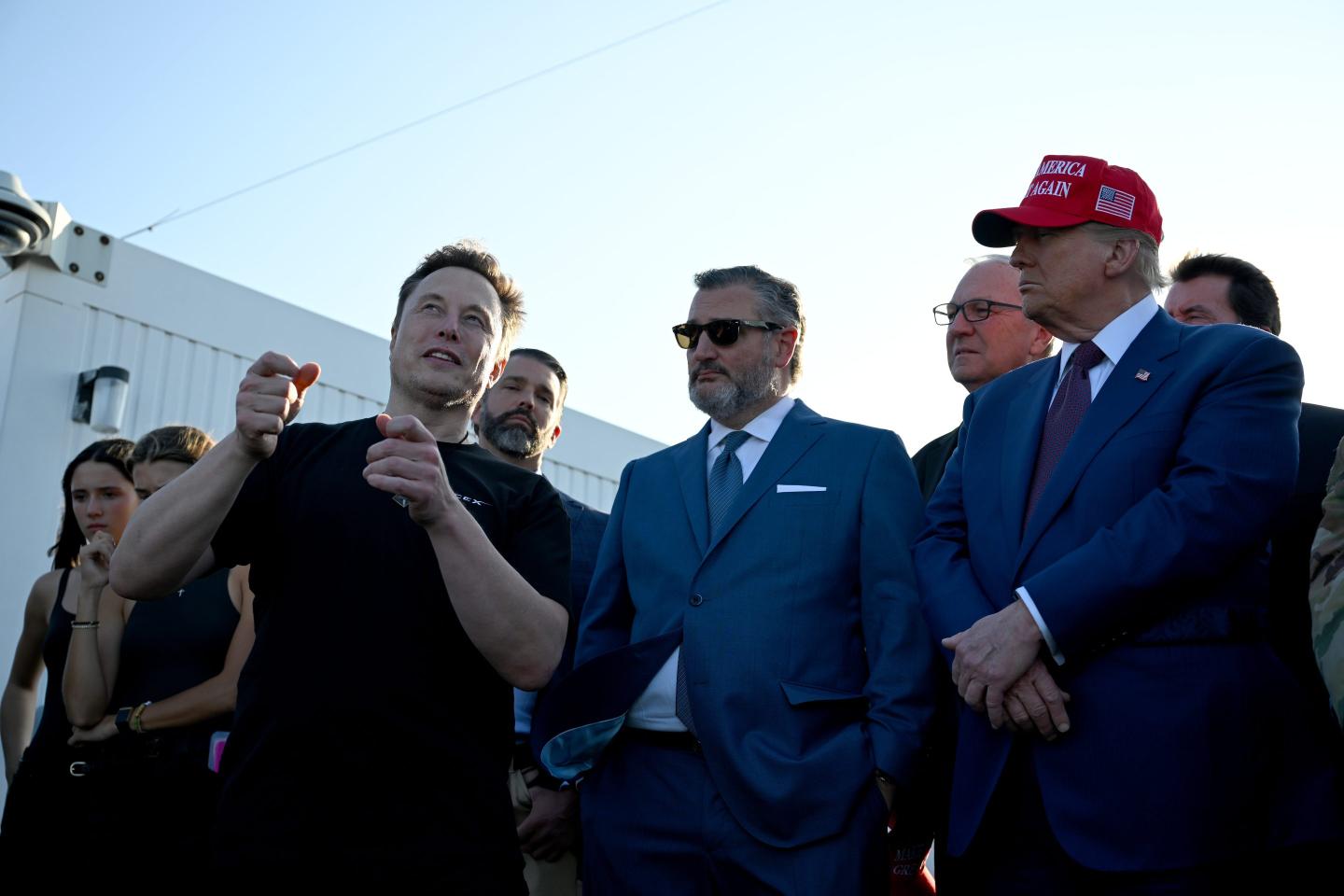
- Elon Musk claimed 14 computers at the Department of Treasury and other government agencies just “send money out of nothing” during a podcast appearance with Sen. Ted Cruz (R-Texas) on Monday. He appeared to be criticizing the government’s bookkeeping, though it’s worth noting the government can, in fact, print money at little to no cost.
Elon Musk said it’s “insane” the U.S. government has computers that can just “make money out of thin air.” Ever since America fully abandoned the gold standard in 1971, however, international finance has depended on just that.
Admittedly, it’s difficult to decipher what Musk was referencing when he talked about “magic money computers” at the Department of Treasury and other government agencies on a podcast appearance Monday with Sen. Ted Cruz (R-Texas). Musk’s comments came in a broader conversation about DOGE’s search for waste, fraud, and abuse in the federal government. The agency says it’s found $115 billion in savings, though a Fortune analysis suggests that figure is significantly overstated. Musk and Cruz discussed what they characterized as a complete breakdown in government bookkeeping.
“I think we found now 14 magic money computers,” Musk said. “They just send money out of nothing.”
Hedge fund and ETF manager Jay Hatfield, CEO of Infrastructure Capital Advisors, said the Tesla CEO may be suggesting that much of the government is not properly implementing double-entry accounting, where a financial transaction must have equal and opposite effects in at least two different accounts. That seems a bit hard to believe, Hatfield said, but he didn’t entirely discount the possibility.
“If it was a public company, it would be delisted immediately,” Musk said of the government. “It would fail its audit, and the officers of the company would be imprisoned.”
Both the Washington, D.C. offices of Cruz and the Treasury Department did not respond to a request for comment.
Meanwhile, others have suggested that Musk may be expressing bewilderment about how the U.S. government can, in essence, issue money to pay for its own spending. Cruz and retired Republican Kentucky Sen. Ron Paul have long argued the government basically taxes its citizens without representation by issuing currency and causing inflation.
“Any computer which can just make money out of thin air,” Musk said, “that’s magic money.”
David Andolfatto, a former senior VP at the Federal Reserve Bank of St. Louis, said that language is a red herring. Banks effectively do the same when they lend out deposits, he said, or when a corporation like Musk’s Tesla issues more shares, diluting the value of existing holdings.
“What Musk was probably trying to communicate was that the resources devoted to these agencies, they’re not being properly audited, or there’s not proper oversight,” said Andolfatto, who now chairs the University of Miami’s economics department. “That may be true or false, I don’t know, but the fact that the government can print money out of thin air is neither here nor there.”
How the U.S. prints money
The government, of course, can do just that, whether or not Musk was referring to money creation. Former Fed chair Ben Bernanke explained this concept during a famous speech to the National Economists Club in 2002. The U.S. dollar, he said, was valuable only in that it is strictly limited in supply.
“But the U.S. government has a technology, called a printing press (or, today, its electronic equivalent), that allows it to produce as many U.S. dollars as it wishes at essentially no cost,” Bernanke said in his address. “By increasing the number of U.S. dollars in circulation, or even by credibly threatening to do so, the U.S. government can also reduce the value of a dollar in terms of goods and services, which is equivalent to raising the prices in dollars of those goods and services.”
While the Treasury oversees the printing of bills and minting of coins, it is the Fed that creates money in practice by buying assets—traditionally Treasuries—from commercial banks, which receive a cash injection as a result. Banks then create credit by lending some of that cash out.
But, as Bernanke acknowledged, this increase in the money supply can be inflationary. In an extreme situation, the government may be tempted to excessively issue currency to help pay down its debts, inducing the type of hyperinflation Germany endured after World War I, which is commonly attributed as a major cause of the rise of the Nazi Party.
The Fed doesn’t buy government debt from the Treasury directly, but it distributes its profits back to the government. Libertarians like Paul have alleged this dynamic leads to similar incentives. In his 2009 book End the Fed, Paul noted that a collection of goods and services worth $1 in 1913 cost $21 at the time of publication.
“Another way to look at this is from the perspective of the purchasing power of the dollar itself,” Paul wrote. “It has fallen to less than $0.05 of its 1913 value. We might say that the government and its banking cartel have together stolen $0.95 of every dollar as they have pursued a relentlessly inflationary policy.”
Andolfatto has acknowledged that inflation constitutes a tax on consumers. “Seigniorage revenue,” he noted in a 2011 blog post, “refers to the purchasing power the government creates through the act of creating new money.”
Still, he called Paul’s claim “preposterous.” The nation’s money stock in 1913 had indeed lost 95% of its value over the course of nearly a century. That was not the case, however, for a dollar issued more recently in, say, 2010.
“This 1913 money stock constitutes a tiny fraction of our total wealth,” Andolfatto wrote. Moreover, since it has been in circulation for almost 100 years (much of it held by banks themselves in the form of reserves), the loss in its purchasing power has been spread over countless individuals, agencies, and generations.”