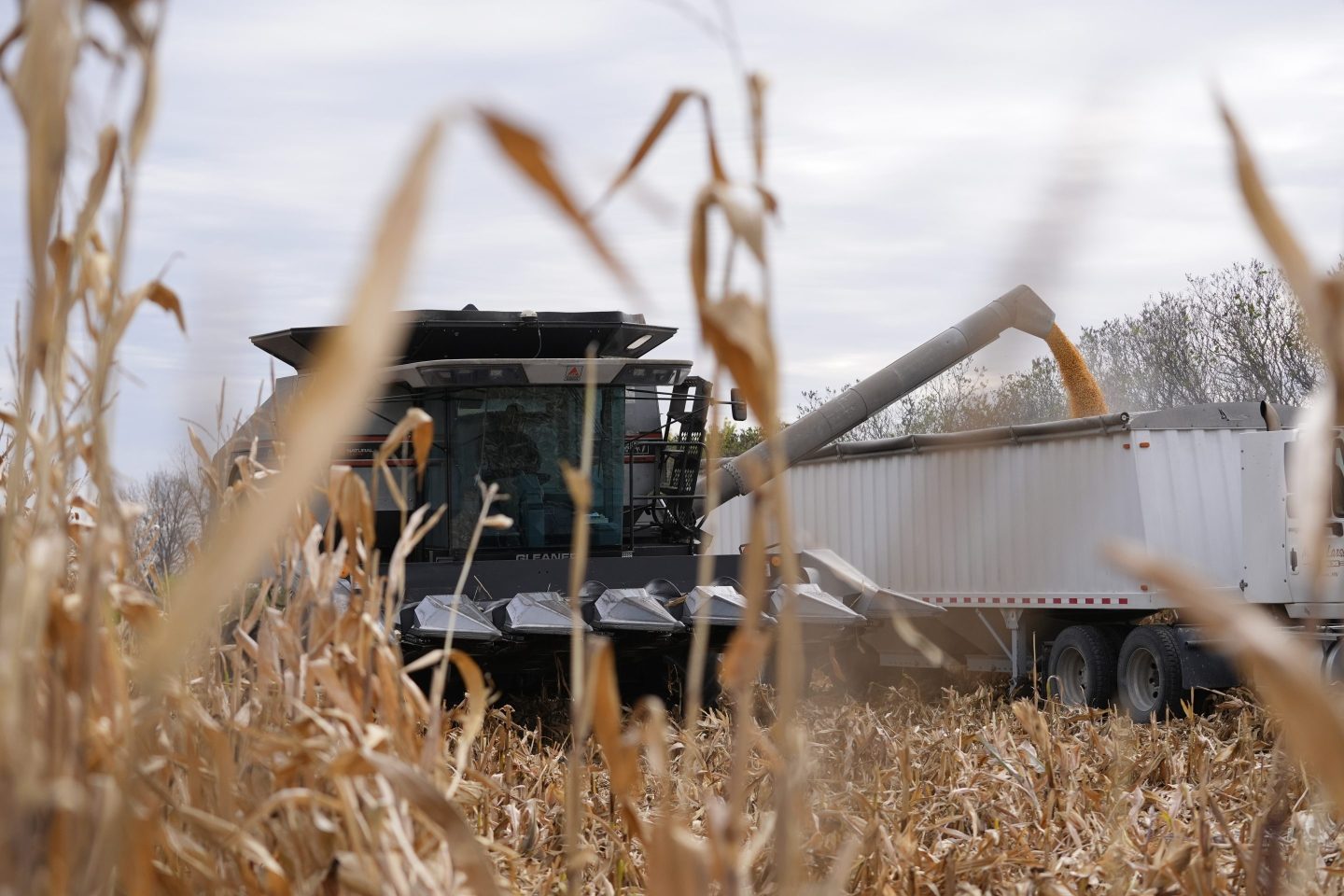
Farmers and meat producers across the U.S. can expect the new tariffs on Mexico, Canada and China and the retaliatory action from those countries to hurt their bottom lines by billions of dollars if they stay in place a while, and consumers could quickly see higher prices for produce and ground beef.
But some of the impact on farmers might not be felt until the next harvest and some products might actually get cheaper in the short run for consumers if exports suffer. And the price of corn, wheat and soybeans accounts for relatively little of the price of most products. Plus, President Donald Trump could offer farmers significant aid payments, as he did during the trade war with China during his first administration, to offset some of the losses.
In his address to Congress Tuesday night, Trump argued that agricultural imports hurt American farmers and asked them to “bear with me again” as he seeks to protect them. He didn’t mention any additional aid.
“I love the farmer,” he said.
If the tariffs make farmers uneasy about investing in expensive tractors and consumers worry so much about groceries that they cut other spending, that would hurt the economy overall and could even lead to a recession. And consumers were already worried about record egg prices amid a bird flu outbreak.
“Exactly how strong our economy is over time has a lot to do with U.S. consumers’ comfort with continuing to go out to restaurants and continuing to buy washers and dryers and just that general activity. And a lot of what we’re talking about here is probably going to slow some of that,” said Glynn Tonsor, an agricultural economist at Kansas State University.
The situation has some farmers stocking up on equipment and supplies in preparation for prices to go up, but it’s not like they can easily buy all their fertilizer ahead of time. And consumers might have a hard time stockpiling perishable products like avocados and ground beef.
The details of how the tariffs are implemented and whether any products are excluded will also matter.
How will farmers be hurt?
Corn and soybean prices for this year’s harvest already fell roughly 10% since the tariffs were first announced a couple of weeks ago.
Joe Janzen, an agricultural economist with the University of Illinois, said that has “snuffed out” any profitability in those crops. He called Trump’s comments that farmers may be able to sell more of their products at home “at best tone deaf.”
“There is no domestic market for the amount of corn, soybeans, wheat, and other agricultural products that we now export in significant quantities,” he said.
Meanwhile, as crop prices decline, farmers might see their fertilizer bill jump because 85% of the potash American farmers use in fertilizer comes from Canada, which also supplies some nitrogen fertilizer as well. The Fertilizer Institute President and CEO Corey Rosenbusch said “an open, fair, predictable and transparent trade environment between the U.S. and Canada is vital.”
“We need potash to raise healthier crops,” said Minnesota farmer Danny Lundell, who hosted Gov. Tim Walz on his corn and soybean farm near Cannon Falls on Tuesday. “And it doesn’t matter if you’re big, medium or small, it’s going to affect you.”
But Iowa State agricultural economist Chad Hart said many farmers applied fertilizer to their fields last fall and may not have to pay the higher fertilizer bills until later.
What about meat prices?
The United States imports a lot of lean beef to mix with fattier beef produced at American plants to make hamburger, and that imported beef will get more expensive because nearly half of it comes from Canada and Mexico. That’s likely to show up in grocery stores in six to eight weeks.
America exported more than $1.8 billion worth of chicken and another $8.4 billion in red meat to Mexico, Canada and China. These tariffs could easily lead to a 10% drop in exports, Tonsor said.
If farmers aren’t able to move that much meat overseas because of tariffs, they can seek to sell more domestically — but they’ll likely have to discount prices. Bad for farmers, but potentially good for consumers.
The impact will vary by product. For instance, demand for steaks and bacon may remain relatively steady because little of that is exported, but the price of hams could drop in the U.S. because Mexico is a major buyer of those. The price of specialty cuts like beef tongue that are almost entirely exported will plummet.
Livestock producers will see a bit of relief because the cost of the feed they use will decline, but Tonsor said they will still lose money overall.
How do farmers feel about this?
“Farmers are very concerned,” said Steve Kuiper, a director at the Iowa Corn Growers Association. “People just aren’t buying stuff,” he said, which is hitting big companies like John Deere and local suppliers that sell their equipment.
That’s the case for farmers who grow table crops as well as commodities. Katy Rogers, who manages an organic farm outside Indianapolis, said that as soon as Trump started talking about tariffs she bought everything she thought would see a price hike in the coming months.
Kuiper hopes that the impacts of tariffs can be mitigated and eventually lead to a more level playing field that benefits farmers. He wants to see trade open with more countries. For instance, he said that for corn, China had already been favoring trade with Brazil, so he instead sees opportunity in places like India.
But Trump has threatened additional reciprocal tariffs on other countries on April 2, which could make it harder for farmers to shift their exports to other countries.
What is the lasting impact?
Trump can do a lot to ease farmers’ pain with aid payments. He gave them more than $22 billion in aid payments in 2019 and nearly $46 billion in 2020, though that year also included aid related to the pandemic.
But Janzen notes that Trump is working to drastically slash spending across the federal government.
Walz, who lost his bid to become vice president last fall, said the tariffs will hurt trading relationships and prompt buyers in China, Mexico and Canada to look elsewhere.
Some trade experts question how long Trump’s tariffs will last as they boost prices for American consumers, including his base voters, who have long complained about inflation and rising food prices.
“It is going to do nothing to help with the food inflation in the U.S,” said Timothy Wise, author of “Eating Tomorrow” and expert on agricultural trade between Mexico and the U.S. “I don’t see it as sustainable. I don’t find it plausible that corporate folks who surround Trump are going to sit back and allow him to destroy their foreign markets.”