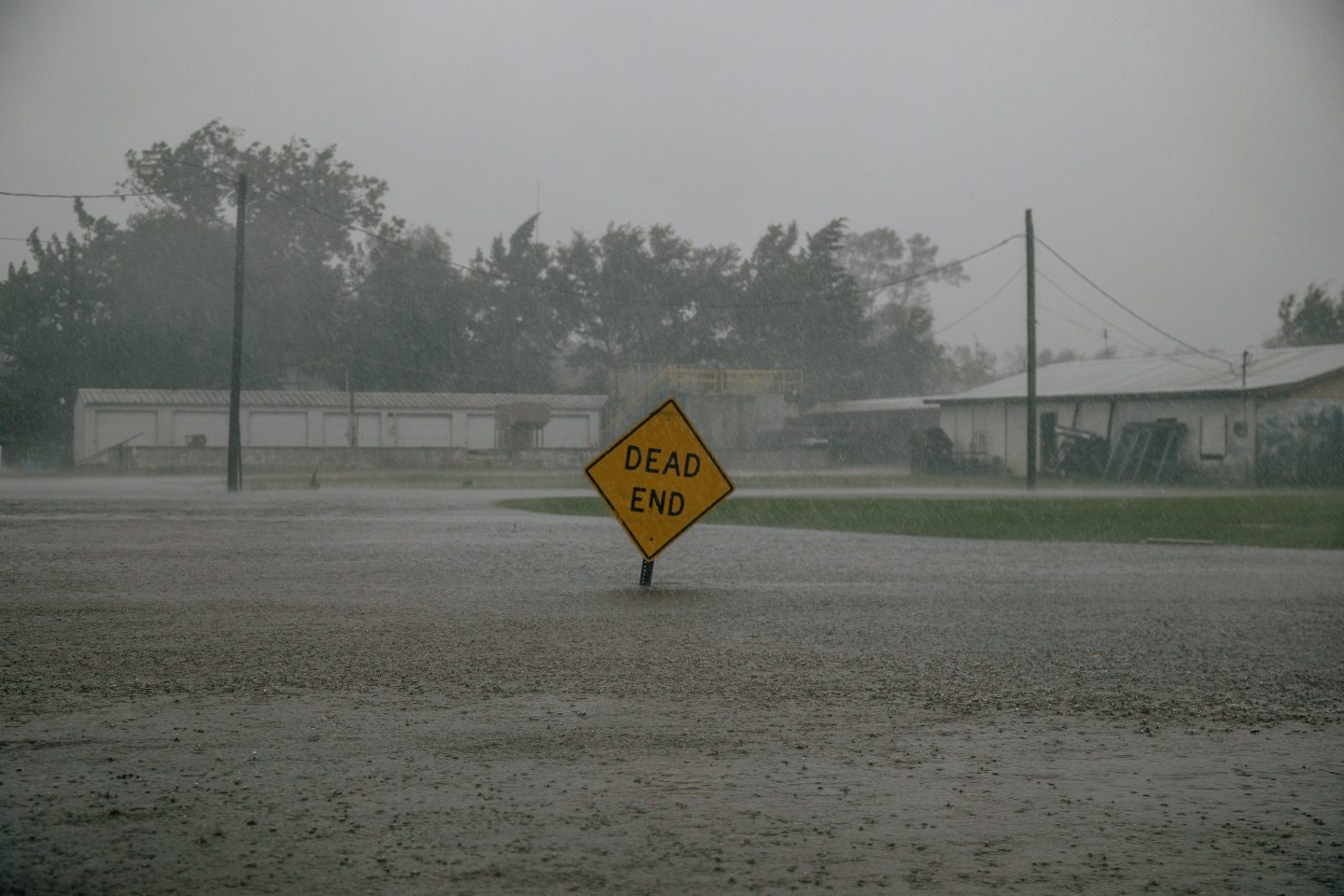
As climate change’s effects continue to more directly manifest in the form of increased and more severe weather, home insurance companies in the U.S. have accelerated policies to offload costs to consumers. Nowhere has this trend been more intimately felt than in Black communities, where a racial gap in climate-related economic disadvantage is quickly deepening. Insurers play a key role in this through a process called “bluelining.”
Bluelining speaks to how financial institutions, specifically insurers, inflate consumer costs or eliminate service in areas that are both at elevated risk for major environmental harms and inhabited mostly by minorities. The practice is deeply connected to redlining, whereby lenders refuse to extend credit to individuals who are otherwise eligible, as a discriminatory means of controlling where certain populations live. Like redlining, bluelining deepens segregation, creating a buffer between minority populations and social and economic opportunities.
Efforts to restrict bluelining are especially fragile as we begin 2025. The National Oceanic and Atmospheric Administration and the Environmental Protection Agency—government agencies tasked with addressing climate forecasting and mitigation, respectively—appear to be greatly imperiled by President-elect Donald Trump’s agenda. And Scott Bessent, Trump’s pick to head the Treasury Department, which oversees the nation’s home insurance market, strongly advocates for deregulation.
Homes at risk
For his part, Trump, throughout his campaign, promised to downsize the entities’ workforces and reduce environmental regulations. Less than 48 hours after Hurricane Helene made landfall, he declared “the environmental stuff” to be “one of the great scams of all time.” The effects of Helene—as with the fires now ravaging the Los Angeles area—were greatly exacerbated by climate change. Helene caused an estimated $53 billion in damage in North Carolina, killing more than 100 people in the state.
Studies show that majority Black communities may have up to a 50% greater vulnerability to wildfires compared to their white counterparts. Flooding risks are also substantially elevated in Black communities, potentially increasing by 20% by 2050. Despite this, flooding preparedness efforts in Black communities tend to severely lag behind those in white communities
Severe weather events not only cause costly damage to homes in Black neighborhoods but can also generate catastrophic damage to basic infrastructure, stifling local commerce, transportation, and access to health care. The insurance industry has been watching.
Louisiana, Texas, and Alabama—states with some of the nation’s deepest legacies of redlining—rank within the top 10 states with the most expensive home insurance and also have some of the largest percentages of Black people in the country. Because property insurance is required for most mortgages and business loans, opting out typically isn’t an option. Some insurers, with redlining as their roadmap, have been artificially valuing homes, inflating insurance costs, and disproportionately denying claims in Black communities—and planting the seeds for future Black populations to be trapped in environmentally vulnerable spaces.
Property patterns
So how did we get here? Dating back to the founding of the U.S., white industrialists deliberately sought out and acquired elevated, arable land, leaving racial minorities to live and work in undesirable locations, including low-lying land more prone to flooding.
Following Reconstruction, Black people fanned out across the country, establishing businesses such as tailoring shops and hardware stores. But racial covenants limited where they could set up shop, impacting how much their consumer bases could grow. These discriminatory practices fostered a deficit among Black entrepreneurs that persists to this day.
Only about 3% of businesses in the nation are Black-owned, and they account for just 1% of gross revenue from all classifiable companies. Black entrepreneurs are also disproportionately denied access to capital. And according to an analysis from the Brookings Institution, the 10 metro areas with the highest proportional representation of Black-owned businesses are all in the Southeast, arguably the most climate-imperiled region in the U.S.
Homeowner fairness
There are some steps that we can take to combat bluelining and its consequences. First, the federal government must do more to support and expand public home insurance, or Fair Access to Insurance Requirements (FAIR) programs. States like New York and Hawaii have robust FAIR offerings that provide homeowners with a more affordable alternative, simultaneously pushing private insurers to limit their premiums and stay in high-risk markets.
Second, we need better ways to assess risks. Research shows that in some cases insurers are—intentionally or unintentionally—overestimating the levels of risk that a home might be subject to. This calls for increased transparency and independent scrutiny around risk modeling and underwriting, which states such as California are currently attempting to achieve.
Finally, white communities are more likely than others to have access to federal buyout assistance, due to the limited ways in which the government and insurers promote and make these resources available. We saw this in the aftermath of Hurricane Katrina in 2005. Although the hurricane had a disproportionately greater impact on Black neighborhoods, white people were more likely to file and challenge insurance claims. Government officials and insurers must work together to better market and ease barriers to filing and challenging claims both for homeowners and businesses.
Not until the Fair Housing Act, which was passed in 1968, was redlining prohibited. And even then, the process continued in subtle ways throughout the country—and is reflected today in bluelining. Without action, bluelining has a far higher ceiling for destruction.
The opinions expressed in Fortune.com commentary pieces are solely the views of their authors and do not necessarily reflect the opinions and beliefs of Fortune.