• Home
  • Latest
  • Fortune 500
  • Finance
  • Tech
  • Leadership
  • Lifestyle
  • Rankings
  • Multimedia
TechChina

Tesla battery cell partner CATL threatens to sue Pentagon after landing on China ‘blacklist’

Christiaan Hetzner
By
Christiaan Hetzner
Christiaan Hetzner
Senior Reporter
Down Arrow Button Icon
Christiaan Hetzner
By
Christiaan Hetzner
Christiaan Hetzner
Senior Reporter
Down Arrow Button Icon
January 7, 2025, 9:41 AM ET
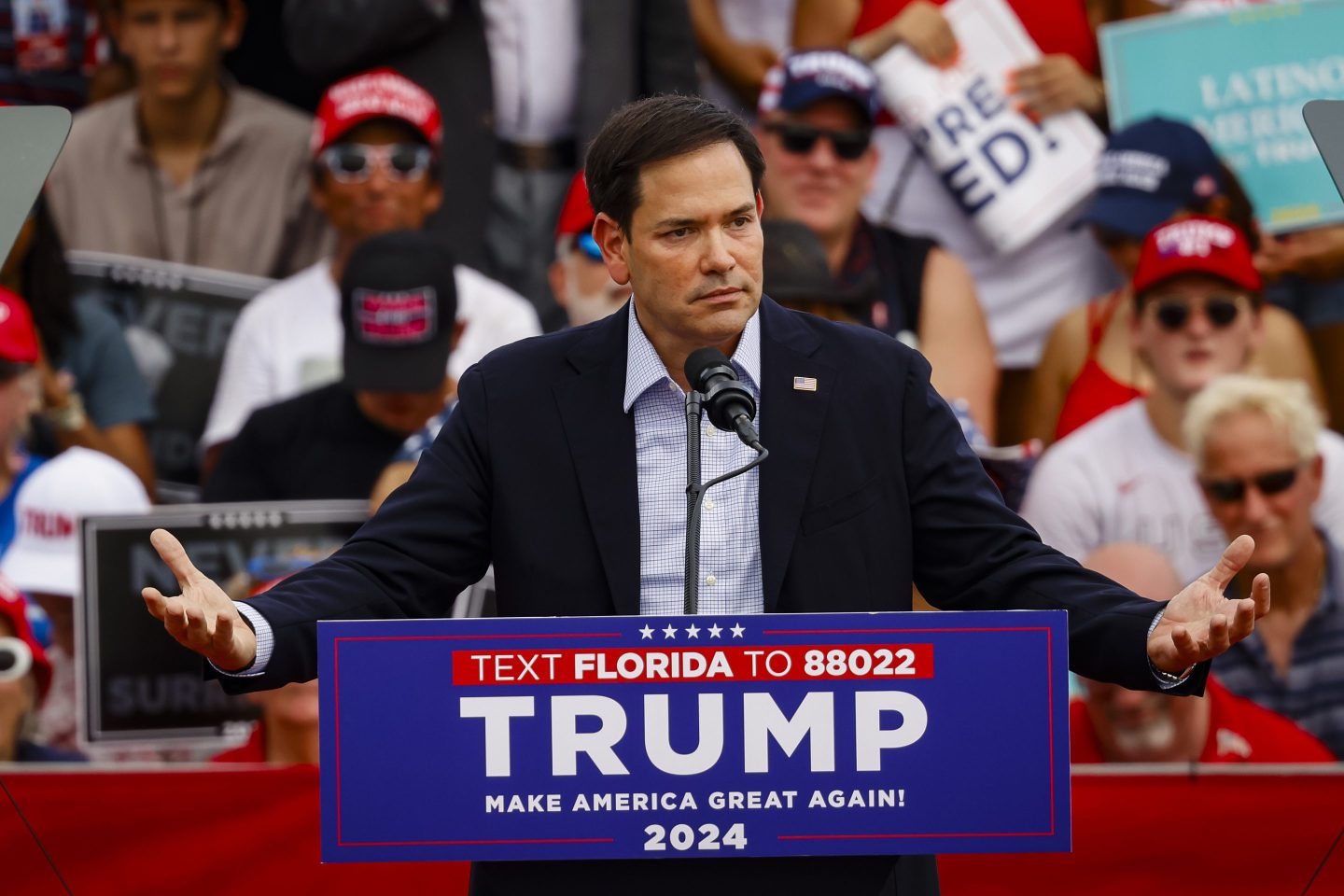
Senator Marco Rubio, a Republican from Florida, speaks during a campaign event with former US President Donald Trump
Trump's designated cabinet pick for Secretary of State, Senator Marco Rubio of Florida, has pushed for CATL to be added to the Pentagon's blacklist of companies that cannot bid for U.S. government contracts.Eva Marie Uzcategui—Bloomberg via Getty Images
  • China’s CATL, the largest EV battery cell manufacturer in the world, has been included in the Department of Defense’s annual list of companies designated as suppliers to the Chinese military. This decision, pushed by incoming Trump cabinet member Marco Rubio, could have unforeseen ramifications as practically the entire auto industry sources at least some of their battery cells from CATL.

A key partner for Elon Musk’s Tesla is threatening to sue the U.S. government over the Pentagon’s decision to blacklist it from federal contracts, blasting it a “mistake.”

Recommended Video

On Tuesday, the Department of Defense published the annual update of its Section 1260H list of Chinese dual-use industrial companies—essentially companies that the Pentagon believes are helping China’s military to modernize.

Included for the first time ever is the world’s largest supplier of EV battery cells, Contemporary Amperex Technology Co., Ltd. 

The Ningde-based manufacturer, whose shares dipped on the news, refuted the decision that sees it join other previous blacklisted entities such as telecom network equipment provider Huawei and semiconductor foundry SMIC, as well as all new ones like social media and gaming giant Tencent.

“CATL has never engaged in any military-related business or activities, so this designation by the Department of Defense is a mistake,” the company, worth the equivalent of $150 billion, said in a statement. 

By including CATL in the blacklist, not only is it barred from bidding for contracts with the U.S. armed forces, but partners like Tesla that source from it could be as well. 

Musk’s EV manufacturer could not be reached by Fortune for comment.

Trump cabinet pick Marco Rubio pushed for blacklisting

The move is controversial, since CATL supplies at least some cells to practically every major carmaker that sells electric vehicles in China.

Importantly, it is also a leader in the field of EV batteries featuring lithium iron phosphate (LFP) chemistry—a popular and affordable alternative to the higher-performance nickel manganese cobalt (NMC) cells more common in wealthy industrial nations.

The Pentagon did not explain its reasoning for including CATL, but it did say companies on the Section 1260H list could seek reconsideration of the decision by providing sufficient evidence to the government either for why the designation is no longer applicable or why it was never accurate to begin with. 

Notably, Trump’s designated Secretary of State, Senator Marco Rubio of Florida, urged the Biden administration in August to immediately add CATL to the list, citing the threat to national security.

“The DoD would not only safeguard America’s military infrastructure from exposure to the [Chinese army] PLA, it would also send a powerful signal to U.S. companies that are currently weighing partnerships with CATL,” Rubio wrote in a letter cosigned by Michigan congressman John Moolenaar, chair of the House select committee on the CCP.

Fortune reached out to the Department of Defense for further information but has not yet received a comment. 

How CATL emerged from obscurity to become a global EV battery leader

Founded only in 2011, CATL emerged out of nowhere to become the leading player in the global EV battery cell industry for the past seven years.

This stemmed in large part from a decade-old campaign by the Chinese Communist Party to promote EVs as an answer to its “airpocalypse,” the scourge of urban air pollution vividly brought to life by the 2015 landmark documentaryUnder the Dome.

Most Chinese megacities soon launched a crackdown on inner-city driving, including alternating days during which drivers could use their combustion-engine cars during days of intense smog. Restrictions were introduced that increased the cost of new license plates for gas-powered vehicles and greatly limited their allocation.

Exempted from this effort were “new energy vehicles,” which mainly included EVs and plug-in hybrids with sufficiently long electric-only ranges, leading to a boom for suppliers like CATL.

It also didn’t hurt that Beijing stipulated carmakers must source their cells from a list of approved domestic manufacturers if they wanted to operate locally. 

This protectionist requirement meant carmakers like Tesla with longstanding supply relationships with suppliers such as Panasonic had no choice but to enter into negotiations with CATL, Farasis, or Guoxuan.
Join us at the Fortune Workplace Innovation Summit May 19–20, 2026, in Atlanta. The next era of workplace innovation is here—and the old playbook is being rewritten. At this exclusive, high-energy event, the world’s most innovative leaders will convene to explore how AI, humanity, and strategy converge to redefine, again, the future of work. Register now.
About the Author
Christiaan Hetzner
By Christiaan HetznerSenior Reporter
Instagram iconLinkedIn iconTwitter icon

Christiaan Hetzner is a former writer for Fortune, where he covered Europe’s changing business landscape.

See full bioRight Arrow Button Icon

Latest in Tech

AIchief executive officer (CEO)
Microsoft AI boss Suleyman opens up about his peers and calls Elon Musk a ‘bulldozer’ with ‘superhuman capabilities to bend reality to his will’
By Jason MaDecember 13, 2025
9 hours ago
InvestingStock
There have been head fakes before, but this time may be different as the latest stock rotation out of AI is just getting started, analysts say
By Jason MaDecember 13, 2025
15 hours ago
Politicsdavid sacks
Can there be competency without conflict in Washington?
By Alyson ShontellDecember 13, 2025
15 hours ago
InnovationRobots
Even in Silicon Valley, skepticism looms over robots, while ‘China has certainly a lot more momentum on humanoids’
By Matt O'Brien and The Associated PressDecember 13, 2025
17 hours ago
Sarandos
Arts & EntertainmentM&A
It’s a sequel, it’s a remake, it’s a reboot: Lawyers grow wistful for old corporate rumbles as Paramount, Netflix fight for Warner
By Nick LichtenbergDecember 13, 2025
21 hours ago
Oracle chairman of the board and chief technology officer Larry Ellison delivers a keynote address during the 2019 Oracle OpenWorld on September 16, 2019 in San Francisco, California.
AIOracle
Oracle’s collapsing stock shows the AI boom is running into two hard limits: physics and debt markets
By Eva RoytburgDecember 13, 2025
22 hours ago

Most Popular

placeholder alt text
Success
Apple cofounder Ronald Wayne sold his 10% stake for $800 in 1976—today it’d be worth up to $400 billion
By Preston ForeDecember 12, 2025
2 days ago
placeholder alt text
Economy
Tariffs are taxes and they were used to finance the federal government until the 1913 income tax. A top economist breaks it down
By Kent JonesDecember 12, 2025
2 days ago
placeholder alt text
Success
40% of Stanford undergrads receive disability accommodations—but it’s become a college-wide phenomenon as Gen Z try to succeed in the current climate
By Preston ForeDecember 12, 2025
2 days ago
placeholder alt text
Economy
The Fed just ‘Trump-proofed’ itself with a unanimous move to preempt a potential leadership shake-up
By Jason MaDecember 12, 2025
1 day ago
placeholder alt text
Success
Apple CEO Tim Cook out-earns the average American’s salary in just 7 hours—to put that into context, he could buy a new $439,000 home in just 2 days
By Emma BurleighDecember 12, 2025
2 days ago
placeholder alt text
Economy
For the first time since Trump’s tariff rollout, import tax revenue has fallen, threatening his lofty plans to slash the $38 trillion national debt
By Sasha RogelbergDecember 12, 2025
2 days ago
Rankings
  • 100 Best Companies
  • Fortune 500
  • Global 500
  • Fortune 500 Europe
  • Most Powerful Women
  • Future 50
  • World’s Most Admired Companies
  • See All Rankings
Sections
  • Finance
  • Leadership
  • Success
  • Tech
  • Asia
  • Europe
  • Environment
  • Fortune Crypto
  • Health
  • Retail
  • Lifestyle
  • Politics
  • Newsletters
  • Magazine
  • Features
  • Commentary
  • Mpw
  • CEO Initiative
  • Conferences
  • Personal Finance
  • Education
Customer Support
  • Frequently Asked Questions
  • Customer Service Portal
  • Privacy Policy
  • Terms Of Use
  • Single Issues For Purchase
  • International Print
Commercial Services
  • Advertising
  • Fortune Brand Studio
  • Fortune Analytics
  • Fortune Conferences
  • Business Development
About Us
  • About Us
  • Editorial Calendar
  • Press Center
  • Work At Fortune
  • Diversity And Inclusion
  • Terms And Conditions
  • Site Map

© 2025 Fortune Media IP Limited. All Rights Reserved. Use of this site constitutes acceptance of our Terms of Use and Privacy Policy | CA Notice at Collection and Privacy Notice | Do Not Sell/Share My Personal Information
FORTUNE is a trademark of Fortune Media IP Limited, registered in the U.S. and other countries. FORTUNE may receive compensation for some links to products and services on this website. Offers may be subject to change without notice.