• Home
  • News
  • Fortune 500
  • Tech
  • Finance
  • Leadership
  • Lifestyle
  • Rankings
  • Multimedia
CommentaryFinance

AI optimists are behaving like the investors who got burned in the Great Depression and dot-com bubble, Vanguard’s chief economist warns

By
Joseph H. Davis
Joseph H. Davis
Down Arrow Button Icon
By
Joseph H. Davis
Joseph H. Davis
Down Arrow Button Icon
December 2, 2024, 8:50 AM ET
Joseph H. Davis, Ph.D., is Vanguard’s global chief economist and global head of the Investment Strategy Group.
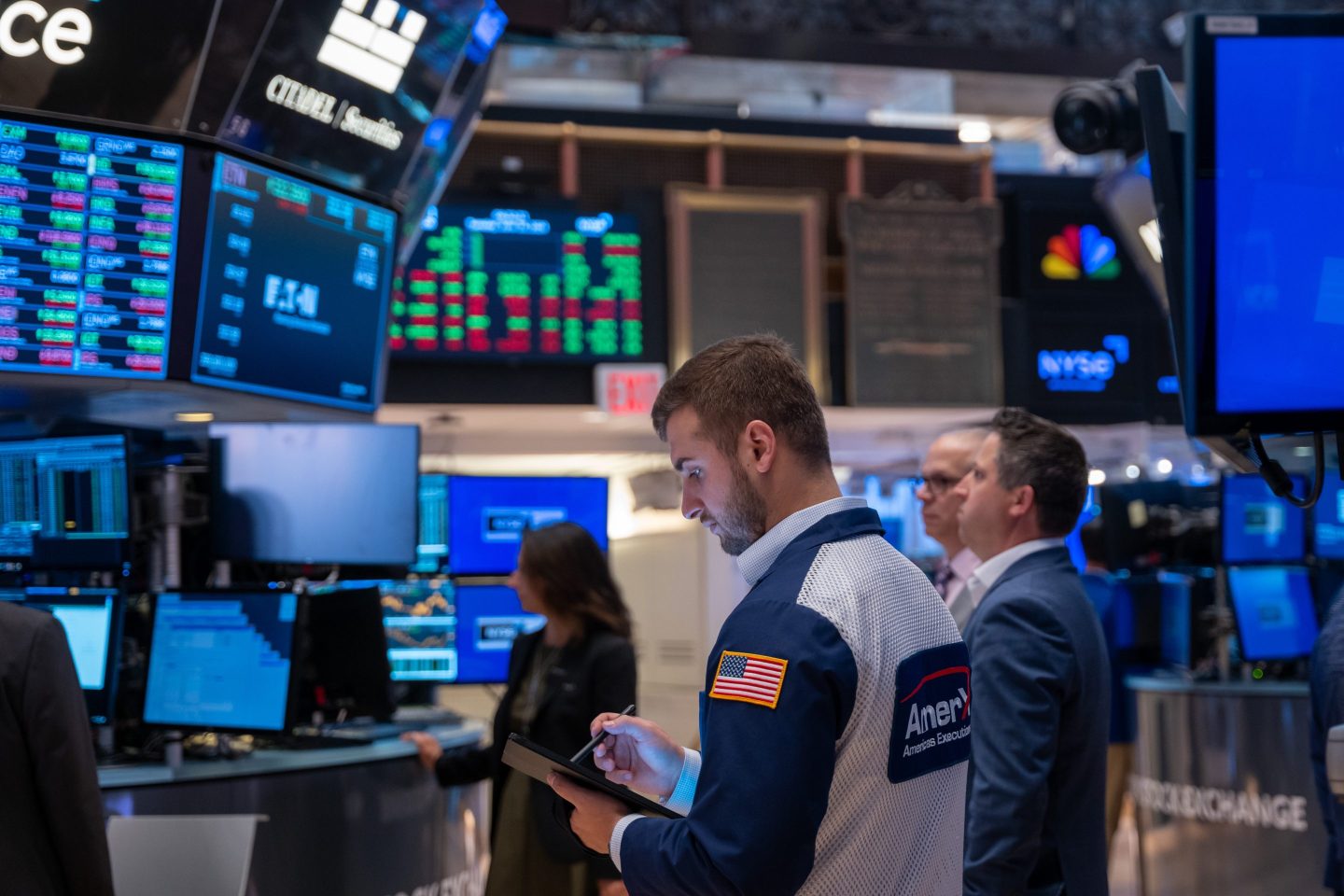
AI-related shares and general optimism for the technology drove stock markets up in 2024.
AI-related shares and general optimism for the technology drove stock markets up in 2024.Spencer Platt - Getty Images

Roughly 100 years ago, electricity began to course through the developed world, transforming lives and sparking a stock price surge. One need not be an economic historian to know that the Great Depression of the 1930s stemmed, in part, from untrammeled risk-taking in the Roaring ‘20s.

Today, signs of investor restraint are once again difficult to find. In aggregate, U.S. stock prices are roughly 45% above the top of what I consider to be their fair-value trading range. I would view stocks as overvalued even if we knew with certainty that artificial intelligence—the probable cause of investors’ recent enthusiasm—would ultimately transform every facet of human life, delivering economic benefits on par with the advent of electricity.

In the U.S. technology and communication services sectors, share prices are inexplicably high relative to expected rates of corporate profit growth. Since ChatGPT launched to the public on Nov. 30, 2022, the average stock in both sectors has nearly doubled in price.

The potential of technology to drive productivity and profits obviously justifies some level of share-price premium. But as a group, the large-cap tech companies in the S&P 500 Index lately have been anywhere from 80% more expensive than the rest of the market (in the case of their price-to-trailing earnings ratios) to more than four times as expensive (price-to-sales).

Overvaluations are not confined to one or two sectors. Tremendously expensive AI-related shares combine with optimistic pricing in most other market segments to leave the overall U.S. stock market more overvalued than at any point since early 2001. My estimate is based on a proprietary Vanguard fair-valuation measure that puts stock prices in the context of a decade’s worth of corporate earnings, as well as the prevailing levels of interest rates and inflation.

While there are no good market-timing tools, valuations are a famously poor one. The market tends to swing from periods of overvaluation to periods of undervaluation while spending relatively modest periods in fair-value territory.

Indeed, Vanguard megatrends research finds that outsized overvaluations and corrections tend to coincide with transformative technological changes. Investors grow euphoric early on, then suffer disappointment when the new technology’s vast potential is not more quickly realized.

Consider the late ‘90s. Some of today’s largest companies were small caps then. They would grow into powerhouses, and the Internet would transform the economy. And yet, the broad U.S. stock market still suffered a near-50% decline in the 30-month-long tech, media, and telecom-driven meltdown that began in March 2000. Tech shares suffered much more.

I am optimistic about the future of AI. There’s a meaningful chance for it to drive significant gains in productivity and economic growth over the coming decade or so. But we are not yet in the AI boom. For AI’s promise to be fully realized, low rates of AI adoption must rise, and companies must learn how they can harness the technology. At Vanguard, we do not expect AI’s peak effects on productivity and economic growth until the 2030s.

In the meantime, earnings growth expectations for the next three to five years are wildly optimistic.

The revenues and profit margins of individual companies can surprise dramatically to the up- or the downside, but in the aggregate, the two components of corporate profits tend to be slower-moving and more predictable. They almost surely will disappoint in the near-to-intermediate term.

Even if AI ultimately transforms the economy, as the Vanguard Megatrends Model suggests it will, the companies that will benefit most will be outside the technology sector. In my estimation, the productivity unlocked across industries would be as if the 17 million baby boomers expected to retire between now and 2034 never do so.

Indeed, if AI proves transformative, every company on the planet will benefit—not just those in Silicon Valley.

More must-read commentary published by Fortune:

  • The ‘Trump bump’ has survived tariff announcements—but will it survive the good, the bad, and the unknown in his cabinet?
  • Demis Hassabis-James Manyika: AI will help us understand the very fabric of reality
  • I worked with Steve Jobs. Here’s what he’d say about today’s leadership style
  • The real reason Spain’s economy is bucking the trend of European decline

The opinions expressed in Fortune.com commentary pieces are solely the views of their authors and do not necessarily reflect the opinions and beliefs of Fortune.

Fortune Brainstorm AI returns to San Francisco Dec. 8–9 to convene the smartest people we know—technologists, entrepreneurs, Fortune Global 500 executives, investors, policymakers, and the brilliant minds in between—to explore and interrogate the most pressing questions about AI at another pivotal moment. Register here.
About the Author
By Joseph H. Davis
See full bioRight Arrow Button Icon

Latest in Commentary

Matt Rogers
CommentaryInfrastructure
I built the first iPhone with Steve Jobs. The AI industry is at risk of repeating an early smartphone mistake
By Matt RogersDecember 4, 2025
14 hours ago
Jerome Powell
CommentaryFederal Reserve
Fed officials like the mystique of being seen as financial technocrats, but it’s time to demystify the central bank
By Alexander William SalterDecember 4, 2025
14 hours ago
Rakesh Kumar
CommentarySemiconductors
China does not need Nvidia chips in the AI war — export controls only pushed it to build its own AI machine
By Rakesh KumarDecember 3, 2025
2 days ago
Rochelle Witharana is Chief Financial and Investment Officer for The California Wellness Foundation
Commentarydiversity and inclusion
Fund managers from diverse backgrounds are delivering standout returns and the smart money is slowly starting to pay attention
By Rochelle WitharanaDecember 3, 2025
2 days ago
Ayesha and Stephen Curry (L) and Arndrea Waters King and Martin Luther King III (R), who are behind Eat.Play.Learn and Realize the Dream, respectively.
Commentaryphilanthropy
Why time is becoming the new currency of giving
By Arndrea Waters King and Ayesha CurryDecember 2, 2025
2 days ago
Trump
CommentaryTariffs and trade
The trade war was never going to fix our deficit
By Daniel BunnDecember 2, 2025
3 days ago

Most Popular

placeholder alt text
Economy
Two months into the new fiscal year and the U.S. government is already spending more than $10 billion a week servicing national debt
By Eleanor PringleDecember 4, 2025
16 hours ago
placeholder alt text
Success
‘Godfather of AI’ says Bill Gates and Elon Musk are right about the future of work—but he predicts mass unemployment is on its way
By Preston ForeDecember 4, 2025
12 hours ago
placeholder alt text
North America
Jeff Bezos and Lauren Sánchez Bezos commit $102.5 million to organizations combating homelessness across the U.S.: ‘This is just the beginning’
By Sydney LakeDecember 2, 2025
3 days ago
placeholder alt text
Success
Nearly 4 million new manufacturing jobs are coming to America as boomers retire—but it's the one trade job Gen Z doesn't want
By Emma BurleighDecember 4, 2025
12 hours ago
placeholder alt text
Success
Nvidia CEO Jensen Huang admits he works 7 days a week, including holidays, in a constant 'state of anxiety' out of fear of going bankrupt
By Jessica CoacciDecember 4, 2025
11 hours ago
placeholder alt text
Health
Bill Gates decries ‘significant reversal in child deaths’ as nearly 5 million kids will die before they turn 5 this year
By Nick LichtenbergDecember 4, 2025
23 hours ago
Rankings
  • 100 Best Companies
  • Fortune 500
  • Global 500
  • Fortune 500 Europe
  • Most Powerful Women
  • Future 50
  • World’s Most Admired Companies
  • See All Rankings
Sections
  • Finance
  • Leadership
  • Success
  • Tech
  • Asia
  • Europe
  • Environment
  • Fortune Crypto
  • Health
  • Retail
  • Lifestyle
  • Politics
  • Newsletters
  • Magazine
  • Features
  • Commentary
  • Mpw
  • CEO Initiative
  • Conferences
  • Personal Finance
  • Education
Customer Support
  • Frequently Asked Questions
  • Customer Service Portal
  • Privacy Policy
  • Terms Of Use
  • Single Issues For Purchase
  • International Print
Commercial Services
  • Advertising
  • Fortune Brand Studio
  • Fortune Analytics
  • Fortune Conferences
  • Business Development
About Us
  • About Us
  • Editorial Calendar
  • Press Center
  • Work At Fortune
  • Diversity And Inclusion
  • Terms And Conditions
  • Site Map

© 2025 Fortune Media IP Limited. All Rights Reserved. Use of this site constitutes acceptance of our Terms of Use and Privacy Policy | CA Notice at Collection and Privacy Notice | Do Not Sell/Share My Personal Information
FORTUNE is a trademark of Fortune Media IP Limited, registered in the U.S. and other countries. FORTUNE may receive compensation for some links to products and services on this website. Offers may be subject to change without notice.