• Home
  • Latest
  • Fortune 500
  • Finance
  • Tech
  • Leadership
  • Lifestyle
  • Rankings
  • Multimedia
CommentaryTech

Why breaking Intel in two is the only way to save America’s most important manufacturer, according to its former board directors

By
David B. Yoffie
David B. Yoffie
,
Reed Hundt
Reed Hundt
,
Charlene Barshefsky
Charlene Barshefsky
, and
James Plummer
James Plummer
Down Arrow Button Icon
By
David B. Yoffie
David B. Yoffie
,
Reed Hundt
Reed Hundt
,
Charlene Barshefsky
Charlene Barshefsky
, and
James Plummer
James Plummer
Down Arrow Button Icon
October 22, 2024, 7:24 AM ET
David B. Yoffie is a professor at Harvard Business School. Reed Hundt is a former chair of the FCC. Charlene Barshefsky is a former U.S. Trade Representative. James Plummer is a former Dean of Engineering at Stanford. Professor Yoffie, Mr. Hundt, Ambassador Barshefsky, and Professor Plummer all served as longtime directors on the Intel board.
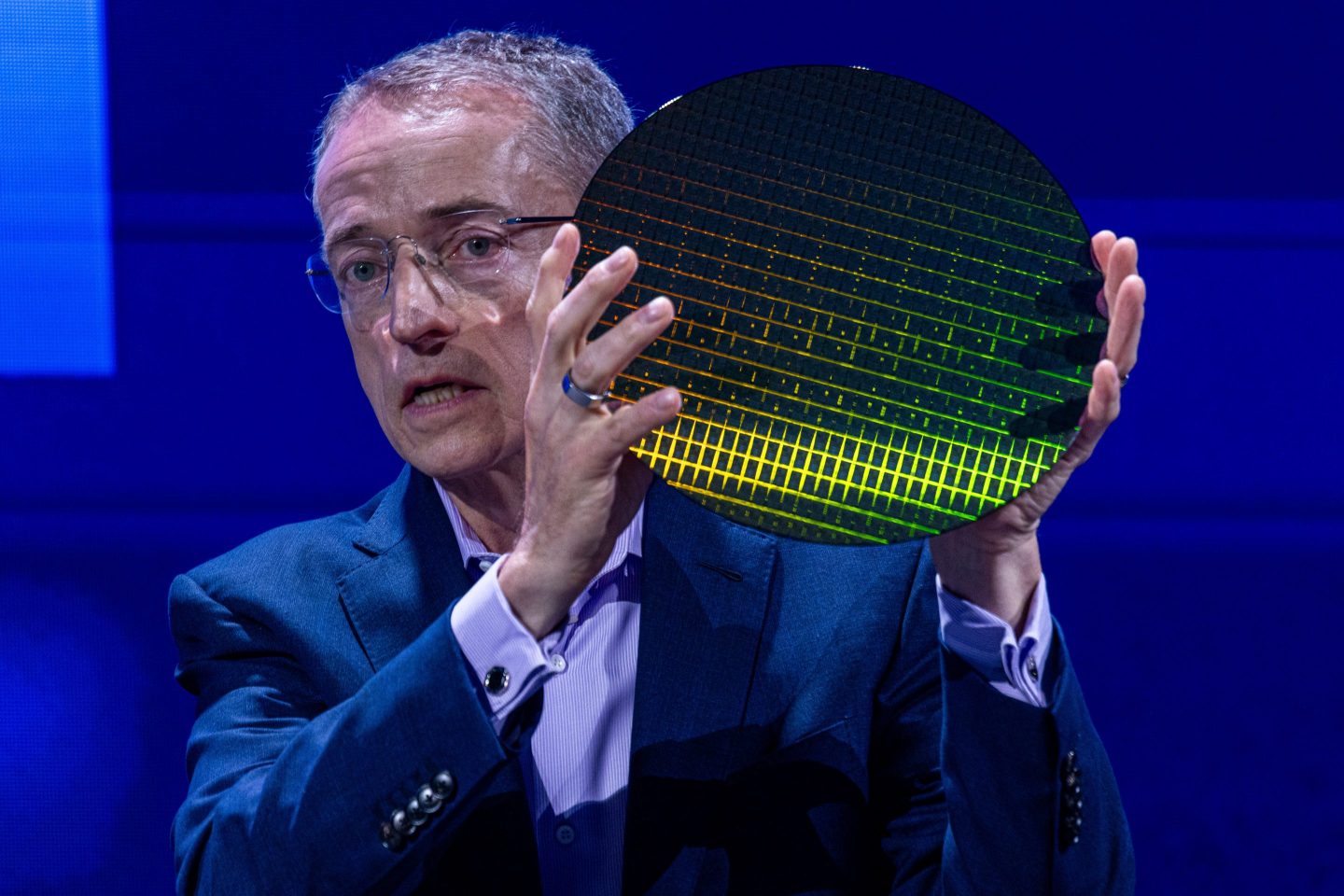
Intel CEO Pat Gelsinger, has announced plans to make the foundry business an independent subsidiary within Intel.
Intel CEO Pat Gelsinger, has announced plans to make the foundry business an independent subsidiary within Intel. Annabelle Chih - Bloomberg - Getty Images

The vultures are circling—and America could potentially lose one of its most important manufacturing assets. After a horrendous earnings report last quarter, Qualcomm, ARM, Apollo, and probably others have been looking at how to pick the flesh off Intel’s bones.

After 30 years of holding the crown as the world’s most valuable semiconductor company, Intel is selling below book value. At today’s price, Intel is an affordable acquisition for many, even much smaller tech companies. But what happens to Intel’s factories, designers, and intellectual property is vitally important.

Intel is the only large-scale American manufacturer of advanced logic semiconductors, even if it is no longer leading at the cutting edge. During the pandemic, we learned that shortages of semiconductors can have a devastating impact on the economy. Moreover, we need to develop leading-edge capacity to stay ahead in many advanced computing and defense-related technologies, including artificial intelligence. Most potential buyers of Intel would likely focus on cost-cutting and see little value in a money-losing manufacturing subsidiary (known in the industry as a foundry). In other words, profit-seeking buyers cannot be depended upon to maintain America’s manufacturing capability.

The entire world benefits if Intel has world-class capacity. TSMC and Intel have been competing for chip leadership for 30 years. Until seven or eight years ago, Intel was winning this battle. While this never-ending competition has made the world richer and must continue, depending on a single manufacturer strategically located with its most advanced factories in Taiwan is a global risk. In semiconductors,  process research and development and leading-edge manufacturing must be co-located. So TSMC will never move its most advanced technology to the U.S.  It is simply too expensive, requires too much infrastructure and too many key employees would have to move. The U.S. needs Intel.

Intel’s management and board must take responsibility and move decisively to stem the bleeding. The actions they’ve taken to date will not suffice. Numerous Intel watchers (including ourselves) have argued for several years that it must separate its foundry/manufacturing business from its design business. An Intel foundry operation, inside Intel’s corporate structure, has little chance of success. 

Nvidia, Qualcomm, Broadcom, and others are desperate for a second manufacturing option to TSMC, but will remain hesitant as long as Intel directly competes with them. Samsung, the only other advanced manufacturer of chips, has similarly discovered that many chip designers such as Apple and Nvidia tend to avoid its foundry because Samsung is a potential competitor. Intel’s management has also failed to prove that it can effectively run a foundry.  Intel offered foundry services to the industry for two decades, never building a successful business. Missed targets and deadlines and management turnover do not inspire confidence.  

Intel’s CEO, Pat Gelsinger, is a true technologist who played an important role in the company’s storied past. Today, he’s faced with a difficult decision: whether to break up the iconic company. He already announced a plan to establish Intel Foundry as an independent subsidiary inside Intel. But this doesn’t go far enough. Emotions aside, the path for the U.S. and Intel should be clear.

Since Intel’s design business remains profitable, it would need to establish a long-term supply contract with a newly created foundry independent of Intel. Just as AMD separated its manufacturing in 2009 and launched Global Foundries with a long-term supply deal, the new Intel design company would need to partially underwrite the foundry’s losses and guarantee sales for several years.

Intel’s design company alone cannot support an independent foundry. Yet, Intel’s manufacturing operation is the only hope for maintaining the most advanced nodes on U.S. soil. An independent foundry would offer open access to all American, Korean, Japanese, and European companies to accrete sufficient volume and ensure its commercial viability.

Since this is a public good (all of Intel’s current competitors and customers, as well as U.S. and global consumers, would benefit), the U.S. government (in cooperation with allies) can and should play a pivotal role.

The CHIPS Act gives the U.S. government $39 billion in grants to revive American semiconductor manufacturing. The government has already promised (but not yet disbursed) up to $8.5 billion in grants and $11.5 billion in low-cost loans for Intel. Today, Intel threatens to become this administration’s Solyndra (the solar company, which went bankrupt after getting more than $500m in government funding). This would be disastrous, both for the government and Intel. The government has the leverage to force Intel down a better path—and it must use it now.

You cannot have an industrial policy without an industry: The government should be very clear on what it is willing to finance, including Intel’s corporate structure. This means that the government should insist that design and manufacturing at Intel be severed into two truly independent companies.

Time is not on our side. It took Intel less than a decade to lose its lead—and it will take at least five years to get back in the game. The pace of change in the chip industry demands quick action by management and the government. TSMC is not slowing down. The longer we wait, the less competitive we become.

More must-read commentary published by Fortune:

  • COVID-19 raises the stakes for heart attacks, strokes, and even death long after infection, new study finds
  • Here’s why the gap between Americans’ perception of U.S. economic performance and reality has doubled since 2019, according to economists
  • The U.S., EU, and India must urgently come together in a free trade agreement on clean energy, says the CEO of one of India’s largest renewables companies
  • Here are the facts that activist critics of Pfizer CEO Albert Bourla are missing, according to a Yale analysis

The opinions expressed in Fortune.com commentary pieces are solely the views of their authors and do not necessarily reflect the opinions and beliefs of Fortune.

Join us at the Fortune Workplace Innovation Summit May 19–20, 2026, in Atlanta. The next era of workplace innovation is here—and the old playbook is being rewritten. At this exclusive, high-energy event, the world’s most innovative leaders will convene to explore how AI, humanity, and strategy converge to redefine, again, the future of work. Register now.
About the Authors
By David B. Yoffie
See full bioRight Arrow Button Icon
By Reed Hundt
See full bioRight Arrow Button Icon
By Charlene Barshefsky
See full bioRight Arrow Button Icon
By James Plummer
See full bioRight Arrow Button Icon

Latest in Commentary

Finance
Lorem ipsum dolor sit amet, consectetur adipiscing elit, sed do eiusmod tempor incididunt ut labore et dolore magna aliqua. Ut enim ad minim veniam
By Fortune Editors
October 20, 2025
Finance
Lorem ipsum dolor sit amet, consectetur adipiscing elit, sed do eiusmod tempor incididunt ut labore et dolore magna aliqua. Ut enim ad minim veniam
By Fortune Editors
October 20, 2025
Finance
Lorem ipsum dolor sit amet, consectetur adipiscing elit, sed do eiusmod tempor incididunt ut labore et dolore magna aliqua. Ut enim ad minim veniam
By Fortune Editors
October 20, 2025
Finance
Lorem ipsum dolor sit amet, consectetur adipiscing elit, sed do eiusmod tempor incididunt ut labore et dolore magna aliqua. Ut enim ad minim veniam
By Fortune Editors
October 20, 2025
Finance
Lorem ipsum dolor sit amet, consectetur adipiscing elit, sed do eiusmod tempor incididunt ut labore et dolore magna aliqua. Ut enim ad minim veniam
By Fortune Editors
October 20, 2025
Finance
Lorem ipsum dolor sit amet, consectetur adipiscing elit, sed do eiusmod tempor incididunt ut labore et dolore magna aliqua. Ut enim ad minim veniam
By Fortune Editors
October 20, 2025

Most Popular

Finance
Lorem ipsum dolor sit amet, consectetur adipiscing elit, sed do eiusmod tempor incididunt ut labore et dolore magna aliqua. Ut enim ad minim veniam
By Fortune Editors
October 20, 2025
Finance
Lorem ipsum dolor sit amet, consectetur adipiscing elit, sed do eiusmod tempor incididunt ut labore et dolore magna aliqua. Ut enim ad minim veniam
By Fortune Editors
October 20, 2025
Finance
Lorem ipsum dolor sit amet, consectetur adipiscing elit, sed do eiusmod tempor incididunt ut labore et dolore magna aliqua. Ut enim ad minim veniam
By Fortune Editors
October 20, 2025
Finance
Lorem ipsum dolor sit amet, consectetur adipiscing elit, sed do eiusmod tempor incididunt ut labore et dolore magna aliqua. Ut enim ad minim veniam
By Fortune Editors
October 20, 2025
Finance
Lorem ipsum dolor sit amet, consectetur adipiscing elit, sed do eiusmod tempor incididunt ut labore et dolore magna aliqua. Ut enim ad minim veniam
By Fortune Editors
October 20, 2025
Finance
Lorem ipsum dolor sit amet, consectetur adipiscing elit, sed do eiusmod tempor incididunt ut labore et dolore magna aliqua. Ut enim ad minim veniam
By Fortune Editors
October 20, 2025
Rankings
  • 100 Best Companies
  • Fortune 500
  • Global 500
  • Fortune 500 Europe
  • Most Powerful Women
  • Future 50
  • World’s Most Admired Companies
  • See All Rankings
Sections
  • Finance
  • Leadership
  • Success
  • Tech
  • Asia
  • Europe
  • Environment
  • Fortune Crypto
  • Health
  • Retail
  • Lifestyle
  • Politics
  • Newsletters
  • Magazine
  • Features
  • Commentary
  • Mpw
  • CEO Initiative
  • Conferences
  • Personal Finance
  • Education
Customer Support
  • Frequently Asked Questions
  • Customer Service Portal
  • Privacy Policy
  • Terms Of Use
  • Single Issues For Purchase
  • International Print
Commercial Services
  • Advertising
  • Fortune Brand Studio
  • Fortune Analytics
  • Fortune Conferences
  • Business Development
About Us
  • About Us
  • Editorial Calendar
  • Press Center
  • Work At Fortune
  • Diversity And Inclusion
  • Terms And Conditions
  • Site Map
  • Facebook icon
  • Twitter icon
  • LinkedIn icon
  • Instagram icon
  • Pinterest icon

Latest in Commentary

ikea
CommentaryLeadership
How leaders are protecting culture while AI rewrites how work gets done
By Keith Ferrazzi and Ulrika BiesertFebruary 14, 2026
2 hours ago
dog
CommentaryAnimals
You love your dog too much. Blame the broken American Dream and loss of purpose since the pandemic
By Margret Grebowicz and The ConversationFebruary 13, 2026
22 hours ago
julio
CommentaryLeadership
Why choosing not to hire was the solution for my startup — we raised over $100 million and tripled revenue with the same people
By Julio MartínezFebruary 13, 2026
1 day ago
betsy atkins
CommentaryCorporate Governance
Why PayPal’s board chose to act early—and what other boards can learn
By Betsy AtkinsFebruary 12, 2026
2 days ago
sid
CommentaryOil
Forget ‘peak oil’: the era of scarcity is dead, and now we’re drowning in abundance
By Siddharth MisraFebruary 12, 2026
2 days ago
TrumpRx
CommentaryPharmaceutical Industry
TrumpRx is here and it helps, though a bit less than advertised
By Jeffrey Sonnenfeld, Stephen Henriques, Ferron Chen, Asuka Koda and Vanessa McLennanFebruary 11, 2026
3 days ago

Most Popular

placeholder alt text
Economy
Some folks on Wall Street think yesterday’s U.S. jobs number is ‘implausible’ and thus due for a downward correction
By Jim EdwardsFebruary 12, 2026
2 days ago
placeholder alt text
North America
‘I gave another girl to Kimbal’: Inside Jeffrey Epstein’s honey-trap plan targeting Elon Musk through his brother
By Eva Roytburg and Jessica MathewsFebruary 13, 2026
20 hours ago
placeholder alt text
Success
Actress Jennifer Garner just took her $724 million organic food empire public. She started her career making just $150 weekly as a ‘broke’ understudy
By Emma BurleighFebruary 13, 2026
20 hours ago
placeholder alt text
AI
Microsoft AI chief gives it 18 months—for all white-collar work to be automated by AI
By Jake AngeloFebruary 13, 2026
18 hours ago
placeholder alt text
Commentary
Something big is happening in AI — and most people will be blindsided
By Matt ShumerFebruary 11, 2026
3 days ago
placeholder alt text
Economy
‘Nothing short of self-sabotage’: Watchdog warns about national debt setting new record in just 4 years
By Tristan BoveFebruary 11, 2026
3 days ago

© 2026 Fortune Media IP Limited. All Rights Reserved. Use of this site constitutes acceptance of our Terms of Use and Privacy Policy | CA Notice at Collection and Privacy Notice | Do Not Sell/Share My Personal Information
FORTUNE is a trademark of Fortune Media IP Limited, registered in the U.S. and other countries. FORTUNE may receive compensation for some links to products and services on this website. Offers may be subject to change without notice.