At a sparsely attended meeting last year, the Saugus Public School Committee approved a new admissions policy, it said, to streamline the process of enrolling students.
But critics say the policy — including stringent requests for proof of “legal” residency and “criminal and civil penalties” for violators — has another goal: keeping immigrants out of the small school district outside Boston.
The debate over welcoming immigrant children into America’s schools extends far beyond the Boston suburbs. Advocates fear it could figure more prominently into a national agenda if Donald Trump wins a second term in the White House.
Conservative politicians in states such as Oklahoma, Texas and Tennessee are questioning whether immigrants without legal residency should have the right to a public education, raising the possibility of challenges to another landmark U.S. Supreme Court decision.
For decades, children of families living in the country illegally have had the right to attend public school based on a 1982 Supreme Court decision known as Plyler v. Doe. In a 5-4 vote, justices held it is unconstitutional to deny children an education based on their immigration status.
The new Saugus policy requires new students to share immigration records and says children must be “legal residents whose actual residence is in Saugus,” where the share of students who are learning English has nearly tripled to 31% over the last decade. Families must also complete a town census, sign a residency statement and provide occupancy and identity documents.
Civil rights attorneys say the requirements are onerous and violate federal law by disproportionately harming students from immigrant families, who may lack many of the required documents, regardless of whether they’re living in the country legally.
The chairman of the Saugus school committee, Vincent Serino, said during the meeting the policy is “tightening up” of existing residency rules and is not intended to keep out immigrants.
But a Nicaraguan woman said it took six months for her to enroll her 8-year-old child because of the document requirements. The woman, who spoke on condition of anonymity out of fear her child would face retaliation, said the town wouldn’t accept her lease and her complaints to the school were rebuffed.
Growing attempts to undermine Plyler v. Doe should be taken seriously, immigration experts say, pointing to the conservative-dominated Supreme Court’s readiness to overturn longstanding legal precedent, notably on abortion rights and affirmative action in higher education.
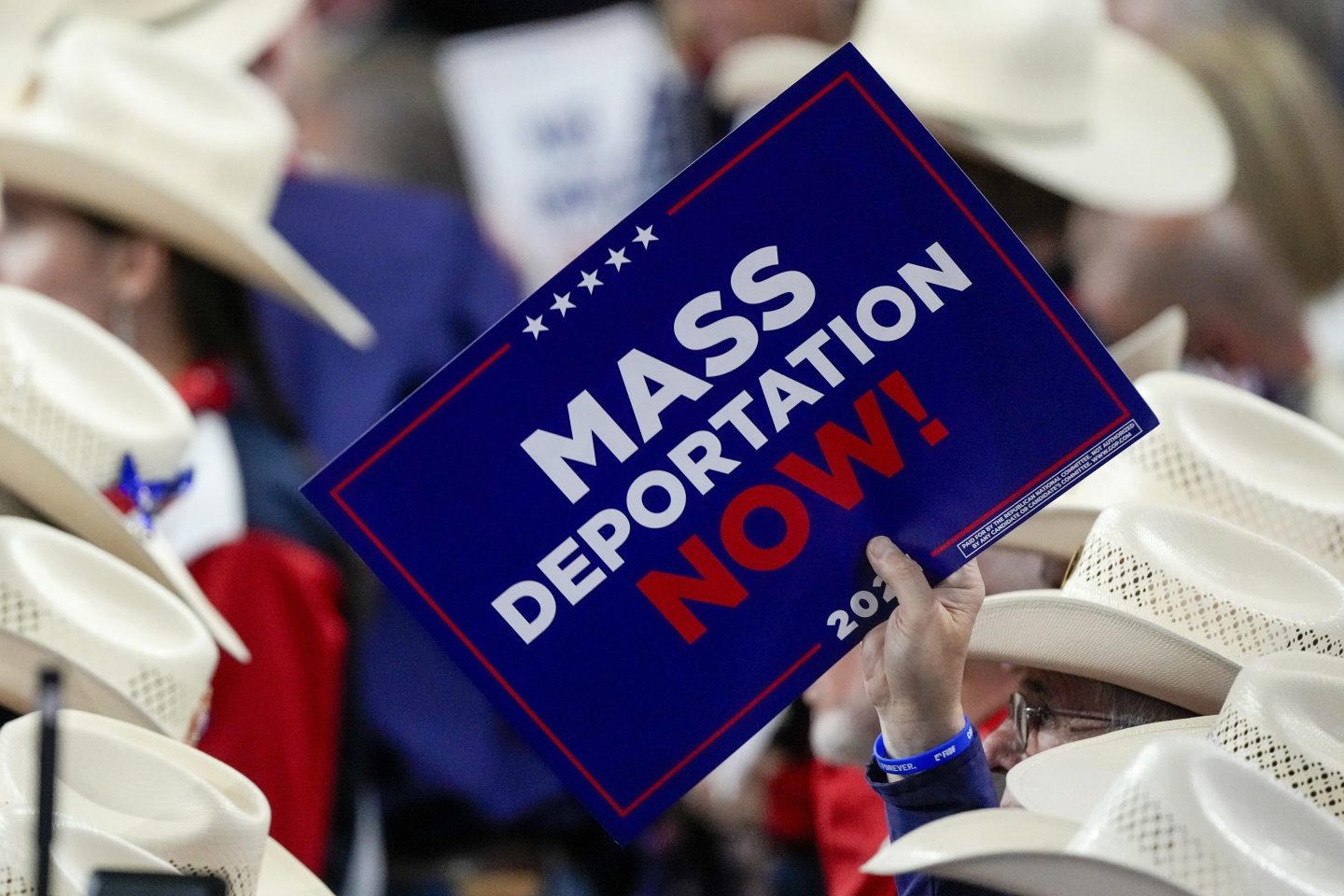
Trump, a Republican, has made immigration a central part of his 2024 campaign, vowing to stage the largest deportation operation in U.S. history if elected. He refers to immigrants as “animals” and “killers” and has spoken of immigrant children bringing disease into classrooms. A photo displayed at a recent Trump rally showed a crowded classroom with the words “Open border = packed classrooms.”
There is no disputing immigrant populations have strained schools in many communities, contributing to crowded classrooms and forcing teachers to adapt to large numbers of Spanish-speaking students.
But until recently, the idea of denying children an education would have been considered “too far to the right and too far fringe,” said Tom K. Wong, director of the U.S. immigration Policy Center at the University of California, San Diego. “But now we are seeing a political climate where previously fringe policies are becoming mainstream.”
Earlier this year, the conservative Heritage Foundation urged states to pass legislation requiring public schools to charge tuition to families living in the country illegally. Doing so, it said in a policy brief, would provoke a lawsuit that likely would “lead the Supreme Court to reconsider its ill-considered Plyler v. Doe decision.”
Over the summer, Oklahoma’s education superintendent, Ryan Walters, announced his agency would be issuing guidance to districts about gathering information on the “costs and burden” of illegal immigration to school districts.
“The federal government has failed to secure our borders. Our schools are suffering over this,” Walters said.
Several school districts have pushed back, saying they will not check students’ immigration status.
“Federal law is quite clear on this topic, as it prohibits districts from asking students or their families about their immigration status or to request documentation of their citizenship,” said Chris Payne, a spokesperson for Union Public Schools in Tulsa, outlining a common interpretation of the Supreme Court ruling.
In Tennessee, a proposal for universal school vouchers by Gov. Bill Lee, a Republican, led to debate over whether immigrant students should be excluded. The idea appealed to many of the Legislature’s conservative members, but some worried the exclusion would spark legal challenges. Ultimately, Lee abandoned his voucher proposal after several aspects of the plan failed to gain support.
The Saugus school committee in Massachusetts approved its admissions policy at a committee meeting in August 2023, two days after Gov. Maura Healey, a Democrat, declared a state of emergency over the state’s migrant crisis. At the time, Healey said nearly 5,600 families — many of them immigrants from Haiti and Venezuela — were living in state shelters, up from about 3,100 families the year before.
Serino, the school committee chairman, said the group began considering updating its residency policy more than a year before migrants became an issue in the state. He said the policy requires documents like a signed landlord affidavit or property tax bill, “simple stuff that everyone has.”
“We haven’t hurt anyone and no one has come to us — no migrant, no parent has come to us to complain about the policy,” Serino said.
Local legal advocates say the policy has been a hurdle for at least two immigrant families trying to enroll in Saugus schools. Lawyers For Civil Rights and the group Massachusetts Advocates for Children said it took their intervention to get the students into the school.
“The policy itself is illegal,” said Oren Sellstrom, litigation director for Lawyers for Civil Rights. “Schools should be welcoming (all) children who are in the district and educating them.”
In Texas, Republican Gov. Greg Abbott said in 2022 that Plyler v. Doe should be challenged and the federal government should pay for the public education of students who are not legal residents. He drew backlash from immigrant advocates and the White House. The following year, Republican lawmakers in Texas introduced several unsuccessful bills aimed at limiting non-citizen children from enrolling in public schools.
In June, the idea also was included in the Republican Party of Texas platform.
The party’s priorities for the upcoming Legislative season include “ending all subsidies and public services, including in-state college tuition and enrollment in public schools, for illegal aliens, except for emergency medical care.”