• Home
  • Latest
  • Fortune 500
  • Finance
  • Tech
  • Leadership
  • Lifestyle
  • Rankings
  • Multimedia
CommentaryPolitics

Venezuela’s Nicolas Maduro proves Milton Friedman right, 60 years later

By
Benjamin Powell
Benjamin Powell
Down Arrow Button Icon
By
Benjamin Powell
Benjamin Powell
Down Arrow Button Icon
July 31, 2024, 10:48 AM ET
Benjamin Powell, a senior fellow at the Independent Institute in Oakland, Calif., is director of the Free Market Institute and a professor of economics in the Rawls College of Business at Texas Tech University. He is co-author of Socialism Sucks: Two Economists Drink Their Way Through the Unfree World. 
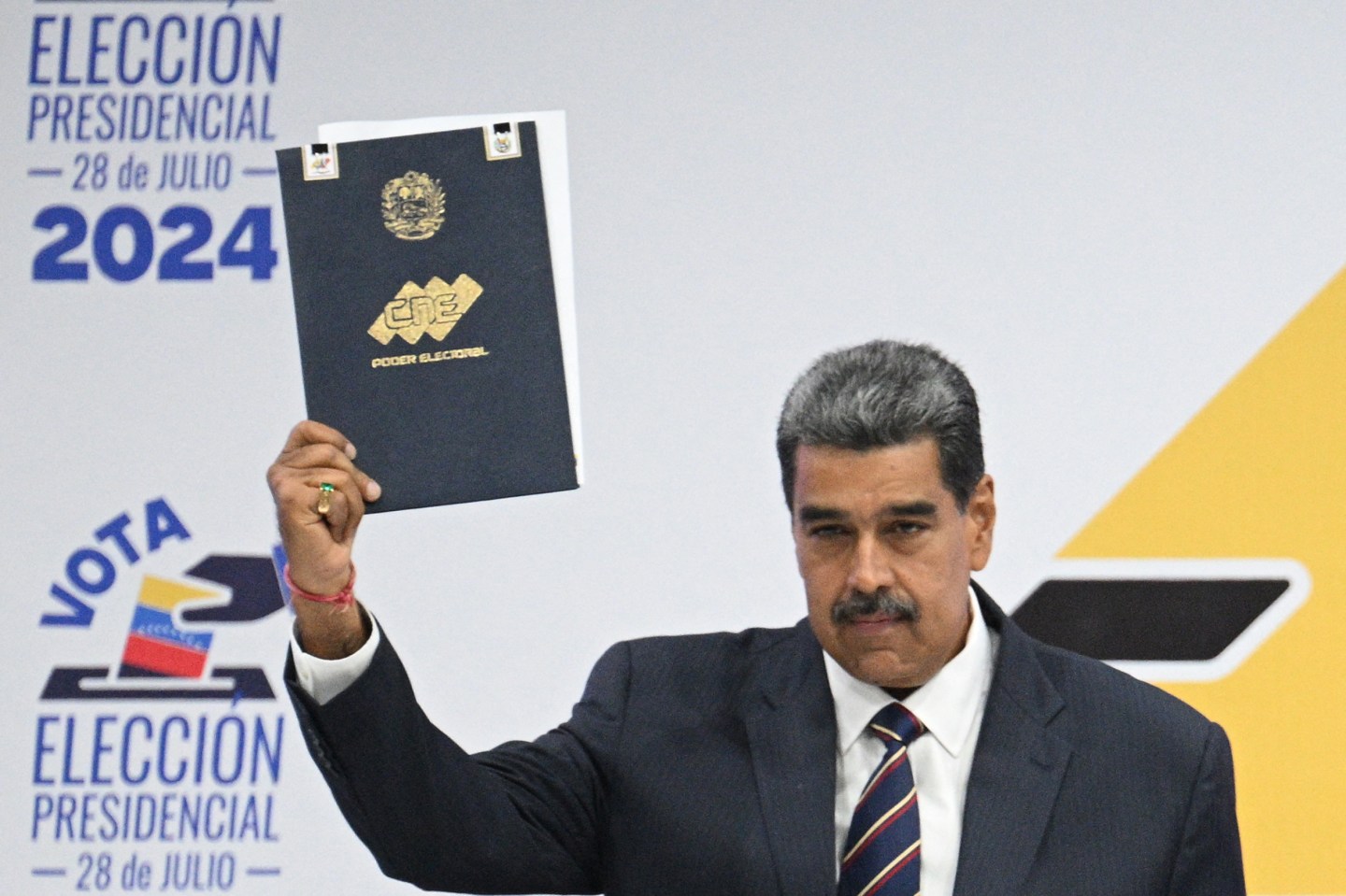
Venezuelan President Nicolas Maduro gestures during his proclamation at the electoral authority's headquarters in Caracas on July 29 in the wake of the Venezuelan presidential election. President Nicolas Maduro was declared the winner but the opposition and key regional neighbors immediately rejected the official results.

The Venezuelan government is claiming that Nicolas Maduro has won re-election to a third term as President. However, this claim does more to illustrate the incompatibility of a democratic political system and a socialist economic system than it does to establish Maduro’s legitimacy as Venezuela’s President.

The problem is that socialist systems centralize economic power in the hands of government. Once that happens, the government also has the power to subvert the democratic process by punishing any political opposition economically. 

Venezuela’s socialism started out democratically with Hugo Chavez’s election in 1998. The state’s monopoly on the world’s largest oil reserves, combined with high prices in the 2000s, gave the government plenty of foreign reserves to import goods and appease voters, even though its policies were undermining its domestic production and causing the economy to underperform. 

Oil production eventually declined due to state incompetence, corruption, and political graft. Once global oil prices also fell, the Venezuelan economy collapsed and has now been in crisis for a decade. 

Under Maduro, socialist economic policies and corruption have caused one of the worst economic and humanitarian crises in the Western Hemisphere in centuries. Annual inflation peaked at 344,509% in 2019. (That’s not a typo!) Shortages of basic goods are widespread. More than 7 million refugees have fled the country.

Voters would surely throw any administration with this track record out of office in a free and fair election. At that point, when voters in any free country would demand a change of course, Venezuela’s democratic socialism evolved into normal authoritarian socialism.

This year, it appears Venezuela’s National Electoral Council (CNE) manipulated the vote count outright, leading to the Organization of American States (OAS) refusing to recognize the election results. However, this is not the first time the Maduro regime has manipulated the democratic process. In his last re-election bid, six years ago, state-owned firms ordered workers to vote for Maduro under threat of losing their jobs and polling places allegedly bribed voters with food aid to support the regime. 

Following Sunday’s hotly contested election, the CNE, run by Maduro appointees, declared him the winner claiming that he had won 51.2% of the votes while opposition candidate Edmundo Gonzalez received only 44.2% of the votes. The opposition was denied access to CNE headquarters while votes were being tallied, but they claim that the 73% of tally sheets they’ve been able to access show Gonzalez winning by a more than two-to-one margin. Independent pre-election polling is much more in line with the opposition’s claims than the Venezuelan government’s. Three independent polls were conducted in the weeks leading up to the election. Each indicated that between 59% and 72% of voters intended to vote for Gonzalez, while Maduro polled at just over 12% in two polls and just under 25% in the third.

More than 60 years ago, Nobel Prize-winning economist Milton Friedman wrote that he knew of no “society that has been marked by a large measure of political freedom, and that has not also used something comparable to a free market to organize the bulk of economic activity.” While Venezuela was briefly an exception, it eventually lost its political freedoms after socialist policies destroyed its economic freedoms.

More must-read commentary published by Fortune:

  • Forget the pundits and polls—internet prediction markets anticipated Biden’s withdrawal weeks ago
  • Private equity is devouring the economy as boomer entrepreneurs exit—but a new approach to employee ownership can change that
  • Gen Z’s enthusiasm for all things touchable is resurrecting the analog economy—and costing parents
  • Nokia CEO: Europe shouldn’t be afraid to back its innovation champions

The opinions expressed in Fortune.com commentary pieces are solely the views of their authors and do not necessarily reflect the opinions and beliefs of Fortune.

Join us at the Fortune Workplace Innovation Summit May 19–20, 2026, in Atlanta. The next era of workplace innovation is here—and the old playbook is being rewritten. At this exclusive, high-energy event, the world’s most innovative leaders will convene to explore how AI, humanity, and strategy converge to redefine, again, the future of work. Register now.
About the Author
By Benjamin Powell
See full bioRight Arrow Button Icon

Latest in Commentary

Dr. Javier Cárdenas is the director of the Rockefeller Neuroscience Institute NeuroPerformance Innovation Center.
Commentaryconcussions
Fists, not football: There is no concussion protocol for domestic violence survivors
By Javier CárdenasDecember 12, 2025
7 hours ago
Gary Locke is the former U.S. ambassador to China, U.S. secretary of commerce, and governor of Washington.
CommentaryChina
China is winning the biotech race. Patent reform is how we catch up
By Gary LockeDecember 12, 2025
7 hours ago
millennial
CommentaryConsumer Spending
Meet the 2025 holiday white whale: the millennial dad spending $500+ per kid
By Phillip GoerickeDecember 12, 2025
8 hours ago
Sarandos
CommentaryAntitrust
Netflix, Warner, Paramount and antitrust: Entertainment megadeal’s outcome must follow the evidence, not politics or fear of integration
By Satya MararDecember 12, 2025
9 hours ago
CommentaryLeadership
Leading the agentic enterprise: What the next wave of AI demands from CEOs
By François Candelon, Amartya Das, Sesh Iyer, Shervin Khodabandeh and Sam RansbothamDecember 12, 2025
11 hours ago
Sarandos
CommentaryAntitrust
Netflix’s takeover of Warner Brothers is a nightmare for consumers
By Ike BrannonDecember 11, 2025
1 day ago

Most Popular

placeholder alt text
Economy
Tariffs are taxes and they were used to finance the federal government until the 1913 income tax. A top economist breaks it down
By Kent JonesDecember 12, 2025
11 hours ago
placeholder alt text
Success
At 18, doctors gave him three hours to live. He played video games from his hospital bed—and now, he’s built a $10 million-a-year video game studio
By Preston ForeDecember 10, 2025
2 days ago
placeholder alt text
Success
Palantir cofounder calls elite college undergrads a ‘loser generation’ as data reveals rise in students seeking support for disabilities, like ADHD
By Preston ForeDecember 11, 2025
1 day ago
placeholder alt text
Investing
Baby boomers have now 'gobbled up' nearly one-third of America's wealth share, and they're leaving Gen Z and millennials behind
By Sasha RogelbergDecember 8, 2025
4 days ago
placeholder alt text
Arts & Entertainment
'We're not just going to want to be fed AI slop for 16 hours a day': Analyst sees Disney/OpenAI deal as a dividing line in entertainment history
By Nick LichtenbergDecember 11, 2025
23 hours ago
placeholder alt text
Economy
‘We have not seen this rosy picture’: ADP’s chief economist warns the real economy is pretty different from Wall Street’s bullish outlook
By Eleanor PringleDecember 11, 2025
1 day ago
Rankings
  • 100 Best Companies
  • Fortune 500
  • Global 500
  • Fortune 500 Europe
  • Most Powerful Women
  • Future 50
  • World’s Most Admired Companies
  • See All Rankings
Sections
  • Finance
  • Leadership
  • Success
  • Tech
  • Asia
  • Europe
  • Environment
  • Fortune Crypto
  • Health
  • Retail
  • Lifestyle
  • Politics
  • Newsletters
  • Magazine
  • Features
  • Commentary
  • Mpw
  • CEO Initiative
  • Conferences
  • Personal Finance
  • Education
Customer Support
  • Frequently Asked Questions
  • Customer Service Portal
  • Privacy Policy
  • Terms Of Use
  • Single Issues For Purchase
  • International Print
Commercial Services
  • Advertising
  • Fortune Brand Studio
  • Fortune Analytics
  • Fortune Conferences
  • Business Development
About Us
  • About Us
  • Editorial Calendar
  • Press Center
  • Work At Fortune
  • Diversity And Inclusion
  • Terms And Conditions
  • Site Map

© 2025 Fortune Media IP Limited. All Rights Reserved. Use of this site constitutes acceptance of our Terms of Use and Privacy Policy | CA Notice at Collection and Privacy Notice | Do Not Sell/Share My Personal Information
FORTUNE is a trademark of Fortune Media IP Limited, registered in the U.S. and other countries. FORTUNE may receive compensation for some links to products and services on this website. Offers may be subject to change without notice.










