The strategic competition between the United States and China is a much broader story that is having an impact on all countries and cross-border business.
The new globalization story starts in China because of the country’s rapid economic rise and geopolitical tensions. For the most part, companies have an over-concentration of manufacturing and supply chains in China. But overconcentration is not limited to China.
As we outlined in May, we do not see deglobalization or decoupling in our research or engagement with Multinational Corporations (MNCs)—nor do we see a continuation of the status quo. The forces causing the decoupling discussion—such as geopolitical stresses, national security concerns, strategic competition considerations, data privacy, vague state secret laws, general distrust, and the demise of rule-enforcing international organizations—are real.
However, manufacturing is, for the most part, not returning to Western countries or tightly targeted emerging consumer countries, a basic claim of deglobalization theory. It is going elsewhere (to countries such as Vietnam and Mexico). Rather than decouple and disengage. MNCs are doing what they have excelled at for over a century: seeking ways to adapt and prosper. We call this transformation “reglobalization.”
Ideally, the end result will be a multipolar world with more countries participating in global business and prosperity.
We concluded that reglobalization will be eventually positive for the West and China, as well as for emerging workforces and consumers everywhere, particularly women.
The end of an era
The migration of supply chain capacity and control to third countries by Chinese, U.S., and European MNCs is an overlooked competitive dimension of the emerging order. Over the past 30 years, MNCs have sought to achieve cost benefits through the migration of manufacturing and related supply chains to lower-cost countries. Export data does little to reveal the commercial entities controlling and benefitting from the cross-border movement of goods and services, and these entities are, of course, the ones making the strategic choices.
To achieve maximum efficiencies of scale in the 1990s and early 2000s, MNCs tended to concentrate growth and sourcing efforts in a single facility or region. In many, if not most cases, this meant China. As reforms unfolded and China became increasingly hospitable to foreign investment, it checked all the boxes. This is not to say there were no hiccups. In 2003, the SARS threat triggered broad discussions of the risks of overconcentration, the importance of contingency planning, and the value of supply chain diversification. But like the SARS threat itself, the discussion was short-lived.
Over the past decade, and particularly since the start of the COVID-19 pandemic, the folly of prioritizing efficiency and ignoring resiliency has become apparent. The global landscape has been transformed by the addition of many complications, including geopolitics, shifts toward nativism in consumer sentiment and politics, climate change, demographic changes, and natural resource distribution.
In parallel with supply chain relocation, MNCs began to seek access to new consumer markets in emerging economies beyond China. Given China’s slowdown in consumption growth, the motivation to branch out for growth amplifies the motivation to branch out for additional supply hubs to build resiliency.
The current phase of reglobalization began with the natural migration of light manufacturing from China to lower-cost countries. China has methodically pressed to climb the value chain to avoid stalling its manufacturing and export success. Even though productivity gains were modest, through the systematic if often inefficient deployment of central resources, overcapacity, and a very rapid ramp-up of export value chains, China continues to be one of the lowest-cost places to manufacture in the world.
Demographic and other societal changes will shrink China’s labor force, and that will build pressure to continue upgrading its production activity and incentivizing its enterprises to internationalize. China’s economic system will likely sustain its exceptional export competitiveness in the areas that the state planners have identified.
While the diversification is being artificially accelerated by these factors, the fact is that more than 2 billion people are yet to be globalized as new and accessible consumers and laborers.
An operational transformation
Most MNCs readily acknowledge that their China experience has transformed their entire global activity. During their China decades, MNCs in industries such as IT, biotech, and semiconductors learned important lessons about speed-to-market, product localization, and profoundly different legal and regulatory approaches that will prove valuable as they now face market challenges that will demand improvements in their own operations.
Many MNCs began the relocation journey in response to the Trump-era tariff strategy, something not to be confused with a resiliency strategy that is now the focus. For MNCs, the initial relocation of manufacturing is costly and not without new risks, including some starting and backtracking. Many American CEOs describe having boards that are split between China hawks and doves—those who see an urgent need to reduce China exposure and those who do not. Initial cost increases of over 20% are frequently reported by companies, even before any new capital expenditure requirements, before falling back within five years to 1 to 3% higher when supply chain efficiency and labor productivity are restored. However, once relocated, multiple and flexible sourcing locations and fast information and response systems provide resiliency and optionality. And they potentially open new markets for growth, too.
Of course, in globalized business, moving your own manufacturing or assembly is not a decision to be taken in isolation. Behind any one company’s operation is an entire supply chain. For decades, China focused on building a comprehensive supply base for commoditized electronic components that remains unparalleled. Many components can be sourced in a destination country without too much difficulty, but there are specialized items that require knowledge, rare resources, and large capital investments (such as semiconductors) that will require continued dependence on Mainland suppliers.
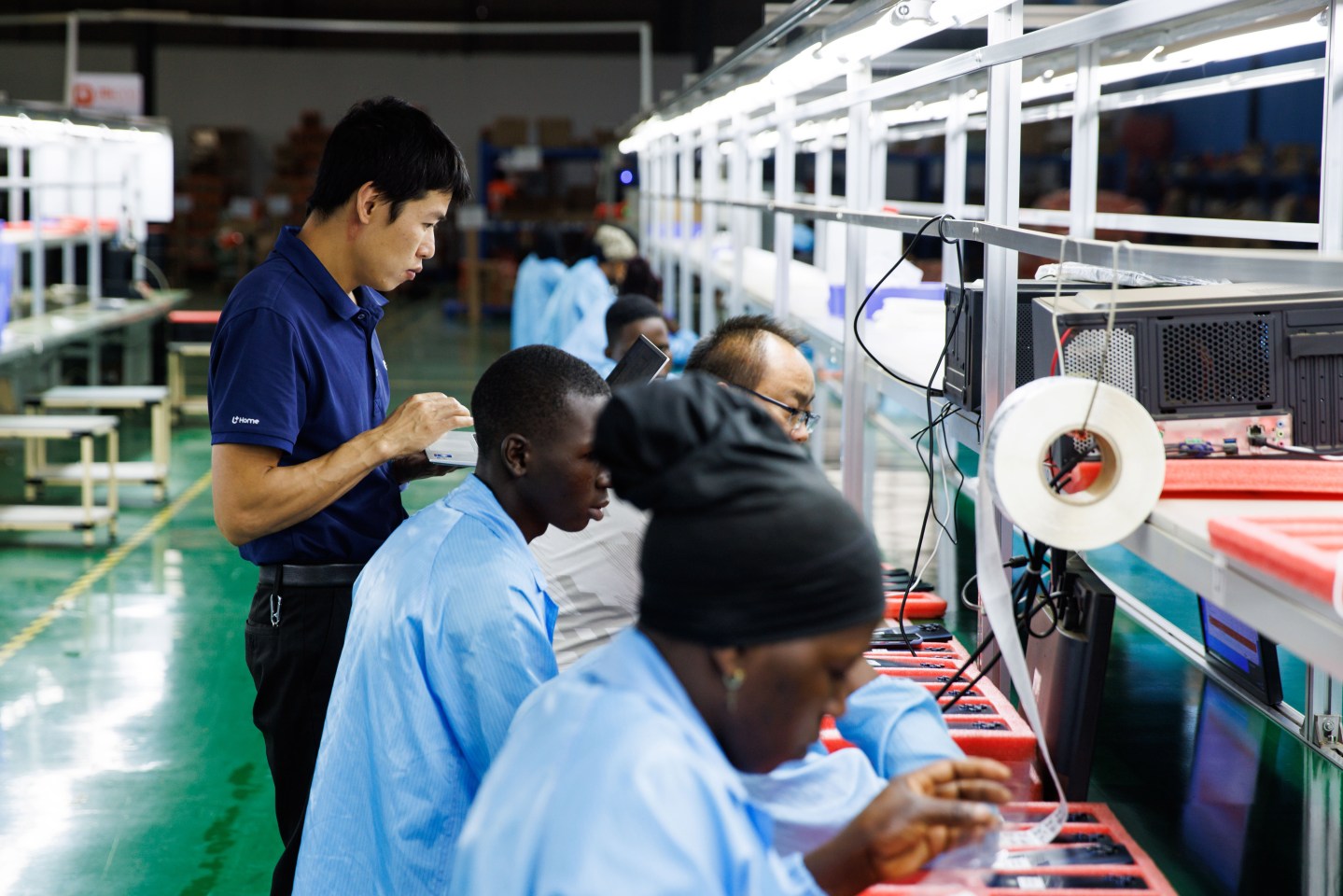
The disruption created by reglobalization, which will be as painful as when globalization first took off for those who get caught up in its effects such as factory worker job losses, will also force MNCs to build resiliency by putting low-end production in countries that have, until now, been largely excluded from global trade. For example, Pakistan, Tanzania, Kenya, much of Central Europe, and the Middle East have significant, untapped potential as manufacturing hubs and future fast-growth consumer markets.
With the creation of manufacturing jobs—typically in light manufacturing such as apparel, running shoes, and other light as well as semi-automated manufacturing—we expect to see the widespread employment of women, who are predominant in these jobs. As MNCs with light manufacturing set up operations in other emerging economies, those populations will both become consumers with their new, stable income and will begin to invest in their families. When women get regular paychecks, we typically see significant societal changes over comparatively short periods of time. In turn, these also positively impact the next generation (through higher living standards and education). There are numerous pro-cyclical dynamics at play when emerging economies open up.
We are also on the cusp of additional changes that are only lightly understood with AI, Network Manufacturing, Manufacturing 2.0, and additive manufacturing, other technologies for real-time manufacturing and logistic control, to name a few, each having significant potential to change the pace and direction of globalization.
The reglobalized landscape
The de-concentration of manufacturing and associated supply chains is a key process in the reglobalizing world. Notwithstanding the interest in Brazil, India, Eastern Europe, and South East Asian countries, we do not expect any emerging market or supply hub to dominate the attention of investors to the degree China did. MNC executives show little interest in a new over-concentration scenario.
A visible trend in recent years for many MNCs has been restructuring equity and control of entities within their constellations of business activities for tax efficiency, sanction compliance, tariff management, and resiliency. National borders have presented little impediment to a steady stream of mergers and acquisitions, which, along with buoyant capital markets, has elevated several MNCs to asset values north of $1 trillion. That’s why de-concentration does not imply descaling or fragmentation. The reglobalized landscape will see an unprecedented scale of strategically aligned business activity. The landscape also features massive, complex, multinational organizations whose geographic origins and legal domiciles are increasingly blurred and whose economic dimensions exceed many nations in the world. The degree to which their commercial decisions align with and influence government policies will be a significant dynamic in reglobalization.
To make this possible, we expect to see corporate structures move from a hub-and-spoke model to a web model, shaped by demand for local knowledge, relationships, data privacy rules, local content and compliance demands, and the ever-shortening viable time to market. For blocs that align more closely (such as North America and the EU), alignment solutions will be found, whereas competing blocs (such as North America and China) will struggle to find a stable solution for the range of interactions that are either unavoidable or commercially compelling.
Potential high-growth emerging economies will have leverage in pursuing their national interests by maintaining an unaligned position with respect to the strategic competition between China and the U.S. The current oil market exemplifies this dynamic in the interplay between allowed and sanctioned trade.
This will result in clusters of expertise and supporting supply chain infrastructure appearing in multiple countries, with virtual teams supplanting physically co-located teams.
Clusters add robustness and redundancy—but they also make it harder to exclude rivals from the global system. It is unclear whether the existing international organizations that support rules-based behaviors and effective dispute resolution will recover their importance and effectiveness.
Some recognized ills of rapid globalization are reflected in a change of ethos, with ESG concerns increasingly enforced by local regulation in economies of all levels of development. Initiatives are building to rein in tax inequalities and systemic tax avoidance, as well as exploitative relationships between investors and investees.
Unrecognized ills are equally certain to emerge in the reglobalized landscape, including innovations in cybercrime and terrorism, biological and chemical health threats, disruptive military events, and political catastrophes in major economies. Once effective global regulatory and dispute resolution bodies have dramatically declined in relevance. Major economies with a stake in stability and level market playing fields will either need to resurrect them or replace them. Fintech and cryptocurrencies, offering many efficiencies for global financial operations, also enable a range of opportunities for regulation avoidance and tax evasion.
However, we are optimistic. As MNCs spread their factories, they will acquire increased resiliency—which, in the longer term, will help to regulate inflation even as disruptions become more frequent. Emerging markets will benefit, uplifting populations and empowering women. But it will take a different type of manager, a different kind of company, and different processes to achieve commercial success under this new world order.
Envisioning the landscape of a reglobalized world is just the starting point for successful decision-making. In our final article in the series, we will analyze approaches to adjust to reglobalization and look at the corporate responses we are observing in the market to these changes and opportunities.
More must-read commentary published by Fortune:
- Booz Allen Hamilton CEO: America needs a whole-of-nation approach in its great power competition with China
- ‘A head-in-the-sand approach’: The U.S. strategic drug stockpile is inadequate for a bird flu outbreak
- The national debt is over $34 trillion. It’s time to tell the truth about the U.S. government’s finances
- ‘Sometimes, the facts don’t matter’: Attacks on DEI are an anti-capitalist war on American prosperity
The opinions expressed in Fortune.com commentary pieces are solely the views of their authors and do not necessarily reflect the opinions and beliefs of Fortune.