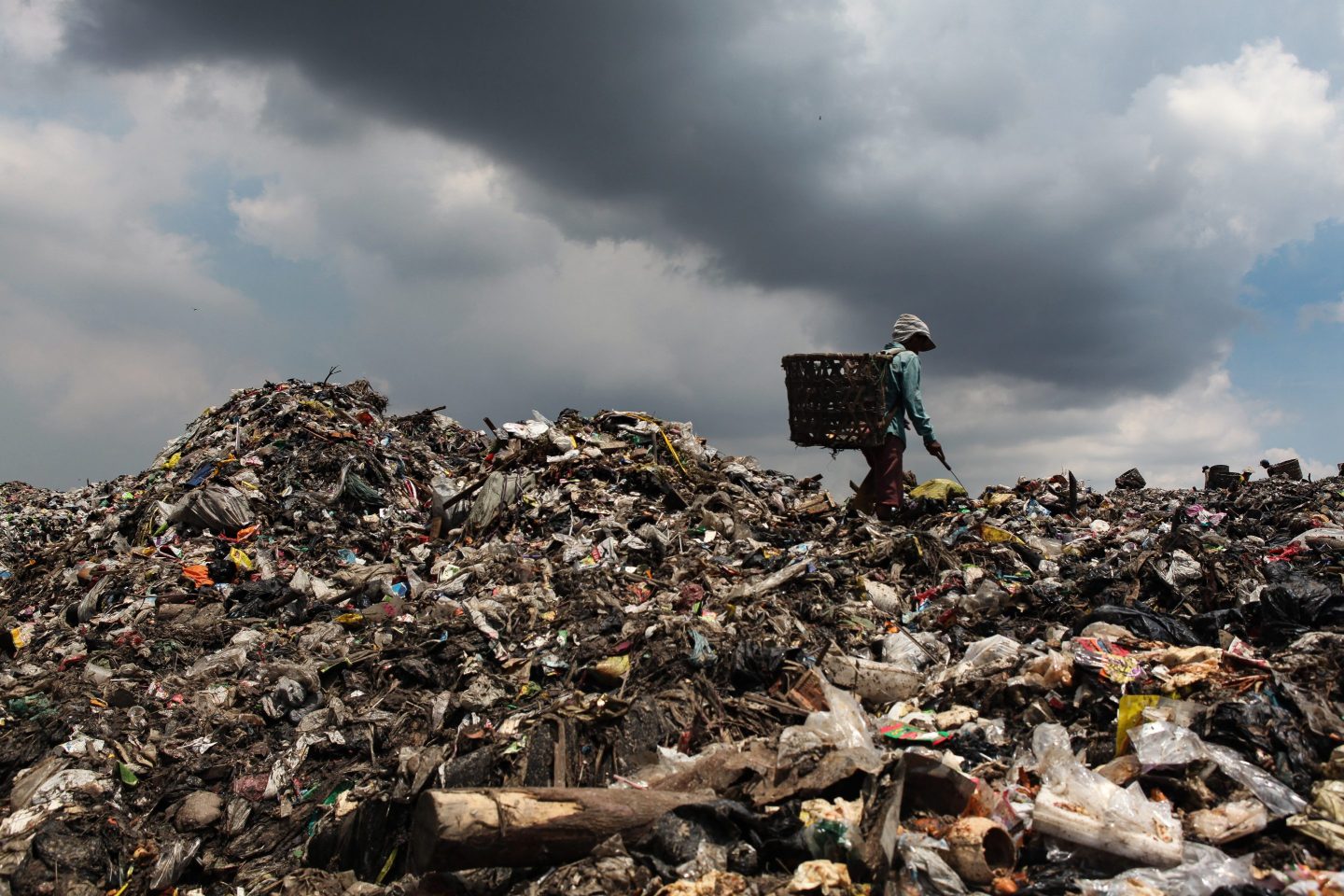
America’s landfills—and the environmental havoc they create—are sizable. There are roughly 1,200 landfills currently in operation, and on average, each one takes up about 600 acres of land, the equivalent of 480 football fields.
Landfills are also a hotbed for waste, from decomposing vegetable scraps and meat bones to worn household appliances, which produce copious amounts of methane, a greenhouse gas with a warming effect 80 times as powerful as carbon dioxide over a 20-year period.
A new study published in the journal Science found the rate of methane emissions from landfills is three times as large as the rate previously reported to federal regulators. In combination with methane’s high potency, the study’s findings add to a growing body of evidence about how landfills around the globe significantly contribute to global warming and highlight the need for reforms, both in the infrastructure of landfills and the way Americans dispose of waste.
The study used a new technology, an imaging spectrometer, which measures electromagnetic radiation to detect and measure processes in the Earth’s atmosphere, to collect data on methane emissions from 20% of the country’s largest landfills. Before the advent of this technology, estimates of methane emissions were based mostly on computer models, which, according to the study, are less than optimal, given the unique circumstances of each landfill and its operational oversight. Previously reported methane emission estimates are also likely lower than reality, as a result of the dangerous nature of manually measuring emissions at landfills, which require workers to walk around dumps with handheld sensors.
Landfills often contain layers upon layers of garbage, encompassing everything from decomposing food scraps and plastic to household appliances and paper, that pile up for decades. When food waste ends up buried in these layers, it decomposes without much oxygen and, as a result, releases methane.
“You can sometimes get decades of trash that’s sitting under the landfill,” according to Daniel Cusworth, the lead author of the study and a climate scientist at the University of Arizona. As he told the New York Times, “We call it a garbage lasagna.”
Among the most common atmospheric greenhouse gases, methane isn’t the most abundant or the longest-lasting in the atmosphere, but its potent warming effect is 80 times as powerful as the most common greenhouse gas, carbon dioxide. That means it can significantly contribute to global warming, and in turn, spur climate-change–related events, such as intense storms, rising sea levels, heat waves, and drought, which are just some of the catastrophes that can occur.
In the new study, scientists collected data using airplane flyovers and imaging spectrometers to measure concentrations, or plumes, of methane in the air. Planes flew across 18 states and over 250 landfill sites between 2018 and 2022. At more than half of the landfills surveyed, researchers detected methane hotspots that suggest something had gone wrong at the site, like a big methane leak from long-buried trash.
Many landfills contain wells and pipes meant to capture methane leaks, and the gases are sometimes then collected and burned to produce electricity or heat. With the new technology used in the study, landfill operators and federal regulators will more easily be able to pinpoint and flare methane leaks.
The Environmental Protection Agency considers landfills to be the third-largest source of human-caused methane pollution in the country, accounting for roughly 14% of these emissions in 2022 and equal to the yearly emissions of 24 million cars. Atmospheric levels of methane, which is measured in parts per billion, are now more than 160% higher than preindustrial levels, according to Oceanic and Atmospheric Research, a group that investigates systems affecting the planet.
The high levels of methane will contribute to climate-related disasters while also posing health risks to wildlife and families who live near landfills, including odors, smoke, smog, and water-supply contamination. What’s worse is those living in low-income areas are most likely to live with those risks, and have fewer financial resources to oppose the placement of waste facilities.
To be sure, landfill reforms are a pressing need—but changes in how people dispose of food waste can also be impactful in reducing methane emissions at waste sites. Food waste that is composted, for example, undergoes an aerobic, or oxygenated, decomposition, a process that doesn’t release methane owing to the presence of oxygen.
Industries like landfills, agriculture, and oil and gas production are among the sectors that emit the most methane, and have been under intense scrutiny by scientists and environmental activists in recent years. Oil Change International, a fossil fuel research and advocacy group, recently examined climate plans and pledges from the eight largest U.S.- and European-based international oil and gas producers, and found that none of the plans were compatible with limiting global warming to 1.5 degrees Celsius above preindustrial levels—a threshold scientists warn will have disastrous effects when breached.