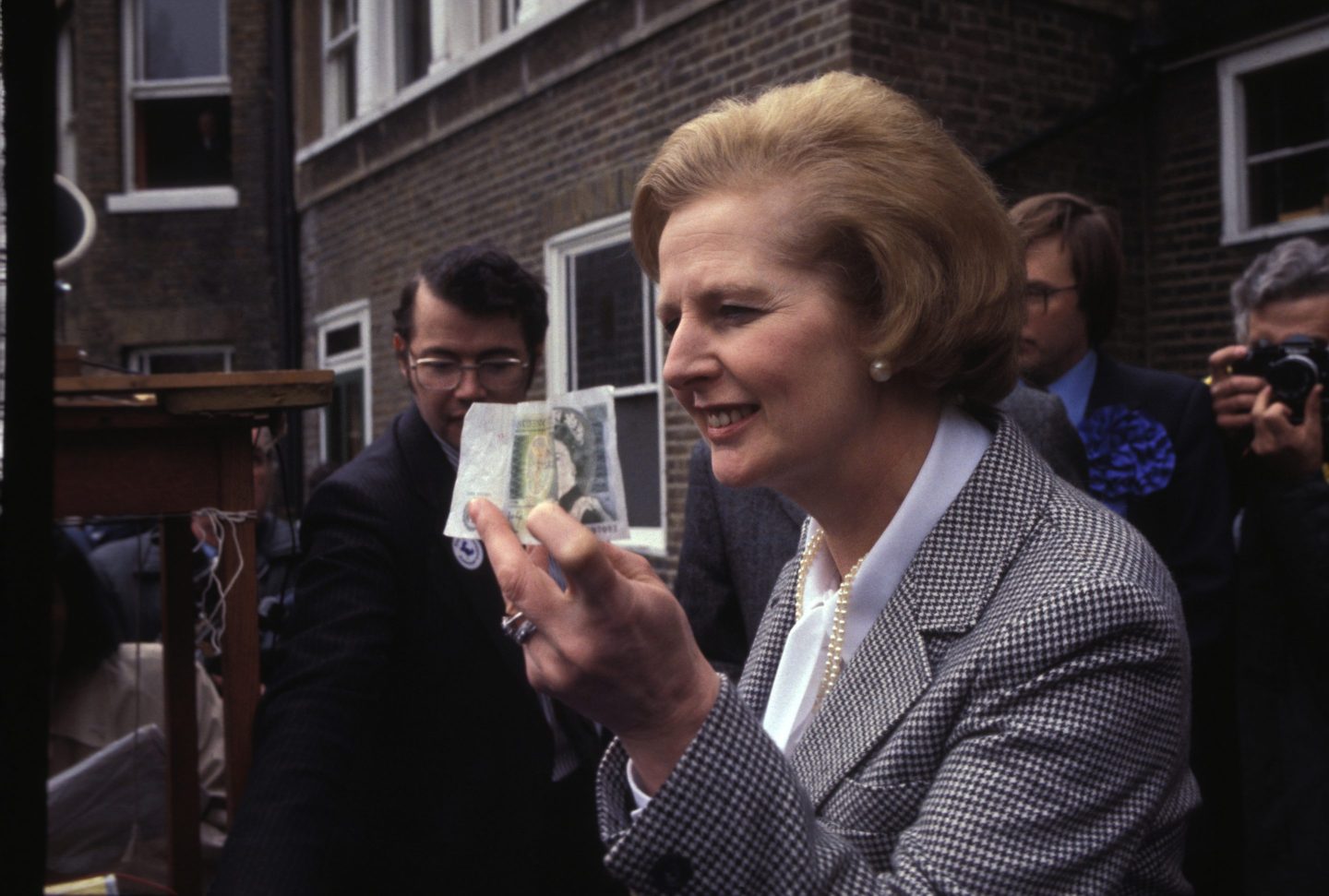
After a decade of unsatisfactory leadership and economic and political turbulence, Britons will soon be heading to the polls to elect a new government. Although, for many, Margaret Thatcher remains a divisive figure, others are looking back with nostalgia at her character and at her achievements as prime minister in the 1980s.
Even Keir Starmer, the leader of the opposition Labour Party and clear favorite to be the U.K.’s next prime minister, has praised her for effecting “meaningful change,” and for having “set loose our natural entrepreneurialism.” David Lammy, likely to be foreign secretary in a Labour government, has called Thatcher a “visionary leader.”
What no one has been paying homage to is the big policy mistake she made at the start of her premiership: her attempt to apply the theory of monetarism in order to bring down inflation.
The influence of Milton Friedman’s monetarism
For Thatcher, inflation was both a moral and an economic issue. During her years as leader of the Tory opposition in the late 1970s, she and her inner circle had become convinced that the “orthodox” Keynesian policy of trying to regulate output and employment and tackling inflation through changes in taxes and public spending was no longer working–and that it had actually been responsible for the upward march of inflation since the 1950s. Furthermore, she had no faith in the statutory or voluntary arrangements for limiting pay and prices of the kind that Labour and Tory governments had attempted over the previous two decades.
In 1979, the year she came to power, inflation was running at 13%. Bringing the inflation rate down was her number one priority—and monetarism as advocated by Milton Friedman in Chicago seemed to her to be the obvious and common-sense answer.
For Friedman, inflation was always and everywhere a monetary phenomenon. It was caused by the money supply increasing too fast. The only way, therefore, to curb inflation was to curb the growth of the money supply; and this could be achieved, he argued, with only minimal effect on output and employment. Friedman’s study of inflation in the U.S. going back nearly 100 years, and his later study of inflation in the U.K., purported to show a close correlation between monetary growth and prices over long periods of time—which in his view proved his theory.
In fact, it did no such thing. Leading critics in the U.S. and the U.K.–such as Paul Samuelson at MIT, James Tobin at Yale, and James Meade at Cambridge–would point out that, on a year-to-year basis, the relationship between money and prices was far less stable than Friedman suggested. His explanation of how a higher stock of money automatically translated into higher spending, and into higher nominal income and prices, was far from convincing. On the contrary, they argued, since growth of the money supply in a modern economy was largely demand-driven, it was to a large extent dependent on spending and nominal income growth rather than the reverse. And to the extent that a monetary expansion or contraction did translate into higher or lower nominal income, it was as likely to have an impact on output as it was on prices.
‘The myth of a golden monetarist age’
None of these criticisms deterred Thatcher. In those days, before the Bank of England became operationally independent, the prime minister and the Treasury were responsible for all key decisions on monetary policy; the Bank merely executed them. She and her Treasury team set about trying to curb monetary growth. In 1979, the Bank of England’s discount rate was raised to an all-time high of 17%, which was followed in 1981–while the U.K. was still in recession–by a severely deflationary budget.
In her efforts to curb monetary growth, Thatcher was singularly unsuccessful. In her first five years, the money supply exceeded its original growth target by a wide margin every year. In due course, inflation did come down–to 5% by 1983. But this reduction was clearly not the result of curbing the money supply: it was due to exceptionally tight financial conditions, including a greatly over-valued sterling exchange rate, and to the sharp recession and high unemployment which ensued.
The rate of unemployment more than doubled from 5% in 1979 to over 11% in 1983, and continued at this level until early 1987. Manufacturing industries and the communities that depended on them for jobs took a terrible hit. The money supply proved a very poor indicator of inflationary pressures, and the measures taken in the attempt to bring it under control led to a much sharper recession than was needed to bring inflation down.
From 1982, incidentally the year in which Paul Volcker pulled the plug on monetarism in America, monetarism in the U.K. was progressively abandoned. In the summer of 1981, there had been rioting in major cities, and a large majority in Thatcher’s cabinet had called for a change in policy. Monetary targets continued to exist for the rest of the decade, but never again was controlling the money supply the holy grail it had been in the earlier years. Since the mid-1990s, as in the U.S., the U.K. has used interest rates rather than the money supply to target inflation—and, with the notable exception of the recent post-pandemic/post-Brexit period, has done so with considerable success.
Having interest rates do the work of controlling inflation, while different from what Keynes would have advocated, is a far cry from Friedman’s monetarism. Anyone who suggests that a return to monetarism could have prevented the reemergence of inflation in recent years should look carefully at Thatcher’s experience with monetarism—and at Paul Volcker’s too—and steer well clear of it.
Thatcher remained emotionally attached to monetarism–so much so that she would write in her memoirs: “Our success in bringing down inflation in our first term… had been achieved by controlling the money supply.” Nigel Lawson, her Chancellor of the Exchequer for six years, who had been an original advocate of monetarism but then led the retreat away from it, described this in his memoirs as “the myth of a golden monetarist age.”
The failure of Thatcher’s experiment with monetarism would probably have cost her the 1983 general election, had it not been for the military victory over Argentina in the Falklands war in 1982. Unsurprisingly, it is not an aspect of her premiership that people look back on with any nostalgia.
Sir Tim Lankester was Margaret Thatcher’s first private secretary for economic affairs (from 1979 to 1981), and later the U.K. director on the boards of the IMF and World Bank. He is the author of Inside Thatcher’s Monetarism Experiment.
More must-read commentary published by Fortune:
- Fannie Mae CEO: Beyoncé is right. Climate change has already hit the housing market—and homeowners aren’t prepared
- A new Cold War is brewing at sea–and the West’s security and prosperity are at stake
- How to fix Boeing, according to a former Airbus technology chief
- Congress could soon spell the end of employment arbitration—but it’s not all good news for American workers
The opinions expressed in Fortune.com commentary pieces are solely the views of their authors and do not necessarily reflect the opinions and beliefs of Fortune.