• Home
  • Latest
  • Fortune 500
  • Finance
  • Tech
  • Leadership
  • Lifestyle
  • Rankings
  • Multimedia
CommentaryTaxes

Congratulations, you survived another tax season—and paid a higher rate than top American companies

By
Irit Tamir
Irit Tamir
Down Arrow Button Icon
By
Irit Tamir
Irit Tamir
Down Arrow Button Icon
April 30, 2024, 11:35 AM ET
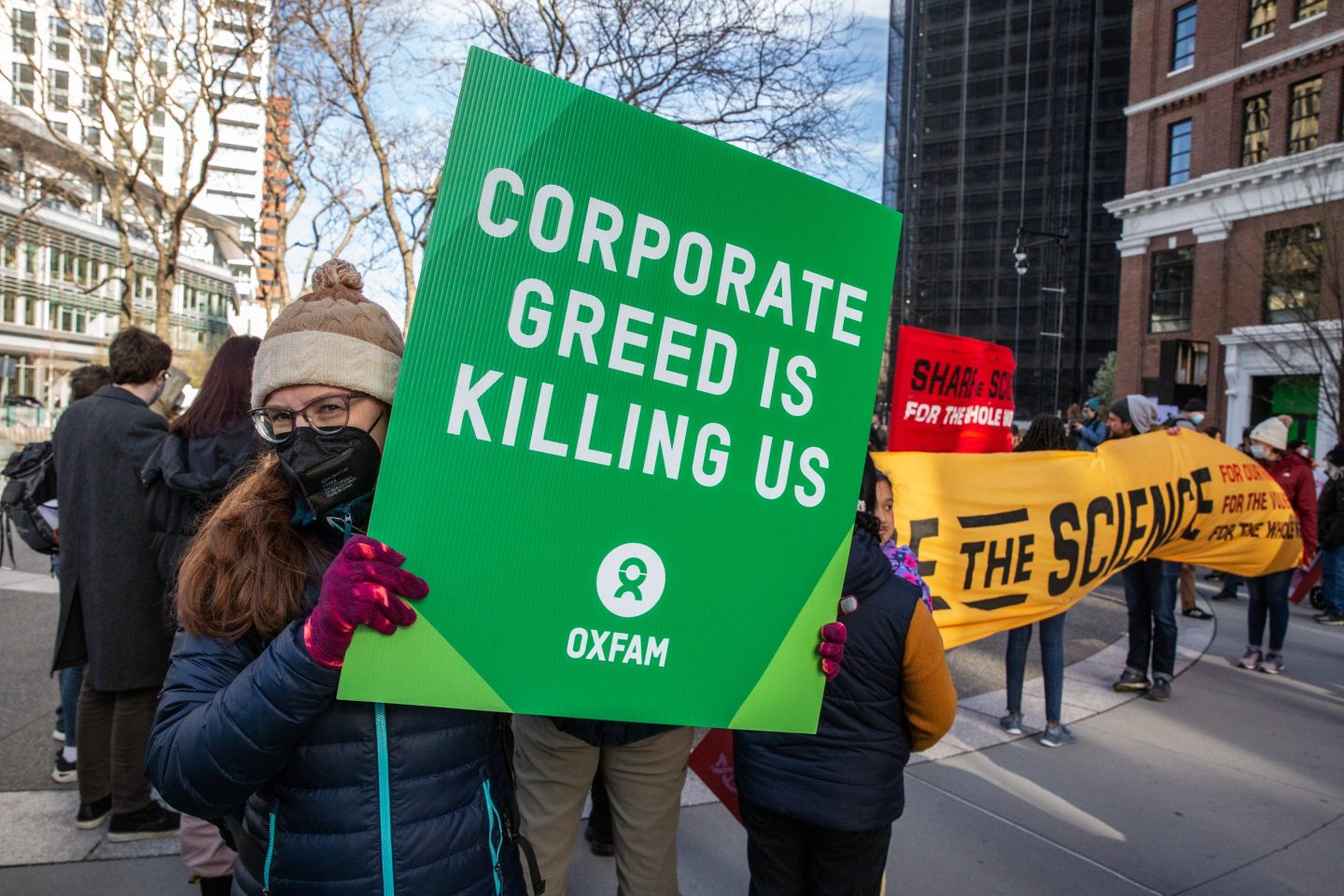
When corporations aren’t taxed appropriately, everyday Americans pay the price, argues Oxfam's Irit Tamir.
When corporations aren’t taxed appropriately, everyday Americans pay the price, argues Oxfam's Irit Tamir. Oxfam

Another Tax Day has come and gone. While everyday working people struggle to make their tax payments or hope for a small refund, corporate America continues to avoid paying their fair share, evading and limiting their tax payments through loopholes and legal maneuvers. The current system that supercharges this inequality is not an accident; it is written into our tax code and is manipulated by corporations and billionaires. With many of the 2017 “Trump tax cuts” set to expire, the time is now to curb the corrosive concentrations of extreme wealth and corporate power, and to fairly tax companies and the astronomically wealthy so that next Tax Day, the divide is not so wide.

The statutory corporate tax rate in America is a mere 21%, which dramatically declined from 35% under the Trump administration. But far too many companies pay far less than this already low rate. Oxfam’s recent analysis of the 200 largest public companies in the U.S. finds that effective tax rates—the amounts companies actually pay—vary greatly.

The pharmaceutical industry pays the lowest, with an 11.6% effective tax rate in 2022, and some of the largest Big Pharma companies paid even lower. For example, Pfizer paid 6.8% and Abbvie only 5.9%. The tech sector closely follows pharma, with companies like IBM, Intel, and Nvidia all reporting profits in 2022 yet paying zero income taxes. Instead, all received a tax credit (IBM: $626 million; Intel: $249 million; Nvidia: $187 million).

This is far lower than what the average American pays, putting the tax inequality into stark relief.

Corporate tax havens

Of the 200 companies Oxfam analyzed, only 22% have published statements and policies of responsible tax practices. A closer look reveals that the specificity, scope, and ambition of these policy statements vary greatly. Few contain provisions for the most important assessment categories, including the use of tax havens and internal structures for the accountability and governance of tax planning. Nevertheless, these policies are an important indicator, as we also found that companies sharing them are less likely to operate in tax havens. In fact, 82% of companies in the analysis have a presence in at least one identified tax haven.

Evidence suggests corporate income tax is progressive since shareholders, who are predominantly at the top of the income distribution, bear most of the tax burden. By minimizing their tax burden, companies can increase profits, which typically reward corporate executives and wealthy shareholders at the expense of not only their employees but broader public services systems as well. These tax minimization strategies aggressively sustain wealth disparities, making them one of the most significant corporate practices that enable and contribute to inequality. Case in point, the combined net profits of the top 200 U.S. corporations soared to $1.25 trillion in 2022, a 63% increase from combined net profits in 2018. To add, 90% of these profits (more than $1.1 trillion) are paid out to wealthy shareholders—more than any time in the history of these companies.

We know that when corporations and wealthy individuals aren’t taxed appropriately, low- and middle-income Americans pay the price. Taxing corporations fairly is a crucial step toward tackling billionaire excess, reducing today’s pernicious inequality, battling the climate crisis, making infrastructure investments, and providing critical essential services. Corporate taxation, or its lack thereof, can fuel inequality—as it currently does—or reduce it when used for essential public services and social programs that benefit low-income groups.

A more equitable tax code

Tax revenue also helps provide the backbone for goods and services (e.g. infrastructure, the education system) that companies rely on to be successful. While a company’s strategy to minimize tax payments may reward corporate management and shareholders in the short term, such strategies often come at the cost of exacerbating income inequality and hindering long-term value creation.

With many of the Trump tax cuts set to expire at the end of 2025, Congress should use the opportunity to work toward a tax code that is more equitable and supports investments that make the economy work for everyone. Specifically, Congress must ensure that this overhaul is used to bring the corporate tax rate up to at least 35%; put an end to the loopholes and tax breaks that companies so often abuse; and end corporate tax secrecy by ensuring all multinational companies publish tax transparency reports (including financial details) for every country in which they operate.

More immediately, taxes remain a top-of-mind issue as we approach the general election. Promises regarding further tax cuts for the wealthy have been a key element of Donald Trump’s presidential campaign, while tax increases for corporations are included in President Joe Biden’s. Trump’s plan is predicted to increase the cost of living for lower- and middle-income Americans to offset breaks for billionaires. The truth is that any federal policy that leans on tax cuts for wealthy individuals and corporations is one that will further inequality in this country.

On future Tax Days, corporations and billionaires must begin to pay their fair share. The battle against extreme inequality depends on it.

Irit Tamir is Senior director of Oxfam America’s Private Sector Department.

More must-read commentary:

  • $122 Thai delivery and $26 to-go coffees: New wage laws meant to help gig workers are backfiring big-time
  • Rihanna’s ‘Fenty effect’ could teach AI developers about inclusivity and fighting bias
  • How to fix Boeing, according to a former Airbus technology chief
  • AI lets anyone generate music in seconds. That’s putting artists on edge—and setting the stage for ‘dataset ethics’

The opinions expressed in Fortune.com commentary pieces are solely the views of their authors and do not necessarily reflect the opinions and beliefs of Fortune.

Join us at the Fortune Workplace Innovation Summit May 19–20, 2026, in Atlanta. The next era of workplace innovation is here—and the old playbook is being rewritten. At this exclusive, high-energy event, the world’s most innovative leaders will convene to explore how AI, humanity, and strategy converge to redefine, again, the future of work. Register now.
About the Author
By Irit Tamir
See full bioRight Arrow Button Icon

Latest in Commentary

Finance
Lorem ipsum dolor sit amet, consectetur adipiscing elit, sed do eiusmod tempor incididunt ut labore et dolore magna aliqua. Ut enim ad minim veniam
By Fortune Editors
October 20, 2025
Finance
Lorem ipsum dolor sit amet, consectetur adipiscing elit, sed do eiusmod tempor incididunt ut labore et dolore magna aliqua. Ut enim ad minim veniam
By Fortune Editors
October 20, 2025
Finance
Lorem ipsum dolor sit amet, consectetur adipiscing elit, sed do eiusmod tempor incididunt ut labore et dolore magna aliqua. Ut enim ad minim veniam
By Fortune Editors
October 20, 2025
Finance
Lorem ipsum dolor sit amet, consectetur adipiscing elit, sed do eiusmod tempor incididunt ut labore et dolore magna aliqua. Ut enim ad minim veniam
By Fortune Editors
October 20, 2025
Finance
Lorem ipsum dolor sit amet, consectetur adipiscing elit, sed do eiusmod tempor incididunt ut labore et dolore magna aliqua. Ut enim ad minim veniam
By Fortune Editors
October 20, 2025
Finance
Lorem ipsum dolor sit amet, consectetur adipiscing elit, sed do eiusmod tempor incididunt ut labore et dolore magna aliqua. Ut enim ad minim veniam
By Fortune Editors
October 20, 2025

Most Popular

Finance
Lorem ipsum dolor sit amet, consectetur adipiscing elit, sed do eiusmod tempor incididunt ut labore et dolore magna aliqua. Ut enim ad minim veniam
By Fortune Editors
October 20, 2025
Finance
Lorem ipsum dolor sit amet, consectetur adipiscing elit, sed do eiusmod tempor incididunt ut labore et dolore magna aliqua. Ut enim ad minim veniam
By Fortune Editors
October 20, 2025
Finance
Lorem ipsum dolor sit amet, consectetur adipiscing elit, sed do eiusmod tempor incididunt ut labore et dolore magna aliqua. Ut enim ad minim veniam
By Fortune Editors
October 20, 2025
Finance
Lorem ipsum dolor sit amet, consectetur adipiscing elit, sed do eiusmod tempor incididunt ut labore et dolore magna aliqua. Ut enim ad minim veniam
By Fortune Editors
October 20, 2025
Finance
Lorem ipsum dolor sit amet, consectetur adipiscing elit, sed do eiusmod tempor incididunt ut labore et dolore magna aliqua. Ut enim ad minim veniam
By Fortune Editors
October 20, 2025
Finance
Lorem ipsum dolor sit amet, consectetur adipiscing elit, sed do eiusmod tempor incididunt ut labore et dolore magna aliqua. Ut enim ad minim veniam
By Fortune Editors
October 20, 2025
Rankings
  • 100 Best Companies
  • Fortune 500
  • Global 500
  • Fortune 500 Europe
  • Most Powerful Women
  • Future 50
  • World’s Most Admired Companies
  • See All Rankings
Sections
  • Finance
  • Leadership
  • Success
  • Tech
  • Asia
  • Europe
  • Environment
  • Fortune Crypto
  • Health
  • Retail
  • Lifestyle
  • Politics
  • Newsletters
  • Magazine
  • Features
  • Commentary
  • Mpw
  • CEO Initiative
  • Conferences
  • Personal Finance
  • Education
Customer Support
  • Frequently Asked Questions
  • Customer Service Portal
  • Privacy Policy
  • Terms Of Use
  • Single Issues For Purchase
  • International Print
Commercial Services
  • Advertising
  • Fortune Brand Studio
  • Fortune Analytics
  • Fortune Conferences
  • Business Development
About Us
  • About Us
  • Editorial Calendar
  • Press Center
  • Work At Fortune
  • Diversity And Inclusion
  • Terms And Conditions
  • Site Map
  • Facebook icon
  • Twitter icon
  • LinkedIn icon
  • Instagram icon
  • Pinterest icon

Most Popular

placeholder alt text
Success
In 2026, many employers are ditching merit-based pay bumps in favor of ‘peanut butter raises’
By Emma BurleighFebruary 2, 2026
1 day ago
placeholder alt text
Politics
Meet the Palm Beach billionaire who paid $2 million for a private White House visit with Trump
By Tristan BoveFebruary 3, 2026
10 hours ago
placeholder alt text
Cybersecurity
Top AI leaders are begging people not to use Moltbook, a social media platform for AI agents: It’s a ‘disaster waiting to happen’
By Eva RoytburgFebruary 2, 2026
1 day ago
placeholder alt text
Future of Work
‘You’re not a hero, you’re a liability’: Shark Tank’s Kevin O’Leary warns Gen Z founders to stop glorifying hustle culture
By Jacqueline MunisFebruary 2, 2026
1 day ago
placeholder alt text
Personal Finance
Current price of silver as of Monday, February 2, 2026
By Joseph HostetlerFebruary 2, 2026
2 days ago
placeholder alt text
Economy
'I just don't have a good feeling about this': Top economist Claudia Sahm says the economy quietly shifted and everyone's now looking at the wrong alarm
By Eleanor PringleJanuary 31, 2026
4 days ago

© 2026 Fortune Media IP Limited. All Rights Reserved. Use of this site constitutes acceptance of our Terms of Use and Privacy Policy | CA Notice at Collection and Privacy Notice | Do Not Sell/Share My Personal Information
FORTUNE is a trademark of Fortune Media IP Limited, registered in the U.S. and other countries. FORTUNE may receive compensation for some links to products and services on this website. Offers may be subject to change without notice.


Latest in Commentary

minnesota
CommentaryMinnesota
I’ve studied nonviolent resistance in war zones for 20 years and Minnesota reminds me of Colombia, the Philippines and Syria
By Oliver Kaplan and The ConversationFebruary 3, 2026
8 hours ago
EuropeLetter from London
Oracle billionaire Larry Ellison’s next big bet: Redefining how long–and how well–we live
By Kamal AhmedFebruary 3, 2026
12 hours ago
davos
CommentaryCareers
While elites debate geopolitics, Americans are rethinking college in the search for economic mobility
By Ed MitzenFebruary 3, 2026
13 hours ago
american dream
CommentaryCapitalism
We need more capitalists, not necessarily more capitalism
By Seth Levine and Elizabeth MacBrideFebruary 3, 2026
13 hours ago
pretti
CommentaryLeadership
What should business leaders say about Alex Pretti’s death?
By Deepak MalhotraFebruary 3, 2026
14 hours ago
Photo of Donald Trump
CommentaryLeadership
What happened at Davos was a warning to CEOs: Their companies are designed for a world that no longer exists
By Ram CharanFebruary 3, 2026
15 hours ago










